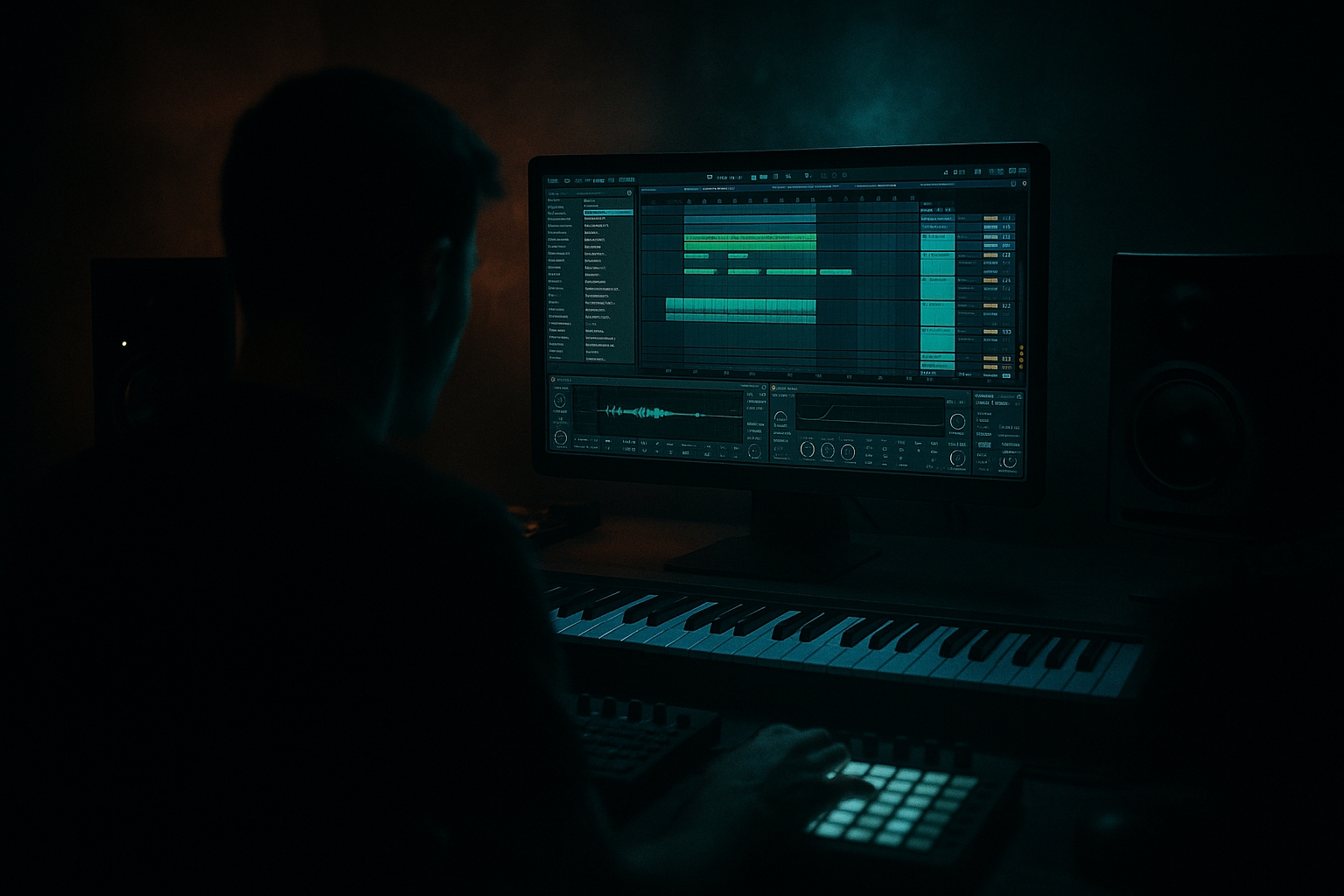
Main tutorial
Lesson Overview
This lesson is about taking a classic Amen break variation and making it feel glued, intentional, and track-ready inside Ableton Live 12 for oldskool jungle / DnB vibes. The goal is not just to chop a break — it’s to make the break, bass, and arrangement feel like one record-moving system.
In a real DnB track, this technique lives in the space where the drum break becomes the identity of the groove. It usually sits in the main drop, a half-time switch, a second-drop variation, or a call-and-response section where the Amen needs to sound edited but still human. If the break is too raw, it can feel messy against the bass. If it’s too processed, it loses the ragged excitement that makes jungle work.
Musically, this matters because oldskool DnB relies on momentum through micro-edits: tiny chops, selective hits, filtered repeats, and controlled saturation that make the break swing against the bassline. Technically, it matters because the Amen has a lot of transient information in the 2–8 kHz range, plus low-mid body that can fight your sub or reese if you don’t shape it carefully.
This is best suited to:
- oldskool jungle / hardcore-inspired DnB
- rollers with break-led energy
- darker dancefloor DnB with retro drum phrasing
- tracks where the break and bass need to feel fused, not separate
- a grainy, punchy drum character
- a broken, rolling rhythmic feel
- a break that leaves room for the bassline instead of masking it
- enough processing to feel polished, but not so much that it becomes overbuilt
- a mix-ready shape that can sit under a sub or reese without collapsing the low end
- Use one repeated ghost snare as a tension device. A tiny repeated hit before the main snare can make the bar feel more urgent without adding a new melodic element. Keep it quiet, and let it act like a warning signal.
- Let the bass answer the break instead of competing with it. If the Amen has a strong fill at the end of bar 2, leave space in the bass there. That call-and-response feel is a huge part of oldskool pressure.
- Print a dirty version and a cleaner version of the same break. The cleaner one can carry the main drop, while the dirtier one can appear in the second drop or final 8 bars. This gives you arrangement contrast without rebuilding the whole pattern.
- Use selective filtering, not blanket dulling. If the break is harsh, trim the most aggressive top-end zone rather than rolling off everything. You want attitude, not fog.
- Keep the snare as the emotional anchor. In darker DnB, the snare often does the heavy lifting. If you process everything equally, you flatten the phrasing. Protect the snare transient and build the grit around it.
- Add movement through edits, not endless modulation. A couple of smart chops and a small filter move usually beat a stack of LFO-driven effects when you want underground character.
- Think in phrases, not bars. A 4-bar loop might be technically correct, but an 8-bar phrase with a stronger bar 4 or bar 8 payoff will feel much more like a finished DnB record.
- Use only one Amen break source
- Use only stock Ableton devices
- Keep your processing chain to no more than 4 devices
- Make exactly one version that is cleaner and one that is dirtier
- a 4-bar loop with an Amen variation
- a bassline underneath it
- a second pass with one small fill or chop change for bar 4
- Can you still clearly hear the main snare?
- Does the kick feel like it pushes the bar forward?
- Does the bass leave space for the break’s main hits?
- Does the loop feel like a real jungle/DnB phrase, not just a chopped sample?
By the end, you should be able to hear a loop that feels like a tight, musical Amen variation with attitude: the kick/snare pattern still drives the tune, the ghost hits add movement, the low end stays clean, and the break sounds like it belongs in a finished record rather than a rough loop.
What You Will Build
You will build a 4-bar Amen variation in Ableton Live 12 that feels oldskool, rugged, and usable in a real drop.
The finished result should have:
Success sounds like this: the Amen hits with obvious movement and swing, the snare still cracks through, ghost notes keep the phrase alive, and the whole loop feels like it could drive the drop for 8 or 16 bars without getting dull.
Step-by-Step Walkthrough
1. Start with a clean Amen loop and set the track context first
Drop an Amen break onto an audio track in Ableton and warp it if needed so it sits cleanly at your project tempo. For beginner workflow, keep it simple: choose a 4-bar slice of the break that already has a strong kick-snare relationship.
Before editing, loop it against:
- a simple sub note
- or a rough reese bass pattern
- plus a basic kick/snare if your break isn’t already providing the full drum picture
Why this matters: in DnB, the break is never judged in isolation. It has to work against the bass and still preserve the push-pull that makes the groove feel alive.
What to listen for:
- Does the snare land with enough authority against the bass?
- Do the ghost notes still move the beat forward, or do they disappear under your low end?
If the loop already feels too busy, don’t fix it later with more FX. First decide which hits are the anchor hits: usually the main snare, the main kick, and 1–2 key ghost hits per bar.
2. Slice the break into playable hits
Use Ableton’s slice workflow to chop the Amen into individual pieces you can rearrange. Keep the main pieces you’ll actually use:
- kick
- snare
- hat
- ghost snare
- small tail or pickup hit
You don’t need every fragment. A beginner mistake is over-slicing and then making the pattern less musical. The goal is to keep the classic Amen identity while giving yourself control over the phrase.
Why it works in DnB: the Amen has natural momentum because the original performance already contains groove. Slicing lets you preserve that feel while moving a few hits to create a bespoke variation that matches your bassline and arrangement.
Workflow tip: color-code or rename the most important slices immediately. That saves you from auditioning random chunks when you’re building the next variation.
3. Lay down the anchor pattern first
Build a 1-bar or 2-bar foundation with the most important hits:
- main kick on the strong part of the bar
- main snare on the backbeat
- one or two ghost hits before the snare or after it
- a small pickup hit leading into the next bar
In oldskool jungle, the “glue” comes from recognisable anchor points. If the break becomes too random, it loses the head-nod pulse that the dancefloor locks onto.
A practical starting point:
- keep the strongest snare in place
- place one kick slightly earlier or later to create momentum
- leave a small gap before the snare so the hit lands harder
- use a ghost hit after the snare to keep the phrase moving
What to listen for:
- Does the snare still feel like the command point of the phrase?
- Does the kick feel like it’s driving forward, or is it stepping on the snare?
If the groove feels stiff, nudge one or two hits by a very small amount. In Ableton, even tiny timing changes matter. Don’t overdo it — you want human push, not sloppy timing.
4. Make the variation feel “glued” with controlled overlap, not just repetition
This is where the lesson really starts. Take one or two hits and let them connect the phrases:
- let a ghost snare from the end of bar 1 lead into bar 2
- use a small hat or top-layer slice to bridge a gap
- repeat a hit once in a row if it creates a shuffle-like pull
The trick is that the variation should feel like it belongs to the same performance, not like a random collection of chops.
Why this works in DnB: jungle and oldskool DnB often sound exciting because the break is constantly “speaking” in short gestures. That connective tissue is what makes the loop feel like a pattern rather than a looped sample.
Try this A versus B decision:
- A: Straight glue — keep the edits subtle, with small overlaps and close-to-original placement.
Best for: rollers, darker tracks, DJ-friendly grooves, cleaner bass interplay.
- B: Broken glue — make a more obvious chop with a repeated hit or a displaced snare.
Best for: ragga-jungle energy, frantic oldskool tension, second-drop intensity.
If you’re making a first drop, A is usually safer. If you’re building a second-drop switch-up, B can bring more danger.
5. Shape the break with stock processing: one clean chain, not a pile of effects
Build a practical Ableton stock-device chain on the break track. Two solid options:
Chain 1: Clean punch + glue
- EQ Eight
- Drum Buss
- Compressor
- Saturator
Suggested starting points:
- EQ Eight: high-pass gently around 25–35 Hz if there’s sub rumble that clashes with the bass
- EQ Eight: small cut around 200–400 Hz if the break sounds boxy
- Drum Buss: drive lightly, around 5–20%, to add body and snap
- Compressor: modest reduction, around 1–3 dB, just to tame peaks
- Saturator: soft drive, often around 1–4 dB, to bring out the break’s grit
Chain 2: Dirtier oldskool edge
- Auto Filter
- Saturator
- EQ Eight
- Drum Buss
Use this if you want the break to feel more worn-in and aggressive:
- Auto Filter to trim some top or low-mid clutter
- Saturator to roughen the tone
- EQ Eight to carve space
- Drum Buss to restore impact after the dirt
Important trade-off: more saturation makes the Amen feel nastier, but it can also blur the snare transient and smear the low mids. If the break loses punch, back off the drive before adding more compression.
6. Place the break in context with the bassline and fix the low-end relationship
Now bring in your bass. This is the real test.
Check the break against:
- sub bass
- reese
- or a bass riff with movement
If the break has a lot of low end, you may need to keep the sub bass simple in the same bar. A useful beginner approach is to let the bass phrase breathe where the kick of the break is busiest.
What to listen for:
- Does the kick from the Amen punch through, or is it disappearing into the bass?
- Do the snare and bass leave each other enough space, or does the groove feel smeared?
A practical fix in Ableton:
- use EQ Eight to remove unnecessary low end from the break
- keep the sub mono and centered
- avoid stereo widening on the break’s low-frequency content
- if needed, reduce bass note length where the kick lands
Mix-clarity note: mono compatibility matters here. Jungle breaks often include width and texture, but the core groove must survive in mono. If your break sounds exciting in stereo but falls apart when summed, you’ve overprocessed the top layer or made the low end too wide.
7. Add micro-movement with automation, but only where it earns its place
Instead of automating everything, automate one or two key things:
- a filter opening before the drop
- a slight Saturator drive increase in the second half of a phrase
- a very small reverb send on one fill hit
- a short delay throw on a transition snare
Keep automation musical and phrase-based:
- 4 bars for a basic drop evolution
- 8 bars for a stronger arrangement shift
- 16 bars if you’re building a second-drop transformation
Arrangement example:
In bars 1–4, keep the Amen more open and readable. In bars 5–8, introduce a repeated ghost snare or filtered pickup. Then in bars 9–12, drop in a more chopped variation to signal the next section. This gives the listener progression without destroying DJ usability.
Why this works in DnB: the dancefloor needs repetition to lock in, but it also needs enough change to avoid fatigue. Small automation moves give you evolution without breaking the groove.
8. Create one tighter version by resampling the best bar
Once the pattern feels right, bounce or resample the best bar or two to audio. This is a major workflow win in DnB because it lets you commit to the sound and start thinking like an arranger instead of a loop tweaker.
Commit this to audio if:
- the groove already works
- the processing sounds right
- you’re tempted to keep changing tiny details without improving the loop
After resampling, you can:
- cut a fill from the printed audio
- reverse one hit for a transition
- chop a final snare pickup
- place a tiny repeat before the drop
Why this matters: printing the loop helps you stop over-editing and start arranging. Many strong jungle tracks are built from a few committed drum phrases, not endless live tweaking.
9. Check the phrase against the drums and arrangement, not just the loop
Put the Amen variation in a real 8- or 16-bar section with:
- intro elements
- bassline
- any extra percussion or atmospheres
- a transition into the next section
The key is to hear whether the Amen still works when the track has actual forward motion. A break that sounds great in a 2-bar loop may become too repetitive in a full drop unless you create a second phrase or a slight variation.
Good structure examples:
- 8 bars: first 4 bars more open, second 4 bars slightly busier
- 16 bars: bars 1–8 stable, bars 9–12 increased chop activity, bars 13–16 a fill or dropout before the next section
This is where your break becomes part of arrangement psychology. It isn’t just a loop anymore — it’s a section that creates payoff.
10. Make one final decision: cleaner or grittier
At this stage, choose one of two valid flavours depending on the track:
- Cleaner, punchier jungle DnB:
Keep the break more transient-rich, with controlled saturation and tighter EQ. This is better if the bassline is already dense or the tune needs more mix clarity.
- Darker, rougher oldskool pressure:
Push the break harder into saturation and texture, but keep the snare punch intact. This works if the track is sparse, menacing, or needs more attitude.
A strong result should feel like the break is holding the groove together while still sounding slightly dangerous. If the break becomes dull, you’ve over-cleaned it. If it becomes blurry, you’ve overcooked it.
Common Mistakes
1. Over-slicing the Amen until it loses the original swing
Why it hurts: the break stops feeling like a performance and starts sounding like random hits.
Fix: keep the main snare and kick logic intact; only move a few hits per bar.
2. Making the break too loud before checking the bass balance
Why it hurts: the break masks the sub and makes the drop feel smaller.
Fix: pull the break down and rebuild the groove around the bass, not the other way around.
3. Using too much saturation on the break
Why it hurts: the snare transient softens and the whole loop turns into midrange mush.
Fix: reduce Drive in Saturator or Drum Buss, then restore punch with less aggressive compression.
4. Ignoring mono compatibility on the top texture
Why it hurts: the break sounds wide and exciting in stereo but weak or phasey in mono.
Fix: keep low frequencies centered, and avoid widening the core drum body.
5. Leaving all the ghost notes in place without editing them to the bassline
Why it hurts: the groove becomes cluttered and fights the phrasing of the sub or reese.
Fix: mute or move the least useful ghost hits so they leave room for the bass accents.
6. Not checking the break in a full 8- or 16-bar section
Why it hurts: the loop may feel good, but the arrangement has no progression.
Fix: build a second phrase with one variation or fill so the drop evolves.
7. Over-compressing the break to “glue” it
Why it hurts: you flatten the natural kick/snare contrast that gives Amen its bite.
Fix: aim for light compression only; let the original sample dynamics do most of the work.
Pro Tips for Darker / Heavier DnB
Mini Practice Exercise
Goal: Build a 4-bar Amen variation that works with a simple bassline and feels like a usable drop loop.
Time box: 15 minutes
Constraints:
Deliverable:
Quick self-check:
Recap
A strong Amen variation in Ableton Live comes from smart slicing, selective glue, and phrase-aware editing. Keep the main snare and kick clear, use ghost notes to maintain movement, process the break lightly but purposefully, and always check it against the bassline and arrangement. If the result feels like a rugged, rhythmic loop that drives the drop without smearing the low end, you’ve nailed the job.

