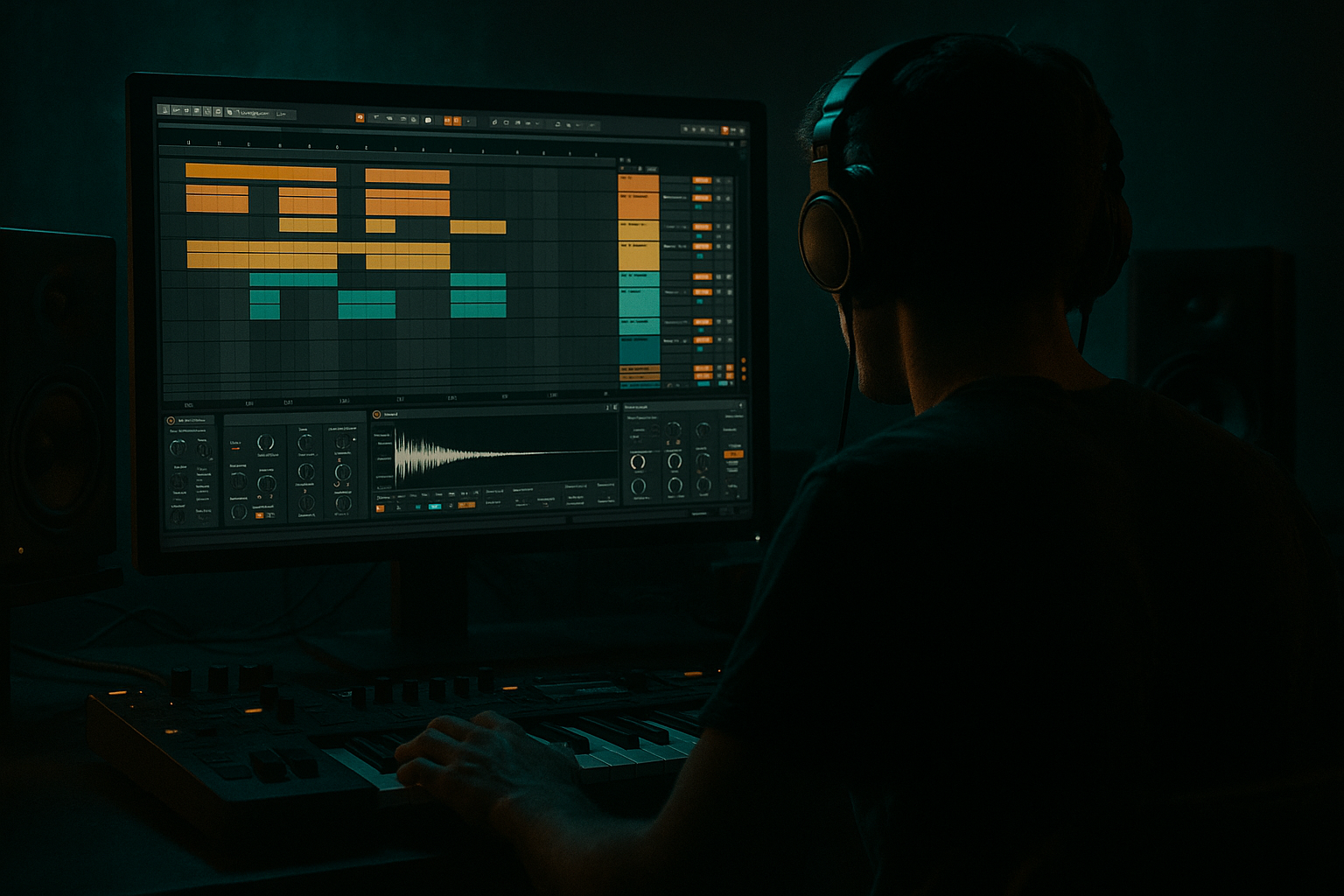
Main tutorial
1. Lesson Overview
This lesson teaches a focused, intermediate arrangement technique titled "Goldie Ableton Live 12 jungle fill blueprint for timeless roller momentum." You’ll learn how to design and place jungle-style fills in Ableton Live 12 that keep a roller moving forward — using slice-based break manipulation, pitch/drum-roll automation, tempo-stable low-end management, and Live’s stock devices (Drum Rack/Simpler/Sampler, Beat Repeat, Auto Filter, Glue Compressor, Saturator, Hybrid Reverb, Ping Pong Delay, Utility, EQ Eight). The goal is a reusable fill template that delivers Goldie-style urgency without killing momentum or muddying the low end.
2. What You Will Build
- A 2–4 bar jungle-style fill track derived from a classic break (Amen / break sample).
- Layered elements: chopped break slices for transient detail, pitched stutters for tension, reversed cymbal hit for snap, and percussion rolls for momentum.
- Device chain and automation that produce a rising intensity across the fill and a clean snap into the next section (roller feel intact).
- A resampled audio fill you can drop into arrangement sections and tweak.
- Not cutting low frequencies: too much low-end in the fill muddies the bass/sub and kills roller momentum.
- Overusing global reverb: long tails stacked across layers smear transients; automate sends so tails are purposeful.
- Excessive pitch shifts: extreme transpose can throw the harmonic center and clash with bass; stay within +/- 4 semitones or automate pitch up confidently then resolve.
- Using Beat Repeat with 100% wet or too-large Grid → destroys groove. Keep repeats tasteful and automate density.
- Leaving everything as MIDI without resampling: CPU overload and accidental parameter drift later in arrangement.
- Save a Fill Rack: group your Drum Rack + Beat Repeat + Auto Filter into an Instrument Rack with macros for Transpose Rise, Repeat Density, Filter Cutoff, and Reverb Send so one macro drives the whole fill.
- Use Clip Envelopes for device parameters (Simpler Transpose, Beat Repeat Chance) rather than only track automation — keeps automation tied to the clip and portable.
- For classic jungle flavor, double a slice and detune one instance slightly (±3–7 cents) with a little chorus/saturation for width.
- Sidechain subtlety: sidechain the fill’s mid/high energy to the kick/sub to retain punch. Use Compressor with sidechain input from the kick and a shallow ratio.
- Freeze & Flatten for CPU: once you have a fill template you like, freeze and flatten or resample it into audio to save CPU and lock the sound.
- Use the Groove Pool to add tiny timing offsets (swing) to hats and rolls to simulate humanized break edits.
3. Step-by-Step Walkthrough
Note: the exact phrase "Goldie Ableton Live 12 jungle fill blueprint for timeless roller momentum" is the guiding concept — apply these steps to create that blueprint.
Step A — Prepare the Break
1. Import your chosen break (e.g., Amen) into an audio track. Warp OFF if you plan to slice; if you want small time-stretching, use Warp Mode = Beats for transients or Complex Pro for full-break time-stretch.
2. Right-click the clip → Slice to New MIDI Track. In the dialog choose "Transient" slicing (or Slice by '1/16' for micro-slices). This creates a Drum Rack with Simpler instances mapped to pads.
Step B — Create the Fill MIDI Pattern
1. Create a new MIDI clip on the Drum Rack track, length 2 bars (or 4 bars for a longer build). Program a pattern that:
- Uses 16th/32nd rolls near the end (bar 2 for a 2-bar fill) for a classic jungle “roll-up.”
- Leaves key transients (kick/snare) at the start of the first bar to retain recognizability.
2. Velocity: push velocity for hits at the start of the roll, then gradually reduce to produce a push into the drop (velocity automation inside MIDI clip).
Step C — Pitch Motion and Slice Manipulation
1. For pitch motion: map each Simpler’s Transpose parameter to a macro (or automate Simpler > Transpose in the clip’s Device chooser). Example automation: transpose +0 semitones at start → +2 to +4 semitones by the last 1/4 bar to create upward tension.
2. Use the Drum Rack pads to add pitched repeats: duplicate the same slice and pitch one chain up by 7–12 semitones for harmonic color. Keep these higher-pitched slices cut with EQ Eight high-pass at ~900–1200 Hz.
Step D — Layer Percussion & Rolls
1. Create a dedicated hi-hat/perc group (new MIDI track). Program tight 16th and 32nd rolls that align rhythmically with the break chops. Use Groove Pool (Classic Jitter or adjust timing) to humanize.
2. Add a second perc track with short, bright sounds (tambourine, shaker) to accent the off-beats of the roll.
Step E — Beat Repeat Micro-Variations
1. Duplicate your Drum Rack audio to a track you’ll use for creative stutter (or place Beat Repeat on the Drum Rack send).
2. Add Beat Repeat (Device view). Set:
- Interval = 1/4 or 1/8 (for repeat trigger)
- Grid = 1/16 or 1/32 (for slice size)
- Offset = 0–1/8 to shift timing
- Repeat (x value) small (1–4 repeats)
- Dry/Wet ~30–60%
3. Automate Beat Repeat's Grid or Chance in the clip’s Device envelope so the repeats become denser toward the fill end (e.g., chance 10% to 60%).
Step F — Reversed Crash and Tails
1. Take a crash or cymbal sample, place it on its own audio track, reverse the clip (in Sample box, click Reverse), then position it so its tail swells into the drop moment.
2. Send that crash to Hybrid Reverb (or Reverb) and Ping Pong Delay: automate the Send amount in the fill clip so tails bloom as the fill finishes.
Step G — Tonal Control & Low-End Management
1. On the fill track(s) place an EQ Eight high-pass at 120–250 Hz (sweep to taste) to keep sub energy consistent for roller momentum.
2. Glue Compressor on the Drum Rack master chain: Threshold -15 to -8 dB, Ratio 2:1–4:1, Attack 10 ms, Release 200–400 ms — gentle bus glue to even transients without squashing the roll.
3. Place Utility after Glue and automate Width or Gain only if you need micro-volume tweaks into the drop.
Step H — Saturation & Character
1. Add Saturator on a return or individual fill chains (Drive 2–4 dB, Soft Clip on, Dry/Wet 20–40%) to replicate analog grit that Goldie-era breaks often have.
2. For transient sparkle, put EQ Eight in mid/high boost (8–12 kHz +2–4 dB) only on higher-pitched slice layers.
Step I — Arrangement Placement & Motion
1. Build a template region in Arrangement: place fill instances at classic roller points — 16/32/64 bars before major changes, and denser fills at 8 bar boundaries.
2. Create a progressive build: reuse the same 2-bar fill three times but increase:
- Transpose (e.g., +1 semitone per repeat)
- Beat Repeat density (automate Grid and Chance)
- Percussion velocity and hat densities
3. At the final fill bar, silence the low-end (Utility -inf on sub-frequency group or automate HPF) and let the reversed crash/reverb tail carry into the drop so momentum translates into the next section rather than mudding it.
Step J — Commit and Resample
1. When happy, arm a new audio track for resampling. Solo the fill tracks and resample the fill with all FX and automation — this gives you a single audio fill clip you can copy/paste and tweak (time-stretch with Warp if needed).
2. Keep the original MIDI template so you can easily remake variations.
4. Common Mistakes
5. Pro Tips
6. Mini Practice Exercise
Goal: Build a 2-bar fill that ramps tension and snaps into the next bar.
1. Slice an amen-style break to a Drum Rack (Transient slicing).
2. Make a 2-bar MIDI clip:
- Bar 1: sparse break hits (retain kick/snare accents).
- Bar 2: 16th → 32nd roll starting at bar 2.2 with increasing velocity.
3. Automate Simpler Transpose: 0 semitones at bar 1 → +3 semitones by the end of bar 2.
4. Add Beat Repeat on a duplicate of the Drum Rack; automate Chance from 10% → 55% across the fill.
5. Put EQ Eight on the fill channel: high-pass at 160 Hz, gentle shelf boost at 10 kHz +2 dB.
6. Add a reversed crash starting at the downbeat after the fill; add Hybrid Reverb send ramped from 0% → 40% during the last 1/2 bar.
7. Resample the fill as a single audio clip and drop it into three different places in your arrangement; test whether it preserves forward motion without cluttering sub frequencies.
7. Recap
This "Goldie Ableton Live 12 jungle fill blueprint for timeless roller momentum" lesson gives you a practical, repeatable arrangement method: slice a break, program a musically rising roll, automate pitch and Beat Repeat for density, manage low end with EQ and bus compression, add reversed crash/reverb tails, then resample into an audio fill. Use macro mapping and clip envelopes so fills remain editable and portable. The result: fills that propel the roller — energetic and gritty, but never muddy — that you can drop into your arrangements to achieve that timeless jungle flow.

