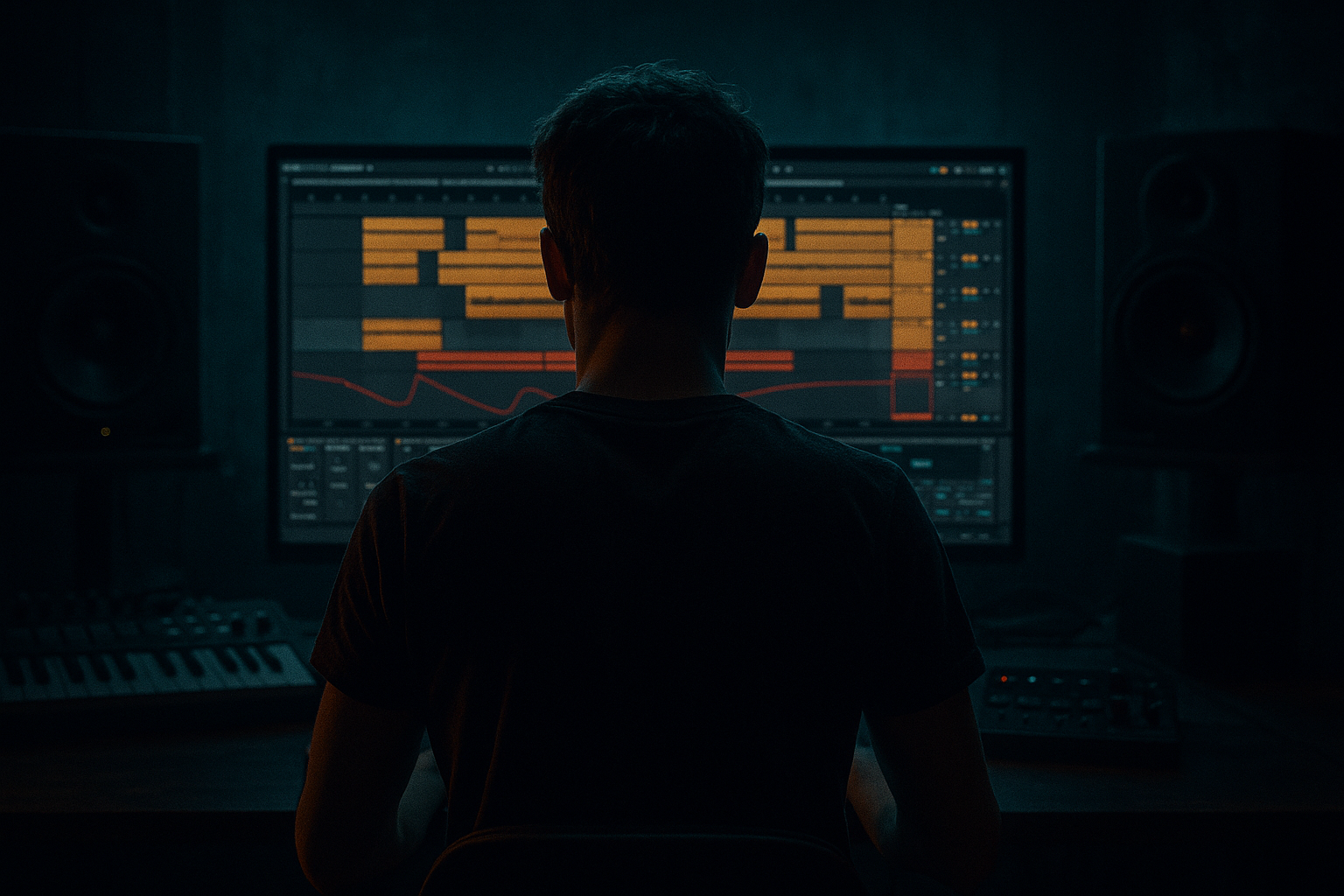
Main tutorial
```markdown
Granular Textures for Dark Intros (DnB in Ableton Live) 🌑🔊
1) Lesson overview
Dark drum & bass intros live or die on texture: tension, atmosphere, movement, and a sense that something heavy is about to land. In this lesson you’ll build granular-style evolving beds using mostly Ableton Live stock devices, with a workflow that’s fast enough for real sessions and flexible enough for advanced sound design.
We’ll focus on:
- Turning one audio source into a moving granular texture
- Building width + depth without washing out the mix
- Creating automation-driven evolution that leads into the drop
- Keeping it rooted in rolling DnB/jungle aesthetics (dark, eerie, functional)
- Swells, morphs, and pulses in time
- Has call-and-response movement (important for DnB pacing)
- Leaves space for vocal chops, risers, and the first break to breathe
- A 1–4 second clip of: vinyl crackle + room tone, cymbal tail, foley scrape, jungle ambience, a Reese tail, a vocal breath, a pad chord hit, or even a resampled drum fill.
- For DnB darkness: choose noisy + harmonically rich sounds (metal, air, distorted tails).
- Right-click clip → Slice to New MIDI Track (optional), OR
- Drag sample into Simpler (recommended for control).
- Mode: Classic
- Warp: Off (inside Simpler) unless you want pitch-time weirdness
- Voices: 8–16 (higher = smoother pads)
- Retrig: On (for consistent grains when you use short envelopes)
- Loop: On
- Loop Length: ~30–150 ms (start at ~80 ms)
- Start: automate later
- Snap: Off (so it can drift)
- Attack: 10–40 ms (prevents clicks)
- Decay: 300–1200 ms
- Sustain: -inf (or very low) if you want plucks; higher for a smear
- Release: 200–800 ms
- Add subtle pitch drift:
- Auto Filter cutoff: slowly rise from ~250 Hz → ~600 Hz
- Reverb mix: 20% → 30%
- Simpler Loop Length: 120 ms → 80 ms (tightens, adds urgency)
- Automate Simpler Start (small range): move 0–15% slowly
- Add Auto Pan (subtle)
- Add Gate (or Auto Filter with LFO) to pulse it in time:
- Filter cutoff: 600 Hz → 1.5–2.5 kHz
- Add a short “pre-drop choke”:
- Loop Length: 20–60 ms
- Amp Attack: 2–10 ms
- Release: 50–200 ms
- Transpose: +12 or +19 (or -12 for creepy low grit)
- Start from the Grain Bed again, but:
- Use EQ Eight to high-pass at ~30 Hz (clean sub garbage)
- Keep it mono with Utility (Width 0%)
- Bars 1–8: Grain Bed only, slowly opening filter + reverb
- Bars 9–16: Add Ghost Shards + a distant one-shot (reverse cymbal / foley hit) every 4 bars
- Bars 17–24: Add a minimal break tease (filtered amen tail or hat loop very low), and start rhythmic gating
- Bars 25–32: Tension tools:
- Too much reverb in the lows → your drop will feel small. High-pass your reverbs (200–500 Hz).
- Random automation with no arc → movement feels “plugin demo” instead of narrative.
- Over-widening early → intro sounds impressive but collapses when drums hit. Keep the core bed stable; widen the shards.
- Harsh resonance buildup (2–6 kHz) → fatigue fast. Use EQ Eight notches when needed.
- Loop clicks in micro loops → increase attack slightly, or crossfade your source before sampling.
- Resample in stages: Print 8 bars of your texture, then re-load it into Simpler and repeat. Each generation gets more “cinematic” and less predictable.
- Use Convolution in Hybrid Reverb with an industrial IR (metal room, tunnel). Then low-pass it hard.
- Parallel nastiness: Create an Audio Effect Rack:
- Create negative space: Automate Utility Gain dips or Gate patterns so the intro breathes like a drum groove.
- Rhythmic modulation: If you have Max for Live, map LFO rate to 1/8T or 1/16 moments for jungle-style nervous energy—briefly, not constantly.
- You built granular-style textures using Simpler micro-looping + modulation, not vague “ambient layering.”
- You shaped darkness with filtering, controlled saturation, and dark reverb while protecting headroom.
- You arranged the intro with intentional evolution every 4 bars, keeping it functional for rolling DnB drops.
- You finished with a repeatable workflow: source → pseudo-granular bed → shards → body → resample → arrange.
---
2) What you will build
You’ll create a 3-layer intro texture rig:
1. Grain Bed (main evolving texture)
2. Ghost Shards (stereo glitter + unsettling movement)
3. Subtle Rumble/Body (low-mid “air pressure” that foreshadows the drop)
You’ll end with a 16–32 bar intro that:
---
3) Step-by-step walkthrough
Step A — Choose the right source material (this matters)
Granular textures are only as good as the source. Pick something with character:
Tip: If your source is too clean, print it through distortion first (we’ll do this later too).
---
Step B — Create the “Grain Bed” rack (stock Ableton)
1) Create an audio track → drop your source sample onto it.
2) Convert it into a granular-style instrument using Simpler:
Simpler settings (Classic mode)
Make it “grain-like” using very short amplitude envelopes + looping
Amp Envelope
Pitch/Texture movement
- In Simpler: LFO (if available in your Live version) → modulate Sample Start and/or Pitch
- If no Simpler LFO: use Max for Live LFO device (stock in Suite) on Sample Start.
3) Add a grain motion chain (devices after Simpler)
Put these in order:
1. Auto Filter
- Type: LP24
- Cutoff: 200–2000 Hz (automate)
- Resonance: 0.20–0.40
- Drive: 2–6 dB (adds bite)
- Env: small amount (+5 to +15) so dynamics “talk”
2. Saturator
- Mode: Analog Clip or Soft Sine
- Drive: 2–8 dB
- Output: trim so it doesn’t jump in level
- Color: On (adds density)
3. Redux (careful—this is your “digital rot”)
- Bit Reduction: 6–12 (subtle)
- Downsample: 1.5–4 (taste)
- Dry/Wet: 10–35%
4. Hybrid Reverb
- Algorithm: Hall or Shimmer OFF (keep it dark)
- Size: 60–90
- Decay: 3–8 s
- Low Cut: 200–500 Hz (important for DnB headroom)
- High Cut: 4–10 kHz (darker)
- Mix: 15–35% (or use it on a send if you prefer control)
5. Utility
- Width: 120–160% (only if lows are controlled)
- Bass Mono: 120–180 Hz
✅ Result: a playable, looping texture that behaves like “pseudo-granular” synthesis.
---
Step C — Make it evolve like a real intro (automation that matters)
DnB intros feel alive when movement is intentional, not random. Here’s the automation map for 16 bars:
Bar 1–4: Establish darkness
Bar 5–8: Introduce instability
- Rate: 0.07–0.15 Hz (slow)
- Amount: 20–40%
- Phase: 180° (wide)
Bar 9–12: Foreshadow rhythm
- Gate: Threshold so it chops gently, Return ~150 ms
- Or Auto Filter LFO: Rate 1/2 or 1/4, Amount small, Phase 0–90
Bar 13–16: Build to impact
- Automate Utility gain down -3 to -6 dB on the last 1/2 bar
- Kill reverb mix for a moment (classic tension trick)
---
Step D — Add “Ghost Shards” layer (stereo granular sparkle) ✨
This layer is the tiny shards and eerie detail that makes it modern.
1) Duplicate the Grain Bed track
2) Change Simpler to be more “shardy”:
3) Device chain
1. EQ Eight
- High-pass: 600–1200 Hz
- Small dip around 2–4 kHz if harsh
2. Frequency Shifter (this is gold for dark intros)
- Mode: Ring Mod or Single Sideband
- Fine: 10–60 Hz (slowly automate)
- Dry/Wet: 10–30%
- Add subtle motion without sounding like a synth lead.
3. Chorus-Ensemble
- Amount: 20–40%
- Rate: 0.10–0.40 Hz
- Width: 100%
- Mix: 15–30%
4. Delay (Echo or Simple Delay)
- Time: dotted 1/8 or 1/4
- Feedback: 15–35%
- Filter: dark (LP around 3–6 kHz)
- Mix: 10–25%
Keep this layer quiet. It should be felt more than heard.
---
Step E — Add “Body/Rumble” (but keep it intro-safe)
DnB intros often hint at sub energy without committing.
Create a new audio track: “Intro Body”
- Pitch: -12 to -24 semitones
- Heavy low-pass (Auto Filter LP24 around 120–250 Hz)
- Add Saturator (Drive 3–10 dB)
- Add Compressor with slow-ish settings to make it “breathe”
- Attack: 20–40 ms
- Release: 150–300 ms
- Ratio: 2:1 to 4:1
- Aim for 2–5 dB GR on peaks
Critical:
This should create “pressure” without fighting your eventual drop bass.
---
Step F — Arrange it like DnB (practical intro blueprint)
Here’s a classic 32-bar dark rolling DnB intro structure:
- Remove low end briefly (last 2 beats)
- Add a short riser (noise + pitch up)
- Hard stop or reverb cut right before the drop
DnB pacing tip: something should change every 4 bars, even if tiny.
---
4) Common mistakes
---
5) Pro tips for darker/heavier DnB 🖤
- Chain A = clean-ish texture
- Chain B = heavy (Saturator + Redux + Overdrive)
- Blend with macros so you can “turn evil” approaching the drop.
---
6) Mini practice exercise (15–25 minutes) 🎯
1. Pick one 2-second source (foley or cymbal tail).
2. Build the Grain Bed rack (Simpler → Auto Filter → Saturator → Redux → Hybrid Reverb → Utility).
3. Create three 8-bar clips:
- Clip A: slow evolving pad (no gating)
- Clip B: subtle pulsing (Gate or Filter LFO at 1/4)
- Clip C: “pre-drop panic” (shorter loop length + higher cutoff + less reverb)
4. Arrange A → B → C across 24 bars.
5. Export/resample the 24 bars, then bring it back in and slice one eerie moment to use as a transition hit.
---
7) Recap
If you want, tell me what kind of drop you’re writing (rollers, neuro, jungle revival, halftime) and I’ll suggest a matching intro texture arc and automation plan.
```

