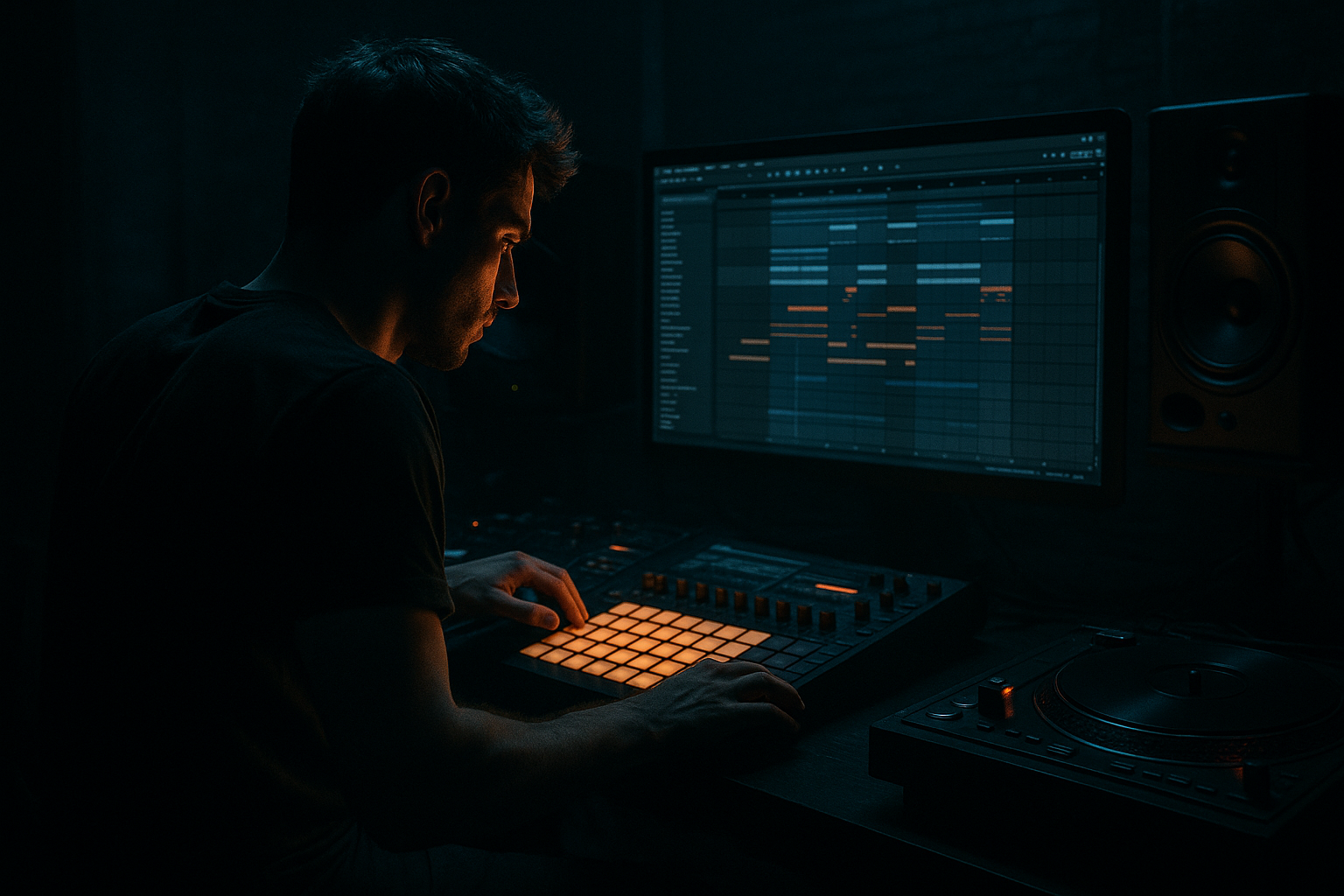
Main tutorial
Guide for a Percussion Layer with Crunchy Sampler Texture in Ableton Live 12 for Jungle / Oldskool DnB Vibes 🥁⚡
1. Lesson overview
In oldskool jungle and drum & bass, percussion is more than just a beat keeper — it’s part of the energy, texture, and movement of the track. A crunchy sampler layer can add that dirty, nostalgic edge you hear in classic breaks, ravey jungle edits, and darker rolling DnB.
In this lesson, you’ll learn how to build a percussion layer using Ableton Live 12’s stock devices, especially Sampler, to create:
- gritty, chopped percussion texture
- a layered rhythm underneath your main break
- movement that feels raw, dusty, and oldskool
- a sound that sits well in jungle, roller DnB, and darker halftime-influenced grooves
- a short sampled drum hit or break fragment
- a Sampler instrument with crunchy character
- a filter + saturation + resampling-style processing chain
- a rhythmic MIDI pattern that supports your main break
- optional arrangement variation for buildup and drop sections
- grit
- stereo movement
- syncopation
- oldskool texture
- density without sounding too polished
- a single snare hit from an old break
- a rimshot
- a tambourine hit
- a shaker fragment
- a chopped piece of a classic break like Amen, Think, Apache, or Funky Drummer
- a short noisy percussion hit from your own drum rack
- Attack: 0 ms
- Decay: short, around 100–300 ms if you want a hit-like feel
- Sustain: low or zero for percussive texture
- Release: short, around 20–80 ms
- Transpose: try -12 to +12 semitones depending on how dark you want it
- Filter on
- Volume envelope
- Glide/Portamento
- Voices
- reduce sample quality slightly by resampling later
- use a darker tuning
- choose a sample with noise or room tone already in it
- place hits on the “and” of beats
- add occasional ghost hits before the snare
- use syncopated 16th-note spacing
- vary note velocity for realism and movement
- High-pass filter: around 150–300 Hz
- Cut harshness: gently dip around 2.5–5 kHz if needed
- Add bite: small boost around 6–10 kHz if the layer needs presence
- Saturator
- Drum Buss
- Pedal for heavier color
- Dynamic Tube
- Redux for lo-fi digital crunch
- Drive: 2–8 dB
- Turn on Soft Clip
- Try Analog Clip or Warmth if available in your version/preferences
- Drive: low to medium
- Transient: adjust carefully, usually slightly up for sharper percussion
- Boom: often off or very low for this layer
- Damp: darker if needed
- Downsample: subtle, not extreme
- Bit reduction: very light unless you want a crushed aesthetic
- LFO: very slow
- Amount: subtle
- Filter type: low-pass or band-pass
- Resonance: low to medium
- Reverb with short decay
- Hybrid Reverb if you want a more characterful space
- Delay very subtly, especially filtered delays
- Decay: short, around 0.3–0.8 s
- Pre-delay: small
- High cut: quite low if you want it dark
- Wet: very low, often 5–15%
- one rimshot
- one noisy hit
- one shaker
- one snare fragment
- alternating accents
- call-and-response percussion
- different hits in verse and drop sections
- Use mild compression only
- Aim for control, not pumping
- If using Glue Compressor, keep gain reduction subtle
- Intro: filtered and low in volume
- Build-up: open the filter gradually
- Drop: full texture with more saturation
- Breakdown: remove low mids and let it echo out
- Second drop: automate extra distortion or stereo width for intensity
- filter cutoff
- saturation drive
- send amount to reverb/delay
- volume
- Auto Filter resonance
- Drum Buss transient
- one sample for crackle
- one sample for body
- one for subtle air
- choose a sample with character
- use Sampler for control
- program syncopated, human-feeling MIDI
- shape with EQ Eight, Saturator, Drum Buss, and Auto Filter
- keep the layer gritty but not overpowering
- automate it across the arrangement for movement
- a rack preset recipe
- a step-by-step Ableton device chain diagram
- or a MIDI pattern example for jungle percussion
This is a beginner-friendly workflow, but it gives you a very authentic result. We’ll keep it practical and focused on making something you can actually use in a track. 🎛️
---
2. What you will build
By the end, you’ll have a dedicated percussion layer made from:
This layer is not meant to replace your main drum loop. Instead, it should sit behind or around it and add:
Think of it like a layer of dusty rhythm glue. 🔥
---
3. Step-by-step walkthrough
Step 1: Choose the right source sample
Start with a sample that already has character. Good options:
Best beginner approach:
1. Drag a short percussion sample into an empty MIDI track.
2. Put it into Sampler or Simpler.
3. If the sample is too clean, don’t worry — we’ll dirty it up with processing.
For a jungle vibe, short noisy hits work especially well because they cut through busy breakbeats without overpowering them.
---
Step 2: Load the sample into Sampler
Use Sampler if you want more control. If you’re just starting out, Sampler is still totally manageable.
#### Basic Sampler setup:
1. Create a new MIDI track.
2. Load Sampler from Instruments.
3. Drag your percussion sample into Sampler.
4. Set playback to Classic if needed.
5. Enable One-Shot behavior if you want each MIDI note to fully trigger the sample.
#### Useful starting settings:
If your sample is a little long, trim it so it feels like a tight rhythmic element rather than a full percussion loop.
---
Step 3: Add crunchy character inside Sampler
Now we start making it feel like old tape, sampler grit, and busted jungle hardware.
#### In Sampler, try these:
- Type: Low-Pass or Band-Pass
- Cutoff: around 3–10 kHz depending on brightness
- Resonance: moderate, not too extreme
- Short decay for punchy texture
- Usually off for percussion
- Mono if you want tighter triggering
- Poly if layering multiple hits creatively
#### If you want more dusty edge:
You’re aiming for a rough, crunchy, used sound, not a polished top loop.
---
Step 4: Program a jungle-friendly percussion pattern
Now create a MIDI clip.
#### A good starting pattern:
Use 1-bar or 2-bar MIDI and place hits off the main kick/snare grid. Jungle and DnB percussion works best when it pushes and pulls around the main groove.
Example idea:
#### Beginner-friendly MIDI approach:
1. Create a 1-bar clip.
2. Put notes on:
- beat 1.2
- beat 1.4
- beat 2.3
- beat 3.1.3
- beat 4.2
3. Duplicate and shift the pattern slightly across 2 bars.
4. Use velocity variation so not every hit feels identical.
#### Important jungle feel:
Don’t make it too rigid. Oldskool DnB often sounds alive because the percussion is slightly messy, human, and chopped.
---
Step 5: Shape the tone with EQ Eight
Add EQ Eight after Sampler.
#### Suggested EQ starting point:
- This clears low-end so it doesn’t fight the kick and bass
For darker DnB, you often want the percussion layer to be more texture than attack. So don’t over-brighten it unless you specifically want a ravey top layer.
---
Step 6: Add saturation and crunch
This is where the texture really comes alive.
Use one or more of these stock Ableton devices:
#### A very solid chain:
Sampler → EQ Eight → Saturator → Drum Buss → Utility
##### Saturator settings to try:
##### Drum Buss settings:
##### Redux settings:
The goal is not destruction for its own sake — it’s vintage grime with control.
---
Step 7: Create movement with filtering or modulation
To make the layer feel less static, add subtle motion.
#### Option A: Auto Filter
Use Auto Filter after saturation.
Settings to try:
This can create a dusty sweep over 8 or 16 bars, which is great for transitions and evolving loops.
#### Option B: Phaser-Flanger
Used very lightly, this can add motion to a percussion texture.
#### Option C: Resample the layer
For oldskool grit, resample your processed percussion layer and chop it again.
This works well if you want a more “found sound” jungle texture.
---
Step 8: Add ambience carefully
A little space can help the texture sit in the track, but too much reverb will wash out the groove.
Try:
#### Suggested reverb settings:
For oldskool jungle, a small room-like space can make the percussion feel like it came from a dusty sampler in a rave warehouse. 🏚️
---
Step 9: Use a Drum Rack if you want variation
If you want more control, put a few different percussion hits into Drum Rack:
Then build a layered MIDI pattern.
This is especially useful if you want:
You can also send all of them through the same group bus for shared crunch.
---
Step 10: Process the percussion layer on a group bus
Route your percussion layer to a group and process it together.
#### Great group chain:
1. EQ Eight
2. Saturator
3. Compressor or Glue Compressor
4. Utility
5. Optional Auto Filter
##### Compressor suggestions:
This helps the percussion feel glued into the drum mix rather than floating on top.
---
Step 11: Arrange it like a real DnB track
A crunchy percussion layer is most effective when it evolves across the arrangement.
#### Arrangement ideas:
#### Easy automation targets:
In DnB, movement is everything. Even a simple percussion layer can sound massive if it evolves over 8 or 16 bars.
---
4. Common mistakes
1. Making it too loud
A percussion texture should support the groove, not fight the kick and snare. If you hear it clearly in solo but it disappears in the mix, that’s often fine.
2. Leaving too much low end
Your bass and kick need space. High-pass the layer so it doesn’t muddy the sub and low-mids.
3. Over-crushing the sample
Too much Redux or distortion can turn character into noise. Keep crunch musical.
4. Using a sample with no rhythm
If the source sound is boring, the layer will feel flat. Choose a hit or break fragment with natural motion.
5. Forgetting velocity variation
Jungle percussion feels alive because not every hit is identical. Vary velocity and timing a little.
6. Too much reverb
Big reverb can blur the swing and make your drums feel soft. Use short spaces and filter them dark.
---
5. Pro tips for darker/heavier DnB
Tip 1: Darken before you distort
If you low-pass the sample first, then saturate it, you’ll often get a more controlled gritty sound. This is great for darker rollers.
Tip 2: Layer a noisy top with a tight body
Use:
This creates a more complex, heavyweight percussion layer.
Tip 3: Resample the chain
For authentic jungle texture, bounce the processed percussion to audio, then chop it again in Simpler or Sampler. This gives you that “sampled and re-sampled” feel.
Tip 4: Use small delays for bounce
A very short, filtered delay can create a bouncing metallic tail without sounding obvious. Keep feedback low.
Tip 5: Add stereo width only to the highs
Use Utility or careful EQ to keep low frequencies mono and let only the upper texture spread slightly.
Tip 6: Automate dirt in the drop
Increase saturation, drive, or bit reduction slightly in the drop section for extra aggression. Small moves can make a huge difference in DnB.
---
6. Mini practice exercise
Exercise: Build a 2-bar crunchy jungle percussion layer
#### Your task:
Create a percussion layer using one sample and stock Ableton devices only.
#### Steps:
1. Find one short percussion sample.
2. Load it into Sampler.
3. Program a 2-bar MIDI clip with off-beat hits and ghost notes.
4. Add this device chain:
- EQ Eight
- Saturator
- Drum Buss
- Auto Filter
- Utility
5. High-pass the layer so it doesn’t interfere with the bass.
6. Automate the Auto Filter cutoff over 8 bars.
7. Duplicate the clip and change at least 3 note velocities.
#### Challenge version:
Resample the processed layer, chop it again, and make a second variation for the drop.
---
7. Recap
You’ve now built a crunchy sampled percussion layer that fits the jungle / oldskool DnB aesthetic. The key ideas were:
This technique is incredibly useful in drum and bass because it adds rhythmic texture, dirt, and energy without cluttering the sub or main break. Once you get comfortable, start making your own variations by resampling and chopping again — that’s where the real jungle magic starts. 🌴🥁
If you want, I can also turn this into:

