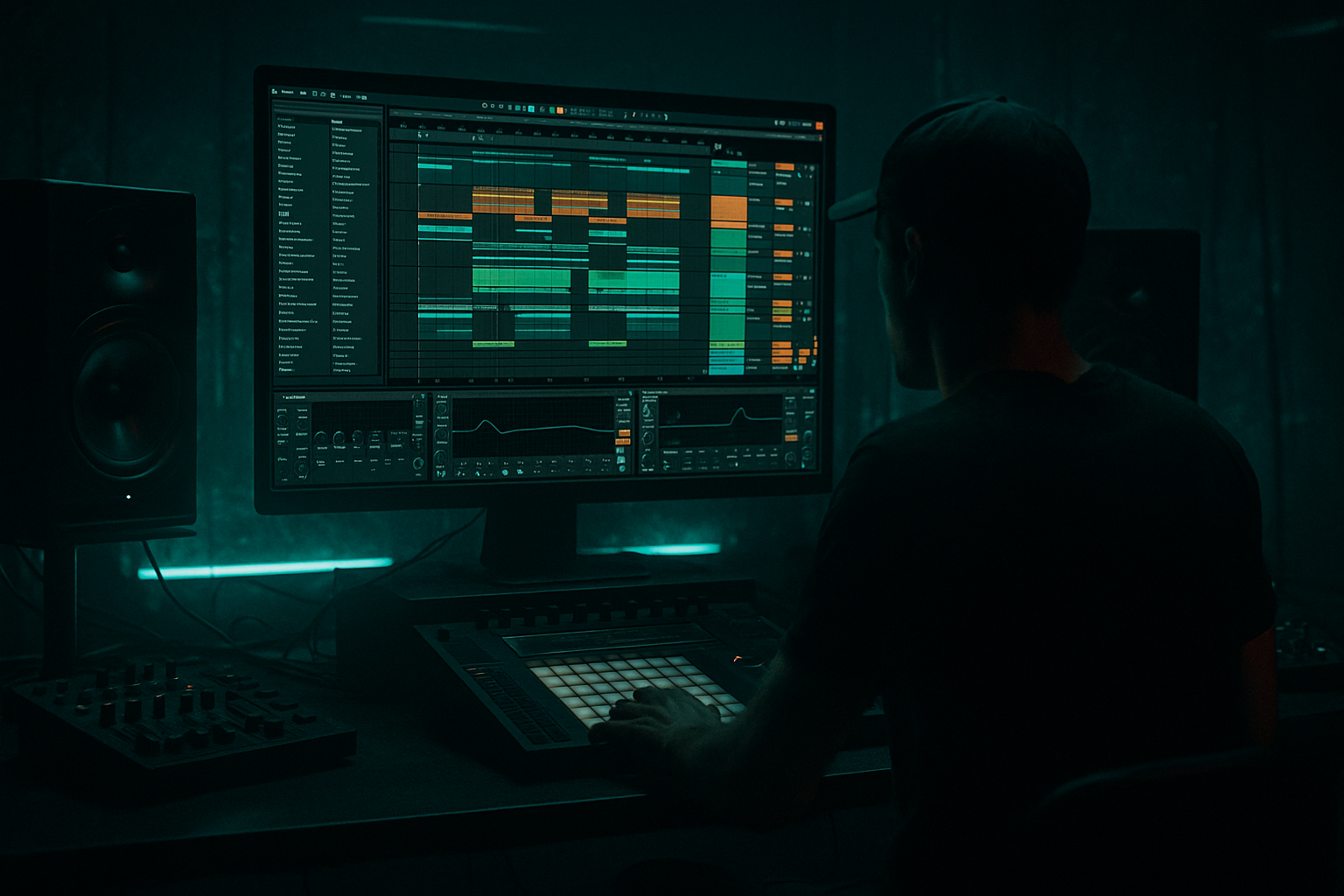
Main tutorial
Guide: Building a Deep Jungle Atmosphere Riser in Ableton Live 12 (Beginner • Mastering Category)
1. Lesson overview
A great jungle/DnB riser isn’t just “noise going up” — it’s a controlled build of tension that glues into the drop, supports the rolling drums + sub, and feels dark and atmospheric. In this lesson you’ll build a deep jungle riser using Ableton Live 12 stock devices, with a workflow that fits real DnB arrangements. ⚡️
We’ll treat it like a mastering-minded task: gain staging, spectral control, mono compatibility, and drop translation.
---
2. What you will build
You’ll create a 4- or 8-bar atmospheric riser made of three layers:
1. Air layer (noise/texture) → width + motion
2. Tone layer (a filtered pitch riser) → musical tension
3. Impact prep (subtle pre-drop suck / band control) → cleaner drop contrast
Plus a Riser Bus chain to keep it polished like a pro.
---
3. Step-by-step walkthrough
Step 0 — Set up your session (DnB context)
- Tempo: 170–175 BPM (classic jungle zone)
- Grid: 1 bar or 1/2 bar increments for automation readability
- Arrangement target: Put your riser in the last 4–8 bars before the drop
- Bars 1–16: intro
- Bars 17–32: build / pre-drop
- Bar 33: drop (full drums + bass)
- Filter type: LP24 (24 dB low-pass)
- Resonance: 0.60–0.85 (adds whistle tension)
- Drive: 2–5 dB (if it feels too polite)
- Map/automate Frequency from ~300 Hz → 14 kHz across 4–8 bars
- Amount: 20–35%
- Rate: 1/4 or 1/8 (sync)
- Phase: 180° for wide movement
- Size: 40–70%
- Decay: 3–6 s
- Pre-delay: 10–25 ms
- High Cut: 6–10 kHz (avoid fizzy top)
- Dry/Wet: 15–30%
- High-pass: cut everything below 200–400 Hz (steep slope)
- Optional small dip around 3–5 kHz if it gets harsh
- Create a 4-bar MIDI clip holding a single note (e.g., A1 or A2).
- We’ll create “riser” via automation and pitch movement.
- In Wavetable, automate Transpose (or Pitch envelope) from:
- Auto Filter: start low, open up:
- Add a second automation on Saturator Drive:
- Saturator mode: Analog Clip
- Turn on Soft Clip ✅
- Time: 1/8 or 3/16 (try 3/16 for a rolling feel)
- Feedback: 15–30%
- Filter inside delay: cut lows below 300 Hz, highs above 8–10 kHz
- Mix: 8–18%
- Width: 110–140%
- BUT: if it starts messing with mono, back it down later.
- Downsample: 1.2–2.5
- Bit reduction: 0–2 (keep it subtle)
- Band-pass (BP) can be great here:
- High-pass up to 250–500 Hz so it won’t cloud the sub drop.
- High-pass at 150–250 Hz (12 or 24 dB slope)
- If harsh: small dip 2.5–5 kHz (1–3 dB)
- If too “hissy”: gentle shelf down above 10–12 kHz
- Attack: 10 ms
- Release: Auto (or 0.3 s)
- Ratio: 2:1
- Aim for 1–2 dB gain reduction max
- Keep it subtle: you’re controlling, not crushing.
- Drive: 2–5 dB
- Soft Clip: On
- Output: trim so level doesn’t jump (match loudness)
- Ceiling: -1.0 dB
- Only catching peaks: 0–2 dB reduction
- Turn on Bass Mono
- If too wide: reduce Width to 90–110%
- Draw a slow rise for 70% of the riser, then steeper rise in the last bar.
- Example (4 bars):
- Pull the Riser BUS volume down by 1–3 dB
- Or automate Reverb Dry/Wet down slightly
- At the drop, hard cut the riser (or a very short fade of 10–30 ms).
- Don’t let long reverb tails wash into your first kick + snare unless that’s a deliberate style choice.
- Too much low end in the riser → kills drop impact. High-pass is non-negotiable.
- Overly wide stereo → sounds huge in headphones, weak in mono/clubs.
- Harsh 3–6 kHz buildup → ear fatigue, makes your snare feel smaller.
- Riser louder than the drop elements → backwards energy.
- No automation variety (only filter sweep) → feels generic and predictable.
- Use band-pass sweeps (BP12/BP24) for that boxed, ominous tension — very jungle.
- Add subtle distortion on the BUS (Saturator) but keep the top controlled with EQ.
- Create call-and-response with the drums:
- Add a short vinyl brake / tape stop vibe right before drop:
- For heavier drops, keep the riser mid-focused (600 Hz–8 kHz) so it doesn’t steal space from your sub and punch.
- A deep jungle riser is usually layered: air + tone + texture.
- Keep it spectrally controlled (high-pass the lows, tame harsh highs).
- Use automation like a producer: filter + pitch + saturation + a final “pull” before the drop.
- Finish with a bus chain (EQ → Glue → Saturation → Limiter → Utility) for consistent, mastering-minded control.
DnB arrangement suggestion (typical):
---
A) Create the Riser Bus (clean workflow)
1. Create 3 MIDI/Audio tracks:
- `Riser Air`
- `Riser Tone`
- `Riser FX`
2. Group them (Cmd/Ctrl+G) → name group Riser BUS
3. On each riser track, aim for peaks around -12 to -9 dBFS (pre-bus).
This gives headroom for the drop and avoids harshness. ✅
---
B) Layer 1: Air / Noise riser (the “jungle fog” ☁️)
Option 1 (fast + effective): White noise with Auto Filter
1. On `Riser Air`, load Operator (stock).
2. In Operator:
- Turn Osc A to Noise White (or Noise mode if available)
- Turn off other oscillators.
3. Add devices in this order:
1. Auto Filter
2. Auto Pan
3. Reverb
4. EQ Eight
#### Suggested settings
Auto Filter
Auto Pan
Reverb
EQ Eight
✅ Result: a wide, moving, filtered air sweep that builds tension but doesn’t fight your bass.
---
C) Layer 2: Tone riser (musical tension, not just noise 🎼)
Make a simple pitch riser in Wavetable (stock)
1. On `Riser Tone`, load Wavetable.
2. Choose a basic wave:
- Osc 1: Sine or Triangle (clean tension)
- Optional: Osc 2 very low level for subtle grit
3. Add devices:
1. Auto Filter
2. Saturator
3. Delay (or Echo)
4. EQ Eight
5. Utility
#### MIDI clip (easy)
#### Automations to draw (main moves)
1) Pitch rise
- 0 semitones → +12 semitones over 4 bars
(For 8 bars, do +12 over 8 bars for slower creep.)
2) Filter opening
- Frequency: 200 Hz → 8–12 kHz
- Resonance: 0.30–0.55
3) Add urgency near the end
- Start: 1–2 dB
- End: 5–8 dB
Delay / Echo (subtle jungle space)
Utility
---
D) Layer 3: Jungle FX riser (movement + dirt without clutter 🥁)
On `Riser FX`, use one of these quick methods:
Method: Granular-ish texture using Simpler + Warp
1. Drop in an atmospheric sample (rain, vinyl crackle, old rave pad stab tail, field recording).
2. In Simpler:
- Mode: Classic (simple)
- Enable Loop with a short loop region for a sustained texture.
3. Add:
1. Redux (tiny amount)
2. Chorus-Ensemble (optional)
3. Auto Filter
4. Reverb
5. EQ Eight
Redux
Auto Filter
- Type: BP12
- Frequency sweep: 600 Hz → 6 kHz
- Resonance: 0.5–0.9 (for that “radio tension”)
EQ Eight
---
E) Riser BUS processing (mastering-minded polish 🧠)
Now process the Riser BUS group (not each layer) so it behaves as one controlled element.
Recommended BUS chain (stock)
1. EQ Eight
2. Glue Compressor
3. Saturator
4. Limiter
5. Utility
#### Settings
1) EQ Eight (clean the lows, shape the bite)
2) Glue Compressor (light “bind”)
3) Saturator (glue + density)
4) Limiter (safety only)
5) Utility (stereo discipline)
- Set Bass Mono Frequency: 120–200 Hz
---
F) Automation that makes it feel like real DnB
This is the part that separates “basic riser” from “proper jungle pre-drop”.
1) Volume curve (don’t just ramp straight)
- Bars 1–3: gradual
- Bar 4: faster push to the peak
2) Add a tiny pre-drop “pull” (contrast trick)
In the last 1/4 bar before the drop:
This creates that “suck in” moment so the drop hits harder. 💥
3) Stop or cut the riser cleanly at the drop
---
4. Common mistakes
---
5. Pro tips for darker/heavier DnB 🖤
- Let the riser “breathe” on snare hits (tiny volume dips on 2 and 4).
- Use Frequency Shifter (very subtle) or automate pitch briefly downward in the last 1/8 bar.
---
6. Mini practice exercise (15 minutes)
1. Build a 4-bar riser using:
- `Riser Air` (Operator noise + Auto Filter)
- `Riser Tone` (Wavetable + pitch rise)
2. On the Riser BUS, add:
- EQ Eight (HP at ~200 Hz)
- Glue Compressor (1–2 dB GR)
3. Add these automations:
- Filter opens across 4 bars
- Pitch goes 0 → +12 semitones
- Last 1/4 bar: volume dips by 2 dB, then hard cut at drop
4. A/B test:
- Toggle Riser BUS on/off and check if the drop feels bigger with it on.
---
7. Recap
If you tell me what kind of drop you’re building (classic jungle break drop, modern roller, halftime fog, etc.), I can suggest a riser length + frequency target that matches your drum/bass pocket perfectly.

