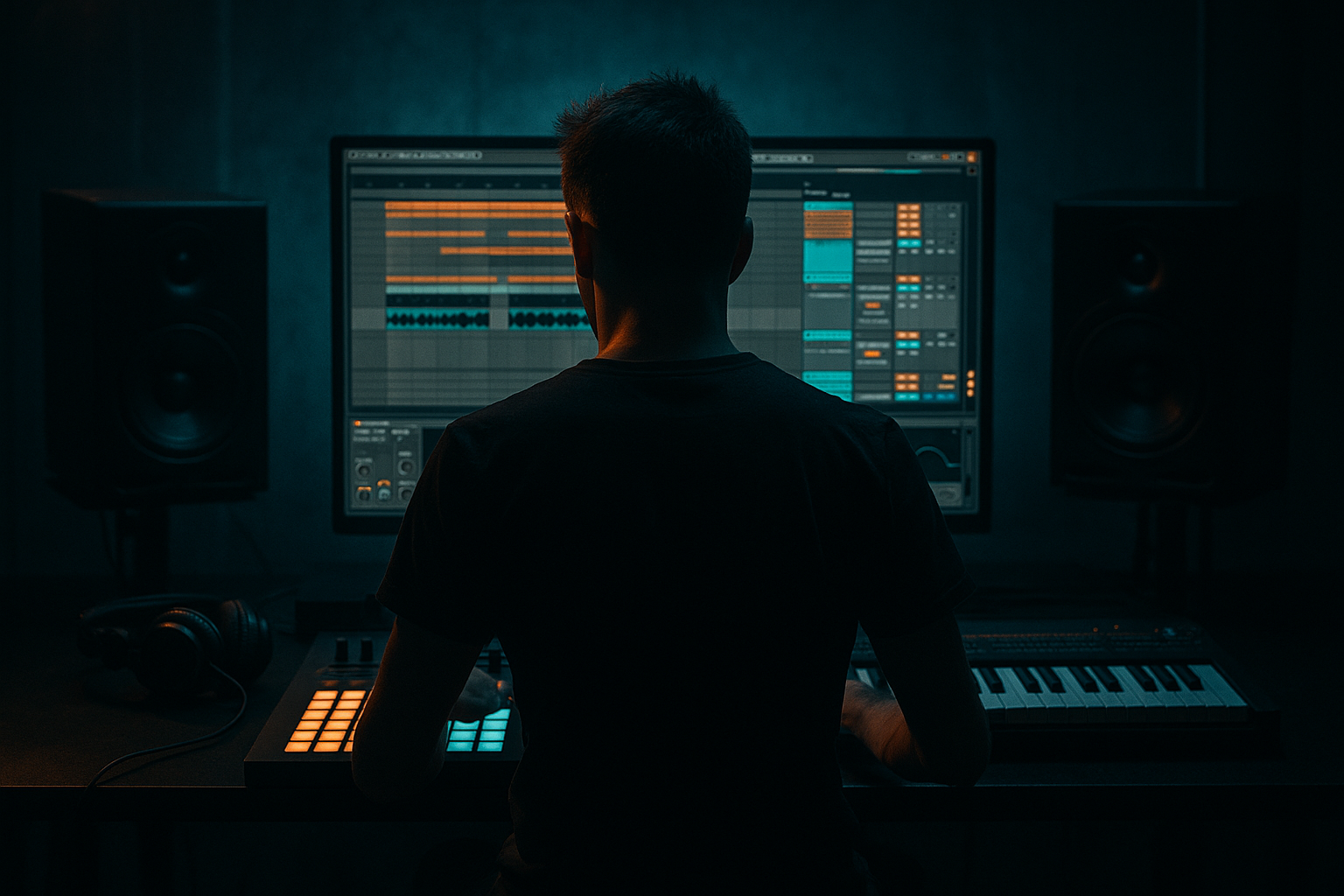
Main tutorial
```markdown
Hat Shuffle Tightening (for Jungle Rollers) — Ableton Live (Advanced) 🥁✨
1. Lesson overview
In jungle rollers, the hats are doing two jobs at once: keeping relentless forward motion and locking the groove to the break + bass.
This lesson is about tightening hat shuffle so it feels skippy and alive without going sloppy, flammy, or phasey.
We’ll focus on:
- Micro-timing that’s intentional (not “random swing”)
- Controlling transient sharpness vs. smear
- Velocity + filtering tricks that sell groove
- Layering hats with breaks so they glue, not fight
- A primary closed hat providing crisp 16th momentum
- A ghost/shuffle hat layer that creates the “skip”
- A ride/open hat accent that breathes with the phrase
- A break-informed timing reference (so hats sit with your Amen/think-style loop)
- Put CH and SH in the same Choke Group (so they don’t stack and smear).
- Keep OH separate, or in the same choke group if your samples are long.
- CH: put hats on every 1/16 (all steps).
- OH: place on off-beats (e.g., 1.2, 1.4, 2.2, 2.4 in 1/8 language) sparingly.
- SH: leave empty for now.
- In MIDI, set most CH hits around 55–75 velocity.
- Accents (every quarter or every “and”) around 80–95.
- Right-click the clip → Commit Groove (but keep a saved version first).
- CH note length: very short (e.g., 1/64–1/32 feel).
- SH note length: slightly longer than CH, but not open-hat long.
- Reduce Decay/Release so each hit is “tick-y”, not “tsssh”.
- Drum Buss
- High-pass around 250–500 Hz (depends on sample)
- Tame harshness:
- Sidechain input: Break bus (or snare)
- Ratio: 2:1
- Attack: 3–10 ms
- Release: 40–90 ms
- Gain reduction: 1–3 dB max
- Gate
- Bars 1–2: CH only (tight engine)
- Bars 3–4: add SH ghosts (shuffle appears)
- Bars 5–6: add OH accents sparingly + slight velocity lift
- Bars 7–8: drop SH for 1 bar, then slam it back in (contrast)
- Auto Filter cutoff on hats: tiny moves (±5–15%) every 8 bars
- Reverb send (very small room): increase slightly into fills, cut on drops
- Distorted ghost layer only:
- Mid/Side control for club translation:
- Resample a hat loop and re-chop:
- Darkness via subtraction, not reverb:
- Build a grid-tight hat engine first, then add shuffle with purposeful micro-timing.
- Use choke groups + short decays to prevent top-end smear.
- Tighten impact with Drum Buss Transients and keep space for breaks using sidechain.
- For modern jungle rollers, the best shuffle is often small (6–14 ms) but consistent.
- Arrange hats like a story across 8–16 bars: introduce, develop, strip back, re-hit.
Ableton tools we’ll lean on: Groove Pool, MIDI Note Length, Delay (stock), Drum Rack, EQ Eight, Saturator, Drum Buss, Gate, and a tiny bit of utility/mono management.
---
2. What you will build
A tight, shuffled hat system for a jungle roller at 170–176 BPM, consisting of:
End result: hats that feel fast, rolling, and controlled, with no messy flams and better impact against the snare/kick.
---
3. Step-by-step walkthrough
Step 0 — Set the context (tempo + reference)
1. Set tempo to 174 BPM (classic roller sweet spot).
2. Drop in your break (Amen, Think, Hot Pants, etc.) or a tight modern break loop.
3. Warp it cleanly:
- Use Complex Pro only if needed; otherwise Beats mode often preserves transients better.
- In Beats mode: try Transient Loop = Off, Preserve = Transients, adjust Envelope if it clicks.
Goal: Your hats will be designed around the break’s pocket, not fighting it.
---
Step 1 — Build a clean hat foundation in Drum Rack
1. Create a MIDI track → Drum Rack.
2. Load:
- Closed hat (CH): short, bright, clean.
- Shuffle hat (SH): slightly softer/rounder or noisier hat.
- Open hat (OH): short-ish open hat, not too washy (rollers need control).
Drum Rack setup tips:
---
Step 2 — Program a “neutral” hat grid first (no groove yet)
On a 1-bar loop:
Now turn DOWN CH velocity range so it’s not machine-gun loud:
Why: You want a stable “engine” before you add shuffle.
---
Step 3 — Create shuffle using deliberate micro-timing (not just Swing %)
#### Option A (best control): Manual micro-nudges
1. Add SH hits on selected 16ths (common roller pattern):
- Place SH on the “e” or “a” positions depending on your break pocket.
- Example: if you count 1 e & a:
- Put SH on “a” of beat 1, “e” of beat 2, “a” of beat 3, “e” of beat 4.
2. Now nudge timing:
- Select only SH notes.
- Nudge late by +6 to +14 ms (start at +9 ms).
- Optionally nudge some early by -3 to -7 ms for tension, but be careful.
Ableton method: Use the Note Editor + nudge (left/right) or set Grid to Off and drag.
✅ Result: You get shuffle that’s in the pocket, not “global swing that wrecks the snare”.
---
#### Option B (fast workflow): Groove Pool with constraints
1. Pick a groove:
- Try MPC 16 Swing 54–58 or something subtle.
2. Drag groove onto only the hat clip (not your kick/snare).
3. In Groove Pool:
- Timing: start 10–25%
- Velocity: 0–15%
- Random: 0–5% (keep this low for tight rollers)
Then commit if you like it:
Key move: If your snare feels late after grooving, you grooved too much or applied it too broadly.
---
Step 4 — Tighten with note length + transient management
Hats in rollers usually feel tighter when the decay is controlled.
#### MIDI note length discipline
If using Simpler/Sampler:
#### Add Drum Buss (subtle!)
On the Drum Rack (or hat group):
- Drive: 2–6%
- Transients: +5 to +20 (tightens attack)
- Boom: Off (usually unnecessary for hats)
This helps hats cut without turning up volume.
---
Step 5 — Frequency slotting so the shuffle reads clearly
Put EQ Eight on the hat group (or per pad if needed):
- Dip 7–10 kHz by -1 to -3 dB if it’s brittle
- If it’s dull, a gentle shelf around 9–12 kHz +1 to +2 dB
Critical: If your break has lots of top end, don’t “outshine” it—complement it.
---
Step 6 — The “micro-delay shuffle” trick (tight but rolling) 🎛️
This is a classic: use a very short delay to create push-pull without messy timing edits.
1. Duplicate your CH chain (or create a return within Drum Rack):
- CH Main (dry)
- CH Shuffle (delayed)
2. On CH Shuffle chain insert Delay (stock):
- Mode: Time
- L/R Linked: On
- Time: 8–18 ms
- Feedback: 0%
- Dry/Wet: 100% (because it’s a parallel chain)
3. Low-pass the delayed chain a bit with Auto Filter or EQ Eight:
- Low-pass around 8–12 kHz (so it feels like a “ghost”)
Then program the Shuffle chain to hit only on chosen 16ths (or feed it via a separate pad/sample).
Why this works: Your main hat stays grid-tight, while the delayed hat gives controlled “lag” that reads as shuffle.
---
Step 7 — Glue hats to the break with sidechain and gating
To stop hats masking the break’s transient detail:
#### A) Sidechain ducking (subtle)
On hat group insert Compressor:
This makes room for break transients without killing your hat engine.
#### B) Gate for ultra-tightness (optional)
On SH (shuffle) chain:
- Threshold: set so only the hat opens cleanly
- Return: low
- Release: short-ish (30–80 ms)
This is great if your shuffle hat is noisy/long and smearing the pocket.
---
Step 8 — Arrangement: make the shuffle evolve like a real roller
A roller that loops unchanged for 64 bars gets stale. Instead:
8-bar hat narrative idea:
Automation suggestions:
Keep reverb short; jungle hats want presence, not wash.
---
4. Common mistakes 🚫
1. Over-swinging the whole drum bus
Your snare will feel late and your roller loses punch. Groove the hats, not everything.
2. Too much randomization
Jungle is human, but rollers are controlled. Keep Random low and use purposeful nudges.
3. Long hat tails stacking
Leads to phasey top-end and “paper tearing” noise. Use choke groups + shorter decays.
4. Hats too loud vs. break
If hats dominate, your break loses identity. Duck, EQ, or simply turn down.
5. Ignoring the break pocket
Your hats should “sit inside” the break’s swing. Reference the break transient timing constantly.
---
5. Pro tips for darker/heavier DnB 🌑
Put Saturator on SH chain:
- Drive 3–8 dB, Soft Clip On
- EQ after: low-pass around 10–12 kHz
This gives gritty movement without harsh fizz.
On hat group:
- Utility: Width 80–120% (don’t go crazy)
- Keep the sharpest transient layer more mono (main CH), and let only airy layers be wide.
Print 4 bars of hats → slice to Drum Rack → re-trigger micro bits.
You’ll get that “sampled-top” energy like classic jungle, but still modern-tight.
Instead of big reverb, use:
- EQ dip at 10–12 kHz a touch
- Add subtle room (very short) only on OH accents
---
6. Mini practice exercise 🧠
Goal: Create two versions of the same roller hats: one “too loose”, one “tight but shuffled”.
1. Make a 2-bar loop at 174 BPM with CH on all 16ths.
2. Add SH on 4 positions per bar (your choice).
3. Version A (loose):
- Groove Timing 40%
- Random 10%
- No choke groups
4. Version B (tight):
- Manual nudge SH: +9 ms late
- Choke group CH/SH
- Drum Buss: Transients +10
- Sidechain duck from break: 2 dB GR
5. A/B them at the same loudness.
Checkpoint: Version B should feel faster and more confident even if it’s technically “more shuffled”.
---
7. Recap ✅
If you want, tell me what break you’re using (Amen/Think/etc.) and whether your roller leans more 90s jungle or modern techy, and I’ll suggest a specific hat pattern + exact timing offsets to match that pocket.
```

