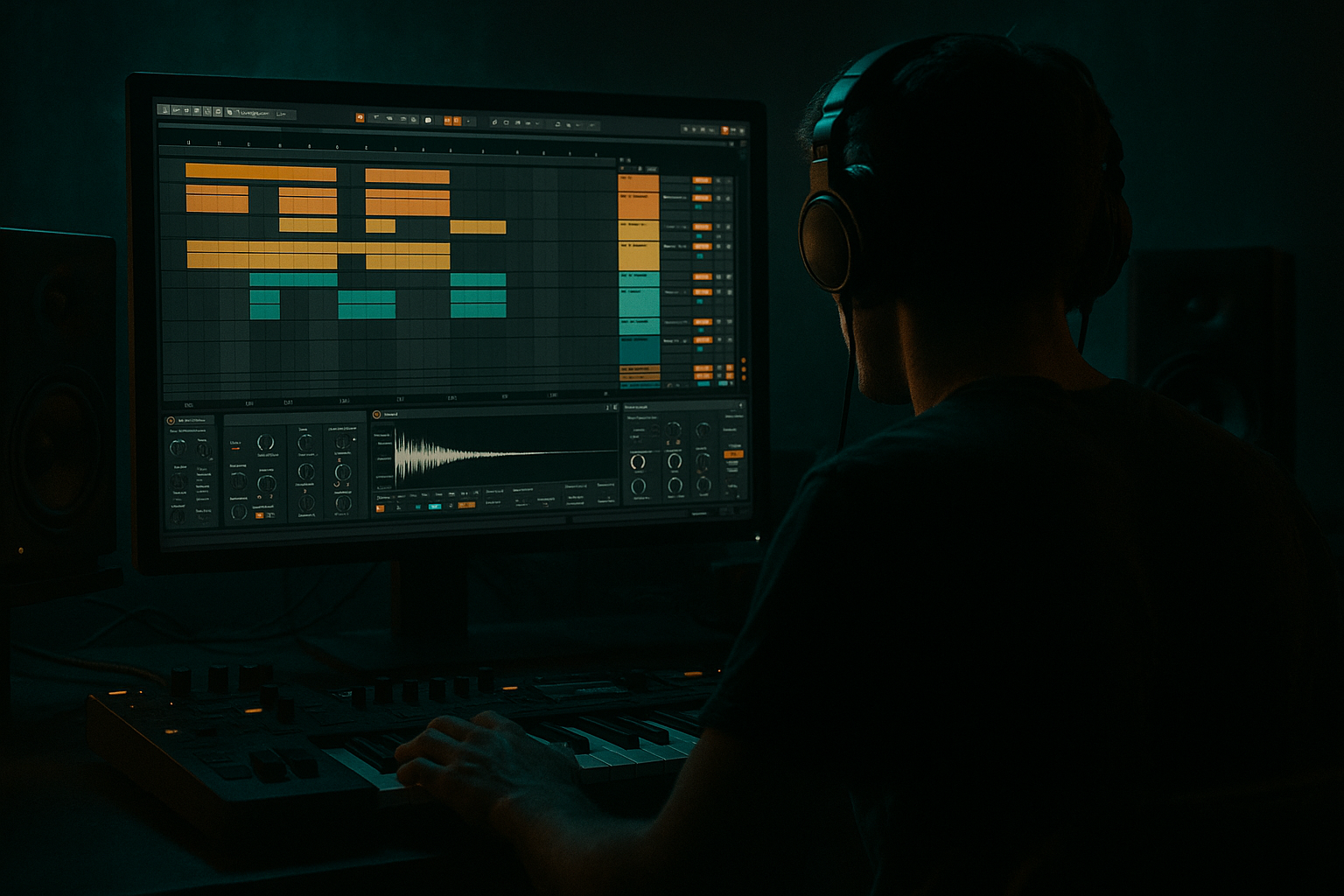
Main tutorial
Hat Shuffle Tightening for Oldskool DnB Vibes (Ableton Live) 🥁✨
1) Lesson overview
Oldskool jungle/DnB hats feel shuffled but still locked. The magic is in micro-timing, swing choices, layering, and tight dynamics—so the groove rolls without sounding sloppy.
In this lesson you’ll learn how to:
- Build a classic shuffled hat pattern (think ‘94–‘98 roller energy)
- Tighten it using Ableton’s Groove Pool, micro-nudging, and velocity shaping
- Use stock devices to control transients, glue, and stereo without losing grit
- Has 16th-note forward motion with swing on the off-grid hits
- Features two hat layers (tight “tick” + noisy/roomy layer)
- Stays tight via timing ranges, velocity ranges, and transient control
- Sits in a DnB mix at 170–175 BPM with room for breaks and bass
- Timing: `15–25` (adds swing without wrecking tightness)
- Velocity: `5–15` (small, human-ish changes)
- Random: `0–5` (keep low for DnB tightness)
- Base: `16` (important—this is hat territory)
- Don’t commit yet. First audition with your drums/bass.
- Once it feels right, right-click the clip → Commit Groove (this writes the timing into the notes).
- After committing, you can manually tighten the worst offenders.
- Make a repeating velocity contour:
- Keep it subtle. You want motion, not a “funk drummer” hat performance.
- Bars 1–4: tight layer only (build tension)
- Bars 5–8: add shuffle layer + slight ride/noise
- Bars 9–12: add occasional open hat on the last 1/8 before snare
- Bars 13–16: drop hats out for 1 beat before the drop (classic)
- Too much swing: If Timing is high (40+), hats start to feel late and lazy—bad for rolling DnB.
- Randomization overload: Random > 10 often makes hats feel “cheap humanize” instead of intentional groove.
- No tight reference layer: If you only have a loose hat, the whole top end smears.
- Ignoring velocity control: Without shaping, shuffle disappears when bass + breaks enter.
- Harsh top end: Over-bright hats fatigue fast at 174 BPM—control 8–12 kHz.
- Parallel grit: Create a return track with Saturator (Soft Clip on), EQ Eight, and Redux (very light). Send only the shuffle layer for crunchy movement.
- Noise hats: Layer subtle vinyl/noise hats and gate them with Gate (sidechain from the hat transient) for that dusty oldskool air without constant hiss.
- Stereo discipline: Keep the tight hat mostly mono, and let the noisy hat be slightly wide. This keeps the groove centered and aggressive.
- Sidechain clarity: If your hats fight the snare snap, use Compressor on hats with Sidechain from snare:
- Break synergy: If you’re using an Amen/think break, match hat swing to break feel—sometimes the “tight hat” is actually what makes the break sound tighter.
- Build two hat layers: tight grid + shuffly texture.
- Use Groove Pool for controlled swing, then commit and micro-tighten key notes.
- Tightness is timing + dynamics: shape velocities and compress/glue lightly.
- Keep hats clean in the lows, controlled in the highs, and arranged with classic drop/variation logic.
---
2) What you will build
A 2-bar hat loop that:
---
3) Step-by-step walkthrough
Step 0 — Session setup (foundation)
1. Set tempo to 174 BPM (classic roller zone).
2. Create a new MIDI track: `HATS`.
3. Drop a Drum Rack on it.
4. Load these samples (from your library or packs):
- Closed hat (short, bright) → “tick”
- Closed hat (noisier/roomier) → “shuffly layer”
- Optional: open hat (shortish) for occasional lifts
DnB mindset: you want a tight metronome layer + a vibe layer.
---
Step 1 — Program a clean “grid” hat base (the tight layer) 🎯
1. Create a 2-bar MIDI clip.
2. In the piano roll, place your tight closed hat on every 1/16.
3. Set initial velocities:
- Downbeats slightly stronger: ~90–100
- Other steps: ~60–80
4. Now remove a few hits to make space (important for oldskool feel):
- Try removing the 1/16 right before the snare (e.g., beat 2.4 and 4.4 in 4/4), depending on your snare placement.
Result: a steady, clean engine that can handle swing without falling apart.
---
Step 2 — Add the shuffle layer (the “push-pull” groove) 🌀
1. Duplicate the hat chain inside Drum Rack (or add a second pad with a different hat).
2. Program only some 1/16s for this layer—focus on the “in-between” steps:
- Common jungle shuffle points: the 3rd and 4th 1/16 of each beat (the “e-&-a” area).
3. Lower its velocity by default (~35–65) so it’s felt more than heard.
Why: If every hat is shuffled, nothing is shuffled. The shuffle layer gives contrast.
---
Step 3 — Use Groove Pool properly (swing + tighten) ✅
Ableton’s Groove Pool can add feel and tighten* by controlling randomization and commitment.
1. Open Groove Pool (`Cmd/Ctrl + Alt + G`).
2. Drag in a groove:
- Start with something like MPC 16 Swing 57–59 (or any subtle 16th swing groove you like).
3. Apply the groove to your MIDI clip.
Now set groove parameters (per clip):
🎛️ Key move: “Commit” selectively
---
Step 4 — Micro-tighten the groove (without killing it) 🔧
This is where intermediate producers level up: keep swing, reduce slop.
Method A: Note nudge + visual landmarks
1. In the MIDI clip, zoom in.
2. Identify the hats that feel late right before snares/kicks.
3. Nudge only those notes slightly earlier:
- Start with -3 ms to -8 ms (tiny moves matter at 174 BPM).
4. Keep the “groove notes” late-ish, but protect the snare lead-in.
Method B: Quantize settings (gentle correction)
1. Select only the busiest hats (usually the shuffle layer).
2. Use `Cmd/Ctrl + U` Quantize, but with:
- Quantize To: `1/16`
- Amount: `40–70%`
3. This pulls notes toward the grid while preserving some groove.
Rule of thumb: tighten transitions (into snare/kick), keep looseness in the middle.
---
Step 5 — Tighten dynamics (velocity shaping that screams oldskool) 📉
A lot of “tightness” is actually consistent transient energy.
Inside the MIDI clip:
- Beat 1: 90, 55, 70, 60
- Beat 2: 85, 50, 75, 55
Then add stock MIDI effects before Drum Rack:
1. Velocity (MIDI device)
- Mode: `Compress`
- Drive: `10–25`
- Out Hi: `95–110`
- Out Low: `35–50`
This narrows the dynamic range so the shuffle remains audible in a dense mix.
---
Step 6 — Transient control + glue (stock devices chain) 🧱
On the HATS track (after Drum Rack), use:
Device chain (solid starting point):
1. EQ Eight
- HP filter at 250–450 Hz (24 dB/oct) to remove box/rumble
- Small dip if harsh: 7–10 kHz by -1 to -3 dB (narrow-ish Q)
2. Drum Buss
- Drive: `2–8`
- Crunch: `0–10` (light)
- Transient: `+5 to +15` (adds “tick” definition)
- Boom: `0` (usually off for hats)
3. Glue Compressor
- Attack: `3 ms` (let transient through)
- Release: `Auto` or `0.1–0.3s`
- Ratio: `2:1`
- Aim for 1–2 dB gain reduction max
4. Optional: Utility
- If hats are too wide/phasey: reduce Width to 80–110%
- Or keep tight hat layer more mono by duplicating chain and narrowing it
🎯 Goal: hats feel “taped together” and consistent, not spiky and random.
---
Step 7 — Arrangement ideas (oldskool DnB context) 🧨
A tight hat shuffle really shines when you arrange it like jungle:
8–16 bar loop suggestion:
Automation tip: automate Drum Buss Drive or EQ Eight high shelf up slightly into fills.
---
4) Common mistakes 🚫
---
5) Pro tips for darker/heavier DnB 🖤
- Ratio `2:1`, Attack `1–3 ms`, Release `50–120 ms`, GR `1–3 dB`.
---
6) Mini practice exercise (15 minutes) ⏱️
1. Build a 2-bar 1/16 hat loop (tight layer).
2. Add a shuffle layer using only 8–12 notes total over 2 bars.
3. Apply Groove Pool swing:
- Timing `20`, Velocity `10`, Random `2`, Base `16`
4. Commit groove.
5. Manually nudge two notes that feel late before snares by -5 ms.
6. Add Drum Buss (Transient +10, Drive 5).
7. Bounce/export the loop and listen next to a reference (any classic jungle roller). Adjust Timing down if your hats drag.
---
7) Recap ✅
If you want, tell me what BPM and what break you’re using (Amen/Think/other), and I’ll suggest a specific swing amount + a 2-bar hat MIDI pattern that locks with it.

