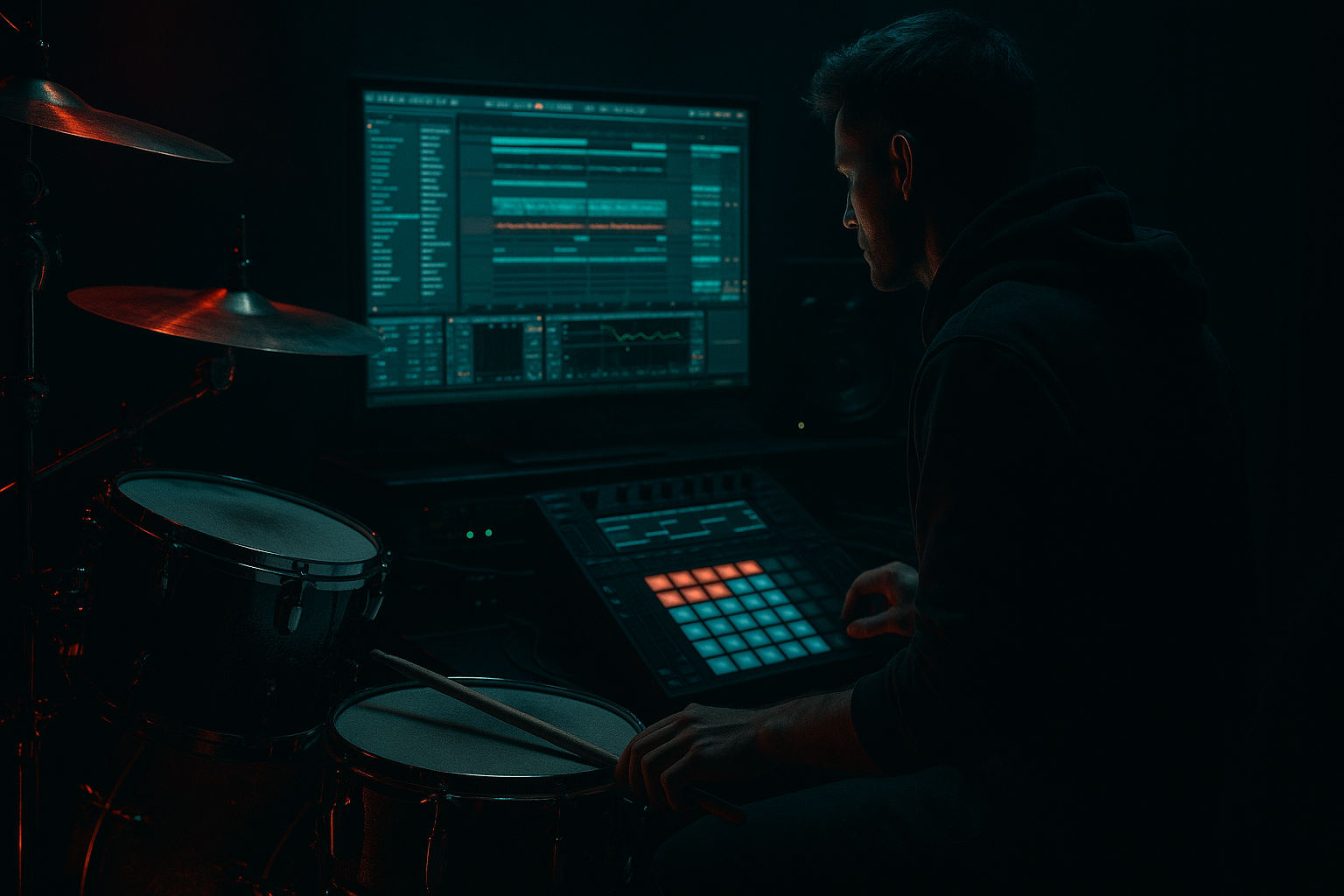
Main tutorial
Heatwave Transition Color Formula for VHS-Rave Color in Ableton Live 12
Oldskool jungle / DnB transition design for that sun-bleached, tape-warped rave energy 🌞📼
1. Lesson overview
In this lesson, we’re building a “heatwave transition color formula”: a repeatable Ableton Live 12 workflow for creating VHS-rave style transition moments in jungle / oldskool DnB.
The goal is not just to make things “effected” — it’s to create a scene change in color:
- from clean / dry / mechanical
- to hot, saturated, unstable, tape-warped, and hyped
- then back into the drop with momentum
- tape hiss
- hazy summer rave energy
- melted top end
- pitch drift
- filtered crowd-pressure
- rotating delay tails
- a slightly damaged VHS glow
- Auto Filter
- Echo
- Reverb
- Redux
- Saturator
- Roar
- Drum Buss
- Utility
- Shifter
- Frequency Shifter
- resampling workflows
- automation and arrangement shaping
- drum breaks
- atmospheres
- vocal snippets
- synth stabs
- bass transitions
- white noise risers
- turnaround fills
- warmth and heat from saturation
- VHS degradation from bit reduction / sample-rate reduction
- color bleed from modulation and filtering
- space from tempo-synced echo and short tape-style reverb
- motion from pitch drift and subtle detune
- pressure from transient shaping and controlled low-end
- end of 16-bar phrase
- last 4 bars before drop
- 2-bar “flash frame” fill
- breakdown into second drop
- call-and-response stop/start switch-ups
- shared transition processing
- quick automation of send amounts
- cohesive scene coloration
- processing a dedicated breakdown layer
- resampling and committing the result
- heavier manipulation and arrangement control
- use a Group Track for the actual transition section
- and a Return Track for shared space/damage FX
- chopped Amen or Think break fragments
- tom fills
- ride loops
- vocal “yeah” or “come on” hits
- stab chords
- noise sweeps
- synth bass reese fragments
- short rave piano or organ notes
- a 2-bar break loop
- a subtle pad or chord wash
- one vocal phrase
- one stab layer
- Gain: adjust so the chain hits the saturators nicely, not clipping wildly
- Width: 80–120% depending on source
- Bass Mono: use carefully, only if the source has low-end that needs tightening
- Drive: +3 to +9 dB
- Soft Clip: On
- Curve Type: Analog Clip or Soft Sine depending on source
- Output: compensate gain so the loudness stays useful
- thickened drums
- fuzzed transients
- more midrange presence
- Style: start with a warmer or dirtier mode
- Drive: moderate, then automate upward
- Tone/Filter: keep some high-end alive
- Dynamics: use lightly so the transients stay punchy
- Feedback/Color: add sparingly for smear and instability
- Drive: 10–25%
- Crunch: subtle; enough to roughen the break
- Boom: use carefully, especially if the source is already low-heavy
- Transients: slightly positive for snap, or slightly negative for smear
- Damp: tune to keep hats from getting painfully bright
- breakbeat density
- rounded punch
- a slightly “baked” texture that feels tape-adjacent
- chopped amen loops
- ghost snares
- percussion clusters
- Sync: 1/4, 1/8 dotted, or 1/16 depending on energy
- Feedback: 20–45%
- Filter: band-limit the repeats
- Modulation: add some wobble
- Noise: a little for tape flavor
- Character: darker or more degraded if the source is bright
- automate Echo send or mix up on the final 1–2 bars
- then cut it hard at the drop
- let the tail vanish or get ducked by the kick/bass
- Downsample: subtle to medium — don’t overdo it unless you want full lo-fi collapse
- Bit reduction: 12–8 bits for texture, lower for extreme effect
- Dry/Wet: keep it blended, not total destruction
- higher percussion elements
- vocal snippets
- noise sweeps
- selected stab layers
- Decay: 1.2–3.5 seconds depending on section
- Pre-delay: 10–30 ms
- Low Cut: high enough to protect the sub
- High Cut: tame the shimmer for a more dusty feel
- Size: medium to large, but not cathedral unless you want full euphoric wash
- vocal snippets
- pads
- one-shot stabs
- break fills
- reversed elements
- pitch wobble
- tape-stop style drift
- subtle detune movement
- Mode: frequency shifting or ring mod style depending on source
- Amount: very low to moderate
- Mix: keep it subtle
- automate during the transition only
- metallic sidebands
- unstable VHS “glitch color”
- moving stereo haze
- Fine: small shifts, not extreme
- Frequency: automate slowly or in a quick ramp
- Dry/Wet: blend carefully
- break fills
- vocal chops
- risers
- filtered chord stabs
- Filter cutoff rising or falling
- Saturator Drive
- Echo feedback
- Reverb dry/wet
- Redux downsample
- Shifter amount
- Utility width
- gain staging into the chain
- start filtered and narrow
- light saturation
- minimal echo
- open filter slightly
- increase Drive
- raise Echo feedback
- add Redux degradation
- widen stereo slightly
- push Reverb up
- taper low end
- peak the instability
- cut or snap to the drop
- rearrange it into custom fills
- create one-shot transition hit packs
- make a reverse pre-drop tail
- chop the “damage” into rhythmic material
- break loop begins getting filtered
- atmos widen
- vocal or stab appears briefly
- distortion increases
- echo becomes more obvious
- snare fills or break edits intensify
- everything narrows into tension
- reverb/echo tail gets bigger
- top-end becomes more broken and hissy
- cut low end
- add a quick fill or tape-stop style artifact
- slam into the drop
- hard contrast is everything
- dry punchy kick/snare
- clean sub
- the transition color disappears or is only hinted at in the background
- Roar
- Saturator with harder curve
- Pedal if you want a gnarlier overdrive flavor
- less nostalgic haze
- more scorched, industrial pressure
- Auto Filter
- band-pass around the mids
- slowly narrowing or opening the range
- 1/16 stutters
- reversed hits
- fill accents
- snare pickups
- an Amen break loop
- a vocal stab
- a dark pad or rave chord
- Utility
- Auto Filter
- Saturator
- Echo
- Redux
- Reverb
- filter cutoff rising
- saturator drive increasing
- echo feedback rising in bars 3–4
- Redux downsample slightly increasing in bar 4
- reverb wet up briefly then cut
- 2 reversed hits
- 1 stutter fill
- 1 tail before the drop
- version A: raw transition
- version B: resampled and edited transition
- tape heat
- rave nostalgia
- tension building
- then a hard, clean impact into the drop
- Utility for control
- Auto Filter for movement
- Saturator / Roar for heat
- Drum Buss for break glue
- Echo for VHS smear
- Redux for tape damage
- Reverb for haze
- Shifter / Frequency Shifter for instability
- build pressure
- color the phrase
- protect the low end
- and make the drop feel bigger by contrast 🎛️🔥
Think:
This is especially useful in 32-bar to 8-bar transition sections, breakdown lifts, pre-drop ramps, and “memory flash” moments inside a jungle tune.
We’ll focus on practical Ableton Live 12 tools:
---
2. What you will build
You’ll create a transition bus that can be dropped onto:
The finished sound will have:
Use case in arrangement
For a jungle / DnB tune, this works best at:
---
3. Step-by-step walkthrough
Step 1: Build a dedicated transition return or group
You have two strong options:
Option A: Transition return track
Create a Return Track called HEAT VHS and send selected elements into it.
Best for:
Option B: Transition group track
Group your transition elements into a Group Track called TRANS COLOR.
Best for:
Recommended approach
For advanced DnB work:
That gives you both commitment and flexibility.
---
Step 2: Choose the source material
The VHS-rave color formula works best when the source already has energy.
Good sources:
Best source choice for jungle flavor
Use:
That combination gives you rhythm, harmony, and texture — perfect for a transition that feels alive.
---
Step 3: Set up the core device chain
On your TRANS COLOR group, start with this chain:
1. Utility
2. Auto Filter
3. Saturator or Roar
4. Drum Buss
5. Echo
6. Redux
7. Reverb
8. Shifter or Frequency Shifter
You won’t always need every device, but this gives you the full “formula.”
---
Step 4: Shape the level with Utility
Start with Utility first.
Settings:
Why this matters
VHS color gets messy fast if the chain is overloaded in the wrong place. Control the input before you distort it.
---
Step 5: Create the heat with Saturator or Roar
This is the first “temperature” stage.
Option A: Saturator
Use Saturator for simple, controllable warmth.
#### Suggested settings:
This gives you:
Option B: Roar
Use Roar if you want a more animated, dangerous VHS heat.
#### Suggested settings:
Pro move
Automate Drive up over 4 or 8 bars, then pull it back right before the drop.
That creates the feeling of tape overheating before impact.
---
Step 6: Add drum glue with Drum Buss
Drum Buss is perfect for oldskool break-driven transitions.
Suggested settings:
Why it works
Drum Buss adds:
For jungle, this is especially good on:
---
Step 7: Build the VHS smear with Echo
Echo is your movement and depth layer.
Suggested settings:
Practical DnB use
For a transition into a drop:
VHS-rave trick
Use a short, slightly unstable repeat on a vocal shout or stab.
This gives instant “memory smear” energy without washing out the whole arrangement.
---
Step 8: Add controlled degradation with Redux
Redux is the “damaged tape” layer.
Suggested settings:
Best use
Apply Redux to:
Important
Do not crush the sub-bass with Redux unless the whole point is a broken-radio breakdown.
In DnB, keep the low-end clean and let the VHS treatment live in the mids and highs.
---
Step 9: Create the hazy atmosphere with Reverb
Use Reverb to create the “heat haze” dimension.
Suggested settings:
Good technique
Put a high-pass filter before Reverb or use the device’s low cut aggressively.
In jungle and DnB, cloudy low-mid reverb can destroy the kick/snare pressure.
Use it on:
---
Step 10: Add unstable motion with Shifter or Frequency Shifter
This is where it gets weird in a good way.
Option A: Shifter
Use Shifter for:
#### Suggested settings:
Option B: Frequency Shifter
Great for:
#### Suggested settings:
DnB usage
This works beautifully on:
A tiny amount goes a long way.
---
Step 11: Automate the color like a cinematic scene change
The biggest mistake is leaving the effects static.
Automate these parameters over 4 or 8 bars:
Example 4-bar transition curve
Bar 1
Bar 2
Bar 3
Bar 4
This creates a strong “heatwave rising” arc.
---
Step 12: Resample the result for maximum control
This is one of the best advanced moves in Ableton Live.
Workflow:
1. Route your TRANS COLOR group to a new audio track
2. Record the transition output
3. Edit the printed audio
4. Reverse sections, slice, or stutter them
5. Bounce again if needed
Why resample?
Because once the texture is printed, you can:
For jungle, this is gold. A printed transition can become part of the groove instead of just an effect.
---
Step 13: Arrange it like a DJ-style energy lift
A strong oldskool DnB transition usually follows this structure:
8 bars before drop
4 bars before drop
2 bars before drop
Final bar
Drop
---
4. Common mistakes
1. Overprocessing the low end
If you VHS-crush the sub, your drop will lose weight.
Fix:
Keep the transition damage mostly above ~150 Hz, or split the source into bands.
---
2. Too much reverb everywhere
This turns a DnB transition into mush.
Fix:
Use shorter decays, more pre-delay, and high-pass the reverb return.
---
3. No automation
Static FX don’t feel like a transition.
Fix:
Automate at least 3 key parameters over time.
---
4. Crushing the full mix with Redux
This can kill impact and make the drop feel weak.
Fix:
Use Redux as a texture layer, not a master destroyer.
---
5. Not leaving room for the kick/snare
If the transition is too dense, the groove disappears.
Fix:
Pull energy down in the final half-bar before the drop and let the drum arrangement breathe.
---
5. Pro tips for darker/heavier DnB
If you want the same formula but darker and heavier, do this:
Tip 1: Replace warm saturation with hard edge
Use:
Aim for:
---
Tip 2: Use band-pass filtering for tension
Instead of a wide open filter sweep, try:
This creates a claustrophobic “locked tunnel” feel before the drop.
---
Tip 3: Duck the transition with the kick
Use Compressor or Glue Compressor sidechained from the kick to the transition bus.
This keeps the transition animated without smearing the downbeat.
---
Tip 4: Add movement with a tiny LFO feel
Use Auto Filter with subtle resonance modulation or automate cutoff in tiny increments.
Dark DnB benefits from unstable micro-motion more than huge sweeping FX.
---
Tip 5: Print distortion and edit it like drums
For heavier tunes, resample your transition and slice it into:
This makes the transition feel integrated with the drum programming.
---
6. Mini practice exercise
Exercise: Build a 4-bar VHS-rave transition into a jungle drop
#### Step 1
Load:
#### Step 2
Put them in a group called TRANS COLOR
#### Step 3
Add this chain:
#### Step 4
Automate over 4 bars:
#### Step 5
Resample the result to audio
#### Step 6
Slice the resampled clip into:
#### Step 7
Drop into your arrangement and compare:
Goal
Make the transition feel like:
---
7. Recap
The heatwave transition color formula is about building a sonic scene change in Ableton Live 12 for jungle / oldskool DnB.
Core recipe:
The real secret:
Don’t just add effects — automate the emotional temperature of the arrangement.
In DnB, transitions should:
If you want, I can also turn this into:
1. a rack preset chain for Ableton Live 12, or
2. a 32-bar arrangement blueprint for a full jungle/DnB tune.

