Main tutorial
1. Lesson Overview
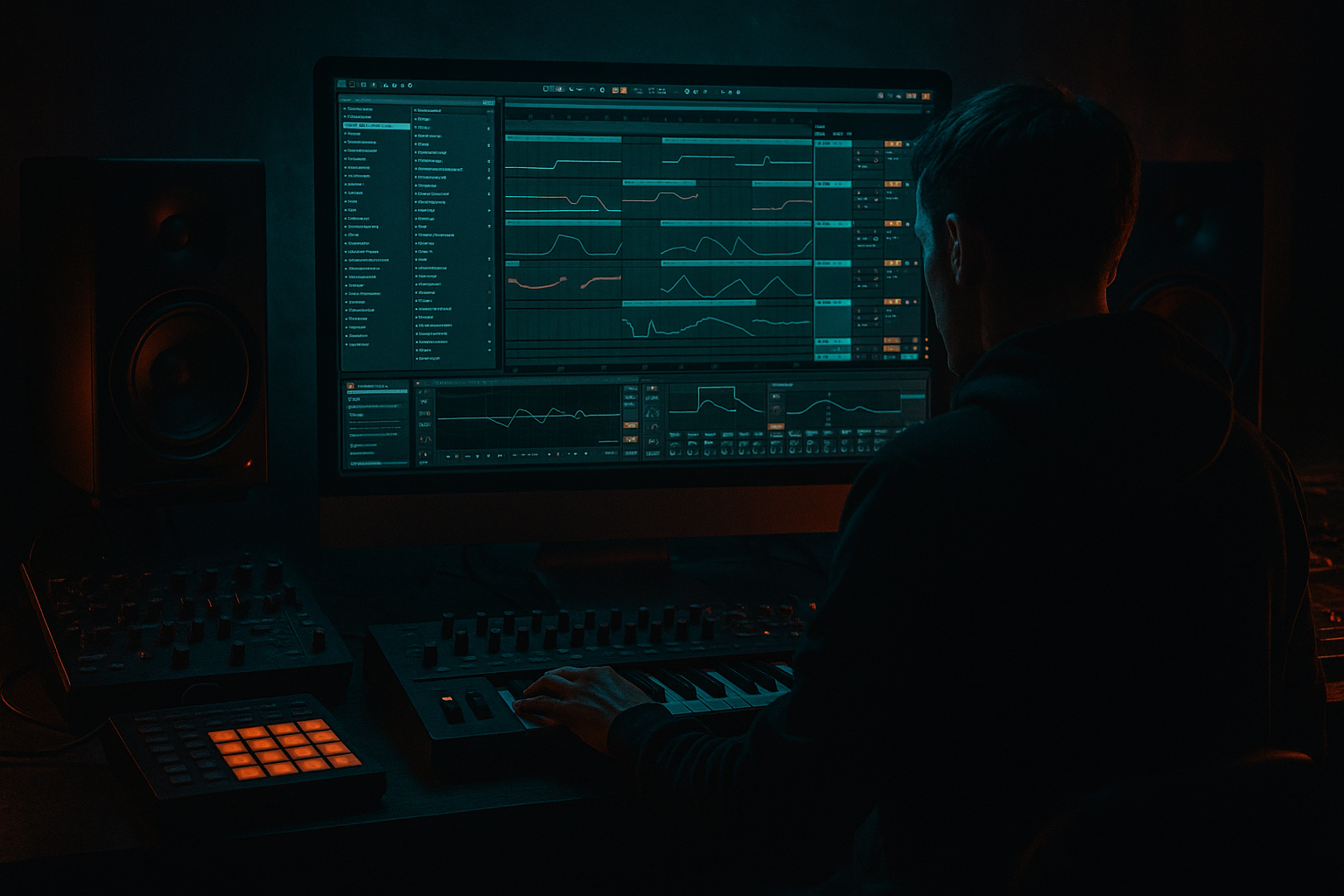
This High Contrast masterclass: shape the drop impact in Ableton Live 12 for deep jungle atmosphere is an advanced workflow lesson that focuses on sculpting a powerful, yet roomy and textural drop for Drum & Bass. We’ll work only with Ableton Live 12 stock devices and routing techniques to: tighten transients, preserve/sub sculpt the low end, create deep jungle atmosphere with spatial and spectral movement, and deliver a punchy, musical hit at the drop that sits in the mix without collision. Expect group routing, parallel processing chains, mid/side EQ, multiband control, sidechain sculpting, creative send-return atmospheres, and detailed automation that together produce a polished drop impact.
2. What You Will Build
- A Drop Bus architecture (Drums + Bass routed to a processing group) with parallel “slam” and “air” chains.
- A multiband, mid/side master subroutine for the drop that keeps sub mono, widens highs, and keeps energy balanced.
- A set of atmosphere returns (Hybrid Reverb + Grain Delay + Saturation) designed for deep jungle textures and automated to breathe during the drop.
- Automation and sidechain shapes that create contrast between the buildup and the drop (tightened transient punch at the hit, then textural expansion afterward).
- Reusable Live Rack chains and macros for rapid iteration.
- Over-saturating the entire drum/bass bus: slam chain should be parallel and high-passed—if you saturate everything you’ll muddy the low end.
- Widening subs: applying Utility width to the whole bus instead of only side/high content creates phase issues and energy loss on club systems; keep sub mono.
- Heavy reverb on bass: sending bass to reverb without low-cut will smear punch. Always high-pass returns or use EQ Eight to remove <200–300 Hz.
- Long reverb tails at the drop without gating: tails can wash the drop out. Automate returns or gate.
- Over-automating small parameters that create jitter: keep automation curves deliberate and musical (short attack-like ramps for impact, longer curves for atmosphere).
- Ignoring pre-delay: without pre-delay your reverb will steal transient clarity.
- Save your DROP_BUS rack as a preset with macros for: SLAM Amount, AIR Width, DRUM BUS Transient, SUB Duck Amount, R_AIR Send. Reuse across projects and tweak quickly.
- Use a transient “hit” clip (single short kick or snare) on a muted track routed to sidechains for consistent ducking across projects instead of linking to an existing kick.
- Use clip-based automation (envelope in clip view) for tiny “attack” boosts—finer resolution than drawing in arrangement sometimes.
- For jungle texture, automate small randomization (use LFO device in Max/Live? — if not available, automate small offsets) to R_GRAIN parameters to keep the tail alive.
- When increasing width, check monos compatibility often: flip Utility to 0% to ensure mappings still translate.
- Use Hybrid Reverb's Mod and Diffuse to add shimmer without excessive decay; pair with a small EQ cut at 400–600 Hz to avoid boxiness.
- To create “space that breathes,” automate a subtle low-mid lift in the first 1–2 beats after the hit, then gradually bring it down to create perceived movement.
- Bars 1–8: Buildup (tight, narrow).
- Bars 9 (the drop): Instant actions (0–1/4 bar)
- Bars 9–16: Let texture breathe with R_GRAIN engaged at a low steady send and reduce SLAM gradually.
3. Step-by-Step Walkthrough
Prereqs: a Drum Rack or clip-based break, bass track (sub + mid-bass), atmospheric pads/noise, and a prepared arrangement where the drop starts at a bar boundary.
A. Prepare routing and groups
1. Create a group called DROP_BUS. Route all drum channels (breaks, hats, percussion) and the bass channels (sub + mid-bass) into DROP_BUS. Keep individual drum channels inside the group so you can parallel-process inside the group.
2. Inside DROP_BUS, create three chains (use Instrument/Audio Effect Rack’s chains or separate tracks within the group if you prefer):
- DRY (clean drums/bass)
- SLAM (parallel saturated/compressed layer)
- AIR (transient/high-frequency enhancement & reverb returns)
3. Create two Return tracks:
- R_AIR (Hybrid Reverb + EQ Eight)
- R_GRAIN (Grain Delay + Frequency Shifter)
B. Basic glue and transient emphasis
4. On DROP_BUS (master chain), insert Drum Buss (stock) first:
- Drive: 2–5% (small)
- Dynamics: 0–6% (very subtle)
- Damp: 12 o’clock
- Transient: start at 0% for buildup, automate to +25–40% at the drop transient. (This gives a controlled transient emphasis similar to High Contrast punch without overdoing distortion.)
5. After Drum Buss, add Glue Compressor for bus cohesion:
- Ratio 4:1
- Attack 3–10 ms (let initial transient through but catch the rest)
- Release 100–250 ms (tempo-sync release if needed)
- Threshold to achieve ~2–4 dB gain reduction on the loudest hits.
C. Parallel Slam chain (inside DROP_BUS)
6. In the SLAM chain:
- Add Saturator (Analog Clip) with Drive 3–6 dB, Color Warmth.
- Add Overdrive with Drive low, Tone adjusted to taste.
- Add EQ Eight (low cut at 40 Hz) to remove low end from the slam chain.
- Add Compressor (fast attack ~1–3 ms, release 40–80 ms, ratio 6:1) in the slam chain for heavy transient control.
- Blend SLAM under the DRY chain — start with SLAM at -10 to -6 dB relative to DRY and automate a +3–6 dB macro at the drop for extra “slam”.
D. Air and high-frequency shaping
7. AIR chain: insert an EQ Eight in Mid/Side mode (switch to M/S view in EQ Eight):
- In Mid: low cut at 30–40 Hz, slight dip 200–400 Hz if muddy.
- In Side: gentle high-shelf boost +2–3 dB above 6–8 kHz to widen cymbals/higher detail.
- Follow with a Utility for width control; default 100% in buildup, automate to +110–160% width at the drop (careful; over-widening can phase).
8. Send some of AIR chain output to R_AIR at drop onset (we’ll automate send later).
E. Sub and Mid-bass management
9. On SUB Bass track, insert EQ Eight first:
- Low shelf or low cut to remove anything below 20 Hz.
- Slight dip around 200–500 Hz if overlapping the mid-bass.
10. Add Compressor with sidechain input from a dedicated “Kick/Hit” transient track (create a tiny transient clip that represents the drop hit). Configure sidechain like this:
- Detector: Peak
- Attack: 0.5–2 ms
- Release: 60–120 ms
- Ratio: 3–6:1
- Threshold so the sub ducks 6–10 dB on the hit transient (this makes the hit feel clearer while keeping subs present).
F. Atmosphere returns and tails
11. Configure R_AIR (Hybrid Reverb):
- PreDelay 20–40 ms (helps separate reverb from transient).
- Early/Late balance: set to 30/70 for space.
- Size: 40–60% for dense space.
- Modulation: small amount to add movement.
- High cut on the reverb tail at ~8–10 kHz to keep sizzle defined and not boomy.
12. R_GRAIN (Grain Delay + Frequency Shifter):
- Grain Delay: Granularity low/medium, Time synced to 1/16 or 1/8 dotted for rhythmic texture, Feedback around 15–25%.
- Dry/Wet around 20–40% (use sends).
- Add Frequency Shifter after Grain Delay with small modulation to create jungle texture.
13. Put Gate (Compressor with sidechain or Gate device) after each return if you want to chop tails tightly in the buildup. Automate to open at drop.
G. Automation to shape the drop contrast
14. Buildup tightening (bars before drop):
- Lower DROP_BUS Macro “SLAM Blend” to -6 to -10 dB.
- Narrow width (Utility Width 70–85%) on AIR chain to make the mix feel focused.
- Apply a low-pass (Auto Filter with 12 dB/oct) to R_AIR with cutoff at 5–8 kHz to keep the atmosphere subdued.
- Slightly increase reverb dampening / reduce decay to keep energy in check.
15. Drop instant (first 1/4–1/2 bar):
- Automate Drum Buss Transient +25–40% immediately at the hit.
- Open SLAM Blend quickly (+3–6 dB) with a fast transient-like envelope (use clip automation or a short envelope in the Arrangement).
- On SUB Bass, momentary ducking via sidechain is already set; add a 3–8 ms transient boost to mid bass with transient emphasis (EQ boost 2–5 kHz + compressor attack quick) to add slap.
- Increase AIR chain Utility width to +110–140% over 0.25–0.5s for quick spatial expansion.
- Send to R_AIR and R_GRAIN: bring send knobs up rapidly (0.1–0.5s) for a split-second “textural bloom” and then settle to a lower sustained send level.
16. Post-drop control (1/2–2 bars after drop):
- Automate reverb decay/dry-wet back down (or gate reverb tails using a transient gate) to avoid smear.
- Lower SLAM after 1 bar to avoid fatigue; crossfade into DRY for musical movement.
- Use Multiband Dynamics on DROP_BUS or Master to control tonal balance across the first phrase: compress mid/high slightly more than sub, but keep sub mainly uncompressed to preserve power.
H. Master/Final touches
17. Insert EQ Eight on Master in M/S mode:
- Mid: High-pass at 18–25 Hz.
- Side: slight high-shelf boost 3 dB above 6–8 kHz.
- Mid: tame 300–600 Hz if muddy (-1.5 to -3 dB).
18. Add Multiband Dynamics on Master (gentle):
- Low band threshold such that there’s minimal gain reduction (1–2 dB) except on the hit if you want more control.
- Mid and High bands more active to glue the transient energy.
19. Limiter last with a ceiling set to taste (-0.3 dB), but use sparingly to keep dynamic impact.
4. Common Mistakes
5. Pro Tips
6. Mini Practice Exercise
Objective: Build a 16-bar drop loop demonstrating the techniques.
- Set DROP_BUS with Drum Buss transient at 0, SLAM at -10 dB, AIR width 80%.
- R_AIR sends subdued, Grain Delay off.
- Automate Drum Buss Transient to +35% immediately at bar 9.
- Automate SLAM macro to +6 dB for 0.5s, then fade to +0 dB over 1 bar.
- Sub Bass sidechain ducks 8–10 dB on the first hit using Compressor sidechain.
- AIR Utility width jumps to 125% over 0.25s; send to R_AIR jumps +8 dB and then settles.
Deliverables: Export the 16-bar loop and compare A/B with and without SLAM & AIR automation to hear the impact.
7. Recap
This High Contrast masterclass: shape the drop impact in Ableton Live 12 for deep jungle atmosphere showed a concrete, stock-device-centered workflow to produce a punchy, musical drop. We covered group routing, parallel slam processing, Drum Buss transient control, mid/side EQ for airy highs while keeping subs mono, reverb and grain-delay returns tailored for jungle texture, and precise automation (instant transient boosts + atmospheric blooms). Use saved Racks and a transient hit clip for consistent results across sessions. Practice the mini exercise to internalize the automation timing and balance between slam and atmosphere — that contrast is what makes a drop hit emotionally and technically in Drum & Bass.

