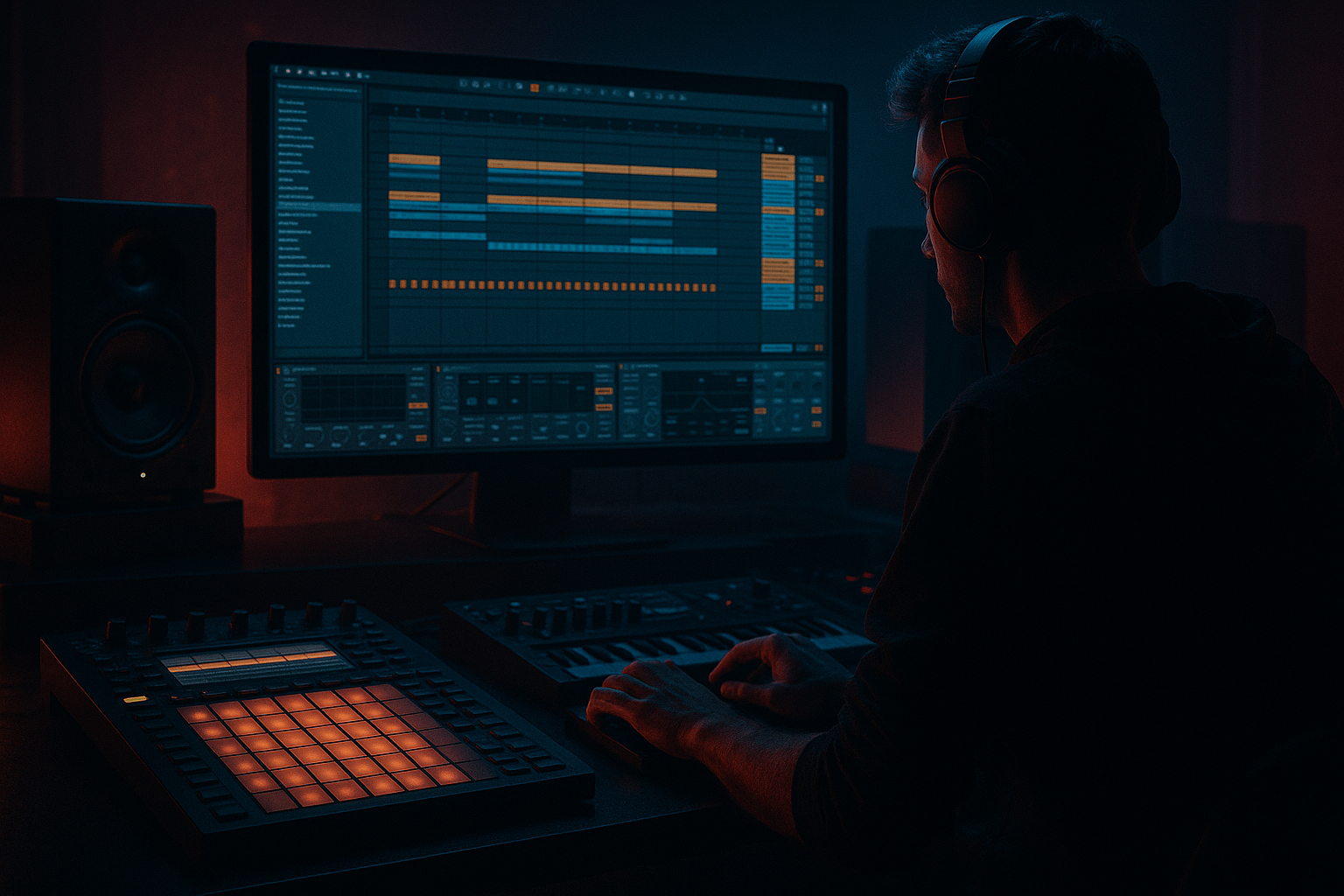
Main tutorial
```markdown
Hot-swap Workflows Masterclass (Session View) — Advanced DnB in Ableton Live ⚡🥁
1. Lesson overview
Hot-swapping in Ableton Live is one of the fastest ways to audition sounds, swap samples, replace devices, and try alternate processing chains without breaking your momentum. In drum and bass—where micro-decisions on kick/snare selection, break edits, bass timbre, and FX chains make or break the groove—hot-swap becomes a high-speed sound design and arrangement engine, especially in Session View.
In this lesson you’ll build a Session View performance + production template designed for rolling DnB/jungle, using hot-swap to:
- audition kicks/snares/hats across curated folders,
- swap breakbeat slices while preserving timing,
- replace bass synths inside a rack without losing MIDI,
- A/B processing chains (clean vs heavy) instantly,
- print variations into Arrangement View for fast arrangement.
- Drums Group: Kick, Snare, Hats, Breaks (each with hot-swappable sample sources + macro-controlled processing)
- Bass Group: Sub + Mid Reece (hot-swappable instruments and/or wavetables inside racks)
- FX/Atmos: One-shot risers, impacts, and noise beds
- “Swap Lanes”: Duplicate scenes for A/B variations (Drop A / Drop B / Fill / Half-time)
- A hot-swap-ready rack system: consistent routing, consistent levels, fast auditioning.
- EQ Eight
- Saturator
- Drum Buss
- Utility
- Create two snare layers inside the rack:
- Put an EQ Eight on each layer to band-limit them.
- Hot-swap the Top layer rapidly to find the perfect crack without losing your body weight.
- In the new Drum Rack, click the sample inside one of the slice pads (Simpler).
- Hit Hot-Swap and replace with a different break slice source only if you want chaos.
- Keep the slice MIDI pattern.
- Swap the original audio clip before slicing:
- Save a “Break Slice Rack” preset with your preferred:
- Then for each new break: drop loop → slice → your rack already has the sound.
- Glue Compressor
- EQ Eight
- Saturator (gentle) to unify slices
- Duplicate a scene (Cmd/Ctrl-D).
- In the duplicated scene:
- Now you have instant A/B without touching Arrangement.
- Click the instrument device in the active chain (e.g., Wavetable).
- Hit Hot-Swap and replace with another instrument preset (or device).
- Your MIDI + rack macros remain stable.
- Clean
- Crunch
- Destroy 😈
- Macro 1: Chain Selector (Clean/Crunch/Destroy)
- Macro 2: “Air” shelf gain (EQ Eight)
- Macro 3: “Punch” (Drum Buss Transients / Drive)
- Save multiple versions of this rack (A, B, C).
- Hot-swap the entire rack on the drum group bus to audition different “mix philosophies” instantly.
- Hot-swapping without level matching → you choose louder samples, not better ones.
- Warp settings inconsistent across loops → groove collapses when swapping breaks.
- No consistent processing context → every swap feels “better/worse” due to chain differences.
- Over-hot-swapping mid-session → decision paralysis.
- Sub and mid bass not separated → swapping mid destroys low end.
- Make “darkness” a macro, not a mood:
- Break “age” control:
- Parallel distortion on snares:
- Reese width management:
- Scene-based “pressure ramps”:
- Use Session View as a high-speed audition and variation engine for DnB.
- Keep comparisons fair by maintaining consistent processing chains and stable levels.
- Hot-swap is most powerful when paired with:
- Record your best decisions into Arrangement and commit.
---
2. What you will build
A Session View set with:
Target vibe: rolling, techy, dark DnB at 174 BPM, with a sprinkle of jungle break energy. 🏎️
---
3. Step-by-step walkthrough
Step 0 — Pre-flight: set up for speed
1. Set tempo: `174 BPM`.
2. Warp mode defaults (important for hot-swap consistency):
- For drums/one-shots: Beats (Preserve = Transients, 1/16 or 1/8 depending on material).
- For breaks: Complex Pro is not ideal for drums; prefer Beats or Tones for certain textures. Most DnB breaks = Beats.
3. Turn on the Browser preview and make sure you can audition quickly:
- Headphone icon (Preview) ON
- Set preview volume comfortable (not blasting).
Mindset: Hot-swap is only “fast” if your gain staging and clip timing are stable. We’ll build that in.
---
Step 1 — Build a hot-swap Kick track (Session View)
1. Create a MIDI track: `Kick`.
2. Drop in a Drum Rack.
3. On pad C1, load a solid kick sample.
4. Create a 1-bar MIDI clip with a classic DnB pulse:
- Hits on 1 and “&” of 2 (typical two-step foundation).
5. Hot-swap workflow:
- Click the kick sample in the pad’s Simpler.
- Hit Hot-Swap (two arrows icon).
- In the Browser, navigate your curated kick folder.
- Use arrow keys to browse; hit Enter to load.
Pro structure tip: Keep your kick samples normalized in perceived loudness (or at least grouped by “punchy / subby / clipped”) so swapping doesn’t destroy your balance.
Add a “Kick Processing” chain (stock devices):
Inside the Drum Rack, on the kick pad chain:
- HP at ~`25–30 Hz` (gentle)
- small cut `200–350 Hz` if boxy
- Mode: Soft Sine or Analog Clip
- Drive: `2–6 dB` (DnB kick presence)
- Output: match level
- Drive `5–20%` (taste)
- Boom: OFF or very subtle (DnB kick usually needs tight low end)
- Width: `0%` (mono low end discipline)
Now when you hot-swap the kick, the processing stays constant, so you’re comparing the sample, not the chain.
---
Step 2 — Hot-swap Snare while preserving “DnB snap”
1. Create MIDI track: `Snare`.
2. Drum Rack again (or a single Simpler if you prefer).
3. Place snare on 2 and 4.
4. Add a snare transient + body chain:
- EQ Eight
- HP `~120 Hz`
- notch harshness `~3–5 kHz` if needed
- gentle shelf up `8–12 kHz` for air (optional)
- Saturator (Drive `1–4 dB`)
- Transient shaping with Drum Buss
- Transients `+10 to +30`
- Drive to taste
Hot-swap trick (advanced):
- Snare Body (200 Hz–2 kHz focus)
- Snare Top (2 kHz–12 kHz focus)
---
Step 3 — Breakbeat lane: hot-swap breaks without losing groove
This is where Session View shines for jungle flavor. 🧨
1. Create an Audio track: `Breaks`.
2. Drag in a break loop (Amen, Think, Funky Drummer, etc.).
3. Set Warp: ON, Mode: Beats, Preserve: Transients, `1/16`.
4. Right-click clip → Slice to New MIDI Track…
- Slice by: Transient
- Create: Drum Rack
- Warp Slices: ON
Now you have a MIDI-controlled break rack, which is perfect for hot-swapping.
Hot-swap workflow for breaks:
Better method (consistent swapping):
- Duplicate the break clip slot (Cmd/Ctrl-D).
- Hot-swap the whole loop in the slot.
- Re-slice if needed.
Speed hack (template approach):
- pad processing
- choke groups (for tight hats)
- bus compression
Break bus processing (stock):
On the Break track (or group bus):
- Attack `3–10 ms`
- Release `Auto` or `0.1–0.3 s`
- Threshold for `1–3 dB` GR
- tame harshness `~6–8 kHz` if needed
- small dip `~300–500 Hz` if muddy
---
Step 4 — Session View “Scenes” for drop variations (hot-swap playground)
Create scenes like:
1. `Intro - hats + atmos`
2. `Build - add break ghost`
3. `Drop A - clean drums`
4. `Drop A Fill - 1 bar edit`
5. `Drop B - heavier snare + alt break`
6. `Half-time - stomp`
7. `Outro - strip down`
How hot-swap fits:
- hot-swap snare top
- hot-swap break loop
- hot-swap hat sample
---
Step 5 — Bass: hot-swap instruments while keeping MIDI + macros
This is the “pro” move for DnB: keep the same MIDI but audition different bass engines.
#### Option A: Instrument Rack with chain selector (best for hot-swapping)
1. Create MIDI track: `Mid Bass`.
2. Drop an Instrument Rack.
3. Create 3 chains:
- Chain 1: Wavetable (Reece)
- Chain 2: Operator (FM growl)
- Chain 3: Analog (simple saw layer)
4. Map Chain Selector to Macro 1 (0–127).
5. Put your processing after the instrument (inside the rack, after chains) so it stays consistent:
- EQ Eight (HP around `~80–120 Hz` to leave room for sub)
- Amp (tighten, add aggression)
- Saturator
- Multiband Dynamics (careful; use as tone control, not “fix everything”)
- Auto Filter mapped to Macro 2 (movement)
Hot-swap workflow:
#### Sub Bass track (separate!)
1. New MIDI track: `Sub`.
2. Operator:
- Osc A: Sine
- Add subtle Drive or Saturator
3. Utility width `0%`.
4. Sidechain it to the kick (Glue Compressor sidechain or Compressor).
Why separate? Hot-swapping mid bass should never ruin sub stability.
---
Step 6 — Hot-swap FX chains using Audio Effect Rack presets
Create an Audio Effect Rack called “DnB Drum Smash” with 3 chains:
- EQ Eight + light Glue
- Saturator + Drum Buss + EQ
- Overdrive → Roar (if available) / Saturator (heavy) → EQ Eight → Limiter (safety)
Map:
Hot-swap workflow:
---
Step 7 — Print your best swaps into Arrangement fast
Session View is for auditioning + performance decisions. Arrangement is for commitment.
Workflow:
1. Arm global record.
2. Launch scenes in order: Intro → Build → Drop A → Drop B → Half-time.
3. Record your performance into Arrangement.
4. Now “commit edits”:
- Consolidate (Cmd/Ctrl-J) key sections
- Freeze/Flatten heavy bass tracks if CPU spikes
- Replace any placeholder clips with final hot-swap winners
---
4. Common mistakes
- Fix: add Utility/limiting safety and keep meters honest.
- Fix: standardize Warp mode for breaks (usually Beats).
- Fix: process on the pad/track consistently, then swap sources.
- Fix: set a timer: 5 minutes to audition, then commit.
- Fix: separate tracks, mono sub, sidechain always.
---
5. Pro tips for darker/heavier DnB 🖤
- Map a low-pass (Auto Filter) + saturation drive to one macro on bass group.
- Add Redux (very light) or Saturator + EQ Eight (roll highs) on breaks to push jungle grit.
- Create a return track “Snare Trash”: Overdrive/Saturator + EQ (band-pass 1–6 kHz) + reverb tiny.
- Send snare selectively in different scenes.
- Keep reese wide above ~200 Hz only:
- Use EQ Eight M/S (or split bands via racks) + Utility width on high band.
- In Session View, automate clip envelopes (filter cutoff, reverb send) per scene so the drop feels like it “locks in.”
---
6. Mini practice exercise (15 minutes) ⏱️
Goal: create 3 drop variants using only hot-swap + scene duplication.
1. Build a basic Drop scene with:
- Kick, Snare, Hats, Breaks, Sub, Mid Bass
2. Duplicate the Drop scene twice:
- `Drop A` (clean)
- `Drop B` (heavier)
- `Drop C` (jungle twist)
3. Constraints:
- You may only change sound sources using Hot-Swap (no new MIDI patterns).
- You may adjust only 3 macros total across the whole set.
4. Record launching Drop A → Drop B → Drop C into Arrangement.
5. Listen back and choose the best 8 bars from each—mark them with locators.
---
7. Recap ✅
- Drum Rack pad-level chains (kick/snare consistency)
- Break slicing templates (jungle flavor at speed)
- Instrument Racks with Chain Selector (swap bass engines without losing MIDI)
- Scene duplication for A/B/C drop versions
If you want, tell me what style you’re aiming for (liquid, neuro, jump-up, jungle) and what your current bass tools are (Wavetable/Operator/3rd party), and I’ll tailor a hot-swap template layout specifically for your sound.
```

