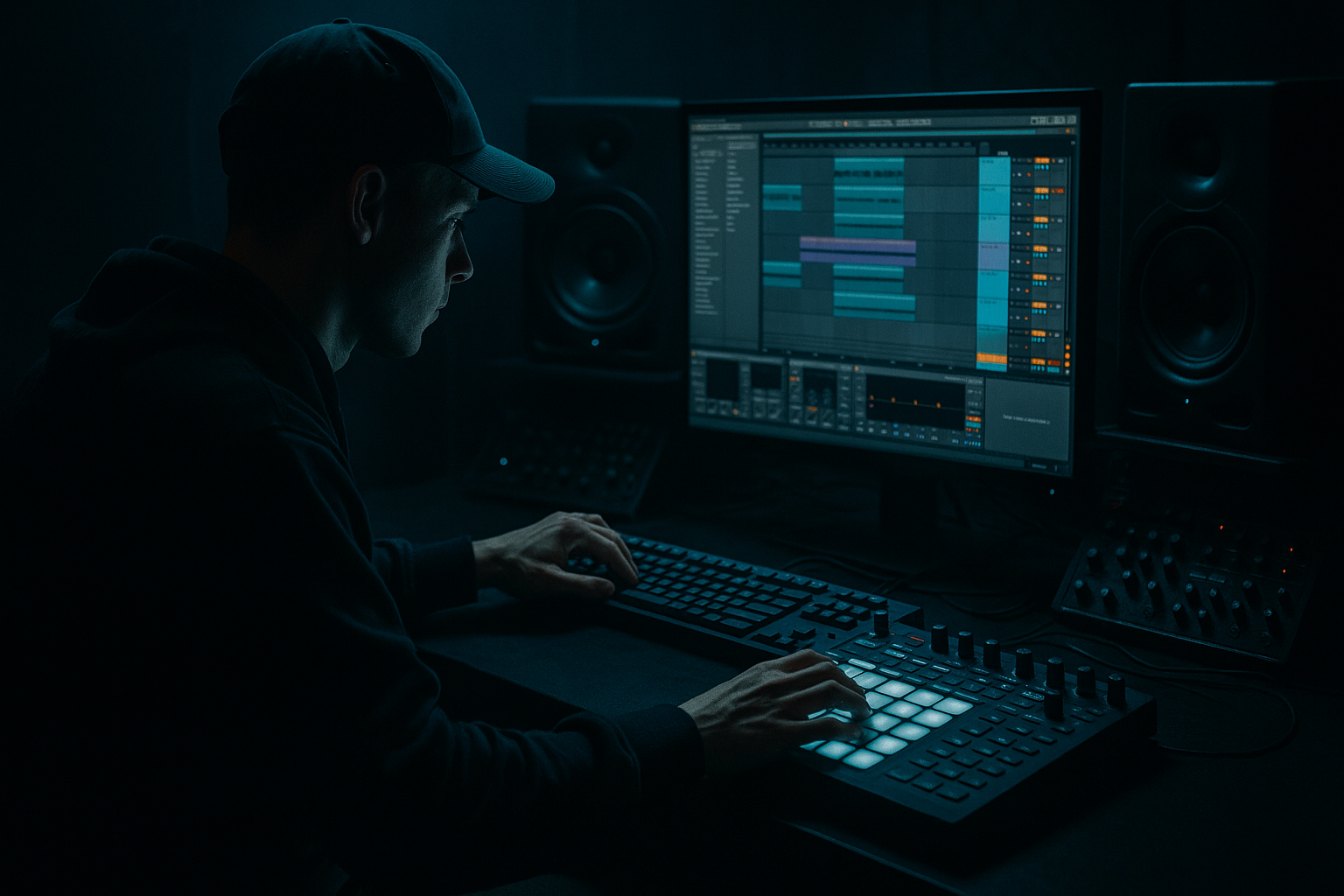
Main tutorial
```markdown
Humanising Repeated Jungle Patterns (Ableton Live) 🥁⚡
Skill level: Beginner
Category: Drums
Focus: Making repetitive jungle/DnB break patterns feel alive, rolling, and not copy‑pasted.
---
1. Lesson overview
Jungle patterns are often built from short loops (like Amen, Think, Hot Pants) repeated for long stretches. The magic isn’t just the break — it’s the micro-variation: tiny timing changes, velocity movement, subtle tone shifts, and tasteful edits that keep the loop exciting without losing the groove.
In this lesson you’ll learn beginner-friendly ways to humanise repeated patterns in Ableton Live using:
- Grooves (Groove Pool)
- Velocity shaping
- Micro-timing nudges
- Ghost notes
- Variation clips
- Stock devices for movement (Drum Buss, Saturator, Auto Filter, Utility, etc.)
- A core 2-bar break loop
- 2–4 variation clips (fills + small edits)
- Humanised timing/velocity
- Subtle tonal drift (filter + saturation) for realism
- Arrangement moves (drops, fills, energy ramps)
- Timing: 15–30%
- Random: 5–15%
- Velocity: 5–20%
- Base: usually 16 for DnB/jungle
- Backbeat snare (usually on beat 2 and 4): keep strong and consistent
- Small hits around it: vary more
- Use the Draw tool (B) to quickly sketch velocity shapes.
- Then manually tweak the most important hits.
- 1/16 before the snare = classic push
- 1/16 after the snare = classic follow-through
- In between kicks = rolling momentum
- Bars 1–4: A A A B
- Bars 5–8: A B A C
- Bars 9–12: A A B A
- Bars 13–16: A B C D (and into the next section)
- Use Groove Pool for instant shuffle and subtle randomness
- Shape velocity so accents and ghosts feel played
- Apply micro-timing carefully (a few hits, tiny moves)
- Create variation clips to avoid copy-paste fatigue
- Add subtle tonal automation (filter/saturation/utility)
- Optional: layer one-shots for modern punch while keeping the break’s soul
---
2. What you will build
You’ll build a 16-bar rolling jungle drum section that starts simple, then evolves with:
End result: your pattern loops like jungle should — hypnotic, but alive 🔥
---
3. Step-by-step walkthrough
Step 0 — Session setup (quick + practical)
1. Tempo: set to 165–175 BPM (try 172 BPM).
2. Create a Drum Group:
- Track 1: `BREAK MAIN`
- Track 2: `DRUM HITS (optional)` (one-shots layered)
- Track 3: `DRUM BUS` (group them later)
Tip: Jungle break work is easier if your drums are in their own group for quick processing + automation.
---
Step 1 — Load a break and make it loop correctly
Option A: Using Simpler (fastest for beginners)
1. Drag an Amen/Think-style break into a new MIDI track.
2. Live will create a Simpler.
3. In Simpler, choose Slice mode → Slice by: Transients.
4. Turn on Warp in the sample if needed (depends on Live version/workflow), and make sure it loops cleanly.
Option B: Audio clip looping
1. Drag break to an Audio Track.
2. Double-click the clip:
- Enable Warp
- Set Warp mode to Beats
- Preserve: Transient
3. Loop 2 bars (classic jungle phrase length).
Goal: A clean 2-bar loop that doesn’t flam or drift.
---
Step 2 — Add groove (instant “human” timing)
1. Open Groove Pool (hit Cmd/Ctrl + Alt + G).
2. Browser → Grooves:
- Start with something like Swing 16-XX (e.g., Swing 16-55).
- Or if you have a break you love: right-click it → Extract Groove (great for authentic shuffle).
3. Drag the groove onto your clip (audio or MIDI).
Groove Pool settings (good starting point):
✅ This keeps the pattern tight but less robotic.
---
Step 3 — Control velocity (the #1 “human feel” lever)
If you’re using MIDI slices (Simpler/Drum Rack), velocity is your best friend.
1. Open the MIDI clip.
2. In the Velocity lane, create a “wave” of energy:
- Kicks/Snares: more consistent (e.g., 90–115)
- Ghost notes: lower (e.g., 20–60)
- Occasional accents: higher (e.g., 110–127)
Practical jungle guideline:
Ableton tool:
---
Step 4 — Micro-timing: nudge a few hits (don’t over-edit)
Perfect grid timing is what makes loops feel programmed. Jungle lives in micro-late snares, slightly early ghosts, and tiny push-pull.
Method (beginner-friendly):
1. Keep snare anchors mostly on-grid.
2. Nudge some ghost hits:
- Select a note → Shift + Arrow keys (depending on Live settings) or drag carefully
3. Aim for subtle moves:
- ± 5 to 15 ms is often enough
- If you can hear the timing move clearly, it’s probably too much (for rolling DnB)
Workflow tip:
Zoom way in and treat it like “drummer feel”, not random chaos.
---
Step 5 — Add ghost notes and “answer” hits
Human drummers fill the gaps. Jungle relies on that chatter.
1. Duplicate your 2-bar clip.
2. In the duplicate, add:
- Low-velocity snare ghosts before/after the main snare
- A quiet kick or hat to “answer” a phrase ending
Where to place them (simple approach):
Velocity rule: keep ghosts quiet (often 20–55).
---
Step 6 — Create variation clips (the arrangement trick)
Instead of one loop for 64 bars, make a small set of variations and rotate them.
1. Make these clips:
- A (Main): your clean loop
- B (Alt): 1–2 extra ghosts + small timing change
- C (Fill): last 1/2 bar has a quick edit (snare roll or stutter)
- D (Drop tool): remove kick for 1/2 bar or mute hats briefly
Arrangement idea (16 bars):
✅ This keeps repetition musical without constant “look at me” edits.
---
Step 7 — Add subtle tonal movement (feels like “real performance”)
Even if timing/velocity is good, static tone can still feel looped. Add tiny tone changes.
On the break track, try this stock chain:
1. Drum Buss
- Drive: 5–15
- Boom: 0–20 (careful in DnB, don’t fight the sub)
- Transients: +5 to +20 (for snap)
2. Saturator
- Mode: Soft Sine or Analog Clip
- Drive: 1–6 dB
- Turn on Soft Clip
3. Auto Filter
- Filter: Low-pass
- Freq: start around 12–18 kHz
- Automate slightly over 8–16 bars (tiny movement!)
4. Utility
- Automate Gain by ±0.5 dB in spots (micro energy shifts)
Important: Keep movement subtle — jungle is about groove + pressure, not obvious filter sweeps (unless it’s a transition).
---
Step 8 — Layer one-shots (optional but very effective)
Sometimes the loop is human, but lacks “modern DnB punch”.
1. Add a Drum Rack track with:
- A tight kick
- A snappy snare
2. Layer only where needed:
- Kick layer on your main kick hits
- Snare layer on the main backbeat
3. Use EQ Eight on the layers:
- Kick layer: high-pass around 30 Hz, maybe dip 200–400 Hz
- Snare layer: high-pass 120–200 Hz, add presence 2–6 kHz
Phase check tip:
If kick loses weight, nudge the layered kick by a tiny amount or try different samples.
---
4. Common mistakes 🚫
1. Too much random timing
Random isn’t “human”. It becomes messy and weak.
2. All hits same velocity
This screams “loop”.
3. Over-processing the break
Heavy saturation + heavy compression can flatten the groove.
4. No variation clips
Even a great 2-bar loop gets tiring over time.
5. Ghost notes too loud
Ghosts should be felt, not dominating the backbeat.
---
5. Pro tips for darker/heavier DnB 🖤
1. Parallel smash for menace
- Create a Return track: Glue Compressor (fast attack, medium release, 4:1) + Saturator
- Send the break lightly (5–20%) to add grit without killing transients.
2. Tighten the low-end of the break
- EQ Eight: high-pass the break around 80–150 Hz (depends on your bass)
- Let your sub and kick own the true low end.
3. Add “air movement” with hats
- A super low-level shuffled hat loop can glue the groove.
- Use Auto Pan subtly (Amount 10–25%) for stereo motion.
4. Dark texture layer
- Layer a quiet “room” or “vinyl” texture.
- Use Auto Filter to roll off lows and keep it atmospheric.
5. Controlled aggression
- Drum Buss + Saturator is often enough.
- If it’s still not heavy, add Redux very lightly (downsample a touch) for grit.
---
6. Mini practice exercise 🎯 (15 minutes)
1. Pick a 2-bar break loop at 172 BPM.
2. Apply a Groove Pool swing:
- Timing 20%, Random 10%, Velocity 10%.
3. Duplicate the clip 3 times (A/B/C/D).
4. For B: add 2 ghost snares at low velocity.
5. For C: create a fill in the last half-bar (quick snare chatter).
6. For D: mute one kick and add a tiny filter dip before bar 1 repeats.
7. Arrange 16 bars using: A A A B / A B A C / A A B A / A B C D
Export and listen: does it still feel like the same groove, but evolving?
---
7. Recap ✅
To humanise repeated jungle patterns in Ableton Live:
If you want, tell me whether you’re working with audio loops or MIDI slices, and what break you’re using (Amen/Think/etc.)—I can suggest a specific 2-bar edit plan and device chain for that vibe.
```

