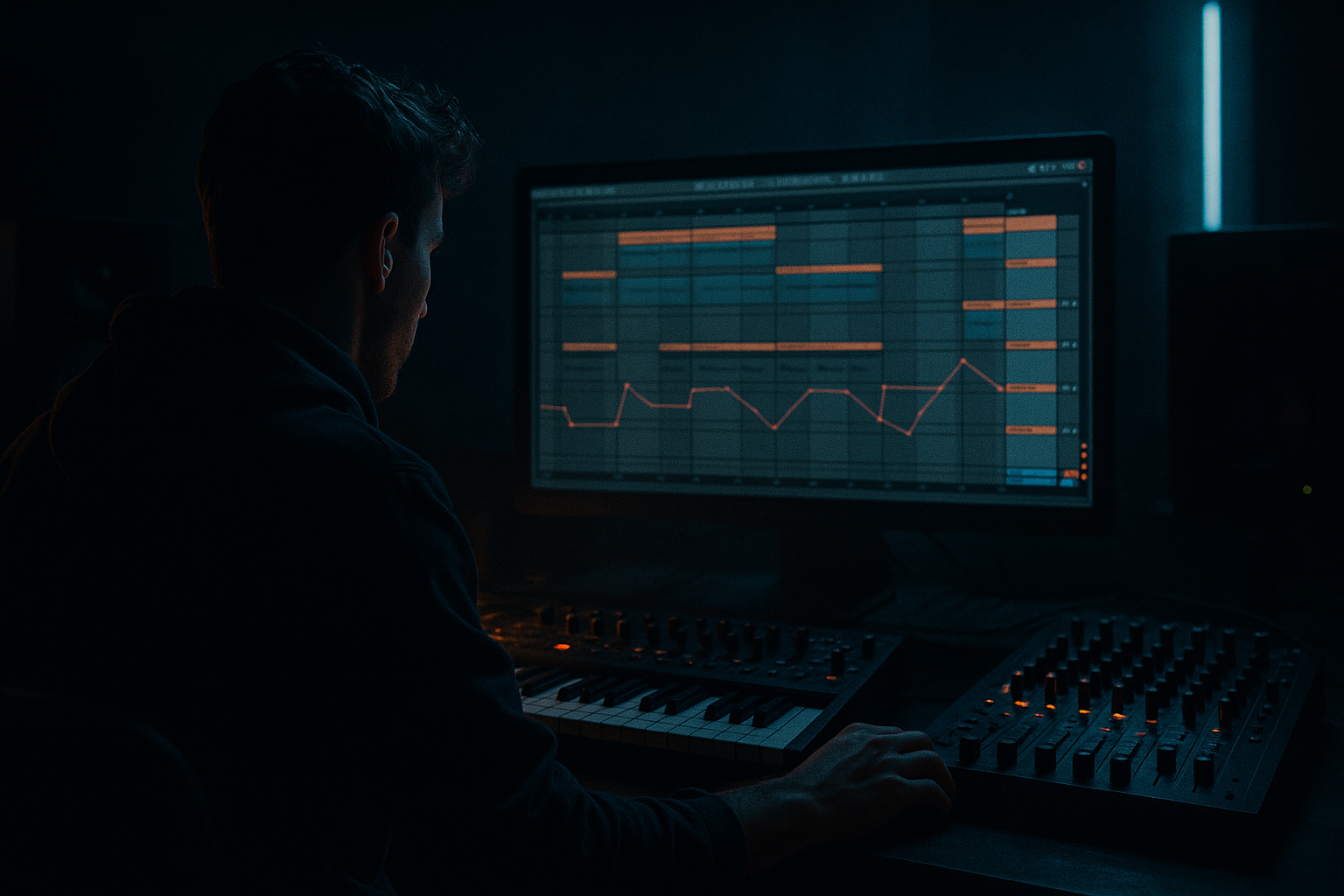
Main tutorial
Lesson Overview
A lot of Drum & Bass producers make the mistake of treating the 808 tail like a static sub note. In jungle and DnB, that tail can do way more than support the drop — it can carry emotion, movement, and atmosphere, especially in a sunrise set where you want that “open sky / emotional release” feeling without losing the low-end pressure.
In this lesson, you’ll learn how to humanize an 808 tail in Ableton Live 12 so it feels alive, not copied-and-pasted. We’ll keep it beginner-friendly, but still rooted in real DnB arrangement thinking: using the tail as a phrase element, shaping it with stock Ableton devices, and placing it in the arrangement so it works with breaks, pads, and rolling drums instead of fighting them.
This matters in DnB because the genre lives on contrast: hard drums vs. emotional space, weight vs. air, precision vs. human feel. A slightly imperfect 808 tail can make a bassline feel warmer and more musical — especially in sunrise sections, where you want uplift without turning soft. 🌅
What You Will Build
By the end of this lesson, you’ll have a humanized 808 tail that feels emotional, organic, and controlled inside an Ableton Live 12 arrangement.
Specifically, you’ll build:
- A single 808 bass hit with a long, expressive tail
- Small variations in volume, pitch, tone, and timing
- A version that works as a sunrise-set transition bass in a DnB track
- A bass element that can sit under:
- Arrangement movement that makes the tail feel like part of the song, not just a sample loop
- Create a MIDI track
- Drag your 808 sample into Simpler
- Set Simpler to Classic or One-Shot mode
- Keep the sample clean and long enough to hear the tail
- on beat 1 of a bar for weight
- or slightly before the downbeat for tension into the drop
- or under a half-time feel with open drums and ambience
- 174 BPM
- 8-bar intro with filtered breakbeats
- 4-bar emotional phrase using an 808 tail under pads
- then a switch into a rolling drop
- Attack: 0–5 ms
- Decay/Release: long enough that the tail breathes, often 300 ms to 2 s depending on sample length
- Volume envelope: avoid a full flat sustain if the sample rings too long
- Set to Low-Pass
- Cutoff around 80–200 Hz if the top of the tail is too clicky or fizzy
- Add a tiny amount of resonance if you want a more vocal, moving tone
- Velocity: use a range like 70–110
- Note length: make some notes slightly shorter, some longer
- Timing: nudge one note a little late or early, but keep it subtle
- Pitch: automate tiny pitch changes if needed, or use MIDI pitch envelope if your instrument supports it
- Bar 1: normal 808 hit
- Bar 2: slightly quieter hit
- Bar 3: slightly longer tail
- Bar 4: add a little slide or pitch movement into the next section
- Transpose
- or a device parameter mapped to pitch
- -2 to +2 semitones for a musical transition
- -10 to +15 cents equivalent feel if you are using subtle pitch shaping in your source
- Keep Shift very small
- Use subtle modulation only
- Don’t make it obvious unless you want a sci-fi texture
- Drive: 1–4 dB to start
- Soft Clip: On
- Output: trim so you don’t get louder just because it sounds nicer
- High-pass everything below your actual sub needs? No — be careful. In DnB, you usually keep the real sub low.
- Instead, remove unnecessary low-mid buildup around 150–350 Hz
- If there’s harshness, tame any aggressive area around 700 Hz–2 kHz depending on the sample
- Use a more filtered tail in the intro
- Open it slightly in the pre-drop
- Bring back full tone in the drop or second drop variation
- Auto Filter cutoff
- Saturator drive
- Simpler filter
- Reverb send
- Delay send
- Volume
- Bars 1–4: low-passed 808 tail, quiet reverb
- Bars 5–8: filter opens slowly, a little more saturation, more reverb send
- Final bar before the drop or switch: shorten the tail and clear space for the drums
- Filter cutoff sweep: roughly 150 Hz → 1.2 kHz if you are opening a tonal tail effect
- Reverb send: small amounts only, often 5–15% feel, not washout
- Saturator drive: automate 1 dB up in the emotional lift section
- Create a return track with Reverb
- Set the reverb to be mostly wet
- Use a short to medium decay
- Roll off low end inside the reverb using EQ on the return
- Very small feedback
- Low wet amount
- Filter out lows so the delay doesn’t blur the sub
- 8 bars: filtered pads + break edits + a very soft 808 tail
- 8 bars: bass tail becomes more present
- 4 bars: strip the drums, let the bass speak
- 4 bars: reintroduce the rolling kick/snare with the bass tail shortened
- Drop: tighten the bass again so it hits harder
- Use the humanized tail in breakdowns and transitions
- Keep it less active during dense drum sections
- Use call-and-response with breaks: let the tail answer a snare fill or break edit
- Save the most emotional version for the last 8 bars before the drop or second-drop lift
- Put Utility on the bass track
- Toggle Mono for the low end if needed
- Check if the bass changes too much in stereo
- Compare it against your kick and break
- Kick should still cut through
- Sub tail shouldn’t mask the snare body
- If the break loses punch, shorten the tail or reduce low-mid saturation
- Making the tail too long
- Using too much reverb on the bass
- Over-humanizing the timing
- Boosting too much low end
- Ignoring arrangement
- Letting the bass fight the breakbeat
- Add gentle distortion, not chaos
- Use a darker filter arc
- Layer a quiet mid-bass under the 808
- Let the tail answer the drums
- Automate micro-contrast
- Resample for character
- In DnB, the 808 tail can be a phrase element, not just a sub note.
- Humanize it with small changes in velocity, length, timing, and tone.
- Use stock Ableton devices like Simpler, Auto Filter, Saturator, EQ Eight, Utility, Reverb, and Echo.
- Keep the low end clean and mono-friendly.
- Arrange the tail across 4–8 bar sections so it supports tension and release.
- For sunrise emotion, aim for warm, controlled movement — not washout.
- chopped jungle breaks
- rolling kick/snare patterns
- atmospheres and pads
- a stripped-back breakdown into a drop
Think of it like this: instead of one flat 808 note repeating every bar, you’ll create a bass tail that subtly changes over 4–8 bars, so the listener feels motion and emotion even when the drums stay simple.
Step-by-Step Walkthrough
1. Load a clean 808 and place it in a musical DnB context
Start with a simple 808 sample or synthesized bass note in a MIDI track. If you’re using a sample, drag it into Simpler. If you’re using a synthesized bass, Operator is a great stock choice, but for beginners Simpler is the easiest route.
In Ableton Live 12:
Now place one note on the grid, and listen to how it sits in a DnB context. For a sunrise feel, try placing the note:
Musical context example:
Why this works in DnB: the 808 tail becomes a low-end phrase marker. In jungle and rollers, bass often answers the drums rather than just holding root notes. A long, humanized tail gives your arrangement a sense of story.
2. Shape the tail with basic amplitude control
Open Simpler and start shaping the tail so it doesn’t just slam and vanish.
Try these starter settings:
If the sample is too sharp, reduce the initial transient a little. If it’s too plain, keep some punch so it still reads on small speakers.
You can also use Auto Filter after Simpler:
Beginner rule: don’t over-edit yet. You’re trying to keep the bass stable while making it feel less robotic.
3. Build the human feel with note-level variation
Now create 2–4 copies of the same bass note in your MIDI clip and vary them slightly. This is the easiest beginner-friendly way to humanize an 808 tail.
Change these things across the notes:
In DnB, small note-level changes matter because repetition is common. If every bass hit has the exact same shape, the ear gets numb fast. Tiny variations help the bass feel performed instead of drawn.
Good beginner approach:
Keep the movement subtle. A sunrise set doesn’t want hyper-aggressive wobble here — it wants emotional drift.
4. Add subtle pitch humanization with stock Ableton tools
If the 808 tail feels too static, you can give it micro movement using stock Ableton devices.
Two easy ways:
Option A: Clip envelopes
In the MIDI clip, automate:
Try tiny moves:
Option B: Frequency Shifter
Add Frequency Shifter after Simpler for a more experimental bass tail.
For beginner DnB, the safer move is clip-based pitch variation. Use it to make the 808 feel like it’s leaning forward or falling back slightly between phrases.
Why this works in DnB: bass movement creates momentum. Jungle and neuro often use pitch, glide, and formant-like shifts to keep the bass line alive while the drums stay busy.
5. Use saturation and filtering to give the tail character without muddying the mix
A sunrise bass tail should feel warm, not muddy. Add a stock Saturator after Simpler.
Try:
Then add EQ Eight:
If you want a brighter sunrise edge, use a gentle EQ boost around 2–5 kHz only if the source supports it. But don’t force brightness into a bass that should stay deep.
Arrangement angle:
That kind of progression feels polished and intentional.
6. Automate movement over 4–8 bars instead of every bar
This is where the lesson becomes arrangement-focused. The humanized tail should change over time, not just from note to note.
In Ableton Live’s Arrangement View, automate one or more of these:
A very practical sunrise arrangement move:
Useful parameter ranges:
This keeps the bass expressive while still fitting DnB’s arrangement discipline.
7. Add space with reverb and delay, but keep the sub clean
For sunrise emotion, a touch of space can make the 808 tail feel huge. But in DnB, the sub itself should stay focused.
Use Reverb or Echo as sends rather than inserting them heavily on the bass track.
Recommended approach:
For Echo:
If the tail is emotional but the mix gets cloudy, reduce the send and shorten the decay. The goal is atmosphere around the bass, not a swamp underneath the drums.
Why this works in DnB: the genre depends on low-end clarity. Even in emotive sunrise sections, the kick and sub need space to breathe so the groove still lands.
8. Arrange the bass so it supports the track’s energy arc
Now place the humanized 808 tail in a real arrangement instead of a loop.
A simple structure for a sunrise-inspired DnB section:
Good arrangement choices:
A key DnB arrangement principle: if everything is emotional all the time, nothing feels emotional. Let the bass tail have a role in the story.
9. Check mono compatibility and low-end balance
Because this is bass music, you need to make sure the humanized tail still translates.
Do this:
If the tail feels huge in stereo but weak in mono, simplify it. In DnB, the low-end power should survive club systems and headphone playback.
Keep the bass balance practical:
A clean low-end makes the emotion feel stronger, not weaker.
Common Mistakes
- Fix: shorten the release or clip the note earlier so the bass doesn’t smear over the next drum hit.
- Fix: move reverb to a return track and high-pass the return so the sub stays clean.
- Fix: tiny shifts only. If the bass is late by too much, the groove feels sloppy instead of soulful.
- Fix: leave the sub focused. If the mix gets heavy but unclear, reduce low-mid buildup before adding more bass.
- Fix: don’t loop the same bass phrase endlessly. Change the filter, length, or density every 4–8 bars.
- Fix: if the bass tail collides with snares or ghost notes, move the bass note or shorten the release.
Pro Tips for Darker / Heavier DnB
- Use Saturator or Overdrive lightly to give the tail more bite.
- Try a small drive increase only in the second half of the phrase for tension.
- Start the tail filtered and open it only slightly. This keeps the emotion but adds underground restraint.
- Duplicate the bass track and band-limit it with EQ Eight so one layer carries sub and the other carries growl.
- Keep the sub mono and the texture layer controlled.
- Use the bass hit after a snare fill or break chop to create call-and-response. That’s very DnB.
- A tiny increase in drive, a tiny decrease in filter cutoff, and a slightly longer tail can make a section feel darker without obvious sound design tricks.
- Once the tail feels good, record it to audio and edit the arrangement. Resampling helps you commit to a vibe and move faster.
Mini Practice Exercise
Spend 10–20 minutes making a 4-bar sunrise bass phrase:
1. Load one 808 into Simpler.
2. Write one bass note in bar 1.
3. Duplicate it across 4 bars.
4. Change the velocity of each hit slightly.
5. Make one note slightly longer, one slightly shorter.
6. Add Saturator with 2 dB drive.
7. Add Auto Filter and automate a gentle cutoff opening over 4 bars.
8. Put Reverb on a return track and send a tiny amount from the bass.
9. Add a breakbeat or basic jungle drum loop underneath.
10. Listen in Arrangement View and ask: does the bass feel like it’s moving emotionally, or just repeating?
If it still feels static, change only one thing at a time: timing, filter, or note length.
Recap
If you get this right, your 808 tail stops sounding like a sample and starts sounding like part of a real DnB story.

