Main tutorial
1. Lesson Overview
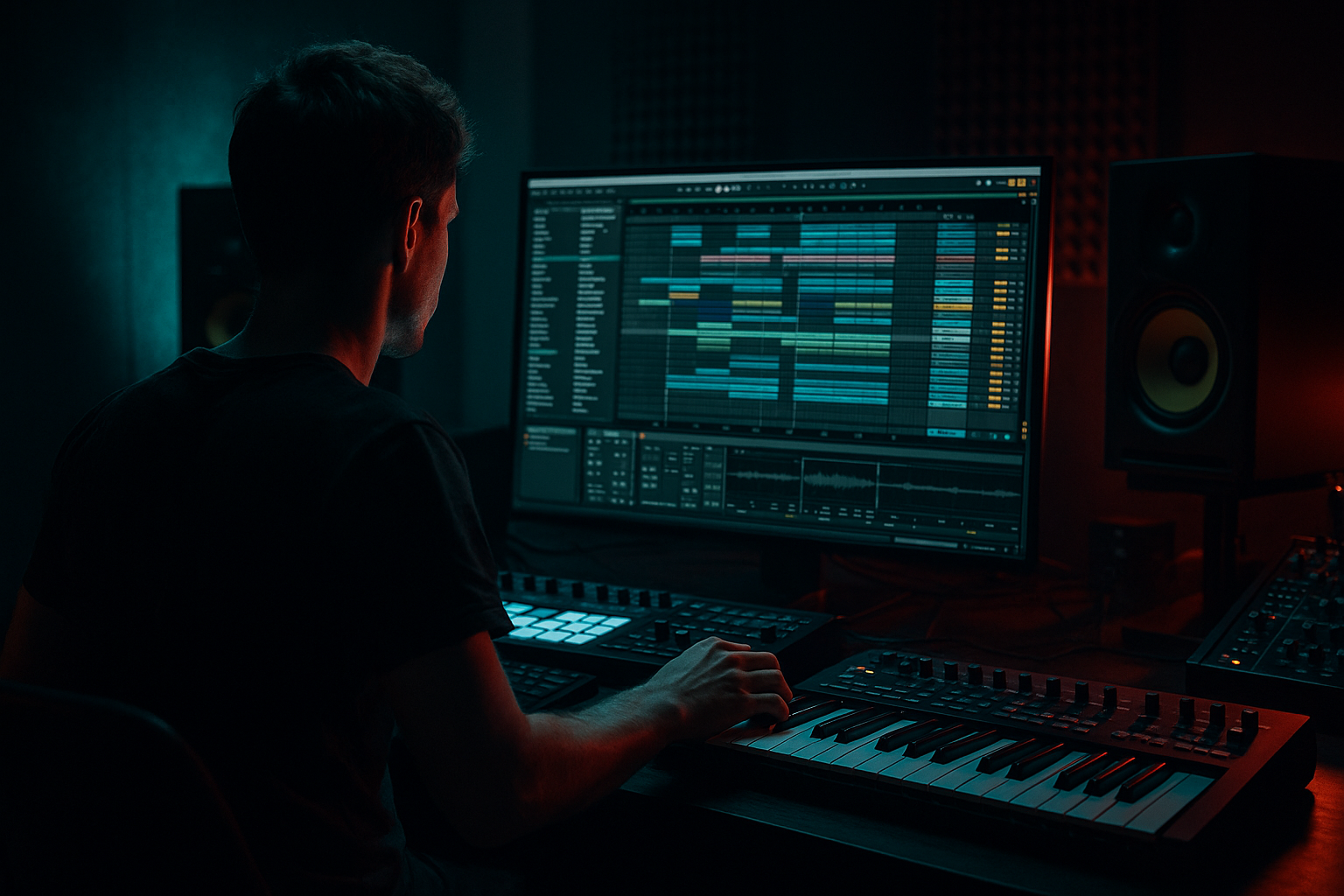
This beginner lesson teaches a focused sampling workflow titled "Hybrid Minds edit: clean a kick and sub lock from scratch in Ableton Live 12 with automation-first workflow". You will start from raw kick/sub samples, build a single clean kick, design a locked sub bass, and use automation as the primary creative and corrective tool—automating sample start, pitch envelopes, filter cutoff, transient emphasis and sidechain parameters—so the kick and sub sit tight together for Drum & Bass.
2. What You Will Build
- A single clean kick (sample-based) tuned and shaped for Drum & Bass.
- A mono-locked sub bass that sits with the kick (clean low-end, phase-checked).
- An automation-first Ableton Live 12 track template that uses stock devices (Sampler/Simpler, EQ Eight, Compressor/Glue, Utility, Drum Buss, Auto Filter) to quickly test and lock kick/sub relationships.
- Over-compressing the sub with sidechain: too much ratio or extreme threshold gives pumping and loses low sustain. If it sounds shrill, reduce ratio or lengthen release.
- Ignoring phase: not checking polarity can cause low-end cancellation. Always try in mono and flip polarity to test.
- Automating wrong lanes: automating track volume vs device gain can lead to unexpected results (e.g., distorting later devices). Prefer device gain/Utility for controlled changes.
- Too much saturation/distortion on the sub: saturating the sub before low-pass will create unwanted harmonics. If you need warmth, use gentle saturation on the Kick body only, or after a low-pass with low drive.
- Relying only on static EQ: not automating EQ cuts/pass can lead to parts clashing in different arrangement sections.
- Automation-first testing: when trying new settings, automate parameter movement over 4 bars to audition rather than committing to static values—this reveals interactions with rhythm and arrangement.
- Use Sampler’s Filter + Pitch Envelope: Sampler gives precise pitch envelope control; a tiny pitch snap can cut through without adding high-frequency click.
- Utility width split: put Utility in an Audio Effect Rack with chain EQs to automate Width independently for low vs higher frequencies (map chain volumes to Macro and automate macros).
- Use Drum Buss transient shape sparingly: pair transient boost with a slightly reduced low-shelf to keep the thump without mud.
- Save the template: once you’ve dialed a Kick/Sub group with automations, save it as a Live Drum Rack or Set Template to speed future Hybrid Minds-style edits.
3. Step-by-Step Walkthrough
Note: This walkthrough uses Ableton stock devices. Wherever a value is suggested, treat it as a starting point — tweak by ear.
A. Setup and sample selection
1. Create two audio tracks: “Kick” and “Sub”.
2. Drag your chosen raw kick sample into the Kick track (use Simpler in Classic mode or Sampler — Sampler gives more control).
3. Drag a sub sample (sine/pitched low) or a single-cycle sine into the Sub track (use Sampler).
B. Automation-first mindset (prepare lanes)
1. On both tracks, open the device view and the track “Automation” lane. Plan to automate:
- Kick: sample start, pitch envelope (Sampler), filter cutoff (EQ/Auto Filter), Drum Buss transient knob, track volume.
- Sub: pitch envelope (Sampler), filter cutoff (EQ Eight low-pass or Auto Filter), Mono width (Utility), sidechain amount (Compressor).
2. Create a 4-bar loop region and duplicate it. The idea is to automate within this loop to audition changes quickly.
C. Clean the kick (from scratch)
1. Temporary gain staging: Insert Utility before other devices. Keep Gain around -6 to +0 dB so plugins aren’t clipping.
2. Use Simpler/Sampler to set sample start:
- Zoom to waveform and automate sample start (Sampler/ Simpler start offset) to remove unwanted pre-transients or tail click. Draw small automation moves to nudge start 2–20 ms depending on sample.
3. Shape attack/transient:
- Insert Drum Buss after Sampler. Automate Drum Buss > Transient: increase transient knob (+3 to +8) for one or two bars to audition a sharper attack, then reduce—this is automation-first: if a one-shot needs punch only on certain hits, automate.
- Alternatively, automate Compressor (fast attack ~0.5–1 ms, medium release) dry/wet or threshold to shape transient via automation.
4. Pitch envelope for weight:
- In Sampler, enable Pitch Envelope with a fast pitch drop (Start at +0–+12 semitones, Decay 30–120 ms, Amount -4 to -12 semitones) and automate the Envelope Amount to audition impact. This creates the “thump” without muddy low harmonics.
5. Basic EQ cleanup:
- Add EQ Eight after Drum Buss. Use a low shelf or bell cut at ~200–300 Hz to remove boxiness if needed, and a narrow cut for any resonant peaks. Automate a small dip (1–3 dB) at problematic frequencies while looping—automation-first means test cuts in context.
6. High-pass non-kick content:
- If the kick sample has high-mid clutter, automate a gentle high-pass (EQ Eight) from 30 Hz up to 40–50 Hz for passages that don’t need sub energy.
D. Build the locked sub
1. Mono sub and routing:
- Insert EQ Eight on Sub. Use a low-pass with cutoff ~140–200 Hz to remove mids. Then use Utility set Width to 0% to mono the sub. You can automate Width if you want stereo wideners only on filtered tails.
2. Tuning and pitch envelope:
- In Sampler, set root key for your sub sample so MIDI notes play correct pitch. Use a very slow filter and nearly 0 attack on amp envelope for a solid steady sub.
- Add pitch envelope if you want a click transient: small pitch drop (few cents to semitones) with very short decay gives extra perceived attack. Automate the Pitch Envelope Amount to try different amounts quickly.
3. Low-end control & phase:
- Insert Utility after EQ and check Phase by toggling Left/Right invert to audition cancellation. Use Spectrum device to confirm single strong low peak. If low frequencies dip when kick and sub play together, flip polarity on the Sub Utility and test again.
4. Sub lock via sidechain and envelope automation-first:
- Insert Compressor on Sub, enable sidechain input from Kick track. Set Ratio 4:1–8:1, Attack very fast (0–1 ms), Release tuned to tempo (80–200 ms). Rather than settling immediately, automate the Compressor’s Threshold/Ratio or Dry/Wet while looping to find the sweet spot where the kick punches and sub recovers.
- Alternative: automate Sub track volume gain or audio clip volume to manually “duck” the sub in time with kick for precise locks without compression artifacts.
5. Frequency separation:
- On Kick track, add EQ Eight and low-pass under ~100 Hz if you want the kick’s main body to sit above the sub, retaining click and mid presence. Automate the cutoff for variety (e.g., during fills reduce low overlap).
E. Final glue and checks
1. Group Kick + Sub into a “Low End” Group. Add Glue Compressor on the group with gentle settings (3:1, medium attack, medium release) to slightly glue transient & body. Automate Glue Compressor Threshold/Makeup to audition cohesion.
2. Mono check & spectrum: Place Utility after Glue set Width to 0 temporarily and listen. Insert Spectrum to verify a single clean low peak (20–120 Hz) without phasing dips.
3. Listen in context: play your drum loop and melodies. Automate the sidechain amount, kick transient emphasis, and sub filter to react to arrangement changes.
4. Common Mistakes
5. Pro Tips
6. Mini Practice Exercise
Goal: Create a clean kick and locked sub for a 4-bar Drum & Bass loop.
Steps:
1. Drag one kick and one sub sample into separate Sampler devices on two audio tracks.
2. Loop 4 bars. Automate: Kick Sampler start + Drum Buss transient (+4) on beat 1 only; Sub Compressor sidechain Threshold toggling between -12 dB and -20 dB (quick automation) to hear the ducking impact.
3. In Sampler, set a pitch envelope on the Kick (decay 60 ms) and automate Envelope Amount from 0% to ~50% over the 4 bars to hear how it changes the hit.
4. Insert EQ Eight on both tracks. Automate a narrow dip on the Kick at 250–350 Hz (-2 to -4 dB).
5. Test phase: mono both tracks with Utility Width=0 and toggle Sub Utility Phase to ensure no cancellation. Adjust pitch or polarity until the low peak is strong.
6. Export or freeze the loop, then listen on headphones and laptop speakers to confirm the kick/sub lock translates.
7. Recap
This lesson, "Hybrid Minds edit: clean a kick and sub lock from scratch in Ableton Live 12 with automation-first workflow", walked you through selecting samples, shaping a clean kick with Sampler, Drum Buss, transient and pitch envelopes, and creating a mono-locked sub with EQ, Utility, and sidechain compression. The emphasis was automation-first: automate sample start, pitch envelopes, filter cutoff and sidechain amounts early to audition how kick and sub interact. Always check phase/mono, use gentle Glue or group compression to glue the low-end, and save your template once you find a setup that works. Repeat the mini exercise until you can get a tight kick/sub relationship within a few minutes.

