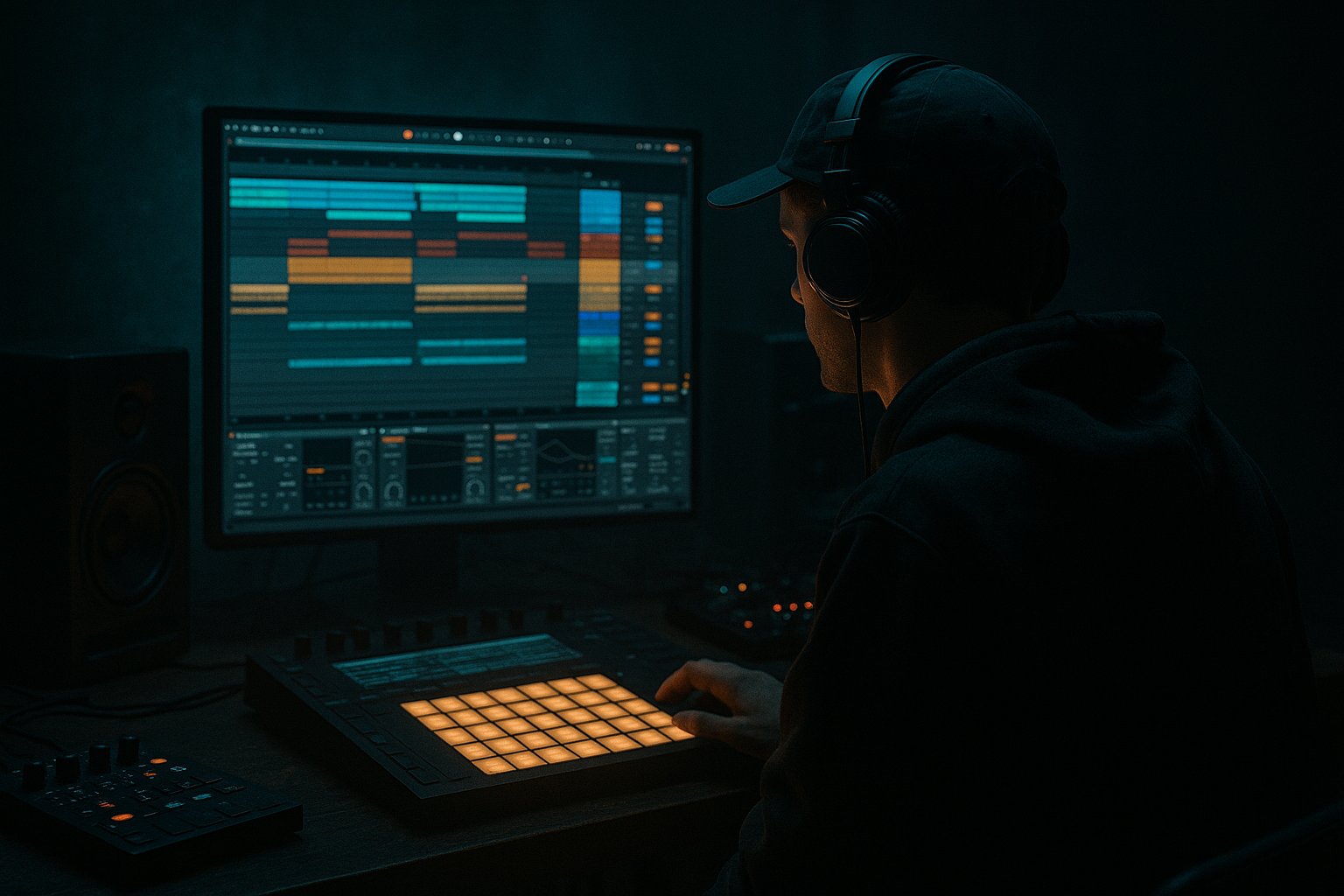
Main tutorial
```markdown
Impact + Sub Drop Coordination (Advanced DnB FX in Ableton Live)
1) Lesson overview
In drum & bass, the drop only feels huge when the impact (mid/high transient + noise + punch) and the sub drop (low-end weight + pitch movement) hit as one coherent event. The goal of this lesson is to make your impacts sound massive without smearing the sub, causing limiter freak-outs, or collapsing mono compatibility.
You’ll build a repeatable Ableton Live workflow to:
- Design an impact stack (click/attack, body, air, tail) 🔥
- Design a sub drop that lands perfectly with your kick + bass
- Time-align the stack, manage phase, and keep headroom
- Use sidechain + dynamic control so the sub doesn’t fight the kick
- Arrange it in classic DnB/jungle drop contexts (rollers, foghorns, techy steppers)
- A pre-drop vacuum (tiny silence/duck + filter move) to make the hit feel larger
- A master-safe gain staging strategy so the drop can be loud later without clipping now
- Keep the drop section peaking around -6 dBFS on Master while building.
- Put a Limiter on Master only as protection:
- Add Spectrum on Master:
- A clean “click” one-shot
- A short snare transient
- A layered foley hit (metal tick) at very low level
- Noise burst
- Tom hit / short kick layer
- Mid-heavy impact sample
- Synth “thump” (Operator) with a short pitch envelope but not too low
- Osc A: Sine
- Voices: 1
- Glide: Off (unless you want slide)
- Enable Pitch Env
- Attack: 0–2 ms
- Decay: 200–500 ms
- Sustain: -inf (or low)
- Release: 50–120 ms (avoid clicks)
- Mode: One-Shot
- Warp: Off
- Snap: On
- Use Pitch Env similarly via Transpose automation if needed.
- The kick transient is the time anchor (especially in rollers).
- Your impact transient can coincide with kick, or land slightly before (1–5 ms) for perceived punch.
- Your sub drop often works best if it arrives immediately but its lowest point lands right with the kick/body.
- Zoom to sample level.
- If your impact transient feels late, nudge the Top layer -5 to -15 samples (tiny).
- If it feels clicky/phasey with the kick, nudge forward slightly or shorten the Top layer.
- Impact Top: high-passed → fine to be wide.
- Impact Body: high-passed → keep mostly mono-ish.
- Impact Tail: high-passed → can be stereo but filtered.
- Sub Drop: mono only.
- Put Utility on Master and toggle Mono.
- If your drop loses power in mono, something low-ish is stereo or phasey.
- Use Utility to mono below 120 Hz on the groups, and re-check.
- Cut (mute) your pre-drop elements for 1/16 to 1/8 right before the impact.
- Keep a tiny reverb tail if you want continuity, but drop the main energy.
- This creates contrast without extra loudness.
- Add Auto Filter:
- Automate Utility Gain down -2 to -6 dB in the last 1/4 bar
- Snap back to 0 dB on the drop.
- Letting the impact tail contain sub → causes low-end bloom and limiter pumping.
- Wide low frequencies (stereo sub drop or tail) → weak mono, club translation issues.
- Sub drop too long → masks the first bar of bassline and ruins roll.
- No sidechain from kick → kick disappears or the sub flams awkwardly.
- Over-layering impacts → transient becomes blurry; “big” turns into “messy”.
- Pitch drop too extreme (e.g., falling into 25 Hz) → you’ll hear less, but your limiter will suffer more.
- Distort above the sub, not the sub itself:
- Use spectral space:
- Sub drop length matches the groove:
- Clip control without killing transients:
- Create “fear” before the hit:
- Build impacts as layers with roles: Top (snap/air), Body (punch), Tail (space).
- Keep the sub drop mono, short, and sidechained to kick.
- Coordinate timing so the transient + sub settle point lands perfectly with the drop grid.
- Use pre-drop vacuum for contrast rather than just making the impact louder.
- Filter lows out of tails and bodies—sub belongs to one source.
---
2) What you will build
A Drop Impact Rack (group) containing:
1. Impact Top (attack/click + air/noise)
2. Impact Body (mid punch / thump around 120–250 Hz if needed)
3. Impact Tail (short reverb/boom tail, controlled)
4. Sub Drop (30–60 Hz focused, pitch envelope, mono-safe)
Plus:
---
3) Step-by-step walkthrough
Step 0 — Session + monitoring setup (fast but crucial)
Tempo: 174 BPM (typical roller)
Warp: Off for one-shots unless needed.
Master headroom target:
- Ceiling: -0.3 dB
- Lookahead: 1 ms
- Don’t push into it yet.
Metering helper (stock):
- Block size: 8192
- Avg: ~1000 ms
- Range: -72 to 0
- Watch 30–80 Hz behavior during the drop.
---
Step 1 — Build the impact stack (grouped for control)
Create a Group Track named: `DROP IMPACT (STACK)`
Inside, create 3 audio tracks: `Top`, `Body`, `Tail`.
#### 1A) Impact Top (attack + air) ✨
Source options (choose one):
Device chain (Top):
1. EQ Eight
- HP at 300–600 Hz (24 dB/Oct)
- Optional gentle shelf boost 8–12 kHz +2 to +5 dB
2. Saturator
- Drive: 2–6 dB
- Soft Clip: On
3. Drum Buss (subtle)
- Drive: 2–10%
- Crunch: 0–10%
- Transients: +10 to +30
4. Utility
- Width: 120–160% (keep this top-only)
- Bass Mono: On, set to 120 Hz (yes, even on Top—safe habit)
Timing tip: zoom in and ensure the transient starts exactly on the drop grid (no lazy fade-in).
---
#### 1B) Impact Body (mid punch / weight) 🥊
This layer is where many producers accidentally ruin the sub. The body should suggest weight without stealing sub space.
Source options:
Device chain (Body):
1. EQ Eight
- HP around 70–90 Hz (24 dB/Oct) to protect your sub drop
- Gentle bell boost 150–220 Hz (+1 to +4 dB) if you need chest
- Cut mud 300–500 Hz if boxy
2. Glue Compressor
- Attack: 3–10 ms
- Release: Auto or 0.1–0.3 s
- Ratio: 2:1
- Aim for 1–3 dB GR on the body hit
3. Saturator (optional)
- Drive: 1–4 dB to densify
Rule: Body layer should feel big on small speakers without adding sub.
---
#### 1C) Impact Tail (controlled boom / space) 🌫️
Tail gives size, but unmanaged tails smear groove at 174.
Device chain (Tail):
1. Reverb
- Decay Time: 0.4–1.2 s
- Pre-Delay: 10–25 ms (keeps transient clean)
- Low Cut: 200–400 Hz
- High Cut: 6–10 kHz
- Keep it dark-ish for DnB
2. Gate (key step!)
- Threshold: set so tail is trimmed to ~200–450 ms
- Return: 0 ms / minimal
- This keeps the tail from washing over the first bar of the drop.
3. EQ Eight
- Aggressive HP: 200–500 Hz
- Notch any ringing frequency you hear
Arrangement tip: for a roller, tail length usually wants to end before the first kick+snare pattern establishes. Jungle-style can be a bit splashier, but still controlled.
---
Step 2 — Create the Sub Drop (dedicated track, mono-safe)
Create a new MIDI track: `SUB DROP`
#### Option A: Operator (clean, reliable) ✅
Load Operator:
Pitch envelope (classic sub drop):
- Amount: -12 to -24 st (start higher, fall into sub)
- Decay: 80–200 ms
- This gives the “fall” into the drop.
Amp envelope:
Sub Drop device chain:
1. EQ Eight
- Low shelf or bell: if needed, small boost at 45–55 Hz (+1–3 dB)
- Cut any DC-ish rumble below 25–30 Hz (HP 12 dB/Oct)
2. Saturator (for translation)
- Drive: 1–3 dB
- Soft Clip: On
- Goal: subtle harmonics so the sub drop “reads” on smaller rigs
3. Compressor (sidechain from Kick)
- Sidechain input: your Kick track (or Kick group)
- Attack: 0.1–1 ms
- Release: 60–120 ms
- Ratio: 4:1
- Aim for 2–6 dB duck during kick hits
4. Utility
- Width: 0% (mono)
- Bass Mono: On (set to 120 Hz)
#### Option B: Sampler (for cinematic drops)
If you have a good sub drop sample, use Simpler:
---
Step 3 — Coordinate timing: impact vs sub vs kick
This is the heart of the lesson. 🧠
#### 3A) Decide the “center of gravity”
In most DnB:
Practical method:
1. Put the drop at bar 33 (example).
2. Place Impact Top/Body transient exactly on 33.1.1.
3. Place Sub Drop MIDI note also at 33.1.1.
4. Adjust Operator Pitch Env decay so the pitch settles into the target sub region right at the kick’s “meat”.
#### 3B) Micro-align by ear + zoom
Important: don’t time-stretch one-shots if you can avoid it. Use Start offset in Simpler or clip nudge.
---
Step 4 — Phase and mono control (don’t skip)
Low-end disasters usually come from stacking lows in multiple layers.
Checklist:
Quick test (stock):
---
Step 5 — Make space with a “pre-drop vacuum” (the secret sauce) 💨
Right before the drop, you want the mix to pull back so the impact feels bigger.
Two practical methods:
#### Method A: Micro-silence (DJ-friendly, super effective)
#### Method B: Pre-drop filter + volume ramp
On your Pre-drop Music Group:
- Filter: LP24
- Automate cutoff down to 300–800 Hz in last 1/2 bar
- Resonance: small, 5–15%
---
Step 6 — Glue the whole impact stack together (bus processing)
On the `DROP IMPACT (STACK)` group, add:
1. Glue Compressor
- Attack: 10 ms (let transient through)
- Release: 0.1–0.3 s or Auto
- Ratio: 2:1
- GR: 1–2 dB max
2. Saturator (optional)
- Drive: 1–2 dB
3. Utility
- Gain: trim so the stack doesn’t clip and leaves headroom
Goal: impact feels like one event, not three layers.
---
Step 7 — Arrangement placements (DnB-specific patterns)
A few common DnB/jungle placements for impact + sub drops:
1. Main drop impact (bar start):
- Full stack + sub drop + crash → then kick + bass enter.
2. Fake drop / switch (mid 16):
- Use smaller impact (Top+Tail only), shorter sub drop (or none), then bass switch.
3. Jungle reload vibe:
- Impact + sub drop + vocal stab + 1/4 silence → slam back into amen.
4. Rolling tech step:
- Impact is tighter: less tail, more transient; sub drop very short (150–300 ms) so groove stays clean.
---
4) Common mistakes
---
5) Pro tips for darker/heavier DnB
Duplicate the Sub Drop track → high-pass the duplicate at 90–120 Hz, saturate it harder (Saturator/Overdrive), then blend in. Keeps weight clean but adds aggression. 😈
Impacts can own 2–6 kHz (bite) and 10–14 kHz (air), while your bass growl owns 200 Hz–2 kHz. Use EQ Eight notches instead of boosting everything.
For rollers, try 200–350 ms sub drop, then let the bassline sub take over. It hits hard without dragging.
If impact spikes are crazy, use Saturator Soft Clip on the impact bus rather than slamming a limiter.
Pre-drop: automate reverb size up and then hard-cut to dry at the impact (reverb throw). Contrast = size.
---
6) Mini practice exercise (15 minutes)
1. Pick a drum & bass project with a drop.
2. Build the Impact Stack group (Top/Body/Tail) using only stock devices.
3. Make an Operator sub drop:
- Pitch Env: -12 st, Decay 120 ms
- Amp: Decay 350 ms, Release 80 ms
4. Sidechain the Sub Drop to the kick (aim 4 dB duck).
5. Add a 1/16 silence right before the drop.
6. Export two versions:
- A) Tail gated to ~250 ms
- B) Tail ungated
7. Compare which one keeps the first bar rolling harder.
---
7) Recap
If you want, tell me your drop style (roller / jump-up / techstep / jungle) and what your kick+bass pattern is, and I’ll suggest an exact sub-drop length + pitch envelope that fits your groove.
```

