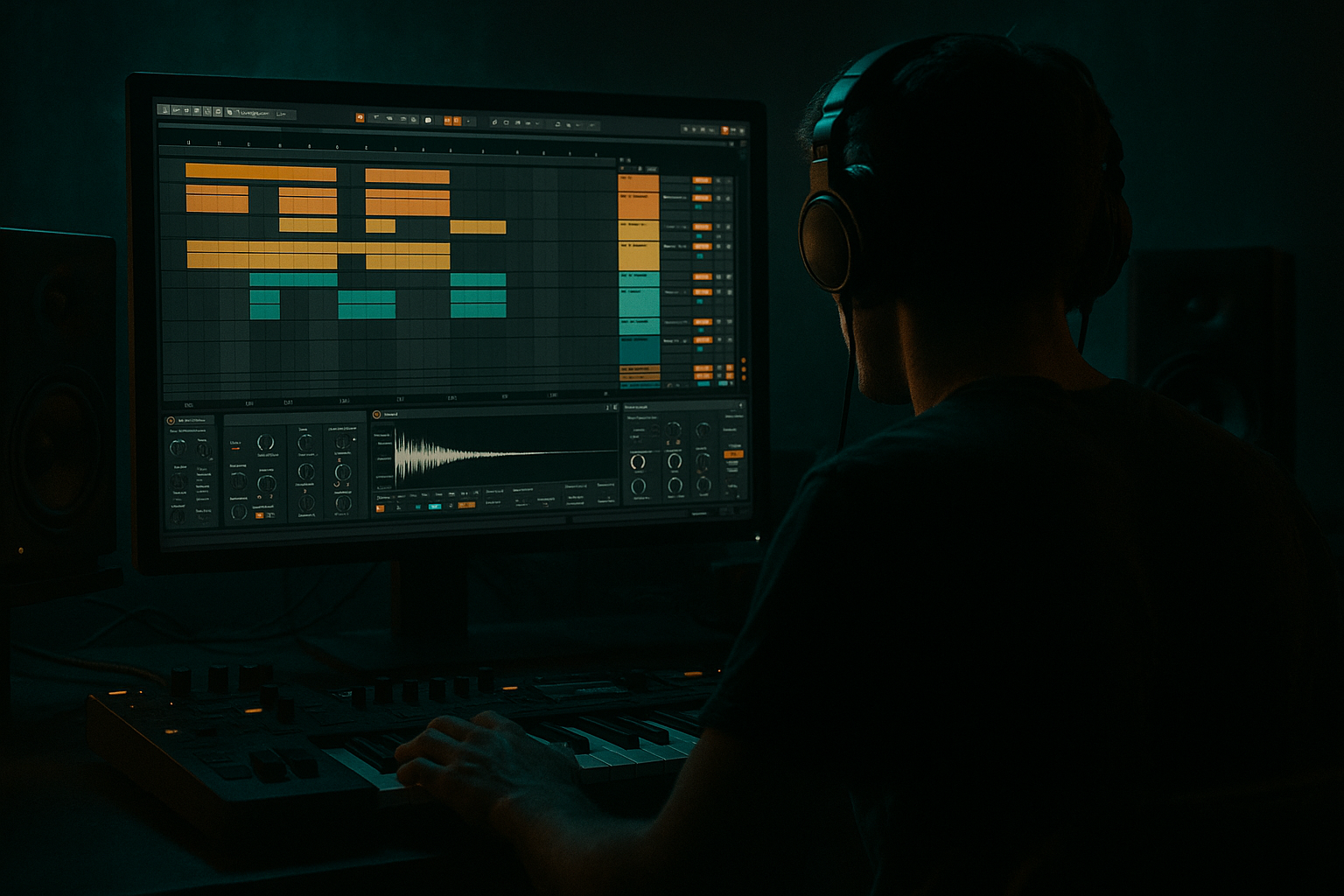
Main tutorial
Impact Layering Basics — Drum & Bass in Ableton Live
Teacher tone: energetic, clear, professional ⚡️
This lesson walks you through building powerful one-shot “impacts” for DnB / jungle / rolling bass music inside Ableton Live using stock devices. You’ll create a layered impact that sits deep in the low end, punches in the mids, and shimmers on top — perfect for drops, bar transitions, and emphasis points at 170–175 BPM.
---
1) Lesson overview
What is an impact?
An impact (aka hit, slam, or “one-shot”) is a layered sound used to punctuate transitions — often a sub thump + punch + click/top + tail. In DnB, impacts give weight to drops and scene changes and help glue heavy elements together.
What you’ll learn:
- How to build a 4-layer impact (Sub, Body, Click, Tail) using Simpler/Operator and Ableton Audio FX.
- Basic layering workflow and phase/align techniques.
- Practical device chains, settings, and macros to control the final sound.
- Arrangement tips and quick variations for heavier/darker DnB.
- Set tempo to 174 BPM.
- Create a new MIDI Track (Cmd/Ctrl + Shift + T).
- Rename it “Impact Rack”.
- Insert an Instrument Rack (Categories → Instruments → Instrument Rack).
- Open the Instrument Rack (show chains). Create four chains and name them: `01 Sub`, `02 Body`, `03 Click`, `04 Tail`.
- Leave them all silent for now.
- On chain `01 Sub`, drop Operator.
- Operator settings:
- After Operator, add `EQ Eight`:
- Add `Utility` and set Width = 0% (sub in mono).
- Set the chain volume so the sub sits around -12 to -6 dB on the master meter when triggered (we’ll mix later).
- Use a short sine or sub-sample in Simpler. Use decay ~250–400 ms. Same EQ/Utility after.
- On chain `02 Body`, use Simpler (One-Shot) and load a kick or engineered “kick/body” sample. If you have a reusable kick sample library, choose one with mid presence.
- Device chain: Simpler → Drum Buss → EQ Eight → Glue Compressor.
- Pan center. This is your meat — controls the attack/body.
- On chain `03 Click`, use Simpler with a snare top, rim/snappy sample, or metal/FX transient.
- Device chain: Simpler → Saturator → EQ Eight → Compressor.
- Slight stereo width (Utility width 110%) or subtle chorus can make it feel bigger but keep the main transient mostly centered.
- On chain `04 Tail`, use an audio reversed cymbal or textural sample (you can create reversed cymbal by placing a crash sample on an audio track and right-click → Reverse, then export or drag into Simpler).
- Device chain: Simpler → Auto Filter (sweep) → Reverb → Ping Pong Delay → EQ Eight.
- Make this chain stereo and wide. It is the “tail” that gives dramatic atmosphere.
- Make sure the transient clicks and the body hit happen at the same MIDI note/time. If using Simpler/Operator, drop a single MIDI note (e.g., C3) — make sure each chain reacts.
- If you hear comb filtering or phase cancellation, nudge the start position of the audio in Simpler or slightly delay the sub by a few ms:
- The sub is often slightly later than the click (2–6 ms) to let the transient cut through.
- On the Instrument Rack, map these Macros:
- On the track (after the Instrument Rack), add:
- Keep peak limiting off unless final loudness is needed.
- Create a simple MIDI clip (1 bar long) with one note on the downbeat — trigger your impact and listen in context alongside drums + bass.
- Mix levels: Sub should sit under the bass. Body and Click should be prominent. Tail is for feel and can be automated per use.
- Typical placements:
- Save the Instrument Rack as a preset to reuse.
- Too many low frequencies across layers → muddy mix. Fix: HP everything except sub (HP on click/tail ~300–500 Hz), low-pass on sub/body as needed.
- Phase cancellation between sub & body → low-end disappears. Fix: nudge/subtle delay, invert phase on one layer to test, adjust sample start times.
- Reverb tail muddying low end → reverb is bleeding sub. Fix: EQ the reverb (cut below 300–500 Hz) or use send/return with filtered reverb.
- Over-saturating the sub → becomes harsh/uncontrollable. Fix: keep sub clean and mono, apply saturation to body/click/tail instead.
- Using long decay tails every time → smears transitions. Fix: create short and long variants and automate macro to choose version.
- Add subtle distortion to the body chain with Saturator in `Analog Clip` mode or use `Overdrive` for grit. Push Drive 4–8 dB but blend in via Dry/Wet or parallel routing.
- Use `Corpus` or an FM Operator on the click chain to create metallic harmonics that cut through 2–6 kHz — great for jungle-style snares/top snaps.
- Use `Redux` lightly on the tail for bitcrush/grit (rate ~8–12 kHz, bits ~10–12) — use in parallel so you keep clarity.
- Parallel multiband processing:
- Automate a lowpass on the tail so the impact opens up: tail LPF at 2 kHz closed → open 1–2 bars before impact for dramatic reveal.
- Use transient emphasis with Drum Buss’s Transient slider to increase punch without killing low end.
- Create “heavy” variant: increase the sub pitch drop (Operator pitch envelope more negative), add extra short noise hit at top end, and map a macro to increase distortion + shorten reverb for slam.
- Build impacts by layering: Sub (sine/pitch drop) + Body (kick/punch) + Click (transient/top) + Tail (reverb/noise). 🔊
- Use Operator/Simpler and stock FX: EQ Eight, Drum Buss, Saturator, Reverb, Glue Compressor.
- Keep sub mono, high-pass non-sub layers, align transients, and glue layers with light compression.
- Map macros (level/brightness/tail) for fast variations and arrangement flexibility.
- For darker/heavier DnB, use distortion, corpus/FM, downsampling, and parallel multiband processing.
Tempo to use: 174 BPM (common for DnB). 🎚️
---
2) What you will build
A single Instrument Rack (or grouped audio stems) with four chains:
1. Sub — clean sine-based thump
2. Body — kick/body sample processed for mid punch
3. Click — high transient/top snap (snare rim / metallic)
4. Tail — reversed cymbal / reverb/noise for atmosphere
You’ll map a few macros (Level, Brightness, Tail) so the impact can be quickly tweaked and used across the arrangement.
---
3) Step-by-step walkthrough
Prereqs: Ableton Live (Lite/Standard/Live Suite are fine). I reference stock devices: Operator, Simpler, Drum Buss, Saturator, EQ Eight, Glue Compressor, Reverb / Hybrid Reverb, Utility, Auto Filter, Ping Pong Delay, Redux.
A. Project prep
B. Create the chain structure
C. Sub layer — the low thump
Option 1 (Operator):
- OSC1 waveform: Sine.
- Amp envelope: Attack 0 ms, Decay 300 ms, Sustain 0, Release 80 ms.
- Pitch envelope: Amount = -18 to -36 semitones (try -24 st), Pitch Env Decay = 120 ms (gives a quick pitch drop for a “thump”).
- Unison: off (keep sub mono).
- Band 1: Low cut 18–25 Hz (HP) if you want to remove inaudible sub rumble (optional).
- Band 2: Low-pass at ~120–160 Hz (slope -24 dB/oct) so this chain sits purely in sub.
Option 2 (Simpler + sample):
D. Body layer — mid punch
- Simpler: set Attack 0–5 ms, Decay 400–600 ms (longer than sub), Start point adjust to taste.
- Drum Buss: Drive 4–8, Boom 2–4 (adds low harmonic weight), Transient 4–8 (adds snap).
- EQ Eight: HP 30 Hz; gentle boost +3 dB at 80–120 Hz (bell) to taste; cut 300–500 Hz if boxy.
- Glue Compressor: Ratio 2:1–4:1, Attack 6–10 ms, Release Auto, Threshold until you get gentle 2–4 dB of gain reduction.
E. Click layer — high transient/top
- Simpler: Short decay 30–100 ms. Turn on One-Shot or use ADSR with short decay.
- Saturator: Drive 3–6 dB, Mode = Soft Clip, Curve medium.
- EQ Eight: High-pass at ~400 Hz (to avoid low conflict); boost 2–6 kHz +3–6 dB for snap.
- Compressor: Fast Attack 1–3 ms, Release 50–150 ms, Ratio 4:1 — lightly clamp to tighten transient.
F. Tail layer — atmosphere and shimmer
- Simpler: set Attack 10–30 ms for fade-in and long decay, one-shot or slice length 1.5–4 s.
- Auto Filter: Envelope amount 30–60% or set an LFO for movement; set LP/HP to shape sweep.
- Reverb (Hybrid Reverb or Reverb): Decay 2–4 s, Pre-delay 20–50 ms, High Cut ~5–8 kHz, Dry/Wet 30–50% (we’ll macro this).
- Ping Pong Delay: Delay time 1/8 — Feedback 25–40%, Dry/Wet 10–20%.
- EQ Eight: Cut below 300–500 Hz to avoid muddying sub/body.
G. Aligning transients and phase
- In the Instrument Rack chain list, click the little “Chain” icon and use the “Delay” field (squares icon → Delay) to add +2–8 ms to the sub or body to tighten the perceived punch.
H. Glue and macros (final glue)
- Macro 1: `Overall Level` — map to chain volumes or final Utility gain.
- Macro 2: `Brightness` — map to Click chain Saturator Drive and Body EQ high-shelf boost.
- Macro 3: `Tail Wet` — map to Tail chain Reverb Dry/Wet and Delay Dry/Wet.
- Drum Buss: Transient +8, Tone +2, Drive minimal — to accent transient if needed.
- Glue Compressor: Ratio 2:1, Attack 6 ms, Release 200 ms, gentle gain reduction 2–3 dB to glue layers.
- Saturator (subtle) or Utility - no more than +1–2 dB of perceived loudness.
I. Testing & arrangement placement
- Bar before drop (full impact with tail).
- On 8-bar markers for scene change (longer tail).
- At end of fills — use short tail, higher brightness.
---
4) Common mistakes (and how to fix them)
---
5) Pro tips for darker / heavier DnB
- Duplicate the impact track, lowpass the duplicate (below 200Hz), clip saturate for sub-distortion, then blend under original.
---
6) Mini practice exercise (20–30 minutes)
1. Create a new track at 174 BPM and an Instrument Rack named `Practice Impact`.
2. Make 4 chains: `Sub`, `Body`, `Click`, `Tail`.
3. Sub: Use Operator. Set amp decay = 300 ms, pitch envelope = -24 st, pitch decay = 120 ms. Make it mono.
4. Body: Load a kick in Simpler. Add Drum Buss (Drive 5, Boom 2), EQ Eight HP 30 Hz, boost 100 Hz +3 dB.
5. Click: Use a snare-top sample. Short decay <100 ms. Add Saturator (Drive 4), EQ boost 3.5 kHz +4 dB.
6. Tail: Reverse a crash sample or use a pad. Reverb decay 2 s, HP 400 Hz, Delay 1/8 25% wet.
7. Map `Overall Level`, `Brightness` (click saturation + body EQ), and `Tail Wet` to Macros.
8. Trigger with a single MIDI note and tweak the macros to make three variations:
- Short punch (Tail Wet ~10%, Brightness + low).
- Big cinematic (Tail Wet ~60%, Brightness moderate).
- Dark heavy (increase Saturator, add Redux 8 kHz/12-bit on tail).
9. Place each variation in a simple 16-bar arrangement: Short punch before snare fill, big cinematic before drop, heavy between sections.
Time-check: you should have three usable impact variants by the end.
---
7) Recap
Have fun building impacts — they’re small sounds that make big moments! If you want, send a short clip of your impact and I’ll give mix feedback and suggest tweaks for maximum punch and clarity. 🚀

