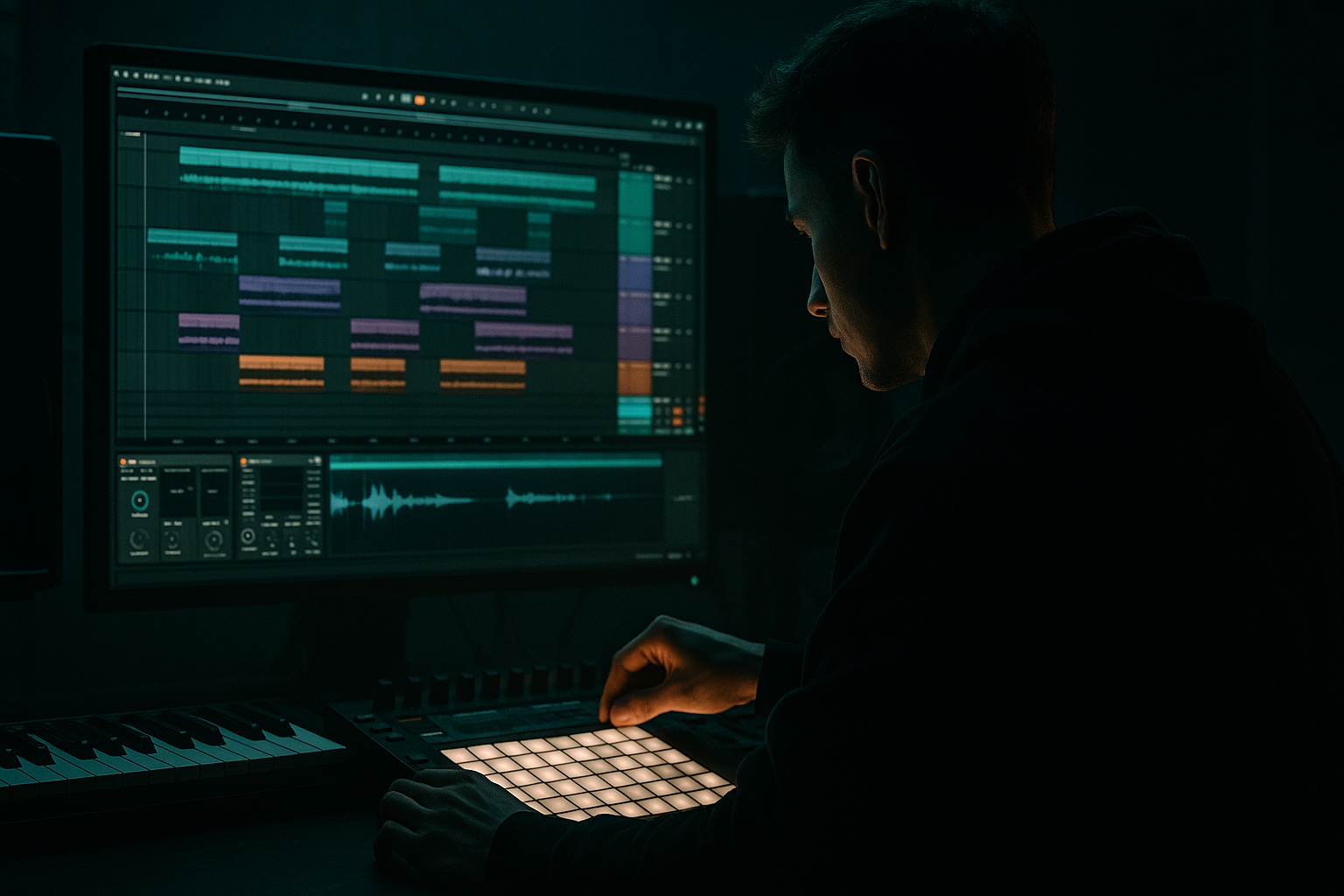
Main tutorial
Intro Glue Workflow for VHS-Rave Color in Ableton Live 12
Beginner mastering tutorial for jungle / oldskool DnB vibes 🎛️🥁
1. Lesson overview
If you want your drum and bass track to feel like it came off a worn VHS tape from a rave in 1994, the key is glue: making the drums, bass, and atmospheres feel like one performance instead of separate sounds.
In mastering, “glue” does not mean making everything loud and flat. It means:
- the kick and snare hit together
- the bass feels locked to the drums
- the top end has a unified texture
- the track sounds like one coherent world, not a bunch of clips stacked together
- chopped breakbeats
- deep sub bass
- dusty atmospheres
- lo-fi edge
- emotional rave synths and samples
- slight tape-style warmth
- controlled low end
- gentle bus glue
- vintage high-end softness
- a little stereo haze for rave atmosphere
- safe final loudness for demos or release prep
- Pull your Master fader down only if needed, but better: keep your mix peaking around -6 dB before mastering.
- Check that your kick and bass are balanced.
- Make sure the sub is mono.
- Don’t master a mix that is clipping all over the place.
- Kick: punchy but not over-loud
- Snare: clearly louder than kick in many oldskool styles
- Bass: present but not swallowing the break
- Breakbeats: energetic, crunchy, not brittle
- Atmospheres: noticeable in the intro, supportive in the full drop
- Band 1: High-pass at 20–25 Hz
- Band 2: Small dip around 250–400 Hz if the track feels boxy
- Band 3: If the top is too sharp, very gentle high shelf around 8–12 kHz
- Ratio: `2:1`
- Attack: `10 ms`
- Release: `Auto` or `0.3 s`
- Threshold: set for about 1–2 dB of gain reduction
- Soft Clip: `On` if you want a slightly denser, more vintage edge
- The drums should feel a bit more connected
- The bass should stop feeling detached from the breaks
- The whole track should “breathe” together
- Drive: `1.5 to 4 dB`
- Soft Clip: `On`
- Curve: leave default or slightly adjust if needed
- Output: compensate so volume stays similar
- makes the kick and bass feel thicker
- brings out breakbeat texture
- gives synth stabs and pads a warmer edge
- creates a subtle “worn media” feel
- If the intro pads feel nicer and the drums feel warmer, good.
- If the low end becomes cloudy, reduce drive or use less low-frequency build-up in the mix.
- Drive: `3–8%`
- Crunch: very low, around `5–15%`
- Boom: usually off for mastering, or very subtle if the track is too thin
- Transients: slightly up if the break needs more snap
- Keep Drive low
- Use a subtle mode or preset
- Blend lightly
- Avoid overcooking the master
- Drum Buss = more classic drum glue
- Roar = more modern character and texture
- Bass Mono: use if available in your version, or manually narrow low frequencies in the mix
- Width: keep at `100%` or slightly less, around `90–95%` if the track feels too wide
- Gain: only if you need a tiny level trim
- Keep sub bass mono
- Let breaks, pads, FX, and reverb have width
- Don’t widen the low end on the master
- Ceiling: `-1.0 dB`
- Lookahead: default is fine
- Gain: raise only enough to catch peaks and bring up loudness slightly
- Aim for clean and punchy
- Don’t chase commercial loudness immediately
- Let the breakbeats breathe
- vinyl noise
- atmospheres
- dub chords
- pads
- chopped breaks entering gradually
- FX and sub drops
- it has one atmosphere
- the textures blend together
- the drums sound like they belong to the same recording world
- the track feels “already in motion”
- slightly reduce upper highs
- emphasize low mids carefully
- preserve snare bite
- reduce compression
- reduce limiter gain
- add a tiny bit more harmonic content with Saturator
- Vinyl Distortion on ambience
- Erosion for gritty top-end texture
- Chorus-Ensemble lightly on pads
- Redux very gently on FX for lo-fi flavor
- Echo with filtered repeats on atmospheric elements
- classic jungle intros
- deep oldskool rollers
- atmospheric DnB with tape-like warmth
- low-end weight
- brightness
- snare presence
- stereo spread
- overall density
- start with filtered pads and noise
- bring in breaks with automation
- open the filter gradually
- delay the full bass drop
- add a short “tape wobble” moment using subtle modulation on FX or pads
- a chopped breakbeat
- a sub bass line
- a VHS-style pad
- vinyl noise or room ambience
- one rave stab or vocal sample
- Bypass the whole chain
- Turn it on
- Ask:
- EQ Eight for cleanup
- Glue Compressor for cohesion
- Saturator for tape-style harmonics
- Drum Buss or Roar for extra character
- Utility for stereo control
- Limiter for safe final peaks
- keep the sub controlled
- preserve the snare
- add warmth, not mush
- let the intro breathe
- use subtlety for vintage vibe
For jungle / oldskool DnB, this is especially important because the style already has:
This tutorial shows you a simple intro glue workflow in Ableton Live 12 to add that VHS-rave color without destroying the punch or the low end.
You will use stock Ableton devices and a light-touch mastering chain that is beginner-friendly and practical. ✅
---
2. What you will build
By the end, you’ll have a basic mastering chain for a DnB intro or full track that gives:
Example chain we’ll build in Ableton Live 12
Place these on your Master track:
1. EQ Eight – cleanup and tone shaping
2. Glue Compressor – subtle bus glue
3. Saturator – VHS-style harmonic thickness
4. Drum Buss or Roar – optional character/weight
5. Utility – bass mono and width management
6. Limiter – final safety ceiling
You can use all of them lightly. The goal is vibe and cohesion, not aggressive mastering.
---
3. Step-by-step walkthrough
Step 1: Prepare your mix before mastering
Before touching the Master chain, make sure your track has decent headroom.
Do this:
For jungle / oldskool DnB:
A good rough balance is:
If the mix is already messy, mastering won’t fix it.
---
Step 2: Put EQ Eight first for gentle cleanup
Add EQ Eight on the Master.
Starting settings:
- Use a gentle slope if possible
- This removes rumble that eats headroom
- Reduce by 1–2 dB
- Reduce by 0.5–1.5 dB
Why this matters for VHS-rave color
Oldskool DnB often sounds thick and slightly worn, but not muddy.
The low cut clears sub-rumble, while a tiny mid dip can make room for the breakbeat and bass to breathe.
Important
Do not over-EQ on the master. If you hear huge changes, you’re probably doing too much.
---
Step 3: Add Glue Compressor for “one-piece” energy
Now add Glue Compressor after EQ Eight.
This is where the track starts feeling like a unified rave record.
Starter settings:
What to listen for
DnB-specific tip
In jungle, the snare and breakbeat transients are important.
If the compressor makes the snare dull or smashes the break too hard, back off the threshold or use a slower attack.
Good rule
If the mastering compressor is doing more than 2–3 dB constantly, it’s probably too much for this style.
---
Step 4: Add Saturator for VHS warmth and harmonics
Next, add Saturator.
This is one of the easiest ways to get that tape-ish, ravey color without buying a plugin.
Starter settings:
What it does
Saturation adds harmonics:
For VHS flavor
You want gentle grit, not obvious distortion.
Think: “slightly baked tape,” not “fuzz pedal.”
A practical move
After adding Saturator, A/B the track:
---
Step 5: Add Drum Buss or Roar for character
This step is optional, but very useful for oldskool flavor.
Option A: Drum Buss
Use Drum Buss if you want a tighter, punchier drum-forward glue.
#### Starting settings:
This can help the breakbeat feel more aggressive and “live.”
Option B: Roar
Use Roar if you want color, harmonic density, and a more experimental VHS-rave edge.
#### Starting idea:
Which one to choose?
For beginner mastering, start with Drum Buss.
---
Step 6: Control the stereo image with Utility
Add Utility near the end of the chain.
This is super important for DnB because low-end phase issues can ruin the power of the track.
Starter settings:
DnB rule of thumb
If your intro has spacious VHS-style synths, widening the full mix too much can weaken the center.
The kick, snare, and bass should still feel anchored.
---
Step 7: Finish with Limiter for safety
Add Limiter last.
This is not for smashing the track. It’s for preventing peaks from clipping.
Starter settings:
Listening target
You want the Limiter to work lightly, not constantly clamp down.
For a beginner DnB master:
If the limiter starts flattening the snare too much, lower the input gain or reduce earlier compression/saturation.
---
Step 8: Check the intro specifically
Because this lesson is about intro glue workflow, listen to the opening section carefully.
In jungle / oldskool DnB intros, you often have:
Your intro should feel like:
A practical mastering trick
If the intro is too clean, use subtle saturation and mild top-end softening to make it feel more cohesive and nostalgic.
If the intro is too dark, restore a little air with a gentle shelf around 10 kHz before the limiter.
---
Step 9: A simple stock Ableton mastering chain example
Here’s a practical chain you can copy:
1. EQ Eight
- HP at 22 Hz
- -1 dB at 300 Hz if muddy
- -1 dB shelf at 10 kHz if harsh
2. Glue Compressor
- Ratio 2:1
- Attack 10 ms
- Release Auto
- 1–2 dB gain reduction
3. Saturator
- Drive +2.5 dB
- Soft Clip On
4. Drum Buss
- Drive 5%
- Crunch 10%
- Keep Boom very subtle or off
5. Utility
- Width 95% if too wide
- Keep lows mono
6. Limiter
- Ceiling -1.0 dB
That’s enough to start learning the feel of glue mastering in Ableton Live 12.
---
4. Common mistakes
1. Compressing too hard
If the Glue Compressor is pumping aggressively, your DnB groove will lose impact.
Fix: Lower threshold, slow the attack, or reduce gain reduction to 1–2 dB.
---
2. Saturating the bass too much
Sub bass can turn messy fast.
Fix: Keep saturation subtle. If needed, saturate mids/highs more than the sub in the mix stage.
---
3. Making the master too bright
A lot of beginners overdo top-end on jungle because they want “shine.”
Fix: Oldskool DnB often sounds slightly softer on top. Aim for character, not sharpness.
---
4. Widening the low end
This can make the track feel weak and phasey.
Fix: Keep sub mono. Leave width for pads, FX, and breaks.
---
5. Trying to “fix” a bad mix on the master
Mastering is not rescue surgery.
Fix: If the kick and bass fight, go back to the mix.
If the break is harsh, tame it in the drum group.
---
6. Making the intro too loud too early
VHS-rave color often comes from contrast and space.
Fix: Keep the intro dynamic. Let it breathe before the drop.
---
5. Pro tips for darker/heavier DnB
Tip 1: Use darker EQ shaping, not just volume
For darker jungle:
A dark master should still have transient definition.
---
Tip 2: Keep the snare authoritative
In oldskool DnB, the snare often drives the energy.
If mastering dulls the snare:
---
Tip 3: Blend analog-style texture before mastering
If you want stronger VHS-rave character, do some of the work earlier in the mix:
Then mastering glue only needs to hold it together.
---
Tip 4: Use reference tracks
Compare your track to:
Match:
Don’t just compare loudness.
---
Tip 5: Automate intro energy in arrangement
Before mastering, make the intro arrangement do some of the VHS-rave work:
Mastering glue sounds better when the arrangement already has shape.
---
6. Mini practice exercise
Build a 16-bar intro in Ableton Live 12 using:
Then do this mastering practice:
1. Put EQ Eight on the master and cut rumble below 22 Hz
2. Add Glue Compressor and aim for 1–2 dB gain reduction
3. Add Saturator with +2 dB drive and Soft Clip on
4. Add Utility and reduce width to 95% if needed
5. Add Limiter with ceiling at -1 dB
Compare A/B
- Does the intro feel more unified?
- Does the break sound more “inside the same room”?
- Did the sub stay solid?
- Did the top get smoother and more nostalgic?
If yes, you’re learning the glue workflow correctly.
---
7. Recap
For intro glue workflow in Ableton Live 12, the goal is to give your jungle / oldskool DnB track that VHS-rave color by making the mix feel unified, warm, and slightly worn without losing punch.
Remember the core chain:
Key mastering mindset for DnB:
If you want, I can also turn this into:
1. a ready-to-copy Ableton master chain preset recipe, or
2. a full jungle mastering template with exact device order and macros 🎚️

