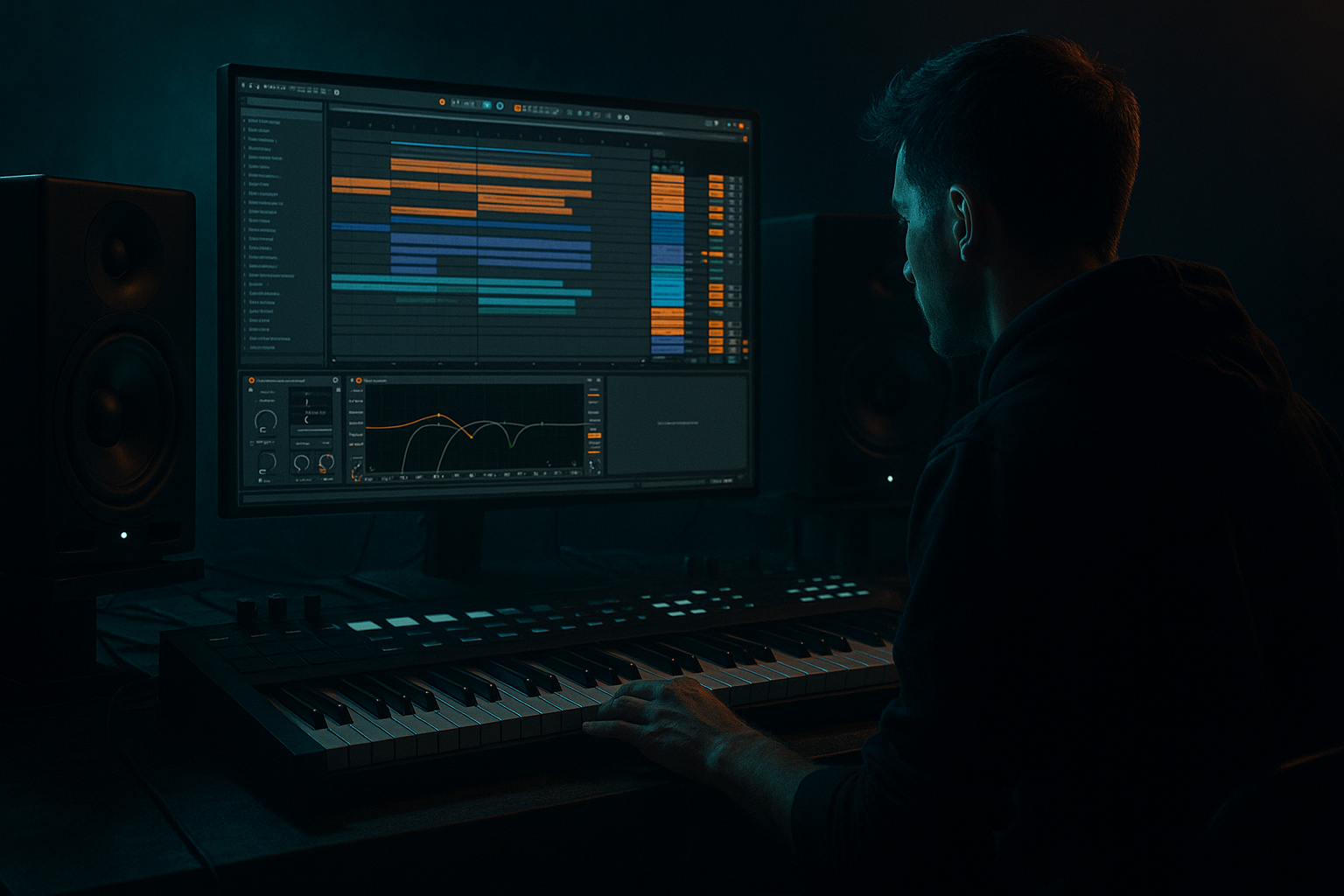
Main tutorial
```markdown
Jacked Breaks Jungle Ragga Cut: Clean + Arrange in Ableton Live 12 (Intermediate) 🥁🔥
1) Lesson overview
In this lesson you’ll take a jungle/ragga break (think: dusty 90s sample, tape-ish top end, messy tails) and turn it into a clean, jacked, DnB-ready edit inside Ableton Live 12. We’ll focus on two big skills:
- Cleaning: remove mud, tame harshness, control transient spikes, keep the vibe.
- Arranging: turn a raw loop into a proper DnB arrangement with fills, drops, and energy management.
- A tight 8–16 bar break edit (main groove + variations)
- A drop-ready drum group with:
- A basic arrangement template: intro → build → drop → switch → outro
- Find the first clear kick transient and set it as 1.1.1 (right-click → Set 1.1.1 Here).
- Adjust warp markers only where it truly drifts. Don’t grid-lock every hit or you’ll kill the swing. 🕺
- In the MIDI clip, keep your core groove but add:
- Bar 1: original groove
- Bar 2: add a 1/16 snare slice right before beat 2 and beat 4
- Start send at -18 to -12 dB, bring up until it adds bite without sounding like a separate layer.
- Choose a short, punchy kick with minimal tail.
- High-pass the kick layer if needed? Usually no—but keep it controlled.
- EQ Eight on kick layer:
- Pick a snare with a nice 200 Hz body and 2–4 kHz crack.
- EQ Eight:
- Earlier = more “snap”
- Later = fatter but lazier
- Start with:
- Add one fill every 4 bars:
- Bring full break in.
- Add a snare roll using slices (1/16 → 1/32 at end).
- Automation:
- Full drums + bass.
- Keep the main break steady for 4 bars, then add variations:
- Change something obvious:
- Strip layers away.
- Keep break but low-pass it down.
- Leave a clean tail for DJs to mix.
- Over-warping every transient: kills swing and makes it sound like a rigid grid loop.
- Too much low end in the break: you’ll fight your bassline forever. HP the break and let bass own sub.
- Parallel crunch with low end included: makes the mix fuzzy and collapses punch.
- Too much Glue compression on breaks: you flatten the life out of it; aim for controlled movement, not a pancake.
- Endless chopping with no groove: edits should support the roll, not distract from it.
- Make the break darker, not dull:
- Sidechain the break to the kick (lightly) if you layer kicks:
- Use Roar for controlled menace:
- Automate crunch for phrasing:
- Make fills with silence:
- Warp with restraint: keep the human swing that makes jungle breathe.
- Slice to MIDI for jacked edits: small, intentional chops > random chaos.
- Clean with stock tools: EQ Eight → Glue → Drum Buss, then parallel crunch for bite.
- Arrange like DnB: phrases, fills, switches, and automation that makes sections feel alive.
- Dark/heavy comes from controlled mid aggression + smart low-end discipline.
You’ll do it using mostly stock devices (EQ Eight, Glue Compressor, Drum Buss, Saturator, Roar, Auto Filter, Utility, Limiter) and a practical workflow that’s quick enough for real production. ⚙️
---
2) What you will build
By the end you’ll have:
- Cleaned break
- Optional layered kick/snare reinforcement
- Parallel crunch bus
- Controlled dynamics (no random peak explosions)
(classic jungle/ragga cut structure)
---
3) Step-by-step walkthrough
Step 0 — Set the session for DnB speed
1. Set BPM to 170–176 (start at 174).
2. Create tracks:
- Audio Track: `BREAK RAW`
- Audio Track: `BREAK CLEAN`
- MIDI Track: `KICK LAYER` (optional)
- MIDI Track: `SNARE LAYER` (optional)
- Return Track A: `PARA CRUNCH`
- Drum Group: group everything into `DRUMS`
> Goal: keep RAW untouched, do your edits on CLEAN so you can always revert.
---
Step 1 — Import + warp like a jungle editor (tight, not sterile)
1. Drag your break loop onto `BREAK RAW`.
2. In the Clip View:
- Enable Warp
- Try Beats mode first
- Preserve: Transients
- Envelope: 60–80%
3. If the break is very “tape/old vinyl” and transient detection gets weird, try:
- Complex Pro (more stable tone), but be careful—it can smear drums.
Workflow tip:
---
Step 2 — Create a clean working copy + consolidate for editing
1. Duplicate the clip from `BREAK RAW` to `BREAK CLEAN`.
2. In Arrangement View, loop 8 bars of the break and Consolidate (`Cmd/Ctrl + J`).
Now you have a stable “edit canvas” you can slice, process, and arrange quickly.
---
Step 3 — Slice to MIDI for jacked rearrangements (fast jungle chopping)
This is where “ragga cut” energy comes from: micro-edits with intent.
1. Right-click the consolidated break clip → Slice to New MIDI Track
2. Choose:
- Slicing Preset: Built-in (works)
- Slice By: Transients
3. Ableton creates a Drum Rack with slices.
Now make it playable:
- Kick re-triggers (often 16th kicks before snares)
- Snare rushes (two quick snare slices leading into bar transitions)
- “Amen-style” turnarounds using 1/8 + 1/16 slices
Practical 2-bar variation idea:
(classic “push” without going full chaos)
---
Step 4 — Clean the break: remove mud, control spikes, keep the snap
Put this chain on the break audio (or on the Drum Rack chain if you’re working sliced):
#### Device chain: BREAK CLEAN (stock)
1. EQ Eight
- HP filter: 24 dB/oct @ 25–35 Hz (remove rumble)
- Gentle cut: -2 to -4 dB @ 200–350 Hz (mud control)
- If harsh: -2 to -5 dB @ 3–6 kHz with a medium Q
- Optional air: +1–2 dB shelf @ 10 kHz (only if it isn’t already fizzy)
2. Glue Compressor
- Attack: 3 ms
- Release: Auto (or 0.1–0.3 s)
- Ratio: 2:1
- Aim for 1–3 dB gain reduction
- Turn on Soft Clip if peaks are spiky
3. Drum Buss
- Drive: 5–15% (taste)
- Crunch: 0–10% (subtle)
- Boom: Off (usually skip Boom on breaks to avoid low-end mess)
- Transients: +5 to +20 (bring snap back after glue)
4. Utility
- If your break has low-end stereo wobble:
- Turn on Bass Mono (if available) or reduce width slightly (Width 80–100%)
Checkpoint:
Your break should feel cleaner and more consistent but still “alive.”
---
Step 5 — Control hi-hat fizz + vinyl noise the right way (surgical)
If the top end is noisy (common in ragga/jungle samples):
1. Add Auto Filter after EQ Eight:
- Mode: Low-pass
- Slope: 12 dB
- Cutoff: 15–18 kHz (just shaving the extreme fizz)
2. If there’s a harsh “ring”:
- Use EQ Eight narrow cut and sweep around 6–9 kHz until it calms.
> Don’t low-pass too low or your break loses that jungle “spray.” ✂️
---
Step 6 — Add a parallel crunch return (instant jacked energy) 💥
On Return A: PARA CRUNCH, build this:
1. Saturator
- Mode: Analog Clip
- Drive: 4–10 dB
- Soft Clip: On
2. Roar (Ableton Live 12)
- Start with a simple setting:
- Distortion type: Tube or Dirt
- Amount: 10–25%
- Tone: slightly dark (don’t brighten too much)
3. EQ Eight
- HP @ 120–200 Hz (keep low end clean)
- Small dip if harsh at 3–5 kHz
4. Glue Compressor
- Ratio 4:1
- Attack 1–3 ms
- Release 0.1 s
- GR: 3–6 dB
Send your break to this return:
---
Step 7 — Reinforce with kick/snare layers (optional but common in modern DnB)
For a “jacked breaks” vibe that still punches in clubs, layer selectively.
#### Kick layer (subtle, not takeover)
- Low shelf boost +1–3 dB @ 60–90 Hz if needed
- Cut 200–400 Hz if boxy
#### Snare layer (crack + consistency)
- HP @ 120 Hz
- Small boost @ 180–220 Hz if thin
- Boost @ 2–4 kHz carefully (harshness lives here)
Timing tip:
Zoom in and nudge layers by ±5–15 ms if needed.
---
Step 8 — Group and bus process like a pro
Group all drum elements into `DRUMS`.
On the DRUMS group:
1. EQ Eight (tiny moves)
- HP @ 20–30 Hz
- If the whole drum bus is honky: tiny cut around 300–500 Hz
2. Glue Compressor (bus glue)
- Ratio 2:1
- Attack 10 ms (let transients breathe)
- Release Auto
- Aim for 1–2 dB GR
3. Limiter (safety, not loudness)
- Ceiling -0.8 dB
- Only kissing peaks (0–1 dB GR)
---
Step 9 — Arrange the ragga cut (energy + call-and-response)
Here’s a practical arrangement you can build in 32–64 bars.
#### A) Intro (16 bars)
- Filtered break (Auto Filter LP @ 500 Hz → 8 kHz over 16 bars)
- Ragga vocal one-shot or phrase sparingly
- Sparse bass preview (or none)
- Reverse snare slice
- 1/8 tape-stop style (use clip fade + quick pitch automation or an effect)
#### B) Build (8 bars)
- Increase PARA CRUNCH send slightly in last 2 bars.
- Add a quick reverb throw on a vocal hit.
#### C) Drop (16 bars)
- Bar 5–8: extra kick slice before snare (classic drive)
- Bar 9–12: swap to alternate 2-bar pattern
- Bar 13–16: bigger fill into the switch
#### D) Switch / Second drop (16 bars)
- Different break variation (more chopped)
- More distortion/parallel
- Half-bar pause (stop drums for 1/2 bar, slam back in)
#### E) Outro (8–16 bars)
---
4) Common mistakes
---
5) Pro tips for darker/heavier DnB 🖤
Use gentle low-pass (16–18 kHz) and add mid bite via Saturator/Roar rather than boosting treble.
- Use Compressor with sidechain from Kick Layer
- GR: 1–2 dB max
This keeps punch without obvious pumping.
- Distort parallel, then EQ out harshness.
- Dark DnB loves midrange aggression (300 Hz–2 kHz), but keep 3–6 kHz in check.
- Less crunch in verses/grooves
- More crunch in drops/fills
That movement feels “produced,” not looped.
- A well-placed 1/4 or 1/2 bar dropout hits harder than 64th-note spam.
---
6) Mini practice exercise (20 minutes) ⏱️
1. Pick one break and set tempo to 174.
2. Warp it cleanly with Beats mode.
3. Slice to MIDI and create:
- 1 main 2-bar pattern
- 2 variations (one “busier,” one “simpler”)
4. Build a 16-bar drop:
- Bars 1–4: main
- Bars 5–8: variation 1
- Bars 9–12: main
- Bars 13–16: variation 2 + fill into next section
5. Add PARA CRUNCH return and automate send:
- +2 to +4 dB more send in bars 15–16.
Deliverable: bounce a quick 32-bar sketch (intro + drop) and listen on low volume—does it still roll?
---
7) Recap
If you want, tell me what kind of break you’re using (Amen-style, think, ragga loop, etc.) and whether your track is more roller or tearout, and I’ll suggest a specific 16-bar chop pattern + processing values tailored to that vibe.
```

