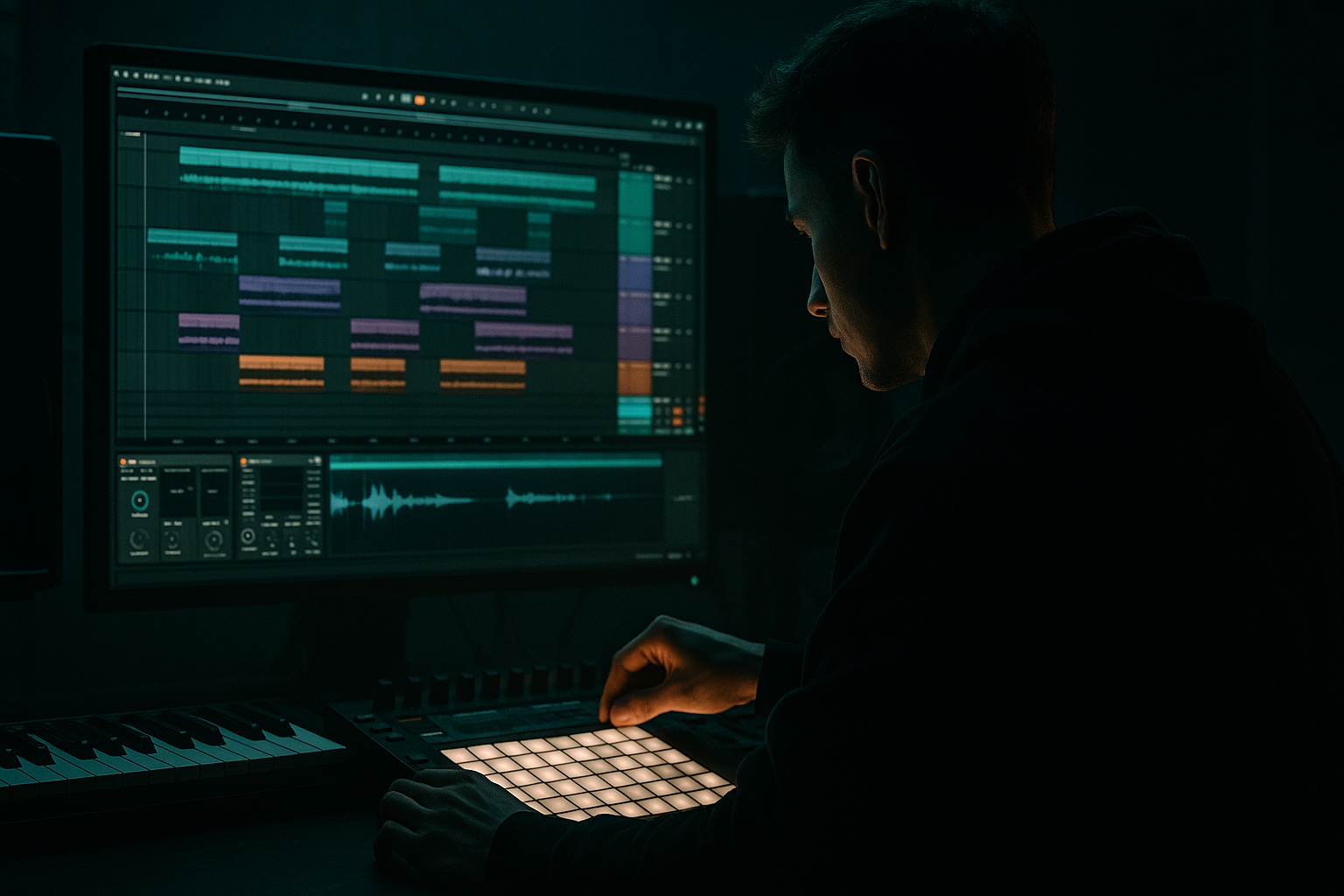
Main tutorial
Jacked Breaks Jungle Top Loop: Drive & Arrange in Ableton Live 12 (Beginner)
Category: Ragga Elements 🇯🇲🥁⚡
---
1. Lesson overview
In this lesson you’ll take a simple jungle/DnB top loop (hats, rides, shakers, bongos, noisy highs) and make it jacked: louder-feeling, brighter, tighter, and more rhythmic—without just turning it up.
You’ll learn how to:
- Create a top-loop bus that hits hard and stays controlled
- Add drive/saturation the DnB way (punch + grit)
- Use gating + transient shaping for that “ch-ch-ch” bounce
- Arrange tops with energy ramps, fills, and ragga-style edits
- Keep it clean with EQ, filtering, and sidechain control
- Top Loop Group with:
- Arrangement automation for intros, drops, and switches
- A few ragga-flavored edits (mutes, tape stops, call/response patterns)
- Drag in a hat/top loop (jungle break tops, ragga shaker loop, ride loop).
- Right-click → Slice to New MIDI Track (choose Transient or 1/16).
- This gives you a Drum Rack with slices you can rearrange.
- Closed hat (tight, short)
- Open hat (short-ish, bright)
- Ride or crashy ride (thin)
- Shaker (stereo if possible)
- Perc hit (rim, bongo, timbale) for ragga flavor
- Closed hats: steady 1/16
- Open hat: on the “&” of 2 and “&” of 4
- Ride: lightly on 1/8 or just on offbeats
- Shaker: syncopated hits (don’t fill every gap)
- High-pass: enable a filter at 200–400 Hz (depends on loop)
- If harsh: dip around 6–10 kHz by -2 to -4 dB, medium Q
- Attack: 3 ms
- Release: Auto (good starter)
- Ratio: 2:1
- Aim for 1–2 dB gain reduction on peaks
- Turn Soft Clip ON (this is very DnB-friendly)
- Leave it mostly as-is (maybe just EQ Eight).
- Set chain volumes so `DRIVE` sits quietly under `CLEAN`.
- You should feel extra urgency, not hear obvious distortion.
- Threshold: lower until hats start cutting nicely (varies by sample)
- Return: 0–6 dB
- Attack: 0.5–2 ms
- Hold: 10–25 ms
- Release: 40–120 ms
- Filter type: HP (high-pass) or BP (band-pass) for thin intros
- Map cutoff to automation.
- Intro (bars 1–17): high-pass up (thin) → slowly open
- Pre-drop (last 2 bars): automate cutoff higher + add resonance slightly
- Drop: filter opens fully (full brightness returns)
- HP cutoff intro: 600 Hz → 200 Hz over 16 bars
- Resonance: 0.8–1.2 (don’t whistle)
- Bars 1–4: full hats
- Bars 5–8: remove ride + add shaker
- Bars 9–12: bring ride back + add a perk fill
- Bars 13–16: drop hats for 1/2 bar before drop
- Mute tops for beat 4 (or last 1/2 bar)
- Let the snare hit alone → instant emphasis 💥
- Use MIDI Note Repeat style chops (or manual duplication)
- Create a quick stutter fill: 1/8 → 1/16 → 1/32 over 1 beat
- Add Beat Repeat
- Automate mix up just before drops.
- Clip tops gently: Glue Compressor Soft Clip + light Saturator = louder without spiky peaks.
- Control 8–12 kHz: if your tops hiss, use EQ Eight to tame that band before heavy drive.
- Make tops narrower at the drop: reduce width slightly so the bass feels huge. (If you have no Utility width control on the bus, at least avoid super-wide samples.)
- Use Phaser-Flanger subtly on a shaker for creepy movement:
- Resample your tops (right-click track → Freeze → Flatten or record resample) and then re-chop for gritty, old-school jungle texture.
- Build or slice a top loop, then group it into a `TOPS BUS`.
- Use EQ Eight + Glue Compressor for clean control and glue.
- Add “jacked” energy with parallel drive (Saturator → Drum Buss → Compression).
- Tighten chatter using Gate and protect the snare using sidechain compression.
- Arrange tops like real jungle: switch patterns, add mutes, automate filters for tension and release.
---
2. What you will build
A playable, arranged jungle top loop system inside Ableton Live 12:
- Clean chain (EQ + dynamics)
- Driven parallel chain (saturation + compression)
- Optional “air” chain (sparkle without harshness)
Result: a loop that sits above rolling drums and bass, with movement and attitude 😤
---
3. Step-by-step walkthrough
Step 0 — Session setup (fast + correct)
1. Set tempo to 170–174 BPM (classic DnB range).
2. In Arrangement View, enable the grid to 1/16 (you’ll be editing hats).
3. Make sure Warp is on:
- For loops: try Beats mode
- Set Preserve: 1/16 (good for hats/shakers)
> If your loop gets clicky: try Complex for noisy tops, but Beats usually keeps the snap.
---
Step 1 — Build your top loop from ragga/jungle-friendly pieces
You have two easy options:
#### Option A: Start from a loop sample
#### Option B: Build tops from one-shots (recommended for control)
Create a MIDI track → Drum Rack, then load:
Beginner pattern (1 bar loop):
🎯 Aim: busy but not constant—DnB tops need space for the snare.
---
Step 2 — Group + bus your tops (important!)
1. Select all your top tracks (or the Drum Rack output track).
2. Cmd/Ctrl + G to Group them.
3. Name it: `TOPS BUS`.
Inside this group, you’ll add controlled drive and a “glued” feel.
---
Step 3 — Clean chain on the TOPS BUS (make room + control harshness)
Add these stock devices in this order:
#### 1) EQ Eight
- Start at 250 Hz, 24 dB/oct
> Tops should not fight bass/kick. Most jungle tops live above ~250 Hz.
#### 2) Glue Compressor (gentle control)
This makes the loop feel like one unit.
---
Step 4 — Make it “jacked”: parallel drive chain (the secret sauce) 🔥
Parallel processing gives you aggression without wrecking your clean tops.
#### Option: Use an Audio Effect Rack
1. Drop Audio Effect Rack on `TOPS BUS`
2. Create 2 chains:
- `CLEAN`
- `DRIVE`
On CLEAN chain:
On DRIVE chain: add:
1) Saturator
- Mode: Analog Clip (great for crunchy jungle bite)
- Drive: start at +4 to +8 dB
- Soft Clip: ON
- Output: reduce so it’s not louder, just thicker
2) Drum Buss
- Drive: 5–15% (small moves!)
- Crunch: 0–10%
- Boom: OFF or very low (tops don’t need low boom)
- Damp: tweak if harsh (turn up Damp to soften highs)
3) Compressor (more pump)
- Ratio: 4:1
- Attack: 10–30 ms (lets transients through)
- Release: 50–120 ms
- Aim for 3–6 dB reduction on the DRIVE chain
Now blend:
✅ If it sounds too fizzy: reduce Saturator drive OR EQ the DRIVE chain with a high-shelf dip.
---
Step 5 — Add rhythmic bounce with Gate (tight jungle chatter)
A classic “jacked” feel comes from controlled tails.
Add Gate after the rack (or on the DRIVE chain):
Goal: reduce washiness and create “tchk tchk” motion. 🥁
---
Step 6 — Sidechain tops to the snare (cleaner drop impact)
You want the snare to smack through the top layer.
1. Add Compressor on `TOPS BUS` (after EQ/Glue is fine).
2. Enable Sidechain
3. Input: your Snare track (or Drum Group with snare)
4. Settings:
- Ratio: 2:1 to 4:1
- Attack: 1–5 ms
- Release: 50–120 ms
- Adjust Threshold for 1–3 dB reduction when snare hits
This gives that “snare owns the moment” jungle snap ✅
---
Step 7 — Movement: Auto Filter + automation (arrangement energy)
Add Auto Filter on `TOPS BUS`:
Typical DnB arrangement moves:
Try:
---
Step 8 — Arrange like jungle: switching patterns + ragga edits ✂️
Here are practical, beginner-friendly moves that sound authentic:
#### A) Call & response every 4 bars
This makes the groove feel “DJ-ready” and rolling.
#### B) 1-beat mutes for impact
At the end of every 8 or 16 bars:
#### C) Ragga-style “chop” using Repeat (quick method)
If you have a vocal/percussion hit:
Even without vocals, chopping a shaker slice works great.
#### D) Add a riser feel with beat-repeat hats
On a duplicate top track (only in transitions):
- Interval: 1 Bar
- Grid: 1/16
- Chance: 20–40%
- Filter on Beat Repeat: slightly high-passed
---
4. Common mistakes
1. No high-pass filter → tops fight bass and the mix gets cloudy.
2. Over-saturating the whole bus → harsh, fizzy, fatiguing highs. Use parallel.
3. Too much stereo width in hats → phasey and weak in mono.
4. Constant full-energy tops for 64 bars → no dynamics, drop feels smaller.
5. Ignoring the snare → tops mask the snare transient; your groove loses punch.
---
5. Pro tips for darker/heavier DnB 😈
- Rate slow, feedback low, mix 5–15%
---
6. Mini practice exercise (15 minutes) ⏱️
1. Create a 1-bar top loop at 172 BPM (hat + shaker + ride).
2. Group into `TOPS BUS`.
3. Build the Audio Effect Rack with CLEAN + DRIVE chains.
4. Add:
- EQ Eight HP at 250 Hz
- Glue Comp (2:1, Soft Clip ON)
- Parallel Saturator (Analog Clip) on DRIVE chain
5. Arrange 16 bars:
- Bars 1–8: filtered intro (Auto Filter HP from 600 → 250 Hz)
- Bars 9–16: full brightness + 1-beat mute on bar 16 beat 4
6. Export a quick bounce and check:
- Can you still clearly hear the snare?
- Do tops feel more energetic without being painfully bright?
---
7. Recap
If you want, tell me what kind of tops you’re using (clean 2-step hats, classic Amen tops, or ragga shaker/percs) and I’ll suggest a specific 8-bar pattern + exact device values for that vibe.

