Main tutorial
Jacked Breaks: Kick Weight Sequence for Deep Jungle Atmosphere in Ableton Live 12 🥁🌲
1. Lesson overview
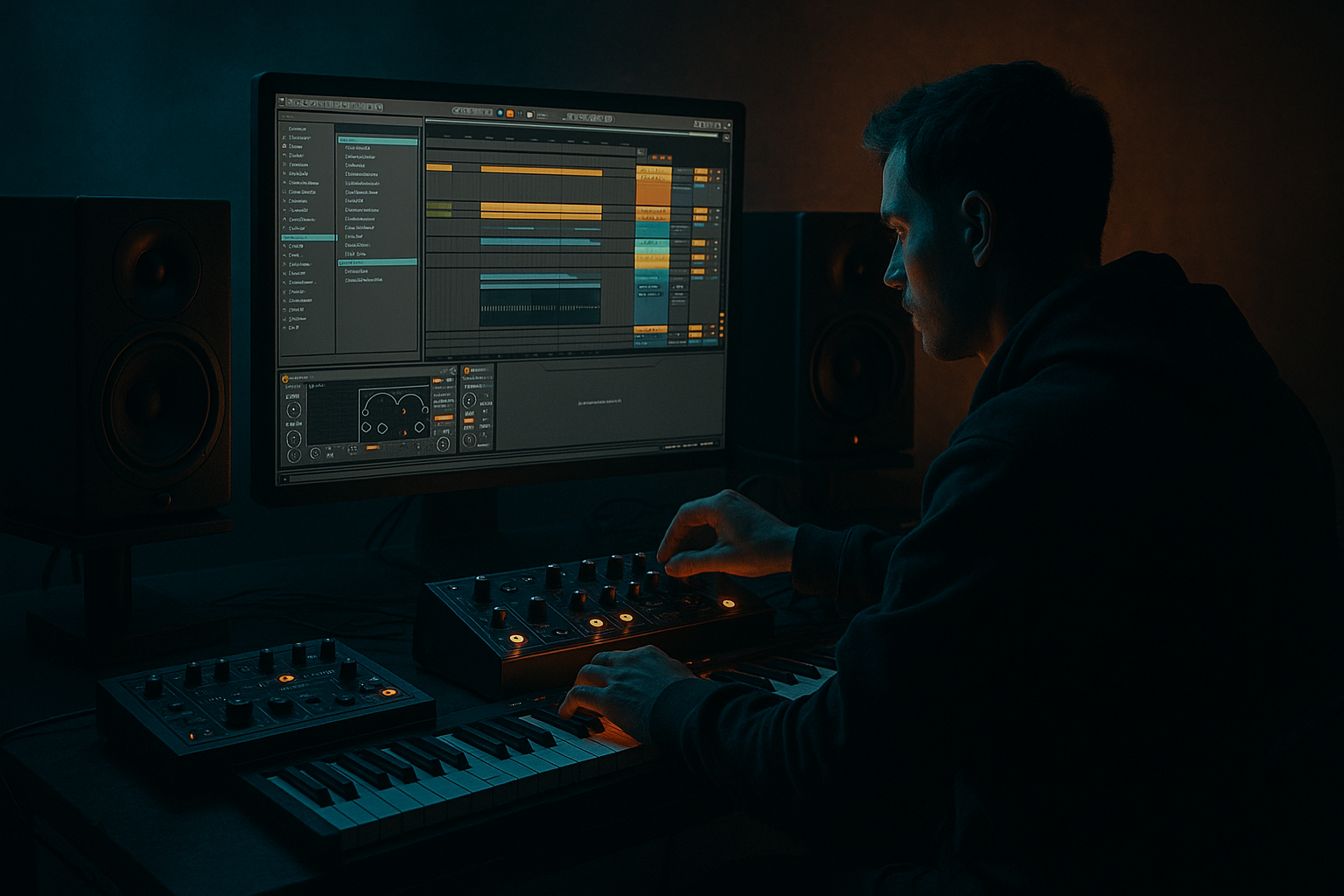
In this lesson, you’ll build a jacked, weighty kick sequence that sits inside a deep jungle / dark DnB atmosphere without losing breakbeat motion. The goal is not just “hard kicks” — it’s kick phrasing that feels like it’s driving the break, creating pressure, and locking into the sub/bass conversation.
We’ll focus on:
- Building a kick weight sequence from a chopped break
- Shaping the kick with Ableton Live 12 stock tools
- Layering and processing for impact without smearing the groove
- Using sequencing, automation, and arrangement to keep it sounding like DnB, not generic half-time
- Designing the kick so it supports deep jungle atmosphere: murky, tense, rolling, and physical
- A 2-bar jack-heavy kick pattern
- A layered kick chain with punch, body, and controlled tail
- A break chop that complements the kick sequence
- A parallel weight bus for extra density
- An arrangement-ready loop that can evolve into a full jungle/DnB drop
- Kick hits with chest-level thump
- Breaks still shuffle and breathe
- Low end stays mono and controlled
- Atmosphere feels dark, humid, and threatening
- Works well around 170–174 BPM
- Clear transient attack
- Some room tone or natural tail
- Enough midrange grit to survive processing
- Amen-style breaks
- Think / funky drummer style cuts
- Darker old-school drum loops with dusty cymbal movement
- Kick on 1
- Extra kick ghost on 1.3
- Main kick on 2
- Light kick or chopped tail on 2.4
- Kick on 1
- Kick on 1.4
- Main kick on 2
- Push kick on 3.3
- Put the kick slice on its own MIDI lane
- Draw notes with varying velocity
- Use short note lengths for tightness
- Offset some hits slightly late for groove, but keep the main downbeats solid
- Clip gain to match the pattern
- Fade in/out to remove clicks
- Warp mode: Complex Pro only if needed for tonal slices; otherwise avoid unnecessary warping on kicks
- For more natural kick slices, keep them as raw as possible
- Low-mid punch
- Natural grit
- Drum identity
- Drum Rack with a sampled kick
- Simpler with a one-shot
- Operator for a very short sine/pitch drop kick if you want synthesized sub-punch
- Oscillator: Sine
- Pitch envelope: downward sweep
- Decay: very short, around 70–140 ms
- No sustain
- Keep it mono
- Main downbeats: higher velocity
- Ghost kicks: lower velocity
- In-between pushes: medium velocity
- Downbeat = 110–127
- Secondary hits = 80–100
- Ghosts = 40–70
- Slightly behind the grid for weight
- Slightly ahead for tension
- Main kick must stay locked
- Only move supporting hits
- An extracted break groove
- Swing from another classic break
- Use sidechain compression from the kick bus
- Keep the kick ducking short and controlled
- Use Compressor or Glue Compressor with sidechain input
- Attack: fast
- Release: timed to the groove, often 50–120 ms
- Let the kick own 50–90 Hz
- Keep bass slightly above or below depending on the arrangement
- Use EQ Eight on bass to carve space around the kick fundamental
- Rain textures
- Vinyl noise
- Distant jungle ambiences
- Low-passed field recordings
- Reverse cymbals or eerie risers
- Auto Filter: low-pass it
- Reverb: long decay, but filtered
- EQ Eight: remove low-end buildup below 150–250 Hz
- Utility: narrow or mono the low atmosphere if needed
- Intro: filtered break elements, no full kick weight yet
- Build: introduce the kick on sparse hits
- Drop 1: full kick sequence with bass
- 8-bar variation: remove one kick, add a fill, or shift a ghost hit
- Drop 2: heavier processing, more saturation, or a new kick layer
- Replace one kick with a tom hit
- Reverse a kick into a downbeat
- Add a snare flam before a big kick phrase
- Drop out the kick for half a bar to make the return hit harder
- Mild drive for harmonic weight
- Transients up for attack
- Boom for low-end reinforcement, used sparingly
- A click layer
- A saturated upper body
- A tiny bit of 200–500 Hz character if it helps the drum read on smaller systems
- Saturator
- Redux
- Overdrive
- EQ Eight
- Increase saturation slightly in the second drop
- Raise transients in fills
- Pull down low-end boom before a breakdown
- Start with a strong break and slice it intelligently
- Build kick weight using body, punch, and click
- Use Drum Buss, Saturator, EQ Eight, Glue Compressor, Utility, and Operator
- Keep the kick short, punchy, and mono-compatible
- Use velocity, micro-timing, and arrangement variation to create motion
- Make space for the kick in the bass and atmosphere
- Resample and refine for a more unified final sound
This is an advanced drums lesson, so we’ll assume you already know your way around warping, slicing, and basic drum processing. We’re going deeper into feel, transient control, low-end management, and groove architecture.
---
2. What you will build
By the end, you’ll have:
The sound target:
---
3. Step-by-step walkthrough
Step 1: Set the tempo and choose the right break
Set your project to 172 BPM as a strong starting point.
In a jungle/DnB context, choose a break with:
Good source types:
Step 2: Chop the break into slices
Drag the break into an audio track.
Then:
1. Right-click the clip
2. Choose Slice to New MIDI Track
3. Use:
- Transient for precise chopping, or
- 1/16 if you want more rigid sequencing control
This creates a Drum Rack of slices, which is ideal for advanced kick phrasing.
Why this matters:
You want the kick to feel like it’s inside the break ecosystem, not pasted over it.
---
Step 3: Identify the kick slice and build a kick sequence
Open the sliced Drum Rack and find the kick-heavy slice.
You want to create a weight sequence, meaning the kick appears in a deliberate pattern that adds propulsion and density.
Try this kind of 2-bar pattern at 172 BPM:
Bar 1
Bar 2
This gives a sense of jacked forward motion without sounding like straight 4-on-the-floor.
#### Practical MIDI approach
If using Drum Rack slices:
#### If using audio clips instead
Duplicate the kick hit into a separate audio track and manually place the hits with sub-frame accuracy. Then consolidate once the pattern feels right.
---
Step 4: Tighten the kick with clip envelope and gain shaping
Open the kick slice sample in the clip view.
Use:
If the kick tail is too long, shorten the clip or slice the tail off so it doesn’t smear into the bassline.
Rule:
In DnB, the kick should feel heavy and short, not bloated.
---
Step 5: Build a kick layer stack
Now we’ll design the kick in three layers:
#### Layer 1: Body
Use the original kick slice or a kick sample from the break.
Goal:
#### Layer 2: Punch
Add a short synthetic kick or a transient-heavy kick sample.
Good stock options:
Suggested synth kick settings in Operator:
#### Layer 3: Click/attack
Use a small click or top transient from a break slice.
This helps the kick cut through dense atmospheres and distorted bass.
---
Step 6: Process each layer cleanly
#### Kick body chain
On the kick body channel, try:
1. EQ Eight
- High-pass only if needed, around 20–30 Hz
- Small boost around 50–80 Hz if the sample supports it
- Cut muddy area around 180–350 Hz if boxy
2. Drum Buss
- Drive: low to moderate
- Boom: subtle, tuned to the track
- Transients: slightly up if the kick lacks edge
3. Saturator
- Soft Clip ON
- Drive: 1–4 dB
- Keep output compensated
#### Kick punch chain
On the punch layer:
1. EQ Eight
- HP around 40–60 Hz to stay out of the sub pocket
- Emphasize 100–140 Hz if needed
2. Transient shaping
- If you prefer stock-only: use Drum Buss transients or Glue Compressor with fast attack/release tastefully
3. Utility
- Keep mono
- Reduce gain if it’s dominating
#### Click layer chain
1. EQ Eight
- High-pass around 200–400 Hz
2. Saturator
- Light drive
3. Hybrid Reverb or Reverb very lightly if you want it to sit in the atmosphere, but be careful: too much wash kills punch
---
Step 7: Glue the layers into a single kick bus
Route all kick layers to a Kick Bus group.
On the bus, use a chain like:
1. EQ Eight
- Tidy sub rumble below 20–25 Hz
- Optional small dip at 250–400 Hz if muddy
2. Glue Compressor
- Attack: 10–30 ms
- Release: Auto or 0.1–0.3 s
- Ratio: 2:1
- Aim for 1–3 dB gain reduction
3. Saturator
- Drive: 1–2 dB
- Soft Clip ON
4. Utility
- Width: 0% if you want total mono in the low end
- Gain trim to final level
This gives you one unified kick image with impact and consistency.
---
Step 8: Add jack motion with velocity and micro-timing
Now make it feel alive.
#### Velocity
Try a velocity arc across the bar:
#### Micro-timing
Move some ghost kicks:
Be careful:
#### Groove Pool
Try subtle groove from:
Apply around 10–25% groove amount to supporting hits only, not the whole bus if it weakens the downbeat.
---
Step 9: Make the sequence work with the bassline
This is where the jungle atmosphere becomes real.
You want the kick to interlock with bass movement, not fight it.
#### Practical method
In your bass channel:
If your bass is a Reese or dark sub:
#### Important
If your kick is tuned around, say, 55–60 Hz, make sure your sub doesn’t constantly occupy the same exact band at full level.
---
Step 10: Add atmosphere without burying the drum weight
Now build the deep jungle mood.
Add:
Process atmosphere so it frames the kick:
The trick is to leave a pocket for the kick to feel massive.
---
Step 11: Arrange it like a DnB weapon
A great kick sequence needs arrangement contrast.
#### Suggested structure
#### Variation ideas
In jungle, tension is everything. A strong kick sequence becomes more powerful when it has space and interruption.
---
4. Common mistakes
1. Making the kick too long
A long kick tail can blur the groove and fight the bassline.
Fix: shorten the sample, use gating, or reshape with clip gain.
2. Overprocessing the kick layers
Too much compression, saturation, and reverb will flatten the hit.
Fix: process in stages and keep each layer focused on one job.
3. Letting the kick and sub occupy the same space constantly
That leads to muddy low end and weak impact.
Fix: use sidechain and EQ separation.
4. Using too much swing on the main kick
If everything swings, the drop loses authority.
Fix: keep primary downbeats locked; apply swing only to supporting hits.
5. Ignoring phase between kick layers
Layered kicks can cancel low end if misaligned.
Fix: zoom in, nudge layers, and compare in mono.
6. Making the break too clean
Jungle/DnB often thrives on grit and instability.
Fix: preserve some break texture, then control it with shaping, not sterilization.
---
5. Pro tips for darker/heavier DnB
Tip 1: Tune the kick to the track key
A kick with a strong fundamental near the track key area can feel more musical. Even in aggressive DnB, tuning matters.
Use Tuner or your ears and compare the kick fundamental to the bass.
---
Tip 2: Use Drum Buss for instant density
Drum Buss is one of the best stock Ableton devices for this style.
Great uses:
---
Tip 3: Make the kick “speak” in the midrange
A sub-only kick won’t cut through dark atmospheres.
Add:
---
Tip 4: Resample your kick bus
Once the kick stack feels right:
1. Resample it to audio
2. Process the printed version lightly
3. Re-chop if needed
This often makes the drum feel more unified and “finished.”
---
Tip 5: Use parallel dirt, not full-time dirt
Create a return track with:
Blend in only a little of this return to add menace without wrecking punch 😈
---
Tip 6: Automate the kick bus subtly
For arrangement movement:
Small changes keep the groove evolving.
---
6. Mini practice exercise
Exercise: Build a 2-bar jacked kick phrase
#### Goal
Create a 2-bar kick sequence that feels like deep jungle pressure, not a standard loop.
#### Instructions
1. Set project to 172 BPM
2. Load a break into a Drum Rack
3. Slice it to MIDI
4. Pick one strong kick slice and one clicky transient slice
5. Program this rough shape:
- Bar 1: strong kick on 1, ghost on 1.3, main hit on 2, support on 2.4
- Bar 2: strong kick on 1, extra push on 1.4, main hit on 2, variation on 3.3
6. Layer a short synthesized kick in Operator under the main hits
7. Group all kick layers and process with:
- EQ Eight
- Drum Buss
- Saturator
- Utility
8. Sidechain your bass to the kick bus
9. Add one atmosphere layer and check whether the kick still feels heavy
#### Challenge
Export the result as audio and re-import it. Then compare the printed version to the live layered version. Decide which one feels more aggressive and why.
---
7. Recap
You’ve now got a practical method for building a jacked breaks kick weight sequence in Ableton Live 12 for deep jungle and dark DnB.
Key takeaways:
If you get this right, the drums won’t just loop — they’ll drive the whole record 🔥
If you want, I can also turn this into:
1. a 1-bar MIDI pattern example,
2. an Ableton device chain template, or
3. a follow-up lesson on bass interplay for this kick style.

