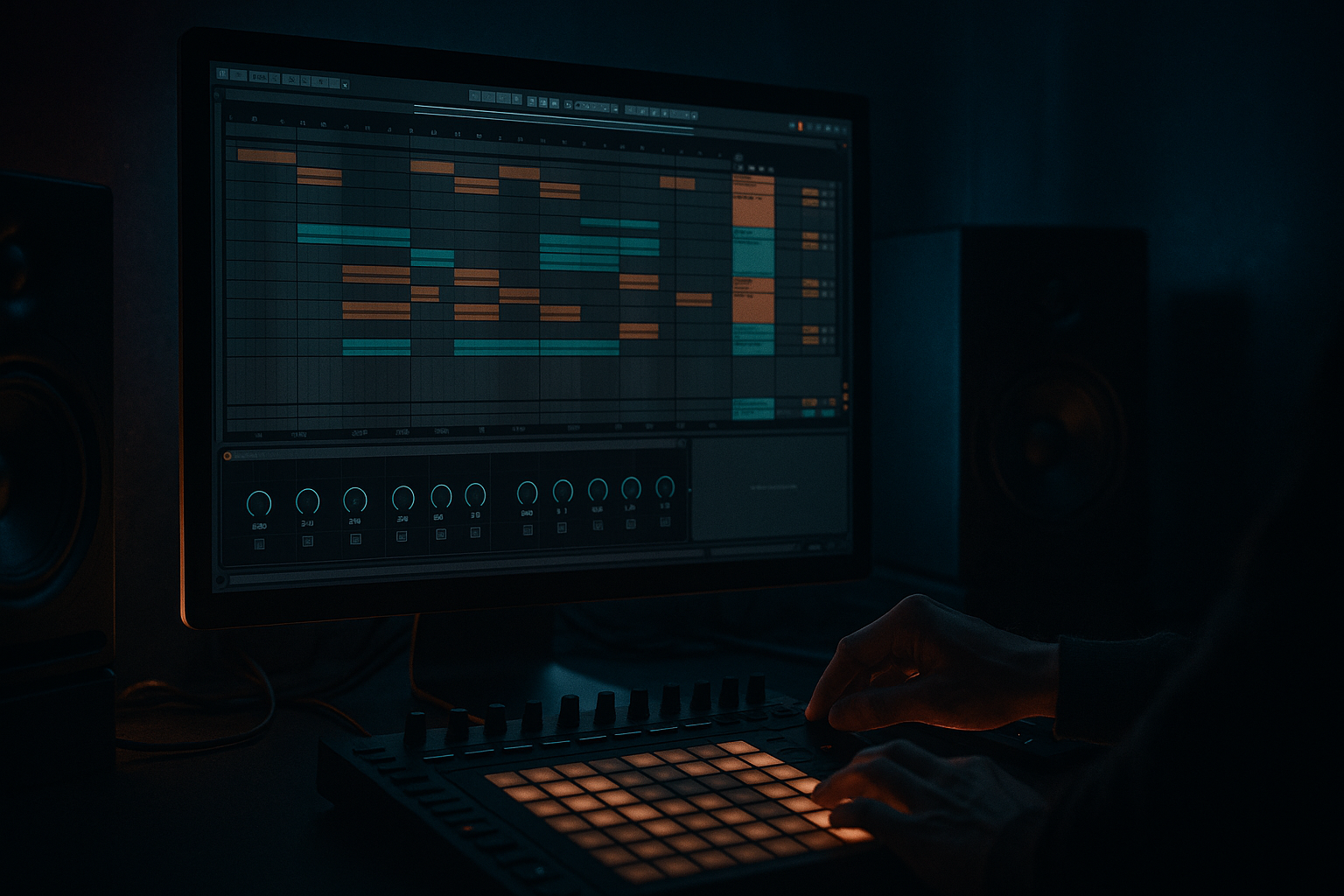
Main tutorial
Lesson Overview
This lesson is about building a jacked, sliced mid-bass for jungle / oldskool DnB inside Ableton Live 12, then mixing it so it sits properly against a chopped breakbeat and sub. The goal is not just “make a bass sound cool” — it’s to create a mid-range bass phrase that feels like it was cut from the same world as classic rave/jungle records, but mixed cleanly enough for modern systems.
In DnB, the mid-bass slice is often the character layer that gives the drop its attitude: a short hook, a syncopated answer to the drums, or a gritty riff that pushes the groove forward without fighting the sub. In oldskool jungle especially, this kind of bass treatment works because it can mimic the chopped, sample-based energy of the era: tight edits, rhythmic gaps, gritty harmonics, and call-and-response with the break.
Why this matters in mixing: if your mid-bass is too wide, too long, or too bright, it will smear the break and mask the sub. If it’s too clean, it loses the bite that makes jacked breaks feel alive. The trick is to shape the mid-bass as a rhythmic object first, then mix it for punch, mono compatibility, and space. ⚡
What You Will Build
By the end of this lesson, you’ll have a 16-bar Ableton Live DnB drop section featuring:
- A jacked break with chopped transients and ghost-note-style movement
- A mid-bass slice built from a short synth stab or resampled bass hit
- A sub layer underneath that stays mono and stable
- A drum/bass groove that locks into a jungle-style swing
- FX and automation that create tension, drop weight, and switch-ups
- A mix that keeps the low end controlled, the mids aggressive, and the stereo image disciplined
- Bars 1–4: stripped intro to the drop, tension building
- Bars 5–8: bass phrase enters with the break, answer-and-push rhythm
- Bars 9–12: variation with note shifts and filter movement
- Bars 13–16: mini switch-up or fill, setting up the next 8 bars
- Making the mid-bass too long
- Letting the mid-bass overlap the sub too much
- Using too much stereo width on low-mid bass
- Over-saturating before the groove is working
- Clashing with the snare and break transients
- Ignoring arrangement
- Resample the bass through a grittier chain
- Use tiny pitch nudges for menace
- Layer a very quiet noise or texture
- Automate saturation on the last hit of a bar
- Use call-and-response with the break
- Keep a dry version of the bass
- For extra underground character, filter the top end intentionally
- Build the sub and mid-bass separately so the low end stays controlled.
- Keep the mid-bass short, rhythmic, and call-and-response with the break.
- Use Saturator, EQ Eight, Drum Buss, Compressor, and Utility to shape tone and mix balance.
- Check mono compatibility, low-end separation, and drum/bass timing constantly.
- Arrange in 8-bar phrases with small variations, fills, and automation to keep the drop moving.
Musically, think:
This is a practical workflow for rollers, jungle, darker half-time DnB, and oldskool-inspired drop sections — the kind of pattern you’d actually want to replay and adapt in future tunes.
Step-by-Step Walkthrough
1. Set up a tight drum/bass session first
Create three main tracks in Ableton Live:
- Drums: your breakbeat or break layer
- Sub: a dedicated mono sub track
- Mid Bass Slice: the character layer we’re building
Start by loading your break onto an audio track. If you’re using a classic break, slice it to a drum rack or manually cut it in Arrangement View. For the groove, nudge the break until the kick and snare accents feel like they “lean” into the bass instead of sitting on top of it.
For the drum track, add Drum Buss lightly:
- Drive: 5–15%
- Crunch: 0–10%
- Boom: usually off or very low if the sub is separate
Why this works in DnB: jungle and oldskool drum programming depends on transient clarity and syncopation. A tight break makes the bass slice feel more rhythmic, because the bass can answer the drums rather than blur into them.
2. Build a mono sub foundation before the mid-bass
On a separate MIDI track, use Operator, Wavetable, or even Analog for a pure sub. Keep it simple:
- Oscillator: sine or triangle-like tone
- Mono mode: on
- Glide: very short if you want slight movement, around 10–40 ms
- Filter: open, or only gently rolled if needed
Add Utility after the synth:
- Width: 0%
- Gain: set so the sub is not overdriving the mix
Write a bassline that supports the break, not one that constantly fills every gap. In jungle and DnB, the sub often works best when it leaves rhythmic space for the kick/snare pattern. Use short notes and occasional longer notes to anchor phrasing.
Mix target: your sub should feel strong but not obviously loud. If you can “hear” it as a separate sound in small speakers, it’s probably too harmonic. You want to feel it below the mid-bass.
3. Create the mid-bass slice from a short source
For the mid-bass slice, start with a source that has body and edge. Good stock Ableton options:
- Wavetable with a saw-rich or detuned source
- Operator with a harmonically richer patch
- A resampled bass hit from your own sound design chain
Keep the note length short and punchy. The goal is not a sustained reese pad — it’s a slice. Program a 1/8 or 1/16 rhythm with gaps. Think “jacked”, not “legato”.
Suggested starting settings:
- Unison detune: low to moderate
- Filter cutoff: around 300 Hz to 2 kHz, depending on the tone
- Amp envelope: fast attack, short decay, little or no sustain
- Release: very short, just enough to avoid clicks
If you’re using Wavetable, try:
- Osc 1: saw-based wavetable
- Osc 2: another saw or slightly different harmonic shape
- Filter: Lowpass 24 or Bandpass if you want a more “sliced” mid character
- Drive: moderate, then shape with saturation later
The key is to leave the sound dry and controllable at first. Don’t over-FX it before the groove works.
4. Shape the jacked character with saturation and transient control
Insert a processing chain on the mid-bass track:
- Saturator
- Drive: 3–8 dB
- Soft Clip: on
- Color: optional, slight low emphasis if the tone needs density
- Drum Buss or Roar if you want more aggressive edge
- Use only enough to add bite and harmonics
- Be careful not to flatten the transient completely
- EQ Eight
- High-pass around 80–150 Hz to stay out of the sub
- Cut muddy zone around 200–400 Hz if it clouds the break
- Small boost around 700 Hz–2.5 kHz if you need talky presence
In DnB mixing, this step is where the bass slice becomes readable on smaller systems. The saturation generates harmonics so the bass is audible even when the sub is removed from the equation. That’s especially important in oldskool jungle-inspired tracks, where the bass needs to speak in the mids while the sub holds the floor.
5. Program the bass rhythm against the break, not on top of it
Write the mid-bass phrase in the MIDI clip using the break’s accents as your guide. A strong oldskool/DnB trick is to place bass hits:
- after the snare, creating push
- in gaps between kick/snare hits, creating bounce
- as brief answers to break fills
Try a 2-bar pattern where:
- Bar 1 has 3–4 short hits
- Bar 2 leaves more space and ends with a pickup note
- Repeat with a slight variation in bar 4 or 8
Use velocity variation to shape movement. Even if the synth itself is the same, the phrase becomes more human and more “sampled” when some notes hit harder than others.
Also try note length differences:
- Shorter notes for jack
- Slightly longer notes for emphasis or transition notes
If the groove feels stiff, use Groove Pool with a subtle swing from a break-inspired template, or manually shift some notes by a few milliseconds. Don’t over-swing the bass; in DnB, too much swing on the bass can make the drop feel lazy.
6. Make the slice feel alive with automation and resampling
Once the basic rhythm works, automate the mid-bass to create movement across 8 or 16 bars.
Good automation targets:
- Filter cutoff: open slightly into fills or drop entries
- Saturator drive: increase by a small amount in high-energy moments
- Auto Filter resonance: keep subtle, around 0.5–1.5 if used
- Device on/off or rack macro: for quick variation between sections
For extra jungle flavor, resample the bass slice:
- Record 4–8 bars of the bass into a new audio track
- Chop the rendered audio into small pieces
- Reverse or pitch a few fragments
- Rebuild a phrase from those slices
This resampling approach makes the bass feel more like an edited break than a static synth. That matters in jungle and oldskool DnB because the genre’s energy often comes from fragmentation, not long sustaining notes.
7. Lock the low end with sidechain and mono discipline
Use Compressor on the sub or bass bus with sidechain from the kick if the kick and sub are colliding. Keep it subtle:
- Ratio: 2:1 to 4:1
- Attack: 5–20 ms
- Release: 50–120 ms, timed to the groove
- Gain reduction: usually 1–4 dB on peaks
If the mid-bass has low-end buildup, high-pass it more aggressively. Your sub should own the true low fundamentals, while the mid-bass owns the movement and harmonics.
Add Utility on the bass bus:
- Width: keep low end mono
- Use Bass Mono if you’re working with a wide bass layer and want to keep the bottom centered
Check your mix in mono regularly. If the bass slice disappears or gets hollow in mono, you likely have too much stereo widening, phasey chorus, or excessive detuning in the low mids.
8. Bus the drums and bass for glue, not for flattening
Route your break track and mid-bass to separate buses if needed:
- Drum Bus
- Bass Bus
On the Bass Bus, use gentle glue-style control:
- Glue Compressor
- Ratio: 2:1
- Attack: 10–30 ms
- Release: Auto or 0.1–0.3 s
- Gain reduction: just 1–2 dB
On the Drum Bus, keep transient energy intact:
- Light Drum Buss
- Small EQ cleanup if the snare is harsh or the hats are spiky
The goal is not to squash everything into one wall. In DnB, punch comes from controlled contrast: the drums snap, the bass answers, the low end stays stable. If you over-compress, the whole phrase loses the “jacked” feeling.
9. Design arrangement with DJ-friendly phrasing
For a practical DnB section, think in 8-bar blocks:
- Bars 1–8: core drop groove
- Bars 9–12: variation, extra bass note, extra break fill
- Bars 13–16: tension lift, filter move, fill, or turnaround
Add a short FX build using stock Ableton tools:
- Reverb on a send, heavily filtered
- Echo for a throw on the final bass hit of a phrase
- Auto Filter on noise or atmosphere for rising tension
You can also place a tiny stop-time moment before the switch-up: mute the bass for half a bar, let the break fill breathe, then bring the slice back with more saturation or a filter opening. That kind of move is classic in jungle and roller arrangement because it creates release without changing the whole drop.
10. Mix-check the bass slice against the break in context
Soloing is useful, but DnB bass is judged in context. Listen to:
- kick + snare + sub + mid-bass together
- the break loop at full drop level
- the section in mono and in stereo
Ask:
- Does the bass slice hit between the drum accents?
- Is the sub still the lowest authority?
- Is the bass audible without making the snare dull?
- Do the hats and break tops still have air?
Use EQ Eight to carve tiny spaces if needed:
- remove harshness around 2.5–5 kHz if the bass is barking too hard
- tame boxiness around 300–500 Hz
- keep the deep low end clean and centralized
This is the real mixing win: the bass slice should sound aggressive, but the drum groove should still read clearly. That balance is what makes the drop feel like a proper DnB system tune.
Common Mistakes
- Fix: shorten note lengths, reduce release, and let the break breathe.
- Fix: high-pass the mid-bass higher, or simplify the subline.
- Fix: keep sub mono, narrow the bass bus, and check mono regularly.
- Fix: get the rhythm right first, then add drive in controlled amounts.
- Fix: move bass notes slightly off the snare, or reduce bass attack/release so the drum remains sharp.
- Fix: build 8-bar phrases with a variation or fill every 4 or 8 bars so the bass slice doesn’t feel looped and static.
Pro Tips for Darker / Heavier DnB
- Try Saturator into EQ Eight into Drum Buss, then chop the rendered audio for a more aged, sample-like feel.
- A small pitch drop on the last note of a phrase can create that darker “pull down” energy common in neuro and half-step DnB.
- Add a filtered noise layer or atmospheric vinyl-style texture, but keep it low so the bass slice gains weight without becoming obvious.
- A slightly hotter final note makes the phrase feel like it leans forward into the next bar.
- Let the bass hit answer the snare fill, not compete with it. This keeps the groove nasty and intelligible.
- Duplicate the track or use an Audio Effect Rack so you can compare the raw slice with the processed one and avoid overcooking the tone.
- A darker bass doesn’t always need more brightness. Sometimes a controlled bandpass or gentle lowpass gives it more authority because it sounds focused, not hyped.
Mini Practice Exercise
Set a 15-minute timer and do this:
1. Load a break and make a 4-bar loop.
2. Build a mono sub line with only 3–5 notes.
3. Create a short mid-bass slice in Wavetable or Operator.
4. Add Saturator and EQ Eight to shape the tone.
5. Write a 2-bar bass rhythm with at least one rest between hits.
6. Duplicate it into 8 bars and add one variation every 4 bars.
7. Check mono, then adjust width and high-pass filtering.
8. Bounce the bass slice to audio and chop one 1-bar section into a new fill.
Goal: by the end, you should have a clean, jacked 8-bar DnB groove with a sub, a gritty mid-bass slice, and one switch-up.
Recap
The big idea: in jungle and oldskool DnB, the bass slice should feel like part of the breakbeat ecosystem — not a separate layer sitting on top. When the rhythm, tone, and mix all lock together, the whole tune gets that jacked, replay-worthy energy.

