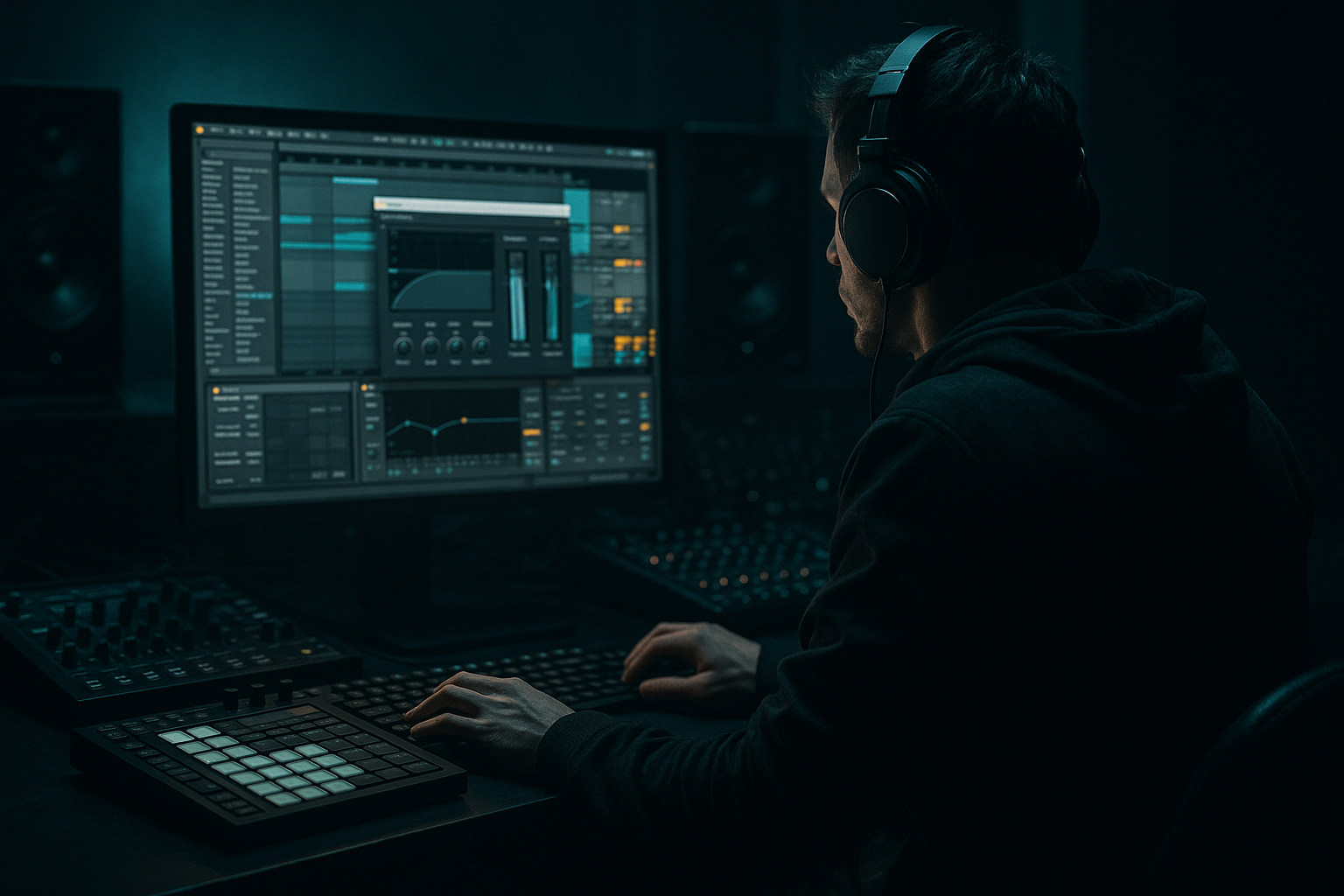
Main tutorial
```markdown
Jungle Bass Fills from Resampled Tails (Ableton Live) 🥁🔊
1. Lesson overview
In jungle and rolling DnB, bass fills often feel like they speak between phrases—little slurs, dives, and gritty flicks that glue the groove together. A powerful (and very “old-school jungle meets modern workflow”) technique is to resample the tail of your bass and turn it into quick fills: pitch dips, reverse swells, distorted yelps, and micro-stutters.
This lesson shows a beginner-friendly way to do it entirely with Ableton Live stock tools, using resampling + audio warping + simple processing.
---
2. What you will build
By the end you’ll have:
- A main rolling bass (could be a simple Reese, sub+mid, or a single bass patch).
- A set of 1/8–1 bar jungle-style bass fills made from the resampled tail of your bass.
- A workflow that lets you create fills fast: print → slice → warp → process → place in arrangement ✅
- Saturator
- Auto Filter
- Glue Compressor
- `tail_grit_01`
- `tail_wobble_02`
- `tail_clean_03`
- Duplicate the tail clip 2–3 times.
- In Clip View → Transpose:
- Place them as 1/8 notes leading into a new phrase.
- Tap fills in with MIDI
- Swap slices
- Process per-hit (very jungle)
- Use Simpler (it loads each slice).
- Set each slice to:
- High-pass around 80–120 Hz (12 or 24 dB/oct)
- If it’s harsh: small cut around 2–5 kHz.
- Drive: 3–10 dB
- Soft Clip: On
- Optional: set Color (turn on) for extra bite.
- Bass Mono: 120 Hz
- Or simply reduce Width: 70–100% depending on how wild the fill is.
- Ratio: 2:1
- Attack: 1–3 ms
- Release: Auto
- Aim: 1–3 dB GR
- Bars 1–4: normal bass phrase
- Bar 4, last 1/2 bar: tail fill (tease)
- Bars 5–8: normal phrase + variation
- Bar 8, last 1 bar: bigger tail fill (answer)
- The last 1/8 or 1/4 note before the snare (creates tension)
- The last beat of bar 4 or 8
- Tiny fills just after a snare (like a “bass yelp” response)
- Leaving sub frequencies in the fill 🧱
- Over-warping without checking pitch
- Too long fills
- No sidechain = groove collapses
- Over-distorting and masking the drums
- Parallel “evil” layer:
- Amp envelope for “barks”:
- Filter movement = instant menace:
- Resample your resample:
- Tiny reverse hits:
- You don’t need new synth patches for fills—the best jungle bass fills often come from the bass you already have.
- Resample the tail, then warp/slice, and add controlled EQ + saturation + sidechain.
- Place fills using 4/8-bar phrasing so they feel intentional and musical.
- Keep the sub stable; let fills live in the mids/high-mids for energy and character.
---
3. Step-by-step walkthrough
Step 0 — Session setup (quick but important)
Tempo: 170–176 BPM (use 174 BPM as a default).
Grid: Turn on 1/16 and 1/8 snap as needed.
Loop: Start with an 8-bar loop so you can place fills at bar 4 and 8 like classic DnB phrasing.
---
Step 1 — Start with a simple bass that has a usable tail
You need a bass sound with a tail that’s interesting—movement, distortion, filter closing, etc.
Option A (super quick): Use your existing bassline.
Option B (stock starting point):
1. Create a MIDI track → load Wavetable.
2. Choose a basic wavetable (e.g., Basic Shapes).
3. Add a little movement:
- Filter: LP24
- Envelope Amount: ~20–40
- Amp Release: 150–350 ms (so there’s an actual “tail” to resample)
Add a simple bass processing chain (stock):
- Drive: 2–6 dB
- Soft Clip: On
- Lowpass
- Freq: 200–800 Hz (map to Macro if you like)
- Attack: 3 ms
- Release: Auto
- Threshold: just 1–3 dB of reduction
> Goal: a bass that’s steady, but has a tail you can “harvest” for fills.
---
Step 2 — Print (resample) the bass tail 🎛️➡️🎧
There are two clean ways. Pick one.
#### Method 1: Resampling track (fastest)
1. Create a new Audio Track called `BASS RESAMPLE`.
2. In its Audio From chooser:
- Select Resampling (records the master output).
3. Arm `BASS RESAMPLE`.
4. Solo your bass (and any FX you want printed).
5. Record a few bars where the bass plays and rings out.
#### Method 2: Freeze & Flatten (cleanest if you only want that track)
1. Right-click your bass MIDI track → Freeze Track.
2. Right-click again → Flatten.
3. Now your bass is audio. Consolidate sections to isolate tails.
Pro workflow tip: Record multiple variations of bass notes (long note, short note, note with filter sweep) so you get a palette of tails.
---
Step 3 — Find the “tail moment” and chop it
1. Double-click the resampled audio clip.
2. Zoom in and locate the end of a note where it decays in a cool way (harmonics + distortion are perfect).
3. Select a small region (start with 1/8 to 1/2 bar) and Cmd/Ctrl+J to Consolidate.
Name clips like:
This keeps your fills organized (huge time saver later).
---
Step 4 — Warp it like jungle: “Texture mode + pitch tricks”
This is where “tail → fill” becomes magic.
1. Turn Warp ON for the tail clip.
2. Try these Warp modes (and listen):
- Texture (great for gritty smears)
- Grain Size: 20–60
- Flux: 10–30
- Complex Pro (more natural but can get phasey)
- Tones (if the tail is more tonal)
Quick pitch-fill recipe (classic):
- Clip A: 0 st
- Clip B: -5 st
- Clip C: -12 st
That descending shape screams jungle/DnB when it hits right before the drop back into the groove.
---
Step 5 — Make it playable: Slice to a Drum Rack 🧩
To create multiple fills quickly:
1. Right-click the tail clip → Slice to New MIDI Track…
2. Slicing preset:
- Choose Transient (or 1/8 if the audio is smooth)
- Slice preset: Built-in → Drum Rack
Now you can:
Inside the Drum Rack:
- One-Shot
- Trigger mode
- Turn Warp OFF inside Simpler unless you want extreme stretching.
---
Step 6 — Shape the fill so it sits with the bassline (key mixing moves)
A fill must be exciting without wrecking the low end.
On the fill track (or Drum Rack chain), add:
#### 1) EQ Eight (mandatory)
Reason: Keep sub clean and consistent.
#### 2) Saturator (for presence)
#### 3) Utility (mono control)
#### 4) Glue Compressor (optional, for punch consistency)
---
Step 7 — Place fills in the arrangement (DnB phrasing)
Classic DnB phrasing is your friend: 4-bar and 8-bar call-and-response.
Try this:
Where fills hit best:
---
Step 8 — Sidechain the fill to the kick/snare (so it rolls)
Even fills should obey the groove.
1. Add Compressor on the fill track.
2. Enable Sidechain.
3. Input: your Kick track (or a ghost kick).
4. Start settings:
- Ratio: 4:1
- Attack: 0.5–3 ms
- Release: 60–140 ms
- Threshold: adjust for 3–6 dB ducking on hits
> This stops fills from stepping on the kick and keeps that rolling DnB bounce.
---
4. Common mistakes
Your main bass/sub should stay stable. HPF the fill (80–120 Hz) unless the fill is the sub moment.
Texture mode can smear pitch. If it sounds “out,” try Tones or less extreme settings.
Jungle fills are often quick. If it’s more than 1 bar, it can feel like you changed the bassline.
If the fill doesn’t breathe around the kick/snare, it’ll feel “late” and heavy in a bad way.
If your break loses snap, your fill is too loud or too bright.
---
5. Pro tips for darker/heavier DnB 😈
Duplicate the fill track → distort the copy hard (Saturator Drive 10–20 dB, or Pedal on OD) → HPF at 200 Hz → blend quietly under the clean fill.
In Simpler, shorten Decay and Release so fills become tight yelps, not long notes.
Add Auto Filter on the fill and automate frequency down over 1/8–1/4 note (like a quick dive).
Once you make a great fill chain, record it again to audio and chop that. Dark DnB often comes from committing and re-processing.
Reverse a tail slice and use it as a 1/16 pickup into a snare. Very “jungle tension” energy.
---
6. Mini practice exercise (15 minutes) ⏱️
1. Make an 8-bar loop at 174 BPM with:
- Drums (break + kick/snare)
- A simple rolling bass
2. Resample 4 bars of bass.
3. Chop 3 different tails (each 1/8–1/4 bar).
4. Make two fills:
- Fill A: descending transpose 0 → -5 → -12 (three 1/8 notes)
- Fill B: reverse tail + distorted hit (two 1/16 notes)
5. Place Fill A at bar 4 end, Fill B at bar 8 end.
6. EQ the fills (HPF 100 Hz) and sidechain to kick.
Deliverable: an 8-bar loop that feels like it “talks” every 4 bars.
---
7. Recap
If you tell me what kind of bass you’re using (Reese, foghorn-ish, sub+mid, etc.), I can suggest a tailored resample chain and a couple fill patterns that match your exact vibe.
```

