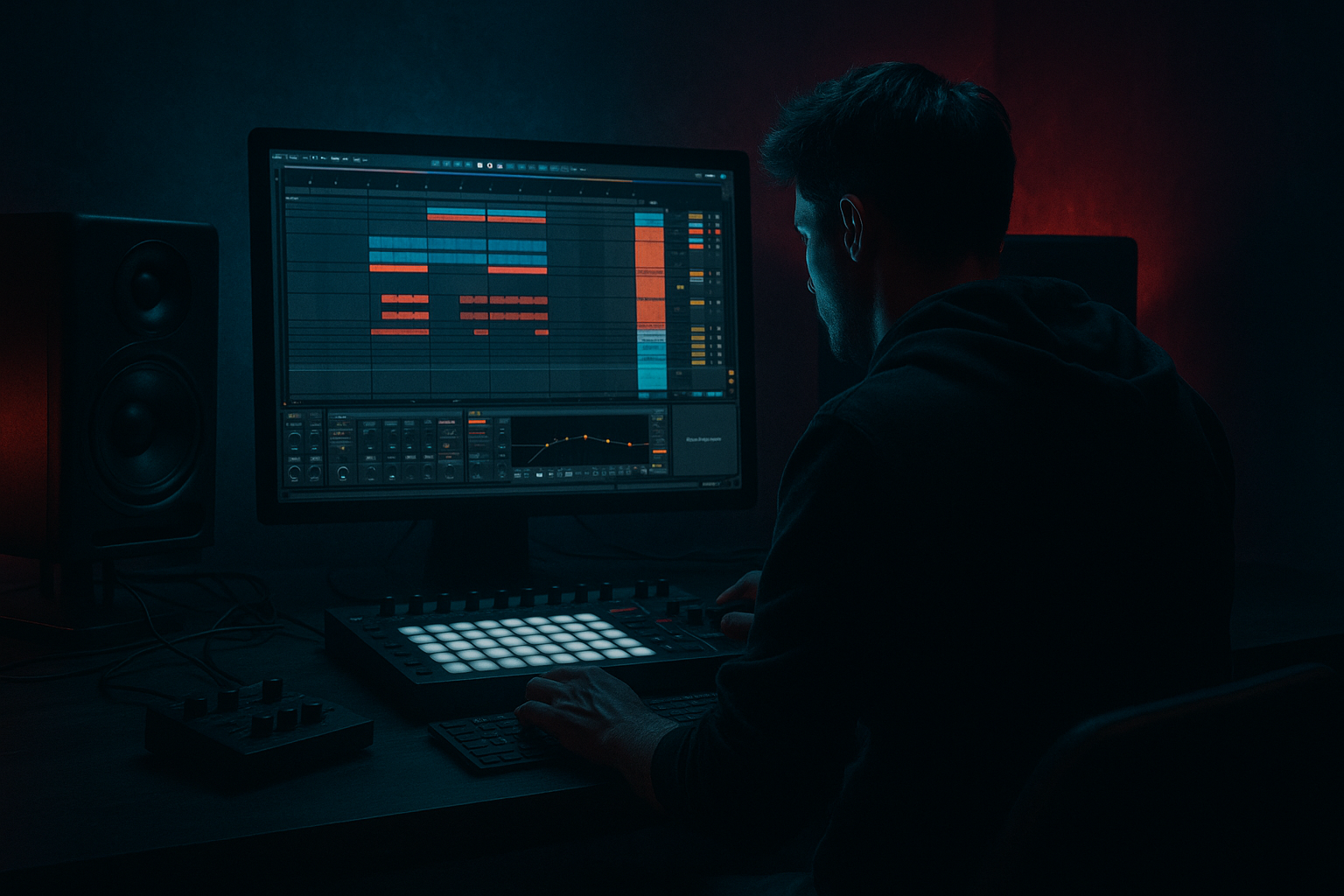
Main tutorial
Jungle Roll Variations Masterclass (Ableton Live)
Modern control, vintage tone — intermediate drum & bass production 🥁⚡
---
1. Lesson overview
In this lesson you’ll learn how to program authentic jungle-style rolls (think Amen/Think breaks energy) while keeping modern DnB control: tight timing, consistent punch, clean sub space, and arrangement-ready variations. We’ll do this using Ableton Live stock devices, smart slicing, velocity shaping, groove control, and targeted saturation/parallel processing for that vintage grit.
---
2. What you will build
By the end you’ll have:
- A Drum Rack break sliced from a classic breakbeat (or any break loop)
- 4 roll variations you can drop into drops/fills:
- A processing chain that keeps the break crunchy and wide without wrecking your mix:
- A simple 8–16 bar arrangement template for real DnB/jungle flow
- Keep the original break rhythm as your starting point OR start classic:
- Notes: 1/16 grid
- Velocity:
- Add micro-timing: select the ghost notes → nudge them slightly late (1–6 ms) for swing.
- Mode: Comp
- Drive: 10–25
- Random: 5–12
- Inside the Drum Rack, open the snare pad → Simpler
- Transpose the flam layer -1 to -3 semitones (or +1 for snap)
- Keep it subtle; you want feel, not “tom snare.”
- Load a Groove from the Groove Pool (e.g., Swing 16 variants)
- Apply lightly:
- Commit only if needed—keep it adjustable during writing.
- Glue Compressor
- Saturator
- EQ Eight
- Bars 1–2: Base groove (minimal edits)
- Bars 3–4: Add Ghosted 1/16 roll at ends of phrases
- Bars 5–6: Switch to Triplet roll for one bar (surprise)
- Bar 7: Drop energy (remove hats for tension)
- Bar 8: Big Flam/Drag into the next section + a stutter in the last 1/4 bar
- Rolls too loud: If ghost notes are anywhere near main snare velocity, the groove turns into a typewriter. Keep ghosts ghosty.
- No anchor hits: Jungle chaos still needs clear backbeats. Keep a stable snare on 2 & 4 (or implied).
- Over-warping breaks: Extreme warp artifacts kill the “vintage” feel. Use Beats mode with sensible settings.
- Too much sub in the break: Break low-end will fight your bass. HPF the break and let the bass own 30–90 Hz.
- Parallel smash full-range: If you don’t high-pass the parallel, your low end gets smeared fast.
- Layer a synthetic snare under the break snare (very low level) for modern punch:
- Resample your best 2-bar loop (Freeze/Flatten or record to audio), then re-slice it again.
- Add controlled distortion in the upper mids only:
- Make rolls darker by filtering the roll itself:
- Slice breaks to Drum Rack for surgical roll control while keeping jungle tone.
- Use velocity + micro-timing for realism: ghosts quiet, anchors strong.
- Build 4 core roll flavors: 1/16 ghost, flam/drag, triplet, modern stutter gate.
- Shape vintage grit with Drum Buss + Saturator, and get modern loudness via parallel smash (HPF it!).
- Arrange rolls at phrase ends for maximum impact in DnB.
1) Ghosted 1/16 roll
2) Flam + drag roll (human jungle feel)
3) Triplet/12-8 roll (old-school swing)
4) Stutter-roll with modern gating (controlled chaos)
- transient shaping, tape-ish saturation, tight EQ, parallel smash bus, and optional stereo control
---
3. Step-by-step walkthrough
Step 0 — Session setup (fast but important) ✅
1. Tempo: 165–175 BPM (use 172 as a sweet spot).
2. Create tracks:
- Audio: `Break Source` (for auditioning loops)
- MIDI: `Break Rack`
- Return A: `Parallel Smash`
- Return B: `Room/Plate` (short)
3. Set your loop length: 2 bars to start.
---
Step 1 — Choose and prep a break (vintage tone starts here) 🎛️
1. Drag a break loop (Amen, Think, Hot Pants, etc.) onto `Break Source`.
2. In the Clip View:
- Warp: ON
- Mode: Beats
- Preserve: Transients
- Transient Loop Mode: Off
- Envelope: 0–20 (lower = punchier, higher = smoother; keep it punchy)
3. Right-click the clip → Slice to New MIDI Track
- Slicing preset: Built-in → Slice to Drum Rack
- Slice by: Transients
- This creates your `Break Rack` with slices mapped across pads.
Workflow tip: Rename key slices (Kick, Snare, Hat, Ghost, Crash) as you identify them. Jungle is fast—labeling saves you.
---
Step 2 — Build a clean “base loop” first (before rolls) 🧱
In the MIDI clip for `Break Rack`, program a simple 2-bar foundation:
- Bar 1: Kick on 1, Snare on 2
- Bar 2: Kick variation + Snare on 4 (or classic jungle switchups)
Goal: Get a groove that already bangs without any roll tricks. Rolls should enhance, not rescue.
---
Step 3 — Create Roll Variation #1: Ghosted 1/16 roll (controlled energy) 🔥
This is your “modern jungle roll”—tight, repeatable, mix-friendly.
1. Pick a snare slice and a ghost snare slice (often a lighter snare hit in the break).
2. In bar 2 (last half-bar), add 1/16 notes on the ghost slice leading into the main snare.
Key settings (MIDI editing):
- Ghost notes: 20–55
- Main snare: 95–120
Modern control trick (stock device):
Add Velocity (MIDI effect) before the Drum Rack:
This adds life without losing control.
---
Step 4 — Roll Variation #2: Flam + Drag (classic jungle human feel) 🥁
Flams and drags make rolls sound “played,” not programmed.
1. Choose your main snare slice.
2. Before a snare hit, add two very close notes (a flam):
- First note: very low velocity (20–40)
- Second note: main velocity (100–120)
3. Timing:
- Put the flam note 10–25 ms before the main hit (nudge left slightly).
Optional: Add a tiny pitch shift for the flam note:
---
Step 5 — Roll Variation #3: Triplet roll (12/8 jungle swing) 🌀
Triplet energy screams early rave/jungle and instantly changes momentum.
1. Change grid temporarily:
- In MIDI editor: 1/8 Triplet or 1/16 Triplet
2. Program a short triplet burst (1/2 bar or 1 bar):
- Use hats/ghost snares for the triplet motion
- Keep main snare anchors on the “normal” backbeat so it doesn’t fall apart
Groove control (Ableton stock):
- Timing: 10–25
- Random: 5–15
- Velocity: 5–20
---
Step 6 — Roll Variation #4: Stutter roll with modern gating (tight chaos) ✂️
This gives you that “edited break” vibe—like hardware samplers + modern precision.
Method A: MIDI stutter (fast + controllable)
1. Pick a hat or snare slice.
2. Draw 1/32 or 1/64 notes for a short burst (last 1/4 bar into a drop).
3. Shape it with velocity:
- Start medium, ramp up, then cut hard right before the downbeat.
Method B: Audio gate on a break layer (more vintage)
1. Duplicate your break: create another chain or track called `Break Stutter`.
2. Add Auto Pan (yes, Auto Pan) and use it as a gate:
- Amount: 100%
- Rate: 1/16 or 1/32
- Phase: 0° (hard gating)
- Shape: 0.0 (square-ish)
3. Automate Rate from 1/16 → 1/32 → 1/64 for rising intensity.
This is chef’s kiss for controlled “amen chopping” builds. 😈
---
Step 7 — Vintage tone + modern punch: the processing chain 🧪
Put this on your `Break Rack` track (start subtle, then push).
#### Suggested stock chain (in order)
1. EQ Eight
- HPF: 25–35 Hz (24 dB/oct) to clear rumble
- Small dip: 200–350 Hz if boxy (1–3 dB)
- Optional tame: 7–10 kHz if harsh (1–2 dB shelf)
2. Drum Buss
- Drive: 5–20 (listen for crunch)
- Crunch: 0–20
- Boom: 0–10 (careful—can fight sub)
- Transients: +5 to +20 for snap OR negative if too clicky
- Damp: adjust to keep top end controlled
3. Saturator (for “tape-ish” density)
- Mode: Soft Sine or Analog Clip
- Drive: 2–6 dB
- Soft Clip: ON
- Output: trim to match loudness (don’t fool yourself)
4. Glue Compressor (optional, light)
- Attack: 3–10 ms
- Release: Auto
- Ratio: 2:1
- GR: aim 1–3 dB max
5. Utility (stereo management)
- If your break is too wide: Width 80–100%
- If it’s narrow: try 110–120%, but check mono
#### Parallel Smash Return (Return A) 💥
On `Parallel Smash`:
- Ratio: 10:1
- Attack: 0.3–1 ms
- Release: 0.1–0.3 s (or Auto)
- GR: 10–20 dB
- Drive: 5–12 dB, Soft Clip ON
- HPF: 120–200 Hz (keep sub clean)
- Optional high shelf: +1–3 dB for fizz
Send your break to this return at -18 to -8 dB, blend to taste.
---
Step 8 — Arrangement ideas: where rolls actually work in DnB 🎚️
Use rolls like punctuation, not constant chatter.
8-bar drop template (easy + effective):
Modern trick: Automate Drum Buss Drive up slightly (e.g., +2–4) during fill bars only.
---
4. Common mistakes 🚫
---
5. Pro tips for darker/heavier DnB 🖤
- Put a clean snare sample on another Drum Rack pad, trigger it with the main snare notes only.
- Process that layer with Drum Buss (more transient, less crunch) and keep it tight/mono.
This “bakes” character like old sampler workflows and makes edits feel more glued.
- Use Saturator + EQ Eight after it, or split with an Audio Effect Rack:
- Chain 1 (Low): clean, HPF OFF, LPF ~200 Hz
- Chain 2 (Mid/High): HPF ~200 Hz, add Drive/Crunch
Blend for aggression without mud.
Automate an Auto Filter (LPF) only during the roll so it sounds like it’s coming from the break, not a bright MIDI machine.
---
6. Mini practice exercise (15–20 min) 🎯
1. Pick one break and slice to Drum Rack.
2. Create a 2-bar base groove you like.
3. Make four 2-bar clips, each with one roll type:
- Clip A: Ghosted 1/16 roll into bar 2 snare
- Clip B: Flam/drag into the downbeat
- Clip C: Triplet burst for 1/2 bar
- Clip D: Stutter using Auto Pan gating (last 1/4 bar)
4. Put the clips in Session View and audition clip-to-clip like live DJ edits.
5. Commit to one 16-bar arrangement with:
- Rolls only at bar 4, 8, 12, 16 (phrase ends)
---
7. Recap ✅
If you want, tell me your preferred subgenre (jungle, jump-up, deep/techy, neuro-ish) and I’ll suggest roll patterns + a matching break processing rack tailored to that vibe.

