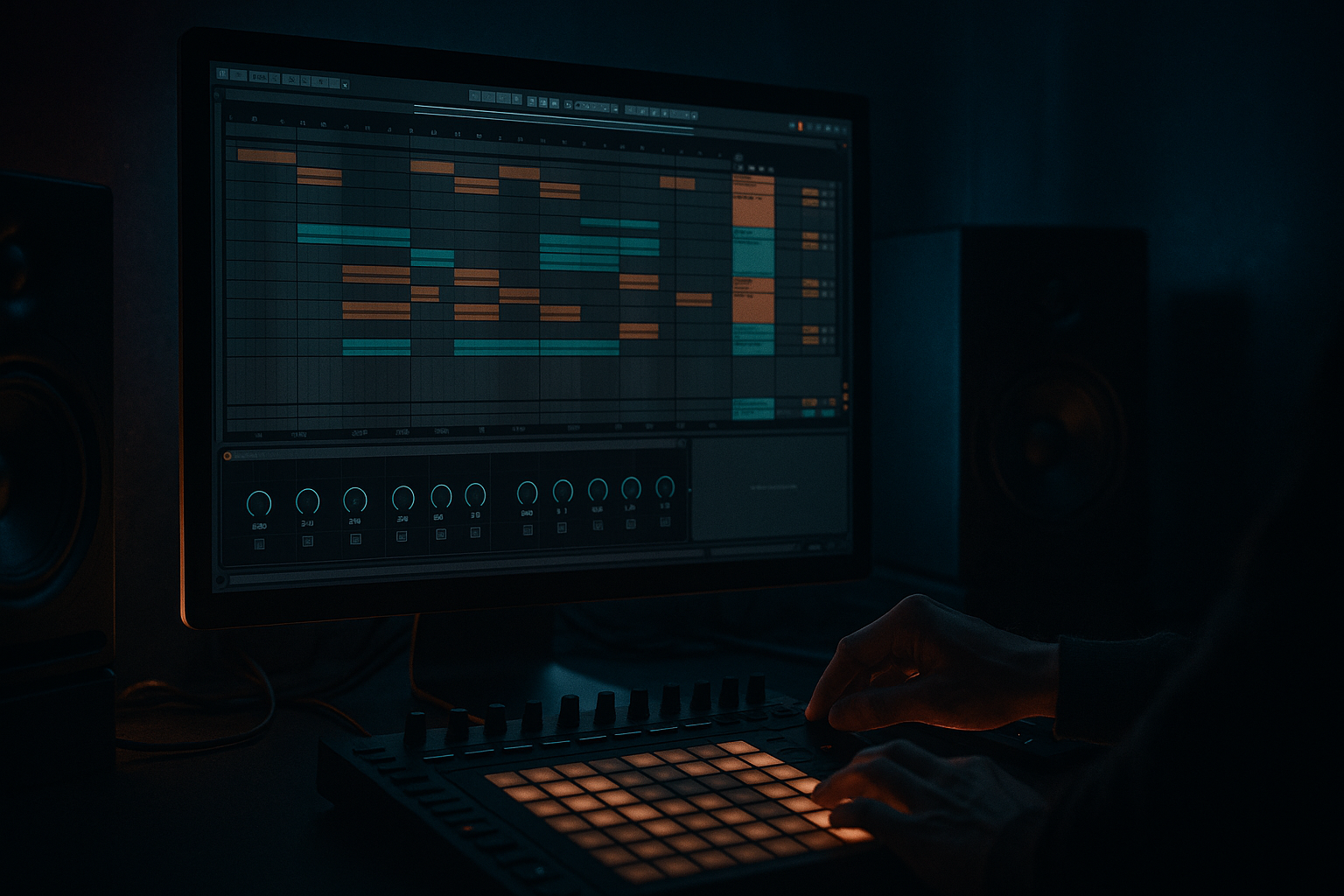
Main tutorial
```markdown
Jungle Roll Variations (Stock Ableton Only) 🥁⚡
Skill level: Intermediate
Category: Drums (Drum & Bass / Jungle)
DAW: Ableton Live (no third‑party plugins)
---
1. Lesson overview
Jungle “rolls” are those fast, momentum-building drum phrases—often centered around snare fills, ghost notes, and breakbeat micro-edits—that push energy into transitions, drops, and 2nd halves. In DnB/jungle they’re rarely “just a drum fill”; they’re groove + tension + variation.
In this lesson you’ll build a toolkit of roll variations using only Ableton stock devices:
- MIDI and audio roll workflows
- Repeat-style rolls (without Beat Repeat dependency)
- Velocity shaping + ghosting
- Filter/drive automation for lift
- Layering with break slices
- Arrangement-ready roll structures
- Tempo: 170–176 BPM (start at 174)
- Create 3 tracks:
- Use a tight DnB snare sample (short tail works best for rolls)
- Copy the snare but lower its gain (or use a softer snare/rim)
- For roll brightness/drive
- Auto Filter
- EQ Eight
- Redux (tiny bit for grit)
- Main snare hits on beats 2 and 4 (standard)
- In the last 1/2 bar, add 16th notes on the main snare (or ghost layer)
- Open Velocity Editor in the MIDI clip.
- For the 16th roll, set a curve like:
- Place ghost snare hits between the main roll notes, but not all the time.
- Keep ghost velocities 15–45.
- Add a Groove Pool groove (stock):
- First half: 1/8 notes
- Next quarter: 1/16
- Last quarter: 1/32 (or 1/24 triplet if you want jungle flavor)
- Velocity ramp up slightly
- Add Auto Filter on the DRUMS track:
- Use 1/16 or 1/32 MIDI notes on a single slice (like a snare fragment)
- Alternate between 2–3 adjacent slices for movement
- Add Transient shaping using Drum Buss
- Add EQ Eight
- Add Utility
- Bars 1–8: main groove (tiny variation every 2 bars)
- Bar 8 (last 1 beat): short 1/16 roll (low velocity, subtle)
- Bars 9–15: groove intensifies (add ride/hat layer)
- Bar 16: full accelerating roll + send to ROLL FX return, then impact/crash/drop
- Use rolls as questions/answers.
- Parallel drive on rolls only:
- Pitch automation for menace:
- Reverb that doesn’t wash out:
- Stereo discipline:
- Make rolls feel “heavier” without louder:
- Use only stock devices
- Keep main snare under control: HP ~120 Hz, soft clip if needed
- Export and A/B: do the rolls add energy without flattening the groove?
- Jungle rolls are about rhythm + dynamics + texture, not just “fast notes”.
- Use velocity curves, ghost notes, and triplet grids for authentic jungle movement.
- Build variations via density ramps, send-based stutters, and break slicing.
- Control mess with EQ Eight, Drum Buss, Saturator, Auto Filter, and good arrangement spacing.
---
2. What you will build
You’ll end up with:
1. A core jungle roll rack: snare + ghost + hat layer with velocity and tone control.
2. 5 roll variations you can drop into any DnB track:
- 16th snare roll (classic)
- Triplet/12⁄8 roll (jungle tension)
- Accelerating roll (rate ramps)
- Stutter + tape-stop style roll (stock tools)
- Break-slice roll (Amen-style vibe)
3. A 16-bar arrangement blueprint for where and how to place them.
---
3. Step-by-step walkthrough
Step 0 — Session setup (fast + practical)
1. DRUMS (Drum Rack) – for snare/ghosts/hats
2. BREAK (Audio) – for a chopped break loop
3. DRUM BUS (Audio) – group processing
Group DRUMS + BREAK into a group, name it DRUM BUS.
---
Step 1 — Build a “Roll Core” Drum Rack (MIDI workflow)
On DRUMS, load a Drum Rack with these pads:
A1 Snare (main)
A#1 Snare (ghost)
C#2 Closed hat (or ride)
#### Add stock processing inside the Drum Rack
On the Snare (main) chain, add:
1. EQ Eight
- HP at 120 Hz (24 dB)
- Small dip 300–500 Hz if boxy
- Slight boost 3–6 kHz if it needs crack
2. Drum Buss
- Drive: 5–15%
- Crunch: 0–10% (optional)
- Boom: Off (usually off for snare rolls)
3. Saturator (soft clip vibe)
- Mode: Soft Sine
- Drive: 2–6 dB
- Turn on Soft Clip
On the Ghost snare chain, add:
- HP 250–500 Hz
- Gentle resonance (0.7–1.2)
This keeps ghosts light and “fluttery”.
On the Hat chain, add:
- HP at 400–800 Hz
- Bits: 10–12
- Downsample: 1.2–2.0 (subtle)
✅ Why this matters: Rolls get messy fast. Filtering + controlled saturation keeps them loud without turning into mush.
---
Step 2 — Program the classic 16th snare roll (with proper dynamics)
Create a 1-bar MIDI clip on DRUMS.
Pattern idea (1 bar):
Key move: velocity shaping
- Start around 40–60
- Rise toward 90–110 near the end
Add ghosts to make it jungle
🎯 Target feel: “rrrRRR”, not “machine-gun”.
---
Step 3 — Create a triplet jungle roll (the secret sauce) 🔥
Jungle tension often comes from triplets or 12/8 swing against straight 2-step.
In the MIDI clip:
1. Set the Grid to 1/12 (triplet 16ths).
2. In the last 2 beats, program a snare roll using 1/12 spacing.
3. Keep velocities lower overall than straight 16ths (triplets get busy quickly).
Optional groove:
- Try Swing 16-65 lightly
- Commit at 10–25% to avoid wobble
✅ Result: instant jungle “skitter” without needing insane edits.
---
Step 4 — Make an accelerating roll (rate ramps without plugins)
This is a go-to “riser” roll into a drop or 2nd half.
Method A: MIDI density ramp
Over the last 1 bar before impact:
Then:
- Filter type: HP
- Start: 200 Hz
- End: 1–2 kHz
- Automate resonance slightly up (0.7 → 1.3)
Method B: Audio resample + warp
1. Resample DRUMS to audio (freeze/flatten or record to new audio track).
2. Warp the roll region.
3. Use Warp mode: Beats
- Preserve: 1/16 → 1/32 automation (clip envelope)
4. Add Fade In micro-fades to avoid clicks.
🎛️ This gives that “increasing intensity” without relying on Beat Repeat.
---
Step 5 — Stutter-roll variation with stock devices (clean + controllable)
You can use Beat Repeat (it’s stock), but here’s a reliable alternative using Simple Delay + gating.
On the DRUM BUS group (or just snare track), create a Return track named ROLL FX:
1. Simple Delay
- Link: Off
- Left: 1/16
- Right: 1/12 (triplet offset = jungle spice)
- Feedback: 20–35%
- Dry/Wet: 100% (since it’s a return)
2. Auto Filter
- HP around 400–800 Hz
3. Saturator
- Drive 3–8 dB, Soft Clip on
4. Gate
- Threshold so it “chops” the delay tails
- Return it to silence between hits
Now automate Send amount to this return only for the last 1–2 beats of a phrase.
✅ You get rhythmic roll/stutter energy that still follows the groove.
---
Step 6 — Break-slice roll (Amen-style, but fast)
On BREAK (Audio):
1. Drop in a break (Amen, Think, etc.).
2. Right-click → Slice to New MIDI Track
- Slicing preset: Transient
- Create: Drum Rack
Now you can trigger micro-slices as a roll:
#### Tighten it with stock tools
Inside that slice Drum Rack:
- Drive 5–10%
- Transients: +10 to +30
- HP 120–200 Hz
- Dip muddy 250–450 Hz
- Mono below 120 Hz (if the break has low rumble)
🎧 This is how you get authentic jungle roll character without over-editing.
---
Step 7 — Arrangement ideas (where rolls actually work)
Try this 16-bar phrase:
Pro move:
Example: bar 8 = small roll, bar 16 = big roll.
---
4. Common mistakes ❌
1. Machine-gun velocity
- If every hit is 127, it sounds like a typewriter. Shape velocities.
2. Too much low-mid buildup
- Rolls stack energy. High-pass ghosts and hats.
3. No space before impact
- A roll hits harder if you cut the drums for 1/8–1/4 right before the drop.
4. Over-layering
- 3 snares + break + ride roll = chaos. Pick a “hero” layer.
5. No transient control
- If your roll is loud but not punchy, add Drum Buss transients or shorten decay.
---
5. Pro tips for darker/heavier DnB 🖤
Use a return with Saturator + EQ Eight (HP 300 Hz) and send only the roll notes.
In Simpler (snare sample), automate Transpose -2 to -5 over the roll for a “falling” pressure effect.
Use Hybrid Reverb on a return:
- Short decay 0.3–0.8s
- HP the reverb input to 600–1k
- Gate after reverb for tight darkness
Keep the main snare mostly mono (Utility width 0–30%), let hats/delays provide width.
Add soft clipping (Saturator Soft Clip) + reduce peaks, then bring overall level up slightly.
---
6. Mini practice exercise 🎯
Make a 4-bar drum loop and add 3 different roll endings:
1. Bar 2 ending: 1/16 roll (velocity ramp 50 → 100)
2. Bar 3 ending: triplet (1/12) roll + subtle swing (10–15%)
3. Bar 4 ending: accelerating roll (1/8 → 1/16 → 1/32) + send automation to ROLL FX return
Rules:
---
7. Recap ✅
If you tell me your current drum style (2-step, break-heavy, or halftime) and what snare/break you’re using, I can suggest a specific roll pattern + device chain that fits your vibe. 🥁
```

