Main tutorial
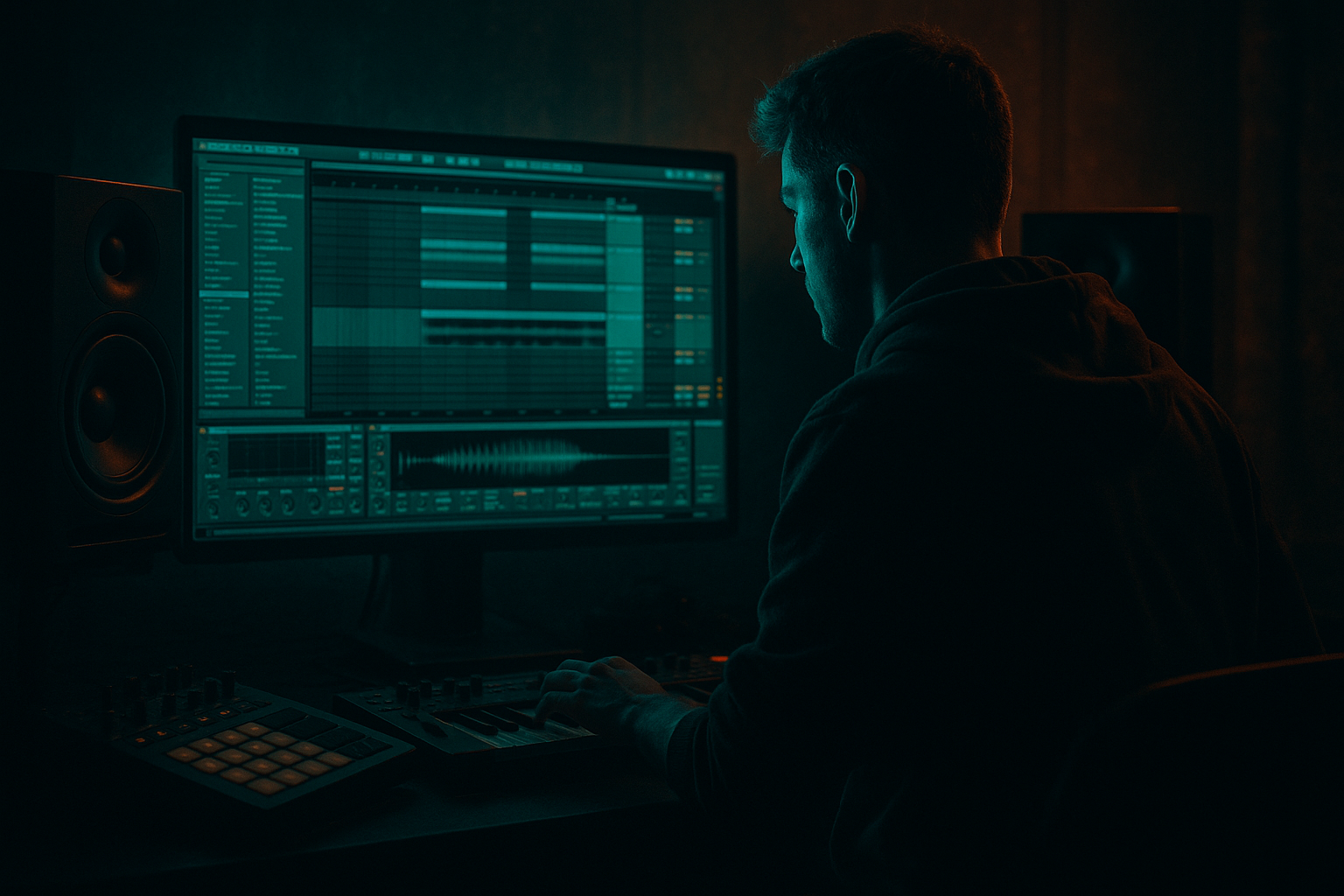
Jungle Warfare: DJ intro color with minimal CPU load in Ableton Live 12
1. Lesson overview
In drum and bass, the DJ intro is not just a “few bars before the drop.” It’s a functional mix tool: it gives DJs space to blend, lets the energy breathe, and sets the tone for the tune without giving away the whole arrangement. For jungle and heavier DnB, the best intros often have strong character, minimal CPU use, and clear low-end discipline.
In this lesson, you’ll build a DJ-friendly intro section in Ableton Live 12 that sounds colorful and atmospheric, but stays lightweight enough to keep your project efficient. We’re aiming for:
- Fast workflow
- Low CPU usage
- Clear intro identity
- Easy mix-in/mix-out utility
- Dark, rolling DnB/jungle vibe 🥁
- A filtered drum loop or break-based groove
- A subtle atmospheric bed for color
- A simple bass hint or low-end tease
- Mix-friendly intro/outro structure
- Efficient processing using:
- A clean kick from your sample library
- A sharp snare or rim
- EQ Eight
- Drum Buss
- Utility
- Optional Transient shaping by arrangement, not plugins
- A DJ can ride them easily
- The groove is clear
- There’s enough space for other tracks to mix in
- vinyl hiss
- rain
- tape noise
- distant city ambience
- sci-fi room tone
- field recording
- EQ Eight
- Auto Filter
- Reverb or Hybrid Reverb
- Utility
- One sustained note
- Simple waveform
- Low polyphony
- No unneeded unison
- Oscillator: saw or noise blend
- Filter: low-pass, slightly closed
- Amp envelope: slow attack, medium release
- Add a little movement via LFO or Auto Filter
- EQ Eight
- Auto Filter
- Chorus-Ensemble very lightly, if needed
- Reverb on a send instead of insert where possible
- Minor 7th or minor 9th voicings work well
- Keep the register mid-to-high
- Avoid too much low-mid buildup
- Instrument: Wavetable / Analog / Sampler
- EQ Eight
- Auto Filter
- Echo or Delay on a return
- Optional Redux at very low amounts for grit
- 1/8 to 1/4 note length
- Velocity variations for movement
- Space them out
- Use a detuned synth tone
- Repeat every 2 or 4 bars
- Automate filter cutoff slightly
- One sub note every 2 bars
- A filtered Reese texture
- A muted bass phrase that appears late in the intro
- Use Operator for a clean sub
- Or Wavetable for a basic Reese-style layer
- Avoid overprocessing at this stage
- Operator
- EQ Eight
- Saturator
- Utility
- Drums only or drums + texture
- Minimal harmonic content
- Plenty of headroom for mixing
- Add a filtered stab, noise sweep, or bass tease
- Introduce a little more movement
- Bring in a second drum element or break variation
- Open the filter slightly
- Add a short fill at the end of bar 16 or 24
- More tension
- Stronger percussion or a small motif
- Prepare the main drop or next phrase
- Use 8-bar phrases for DJ readability
- Add change every 4 or 8 bars
- Avoid huge surprises too early
- Keep the intro clean enough for cueing
- Cut rumble
- Remove mud
- Make room for the next layer
- Slow sweeps
- Building tension
- Moving textures without adding more instruments
- Breaks
- Kick/snare punch
- Subtle dirt and excitement
- Bass tease
- Drum thickness
- Controlled harmonic bite
- Mono control
- Gain staging
- Width management
- Checking intro balance
- Dubby jungle stabs
- Rhythmic throwaways
- Space without excessive reverb wash
- One shared reverb saves CPU
- Keeps the project cleaner
- Lets you adjust space consistently
- Reverb or Hybrid Reverb
- Short decay
- Low wet level
- High-pass the return with EQ Eight
- Echo
- Sync to 1/4 or 1/8 dotted
- Filtered repeats
- Low feedback
- headphones
- club systems
- DJ monitors
- streamed previews
- Keep the intro not too loud
- Leave headroom for the main drop
- Watch the low end
- Make sure the drum groove stays clear even with atmospheric layers
- Drums: peak solidly but not clipping
- Atmos: sit well below drums
- Bass tease: present, but restrained
- Master: leave enough room for the drop to hit
- minor 2nds
- tritones
- very short atonal textures
- detuned resonant stabs
- saturation
- transient bite
- small clip-friendly punch
- chopped edits for movement
- top percussion
- a stab tail
- a texture loop
- 1 break loop or drum pattern
- 1 atmospheric texture
- 1 sparse stab or motif
- 1 bass tease
- 2 return effects
- dark
- clean
- functional
- energetic
- low CPU
- Start with a clear drum foundation
- Add one or two well-chosen color elements
- Use stock Ableton devices efficiently
- Prefer return tracks for reverb/delay
- Keep the intro 8- or 16-bar phrase-aware
- Render or freeze heavy parts when needed
- Let the intro tease the energy, not consume it
- a device-by-device Ableton template
- a 32-bar arrangement map
- or a step-by-step project recipe for a dark roller intro
We’ll use mostly stock Ableton devices and practical arrangement tricks rather than CPU-heavy synth stacks or oversized effect chains.
---
2. What you will build
By the end, you’ll have a 16- or 32-bar DJ intro with:
- EQ Eight
- Auto Filter
- Drum Buss
- Redux
- Utility
- Reverb or Hybrid Reverb in moderation
- Return tracks for shared effects
This is not a “drop intro.” It’s a DJ tool intro: functional, moody, and easy to mix.
---
3. Step-by-step walkthrough
Step 1: Set the project up for DnB workflow
1. Open Ableton Live 12.
2. Set the tempo to 174 BPM or your preferred DnB range:
- 172–176 BPM for classic jungle / roller
- 170–174 BPM for darker half-step-leaning DnB
3. Create a clean session with these tracks:
- Drums
- Atmos
- Bass tease
- FX / Texture
- Optional Reference track for checking energy and density
Tip: If your intro is intended for DJ mixing, leave a clean 8 or 16-bar beat-only section at the start before the main motif enters.
---
Step 2: Build the drum foundation with minimal CPU load
For a jungle intro, the drums are often the most important part. Keep them lean and punchy.
#### Option A: Use a break loop
1. Drag in a classic break or your own processed break to an audio track.
2. Warp it carefully:
- Use Complex Pro only if needed
- For percussion-heavy breaks, try Beats mode
3. Slice the break if needed and manually arrange the hits.
#### Option B: Layer a kick/snare with a break
If the break is thin, layer:
#### Suggested device chain on the drum track:
- High-pass around 25–35 Hz to clear rumble
- Gentle cut at 250–400 Hz if muddy
- Drive: 2–8%
- Boom: subtle, only if the kick needs weight
- Crunch: very light for grit
- Use Bass Mono only if necessary on a full drum bus
#### Practical goal:
Your intro drums should feel like:
---
Step 3: Add color with low-CPU atmospheres
This is where the intro gets its identity. The trick is to make it sound rich without eating CPU.
#### Use one of these lightweight approaches:
##### Approach 1: Audio texture loop
Use a short atmos loop such as:
Then process it lightly:
- High-pass at 150–300 Hz
- Cut harshness around 3–6 kHz if needed
- Slow filter movement over 8 or 16 bars
- Keep decay moderate: 1.2–2.5s
- Wet low, around 8–18%
- Reduce width if the texture is too wide and messy
##### Approach 2: One-note synth pad or noise layer
Use a single Wavetable, Analog, or even Operator patch:
Suggested patch idea:
Then keep the device chain simple:
CPU tip: One simple atmospheric layer often sounds better than three competing pads.
---
Step 4: Design the intro’s harmonic color without overloading the project
For jungle/DnB intros, you don’t need full chord stacks. You need suggestion.
Try one of these:
#### Method A: Sparse chord stabs
Use short, dark stabs on the off-beats or at phrase starts.
##### Example device chain:
Keep the stabs short:
#### Method B: Single-note motif
A one- or two-note motif can be enough to create tension.
This is especially effective for darker DnB because it leaves room for drums and bass.
---
Step 5: Add a bass tease, not a full bassline
A DJ intro should hint at the low-end, not fully detonate it.
#### Good options:
#### Keep it simple:
##### Example bass tease chain:
- Sine wave
- Short envelope
- Mono mode
- Low-pass if needed to keep it restrained
- Soft Clip on
- Drive: modest, around 1–3 dB
- Mono below the crossover if using a wider layer
For a jungle intro, the bass tease can be more of a pressure cue than a full groove.
---
Step 6: Use arrangement to create DJ-friendly energy ramps
This is where the intro becomes mixable and musical.
#### A strong DJ intro layout:
Bars 1–8
Bars 9–16
Bars 17–24
Bars 25–32
#### Arrangement rules:
---
Step 7: Use stock Ableton devices efficiently
Here’s a reliable low-CPU intro toolset:
#### EQ Eight
Use it on nearly every intro element:
#### Auto Filter
Perfect for:
#### Drum Buss
Great for:
#### Saturator
Useful for:
#### Utility
Essential for:
#### Echo
Use sparingly for:
#### Reverb / Hybrid Reverb
Best used on send tracks:
---
Step 8: Set up return tracks for efficiency
Instead of putting reverb and delay on every track, create shared returns.
#### Return A: Short room reverb
#### Return B: Dub delay
This approach keeps your project light and gives the intro cohesion.
---
Step 9: Mix for translation and DJ use
Your intro should sound good on:
#### Mix checks:
#### Quick gain staging guide:
---
Step 10: Freeze/Flatten or consolidate when CPU rises
If you notice CPU climbing:
1. Freeze heavy synth tracks
2. Flatten if you are done editing
3. Consolidate audio loops
4. Replace complex instruments with rendered audio once the sound is locked
This is a smart habit in DnB, where multiple layered elements can pile up quickly.
---
4. Common mistakes
1. Too much going on too early
A DJ intro should create space for mixing. If you front-load the arrangement, it loses utility.
2. Overusing heavy synth stacks
Three pads, two Reese layers, reverb, and chorus on every track will burn CPU and clutter the mix.
3. Weak drum identity
If the drums are vague, the intro won’t feel like DnB. The break or groove must be obvious.
4. Too much reverb on the low end
Reverb on bass or lower drums can make the intro muddy fast.
5. No phrase logic
If the arrangement doesn’t change every 4 or 8 bars, DJs may find it hard to mix.
6. Making the intro sound like the drop
The intro should hint, not reveal everything.
---
5. Pro tips for darker/heavier DnB
Use controlled dissonance
For darker jungle warfare energy, try:
Keep it subtle. You want tension, not chaos.
Emphasize break character
Heavier DnB intros often feel powerful because the break itself has attitude:
Use negative space
A half-bar of silence before a hit can sound heavier than adding another layer.
Let the filter do the drama
A slowly opening Auto Filter can create huge impact with almost no CPU cost.
Add grit with purpose
Use Redux sparingly on:
Tiny amounts of bit reduction can give a jungle intro a nasty, industrial edge.
Keep the sub disciplined
If the intro has a bass tease, keep it mono and simple. Save the full bass movement for the drop.
---
6. Mini practice exercise
Build a 16-bar DJ intro in Ableton Live 12
#### Requirements:
#### Steps:
1. Set tempo to 174 BPM.
2. Create a drum track using a break or simple programmed breakbeat.
3. Add EQ Eight and Drum Buss to shape it.
4. Add a texture loop with Auto Filter and send it to reverb.
5. Add a short stab every 4 bars.
6. Add a single sub hit or bass tease in bars 9–16.
7. Automate the filter on the atmosphere to open gradually.
8. Make sure the first 8 bars are mix-friendly and not too dense.
9. Bounce or export the intro and listen as if you were a DJ cueing into the next tune.
#### Challenge:
Make the intro sound:
If it sounds impressive but still leaves room for a mix, you’ve nailed it.
---
7. Recap
A strong jungle/DnB DJ intro is all about function with personality. You want enough atmosphere to create identity, enough drum power to establish the groove, and enough restraint to keep it useful in a mix.
Key takeaways:
If you can make a DJ intro that sounds moody, functional, and light on CPU, you’ve got a serious practical skill for drum and bass production. That’s jungle warfare done right 💥
If you want, I can also turn this into:

