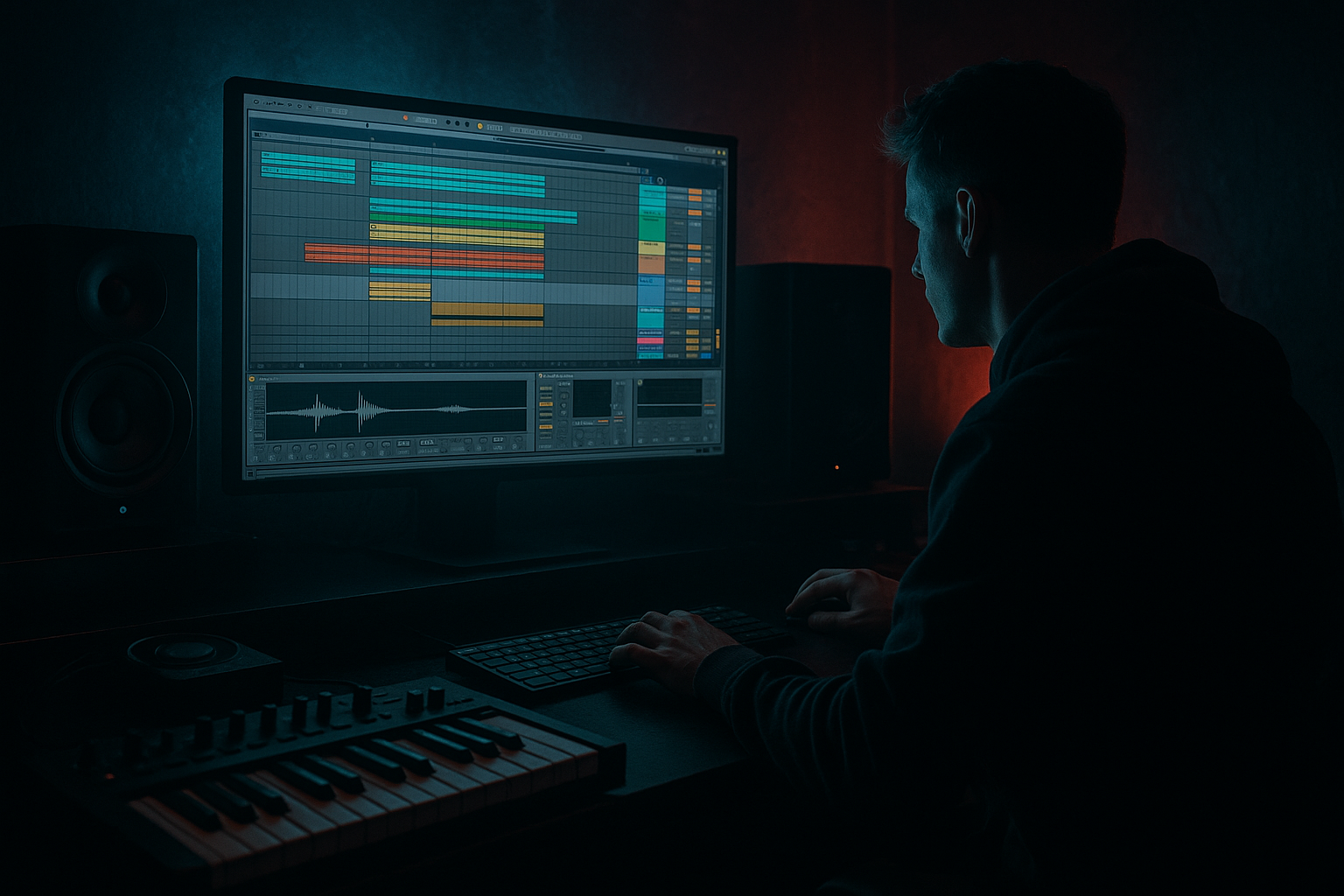
Main tutorial
```markdown
Jungle Warfare Ghost Notes: Shape + Arrange in Ableton Live 12 🥁⚔️
Skill level: Intermediate
Category: Groove (Jungle / DnB)
---
1. Lesson overview
Ghost notes are the “in-between” hits that make jungle/drum & bass grooves feel alive, rolling, and aggressive without getting messy. In classic Jungle Warfare–style breaks, ghost notes are often quiet but punchy, shaped by velocity, filtering, and micro-timing, then arranged to escalate energy across 8/16/32 bars.
In this lesson, you’ll build a ghost-note layer that sits under your main break, and you’ll learn how to shape it so it adds movement without stealing the spotlight. 🎛️
---
2. What you will build
You’ll create:
- A main break loop (Amen-ish / Think-ish / chopped break)
- A ghost note layer (mainly hat/snare “ticks” + tiny kick taps)
- A processing chain that makes ghost notes tight, dark, and controlled
- An arrangement method to evolve the groove over 16–32 bars like proper jungle/DnB
- Snare ghosts: 16ths around the backbeat
- Hat ghosts: steady but not robotic
- Main ghost hits: 25–45 velocity
- Occasional accents (still ghosty): 50–70
- Leave real main snare/kick to your main break (or other track) at higher velocity.
- Select notes → use Velocity lane in the MIDI editor
- Create a wave shape: quieter at the start of each beat, slightly louder leading into the snare.
- HP: 150–300 Hz (depends on samples)
- Dip: 2–5 dB at 400–800 Hz if papery/boxy
- Gentle shelf down: 10 kHz if too bright (for darker jungle)
- Drive: 1–4
- Crunch: 5–15 (careful)
- Transients: +5 to +20 (to make quiet hits still “speak”)
- Boom: 0 (usually off for ghosts)
- Attack: 3 ms
- Release: Auto or 0.1–0.3 s
- Ratio: 2:1
- Aim for 1–3 dB gain reduction
- Turn the whole ghost track down until you miss it when muted, but it’s not obvious when playing.
- Bars 1–4: Minimal ghosts (hats only, low velocity)
- Bars 5–8: Add snare ghosts + slightly more swing
- Bars 9–12: Add 1–2 extra hat 32nds before snare (tiny fill)
- Bars 13–16: Slightly higher velocity + subtle saturation push
- EQ Eight HP frequency: 250 Hz → 180 Hz (opens slightly in the drop)
- Drum Buss Transients: +8 → +18 (more bite later)
- Utility Gain: +0.0 dB → +1.5 dB (energy ramp)
- Main break: keep more body (200–4k)
- Ghost layer: keep more tick (2k–12k) and less low mids
- Sidechain input: your main snare (or break track)
- Fast attack, medium release
- Only 1–2 dB dip when snare hits
- Ghost notes too loud: If you can clearly identify every ghost hit, they’re not ghosts anymore.
- Too much low-mid: Ghost snares with 200–600 Hz buildup will turn your break into cardboard.
- Over-randomized timing: Jungle is human, not sloppy—use intentional push/pull.
- Same ghost pattern for 64 bars: Rolling music needs micro-variation to stay hypnotic.
- Stacking ghosts on top of already-busy breaks: If the break is dense, simplify the ghost layer.
- Make ghosts “darker” with filtering:
- Transient-first, not volume-first:
- Use subtle distortion for menace:
- Ghosts as “movement for the bass”:
- Texture layer trick:
- Ghost notes = velocity + timing + tone control, not just extra hits 👻
- Use MIDI Drum Rack for precision, and keep ghosts short + filtered
- Shape them with EQ Eight → Drum Buss → Glue Compressor → Utility
- Arrange ghosts to evolve over 16–32 bars using subtle automation
- In darker DnB, focus on transients + grit, not loudness
---
3. Step-by-step walkthrough
Step 0 — Session setup (tempo + grid)
1. Set tempo to 168–176 BPM (try 172 BPM).
2. Set Global Quantization to 1 Bar.
3. In Clip View, enable Warp for your break loop.
- Warp mode: Beats
- Preserve: Transient
- Envelope: 40–70 (tight, less smear)
Why: Beats mode keeps transients sharp—critical for jungle snap.
---
Step 1 — Build a solid “anchor” break
1. Drop a break sample (Amen/Think/Hot Pants etc.) onto an audio track.
2. Warp it so 1 bar = 1 bar (or 2 bars = 2 bars).
3. Add Drum Buss (stock) lightly:
- Drive: 2–6
- Crunch: 0–10
- Boom: 0–15 (low, unless it gets flubby)
- Damp: 30–60
4. Add EQ Eight:
- HP at 30–40 Hz
- Small cut 200–400 Hz if boxy
- Tiny lift 5–9 kHz if dull
Goal: The break should already slap before ghost notes.
---
Step 2 — Create a dedicated ghost-note track (MIDI) 👻
We’ll make ghost notes as MIDI so you can control velocity, timing, and tone precisely.
1. Create a MIDI track called “Ghosts”.
2. Load a Drum Rack.
3. Populate it with 3–5 one-shots:
- Ghost snare (short, papery rim/side-stick, or filtered snare)
- Tight hat (closed hat or ride tick)
- Optional: tiny kick tap (short, no sub)
- Optional: percussion tick (woodblock/clave-like)
Sample choice tip: Ghost notes work best with short, fast-decay sounds. Long tails blur the groove.
---
Step 3 — Program a Jungle Warfare-style ghost pattern (1 bar)
Create a 1-bar MIDI clip on “Ghosts” and use a 16th-note grid to start.
Core jungle principle: Ghost notes often “answer” the main snare and fill the gaps around it.
Try this starter pattern (1 bar at 172 BPM, 4/4):
- Put quiet snare ticks at: 1.2.3, 1.2.4, 1.4.1, 1.4.4
- Put hats on every 16th, then remove a few to create air (e.g., remove 1.3.3 and 1.4.3)
Now the important part:
#### Velocity shaping (this is the groove)
In Live 12:
DnB feel cheat: Accentuate notes leading into the main snare, but keep them short.
---
Step 4 — Micro-timing: push/pull for roll 🏎️
Ghost notes should feel human, not quantized grids.
1. In the MIDI clip, turn Off the strict quantization feel:
- Nudge some hats late by +5 to +12 ms
- Nudge some snare ghosts early by -3 to -8 ms
2. Keep it consistent: don’t randomize everything.
Why: Late hats = swing/drag; early snare ghosts = urgency.
---
Step 5 — Shape ghost notes with a tight device chain (stock-only)
On the “Ghosts” track, use this chain:
#### 1) EQ Eight (remove mud + keep it “under”)
#### 2) Drum Buss (tiny grit + glue)
#### 3) Glue Compressor (control peaks)
#### 4) Utility (final level control)
Mix rule: Ghost notes should be felt as movement, not heard as a separate drum loop.
---
Step 6 — “Jungle Warfare” arrangement: make ghosts evolve over 16–32 bars 🔥
Ghost notes become powerful when they change across sections.
#### A) 16-bar loop plan
#### B) Automation ideas (Ableton stock)
Automate on the “Ghosts” track:
🎛️ Keep changes subtle. Jungle is about pressure building, not obvious edits.
---
Step 7 — Blend with your main break (avoid phase + clutter)
If your main break already contains hats/ghosts, your MIDI ghosts should occupy a different pocket.
Two quick approaches:
Option 1: Frequency separation
Option 2: Sidechain ghosts to snare
On “Ghosts” add Compressor:
This keeps the backbeat clean and punchy.
---
4. Common mistakes
---
5. Pro tips for darker/heavier DnB 🖤
Use Auto Filter low-pass at 8–12 kHz, with a tiny resonance (5–15). Automate it to open slightly in fills.
Quiet hits can still cut if you push Transients in Drum Buss instead of turning them up.
Add Saturator after EQ:
- Mode: Soft Sine or Analog Clip
- Drive: 1–3 dB
- Wet/Dry: 30–60%
If you run a heavy reese/rolling sub, ghosts can define groove without adding low-end competition—keep them high-passed.
Duplicate the Ghosts track → on the duplicate, add Redux (very light) + low-pass filter → mix super low for gritty air.
---
6. Mini practice exercise (15 minutes) ⏱️
1. Pick one break and set it to 172 BPM.
2. Create a ghost layer with only hats first:
- 16ths with 3–5 missing steps per bar
- Velocity range 20–55
3. Add two snare ghosts that lead into the main snare.
4. Add micro-timing:
- 3 hats late (+8 ms)
- 2 snare ghosts early (-5 ms)
5. Create two versions of the ghost clip:
- Version A: minimal (intro)
- Version B: more active (drop)
6. Arrange: A for 8 bars → B for 8 bars → A for 4 bars (breakdown tease)
Export and A/B with ghosts muted. If the groove collapses when muted, you nailed it.
---
7. Recap
If you want, tell me what break you’re using (Amen/Think/etc.) and whether your main drums are audio or Drum Rack, and I’ll suggest a specific ghost-note pattern that matches your groove.
```

