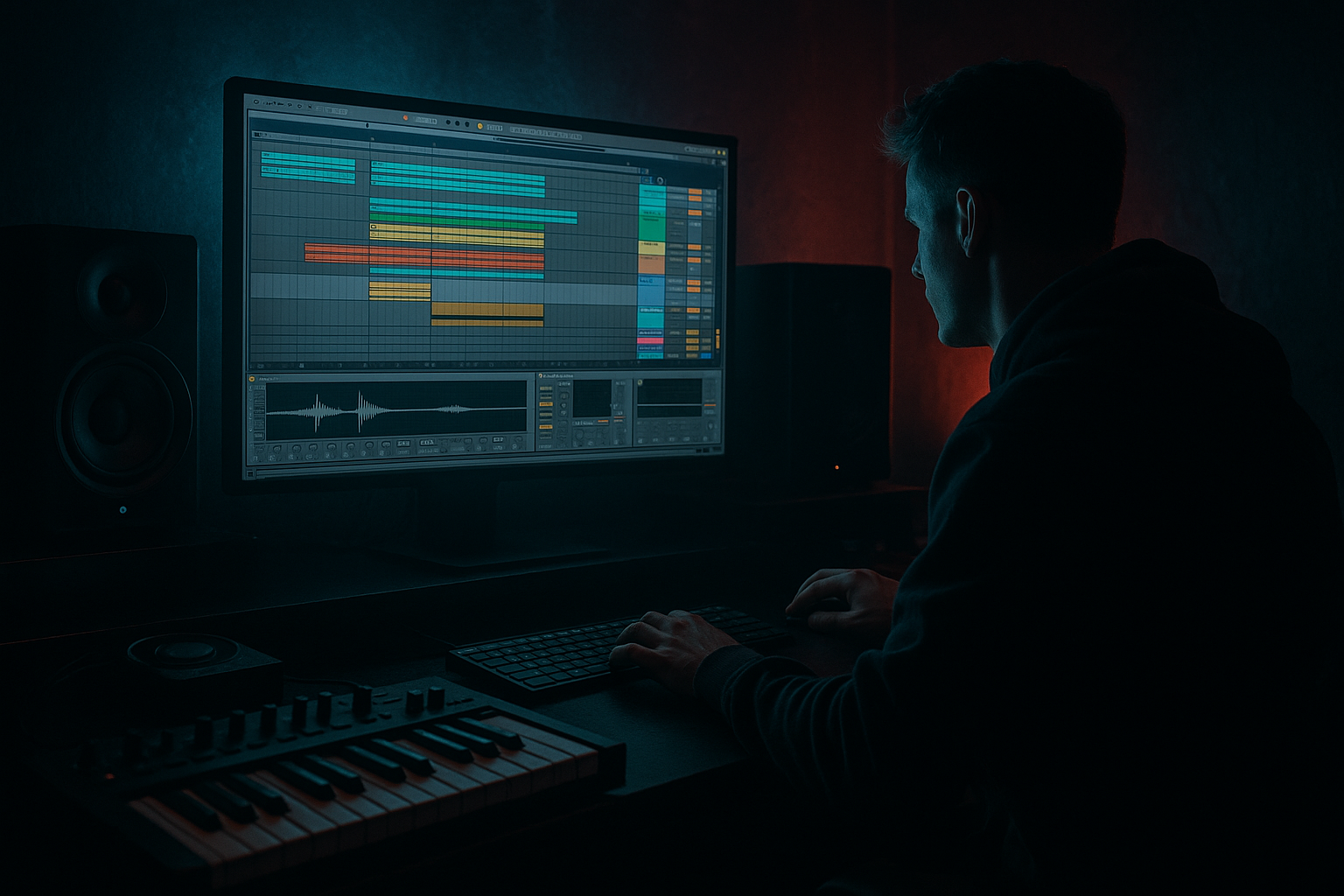
Main tutorial
```markdown
Jungle Warfare: Reese Patch Push (Session → Arrangement) in Ableton Live 12 (FX)
1) Lesson overview
This lesson is about making a reese bass patch feel like it’s “pushing” the groove—that forward, chesty, slightly aggressive movement you hear in jungle/rolling DnB—then performing that movement in Session View and printing it cleanly into Arrangement View for finishing.
We’ll focus on FX-driven motion, not just the synth. You’ll build:
- A playable reese rack with macro control
- A push chain (saturation → dynamic EQ/filters → multiband control → stereo management)
- A Session performance workflow that captures variations into Arrangement
- A quick approach to resampling/printing for commitment and mix speed 🎛️
- A Reese Bass Audio Track (or Instrument Track) with an Audio Effect Rack:
- Session clips that act like “scenes” in a DnB tune:
- A method to record your performance into Arrangement View accurately and musically.
- Osc 1: Basic Shapes → Saw
- Osc 2: Basic Shapes → Square (or another Saw)
- Filter: LP24
- Amp Env:
- Add LFO 1 → Filter Cutoff
- Notes: root note around F1–A1 (classic DnB range)
- Pattern: sustained note or a simple 1/2-bar hold + 1/2-bar hold.
- Keep it minimal—we’re making the motion with FX + performance.
- HPF at 30 Hz (24 dB/oct) to prevent sub-rumble
- Optional: narrow cut -2 to -4 dB around 250–400 Hz if it’s boxy
- Style: Warm or Punch
- Drive: 10–25% (don’t obliterate)
- Tone: slightly darker (pull highs if fizz appears)
- If using Roar’s dynamics: keep it gentle—this is “pressure,” not flatlining.
- Mode: Analog Clip
- Drive: 3–8 dB
- Soft Clip: On
- Output: compensate so level matches bypass (critical!)
- Filter type: LP24 or MS2 (character)
- Cutoff: 250–1.5 kHz depending on vibe
- Resonance: 10–25% (careful—too much whistling)
- Envelope: subtle, or map to Macro for live movement
- Add LFO:
- Mode: Ensemble
- Amount/Rate: keep it low to medium
- Width: 60–100% (but we’ll control sub mono later)
- Mix: 10–25%
- Use it as controlled aggression:
- Low: Ratio ~2:1, Threshold just tickling 1–3 dB GR
- Mid: Ratio ~2–3:1, 2–4 dB GR
- High: Ratio ~2:1, 1–3 dB GR
- Bass Mono: enable and set to 120 Hz (start point)
- Width: 80–110% depending on how wide your chorus is
- Add Compressor
- Clip envelopes (not automation yet):
- Scene 1: Intro
- Scene 2: Drop A (Roll)
- Scene 3: Drop A+ (Pressure)
- Scene 4: Switch / Half-time bar
- Scene 5: Fill (1 bar)
- Keep global launch at 1 bar.
- For fills, temporarily switch to 1/2 or 1/4 when performing.
- Perform one full drop pass (32–64 bars).
- Do a second pass to capture alternate takes.
- Choose the best sections and comp.
- Bars 1–8: Drop A (controlled push)
- Bars 9–16: Add pressure (more DRIVE + PUSH)
- Bars 17–24: Switch (filter darker, wobble slower)
- Bars 25–32: Return (wider + brighter)
- Bars 33–48: Repeat with variation (different clip)
- Bars 49–56: Peak (most aggressive setting)
- Bars 57–64: Exit (filter down, reduce width, set up breakdown)
- Over-widening the sub: If your reese sounds huge alone but weak in the mix, your low end is probably too stereo. Use Utility Bass Mono.
- Sidechain too slow: Release set too long can make the bass lag behind the drums. Tune release so it “breathes” in time.
- Too much resonance: Auto Filter RESO spikes can sound cool but kill headroom fast.
- Not level-matching drive: Saturation tricks you into thinking it’s better because it’s louder. Match output.
- Recording chaos: If you improvise everything with no clip plan, your Arrangement becomes a mess. Build “scenes” first, then perform.
- Split sub and growl:
- Roar for controlled violence: Use Roar drive modestly, then shape with EQ Eight after it (often a small dip at 3–6 kHz removes harshness).
- Multiband “grip”: Multiband Dynamics on the mid band is your “hands on the throat” control—don’t overcompress the whole signal.
- Micro-space, not reverb:
- Print and re-saturate: After printing to audio, try a second gentle Saturator pass. Audio often saturates more predictably than a live synth chain.
- You built a reese push system driven by FX and performance, not random automation.
- You used Session View to create purposeful variations (scenes + clip envelopes).
- You captured everything into Arrangement View via live recording or resampling, which is how many serious DnB tunes get their movement fast.
- Your “push” came from a controlled combo of saturation, rhythmic filtering, sidechain, multiband containment, and stereo discipline. ✅
---
2) What you will build
You’ll end up with:
- Drive (Roar/Saturator)
- Movement (Auto Filter + Chorus/Ensemble)
- Push (sidechain + transient control)
- Control (Multiband Dynamics + EQ Eight)
- Space/Width discipline (Utility + optional Echo micro-space)
- A: clean roll
- B: more push / more drive
- C: dark halftime switch / filter slam
- Fills: 1-bar “pressure spikes” (resample moments)
---
3) Step-by-step walkthrough
Step 0 — Project setup (tight like DnB)
1. Set tempo to 172–176 BPM.
2. In Preferences → Record/Warp/Launch:
- Record Quantization: 1 Bar (good for scenes)
- Launch Quantization: 1 Bar (you can switch to 1/2 later for fills)
3. Create a Drums track (your break + kick/snare). Keep it simple but solid:
- Kick on 1, Snare on 2 and 4 (standard DnB grid)
- Add a break loop if you like, but keep it tight.
> You want the reese to “push” against a stable drum anchor.
---
Step 1 — Build a solid reese source (fast + reliable)
You can do this with Wavetable (stock) or with audio. Here’s a clean Wavetable approach:
Create an Instrument Track → Load Wavetable
- Unison: 2–4
- Detune: 10–20
- Tune: -12 semitones (for weight)
- Level: -6 dB (don’t overstack)
- Cutoff: ~200–600 Hz (we’ll modulate later)
- Drive: 2–5
- Attack: 0–5 ms
- Decay: 200–400 ms
- Sustain: -6 to -12 dB
- Release: 60–120 ms
- Rate: 1/8 (sync) to start
- Amount: subtle, 5–15%
- Shape: sine/triangle for smooth movement
MIDI clip (1 bar loop)
---
Step 2 — The “Reese Push” FX chain (stock devices, real settings)
On the same track, build this device chain after Wavetable:
#### 2.1 EQ Eight (pre-control)
#### 2.2 Roar (or Saturator if you prefer)
Roar (recommended for modern push)
Alternative: Saturator
#### 2.3 Auto Filter (the “shove”)
- Rate: 1/8 or 1/16
- Amount: small (5–12%)
- Phase: try 180° for a different swing feel
> This is where “push” starts: the reese breathes rhythmically.
#### 2.4 Chorus-Ensemble (movement + width, controlled)
If it gets too “90s cheesy,” lower Mix and focus on the midrange.
#### 2.5 Multiband Dynamics (contain + shove)
- Low band: gentle compression to keep sub steady
- Mid band: slightly more compression to keep growl consistent
- High band: tame fizz
A practical starting point:
Keep output gain sensible—don’t “win” by getting louder.
#### 2.6 Utility (stereo discipline = instant pro)
DnB mixes die when reese low-end is wide.
---
Step 3 — Add the “Push” sidechain (the groove weapon) 🥊
Create a Ghost Kick track:
1. New MIDI track → load a simple short kick sample in Simpler
2. Program 4-on-the-floor or DnB kick pattern matching your main kick.
3. Turn its output off:
- Set track Audio To: Sends Only (or lower track fader to -inf while keeping it feeding sidechain)
Now on the Reese track:
- Sidechain: On
- Audio From: Ghost Kick
- Ratio: 4:1
- Attack: 1–5 ms
- Release: 60–120 ms (tune to tempo—faster = more pump)
- Threshold: aim for 3–6 dB gain reduction on hits
For extra “push,” try Auto Filter AFTER the Compressor so the filter movement rises as the bass returns.
---
Step 4 — Turn it into a playable performance rack (macro control)
Select your FX (EQ Eight → Roar/Saturator → Auto Filter → Chorus → Multiband → Utility → Compressor) and Group them into an Audio Effect Rack.
Create 8 Macros (example mapping):
1. PUSH: Compressor Threshold (and maybe Release slightly)
2. DRIVE: Roar Drive (or Saturator Drive)
3. CUTOFF: Auto Filter Cutoff
4. RESO: Auto Filter Resonance
5. WOBBLE: Auto Filter LFO Amount
6. WIDTH: Utility Width (and/or Chorus Mix)
7. MID BITE: EQ Eight bell at ~1–2.5 kHz +1 to +3 dB (optional)
8. SUB TIGHT: Utility Bass Mono freq (80–150 Hz range)
Now you can perform your reese like an instrument. 🎚️
---
Step 5 — Session View performance: building “warfare” scenes
In Session View, duplicate your reese clip into 4–6 clip slots (same MIDI, different settings).
For each clip, do this:
- In the clip, go to Envelopes and modulate one macro.
- Example: Clip A = steady, Clip B = more wobble, Clip C = filter sweep.
Suggested scene layout (classic DnB arrangement thinking):
- CUTOFF low, WOBBLE low, WIDTH reduced
- PUSH medium, DRIVE medium, WOBBLE subtle 1/8
- PUSH higher, DRIVE higher, small RESO bump
- CUTOFF lower, WOBBLE slower (1/4 feel), WIDTH tighter
- Quick CUTOFF rise + RESO spike + immediate snap back next scene
Launch Quantization tip:
---
Step 6 — Capture Session → Arrangement like a pro (the “patch push” commit)
Now we commit the performance.
Option A: Record to Arrangement (fast, flexible)
1. Press Tab to ensure you’re in Session view for launching.
2. Hit the Arrangement Record button (top transport).
3. Launch scenes/clips live:
- Move macros while clips are playing.
- Use clip variations to do most of the work; use macro tweaks for “human” feel.
4. Press Tab to go to Arrangement and you’ll see your performance recorded.
Key workflow:
Option B: Resample to audio (commit + heavier sound)
1. Create a new Audio Track named `REESE_PRINT`.
2. Set Audio From: your Reese track (Post FX).
3. Arm `REESE_PRINT`, hit record, and print 8–16 bar loops of your best “push” moments.
4. Slice/warp the printed audio:
- Warp mode: Complex Pro (for full-spectrum) or Tones (for more bite)
- Tighten to grid, then intentionally nudge certain hits for swing.
This is where you get that “this bass is a weapon” density—audio printing often feels more decisive and mix-ready.
---
Step 7 — Arrangement ideas (DnB structure)
A practical 64-bar drop plan using your recorded performance:
---
4) Common mistakes
---
5) Pro tips for darker/heavier DnB
Duplicate the reese:
- Track 1 = SUB (lowpassed at ~90–120 Hz, mono, clean, minimal movement)
- Track 2 = MID REESE (everything above, heavy FX, width allowed)
This keeps weight consistent while you go wild with push FX.
Add Echo at the end:
- Time: 1/16 or 1/32
- Feedback: 5–12%
- Filter: dark (HP around 300 Hz, LP around 4–6 kHz)
- Mix: 3–8%
This adds depth without washing the bass.
---
6) Mini practice exercise (15–25 minutes)
1. Build the rack with 8 macros as described.
2. Make 3 Session clips:
- Clip 1: steady roll (no envelope)
- Clip 2: wobble envelope on WOBBLE macro (subtle)
- Clip 3: 1-bar fill envelope on CUTOFF + RESO
3. Record a 32-bar performance into Arrangement:
- Bars 1–8: Clip 1
- Bars 9–16: Clip 2 + slight DRIVE increase
- Bar 16: Clip 3 fill
- Bars 17–32: Clip 2 but automate WIDTH down then back up
4. Print to audio for the last 8 bars and compare:
- Which feels heavier? Which sits better with drums?
---
7) Recap
If you want, tell me whether you’re using Wavetable or audio reese samples, and what sub note your track is in—I can suggest a macro mapping and scene plan tailored to your drum pattern.
```

