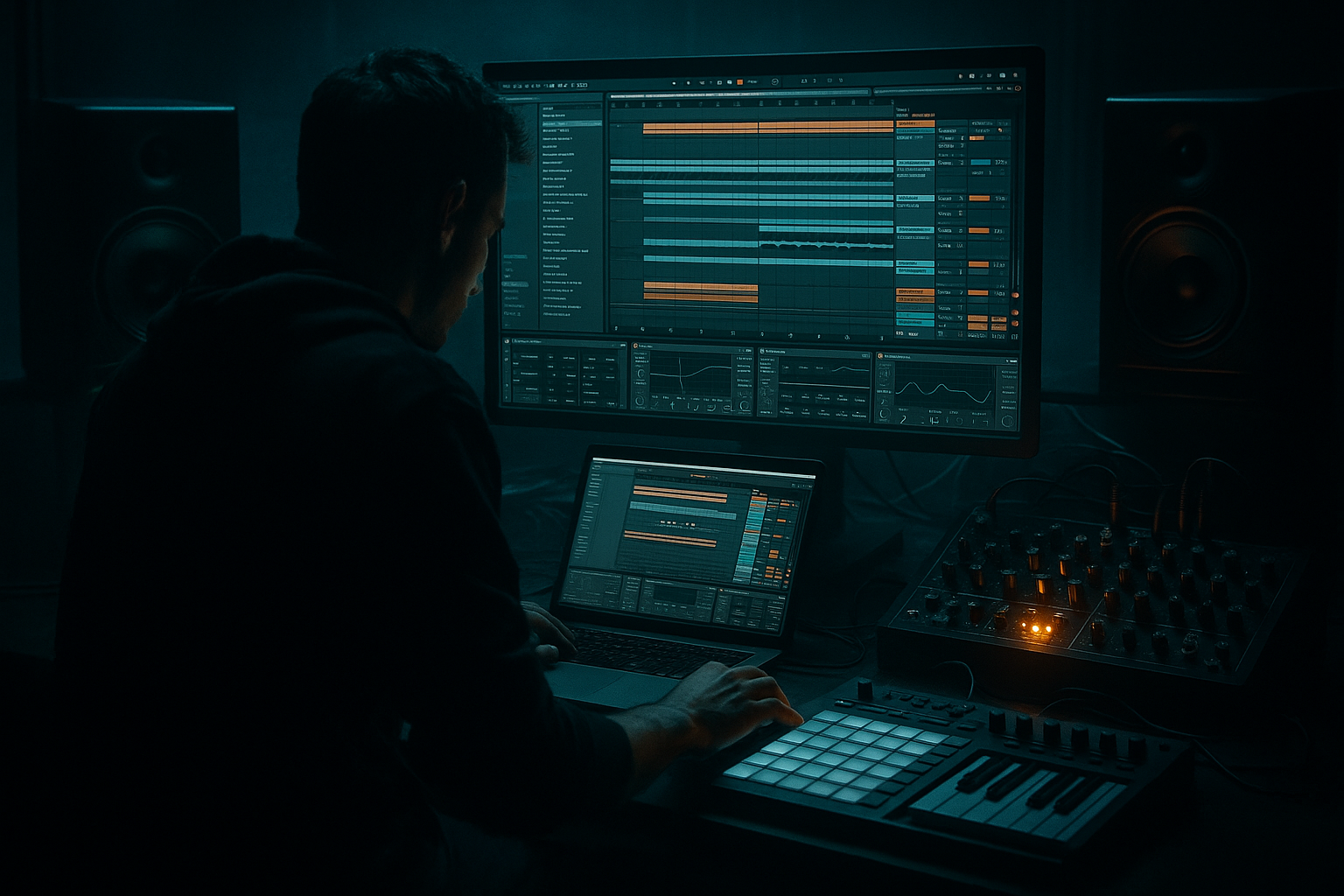
Main tutorial
Junglist Ableton Live 12 Shuffle Deep Dive
90s-Inspired Darkness for Jungle / Oldskool DnB Vibes 🥁🌑
---
1. Lesson overview
In this lesson, you’re going to build authentic jungle-style shuffle in Ableton Live 12 — not just a generic swing, but that uneven, loping, slightly drunken 90s break feel that makes oldskool DnB and jungle feel alive.
We’ll focus on:
- How to create shuffle that grooves without sounding quantized
- How to layer breakbeats with programmed drums
- How to use Ableton Live 12 tools to shape timing, feel, and darkness
- How to turn one drum groove into a full section with fills, drops, and transitions
- How to keep the vibe dark, raw, and rolling without losing power
- A 2-bar jungle drum loop with strong shuffle and break swing
- A layered breakbeat stack: one main break + supporting kicks/snares
- A dark rolling bass pocket that leaves room for the drums
- A 16-bar loop section with variations and fills
- A workflow you can reuse for jungle, oldskool DnB, ragga-influenced breaks, and darker rollers
- Broken, human, slightly unstable groove
- Snare placement that drives the rhythm
- Ghost notes and off-grid hat chatter
- Subby pressure underneath, but not over-quantized
- Rain-soaked, tense, warehouse energy
- 160–172 BPM for classic jungle / early DnB
- 168 BPM is a great sweet spot
- If you want more pressure and less breakbeat chaos, push 174–176 BPM
- break energy
- push and pull
- ghosted syncopation
- snare-led momentum
- Amen-style break
- Think-style break
- Hot Pants-style break
- Funky drummer-derived material
- Any dusty 2-bar break with strong ghost notes
- Audio track, then slice it
- Or use Drum Sampler / Simpler if you want to trigger sections
- Drag the break into Arrangement or Session
- Right-click the clip
- Choose Slice to New MIDI Track
- Slice by:
- Keep the main break doing the groove work
- Add only minimal programming to support missing low-end hits
- Kick
- Snare
- Ghost snare hits
- Hat chatter
- Open break tail / ride fragments
- Drum Rack
- Simpler
- EQ Eight
- Saturator
- Drum Buss
- Glue Compressor
- Utility
- classic break feel
- subtle timing drift
- natural offset in 1/16 and 1/8 subdivisions
- Move offbeat hats slightly late by 5–15 ms
- Pull some ghost notes ahead of the beat by 5–10 ms
- Leave main snares mostly solid, but try tiny deviations:
- Bar 1: main snare on 2 and 4, extra ghost note before beat 2
- Bar 2: same core, but change one kick and one hat to create forward motion
- Use nudge keys to shift notes off grid
- Use velocity lane to vary ghost hits
- Use chance and velocity randomization sparingly for hats and percussion
- velocity contrast
- microtiming offsets
- occasional dropped hits
- ghost notes with low velocity
- Main snare: 110–127
- Ghost snare: 25–70
- Kick accents: 90–120
- Hats: 15–90 depending on role
- Keep the character and shuffle
- High-pass lightly if needed to make room for sub
- Don’t crush the transient
- short
- dry
- punchy
- maybe slightly noisy or vinyl-textured
- layer a clean kick underneath
- keep it short
- tune it to the track if necessary
- shuffled hats
- ride fragments
- percussion hits
- reversed noise swells for transition energy
- 1/16 hats with varying velocities
- offbeat shaker patterns
- tiny conga or rim fragments
- vinyl noise or foley textures chopped rhythmically
- Closed hat on every 1/8 note
- Duplicate a second hat lane
- Offset the second lane slightly late
- Lower its velocity on repeating hits
- Pan alternating hats slightly left/right
- Auto Pan for subtle movement
- Echo for dark rhythmic repeats
- Beat Repeat for glitchy fills
- Redux for roughening textures
- Vinyl Distortion for grime and character
- use a sub-heavy mono layer
- add a mid-bass layer with character
- leave space for the kick/snare movement
- leave tiny gaps
- use syncopated note lengths
- let some notes answer the snare
- make the bass phrase feel like part of the percussion
- Bars 1–4: intro groove, filtered drums, light texture
- Bars 5–8: full break enters, bass joins
- Bars 9–12: variation with extra hat layer or snare fill
- Bars 13–16: breakdown or transition into drop extension
- Remove the kick for 1 bar to create tension
- Drop in a reversed break or reverb tail before a new section
- Strip bass out for 2 beats so the snare lands harder
- Use a Beat Repeat fill in the last half of bar 8 or 16
- Let the break breathe for a bar before full return
- Use a short filter sweep instead of huge modern risers
- Add a low-passed vocal chop or ragga stab for instant jungle identity
- detuned synth stabs
- low-passed dub chords
- ominous atmospheres
- reversed cymbal noise
- tape warble
- gritty room reverb
- Reverb
- Hybrid Reverb
- Echo
- Chorus-Ensemble
- Vinyl Distortion
- Roar if you want modern controlled aggression
- Auto Filter for tension shaping
- classic breakbeat motion
- dark rolling energy
- enough space for a subline
- one more raw and loose
- one more tight and heavy
- one more dark and minimal
- Jungle shuffle comes from microtiming, velocity, and layered breaks
- Ableton Live 12 gives you powerful tools for groove extraction, MIDI shaping, and drum processing
- The best oldskool-inspired DnB feels human, dusty, and slightly unstable
- Use Break + Support Layer + Top Percussion + Bass Pocket as your core system
- Keep the drums alive by varying:
- Darker DnB works best when it is controlled, not overpacked 🌑
- a project template for Ableton Live 12
- a MIDI step pattern example
- or a full jungle drum rack chain with exact device settings.
This is an advanced composition lesson, so we’ll assume you already know your way around Ableton and basic drum programming. We’re going deeper: microtiming, groove extraction, break layering, and arrangement choices that make the track feel like it came out of a foggy basement rave in 1994 🕶️
---
2. What you will build
By the end of this lesson, you’ll have:
Target vibe:
---
3. Step-by-step walkthrough
---
Step 1: Set the tempo and frame the groove
For oldskool jungle, start around:
In Ableton:
1. Create a new MIDI track for drums.
2. Set the tempo to 168 BPM.
3. Turn on the metronome.
4. Drop a 4-bar loop region so you can hear repetition and variation clearly.
Your mindset:
Don’t think “straight 1/16 grid.” Think:
---
Step 2: Choose the right break material
For this sound, start with a classic break such as:
In Ableton Live 12, import your break into:
#### Best workflow:
- Transient for detailed control
- Warp markers if you want a looser feel, but be careful
If your break already has good groove, do not over-edit it. The goal is to preserve feel, not sterilize it.
---
Step 3: Build the core break layer
Create a drum rack or MIDI track with your sliced break.
#### Start with this approach:
Typical core elements:
#### Useful stock devices:
---
Step 4: Shape the shuffle with groove, not just swing
This is the heart of the lesson.
Ableton’s groove system lets you apply feel from one clip to another.
#### Option A: Use an extracted groove
1. Drag a break clip into a track.
2. In the Clip View, extract groove using Groove Pool.
3. Apply that groove to your programmed hats, ghost percussion, or supporting drums.
This is excellent if you want:
#### Option B: Program your own shuffle manually
If you want control, edit the MIDI notes directly.
##### Suggested timing approach:
- main snare: close to grid
- ghost snare: slightly late or early depending on the groove
That contrast creates the feeling of a real drummer.
#### A practical 2-bar shuffle concept:
The goal is symmetry with small imperfections.
---
Step 5: Use Ableton Live 12’s note and groove tools intelligently
In Live 12, you can get very surgical with note timing.
#### In MIDI clips:
For jungle drums, focus on:
##### Practical velocity ranges:
That velocity difference is what makes the shuffle breathe.
---
Step 6: Layer the break with programmed drums
This is where your loop becomes a track-ready jungle groove.
#### Layer 1: Main break
#### Layer 2: Snare reinforcement
Use a separate snare sample:
Place it subtly under the main snare to add consistency.
#### Layer 3: Kick reinforcement
If your break kick is weak or buried:
#### Layer 4: Hats and top loop
Add:
This gives you that classic “busy but controlled” jungle texture.
---
Step 7: Process the drum bus for darkness and weight
Route all drum elements to a Drum Bus group.
#### Suggested drum bus chain:
1. EQ Eight
- high-pass only very low rumble if needed
- small cut around muddy low-mids if the break and kick are fighting
2. Drum Buss
- Drive: light to moderate
- Crunch: subtle
- Boom: only if needed, and keep it controlled
3. Saturator
- Soft Clip ON
- Drive: 1–5 dB
4. Glue Compressor
- Ratio: 2:1 or 4:1
- Attack: 10–30 ms
- Release: Auto or 0.3–0.6 sec
- Aim for gentle glue, not pumping
5. Utility
- mono the low end if required
- use width carefully on the top layer
#### Darker tone tip:
Use saturation to darken the drums, not just make them louder.
A little harmonic dirt can make oldskool drums feel like they came off tape or vinyl.
---
Step 8: Build shuffle through percussion layers
The secret to jungle shuffle is often not the main break — it’s the supporting percussion.
Try adding:
#### Example:
This creates motion without clutter.
#### Ableton devices to use:
Keep it musical. Avoid making the top end too shiny — jungle should feel dusty, not sterile.
---
Step 9: Add bass that respects the shuffle
In jungle and oldskool DnB, the bass must sit with the drums, not against them.
For a dark rolling bass:
#### Strong stock device chain for bass:
1. Operator or Wavetable
- pure sine or simple saw
2. EQ Eight
- clean up unwanted highs if needed
3. Saturator
- add harmonics for audibility
4. Compressor
- sidechain gently to the kick if necessary
5. Utility
- mono below 120 Hz
#### Groove tip:
Do not place bass notes directly on top of every kick if the groove starts to feel stiff.
Instead:
In jungle, bass is often a rhythmic instrument, not just a low drone.
---
Step 10: Create a 16-bar arrangement from the loop
A loop alone is not enough. Jungle thrives on arrangement movement.
#### A practical 16-bar structure:
#### Arrangement ideas:
#### Oldskool-friendly tricks:
---
Step 11: Make the shuffle darker with sound design choices
Darkness in jungle is not just minor keys. It’s texture, space, and tension.
#### Use:
#### Stock devices that help:
#### Keep the drums upfront:
Use your atmospheres as a frame, not the focus.
The break should still feel like the engine of the track.
---
4. Common mistakes
1. Over-quantizing everything
If every hit is locked to the grid, the groove dies. Jungle needs human timing.
2. Too much swing on everything
Not every element should share the same shuffle. Layering different degrees of offset is more natural.
3. Making the drums too clean
Oldskool jungle thrives on grit. If it sounds like polished techstep or modern pop drums, you may have overprocessed it.
4. Overcrowding the low end
Kick, bass, and break low frequencies can clash fast. Keep the sub clear and use EQ carefully.
5. Too many fill ideas
A jungle loop can get busy quickly. Fills should feel like punctuation, not constant interruption.
6. Ignoring velocity
A flat velocity pattern makes ghost notes useless. Velocity is essential for shuffle realism.
---
5. Pro tips for darker/heavier DnB
Tip 1: Separate the “groove layer” from the “impact layer”
Let the break provide movement, and use a cleaner snare/kick layer for impact. This gives you both feel and power.
Tip 2: Use short reverb on snares, not huge wash
A very short room or plate can make the snare feel ominous without washing out the groove.
Tip 3: Slightly delay top percussion
A few ms late on hats can create a lazier, moodier pocket.
Tip 4: Use subtle tape-style saturation on the drum bus
This softens transients in a way that feels period-correct for 90s-inspired material.
Tip 5: Build tension with absence
Pull elements out for one or two beats. In jungle, silence can hit harder than fills.
Tip 6: Make the bass phrase answer the snare
A call-and-response between snare and bass is a huge part of rolling DnB energy.
Tip 7: Layer one “ugly” texture
A noisy layer, radio sample, or degraded percussion hit can make the whole track feel darker and more authentic.
---
6. Mini practice exercise
Exercise: Build a 2-bar jungle shuffle loop
#### Goal:
Create a loop that feels like:
#### Steps:
1. Set tempo to 168 BPM.
2. Import one classic break.
3. Slice it to MIDI.
4. Program:
- main snare on 2 and 4
- one ghost snare before beat 2
- one extra kick variation in bar 2
- 1/16 hats with velocity variation
5. Apply a groove from the break to your hats only.
6. Add a separate kick and snare layer quietly underneath.
7. Route everything to a drum bus.
8. Add EQ Eight, Drum Buss, and subtle Saturator.
9. Write a simple 2-bar bass phrase that leaves room for the snare.
10. Loop it and listen for:
- swing
- punch
- groove continuity
- tension
#### Challenge mode:
Make three versions:
Compare how timing and velocity change the whole feel.
---
7. Recap
Let’s lock in the key ideas:
- timing
- velocity
- texture
- arrangement density
If you can make one 2-bar loop feel like it’s breathing, swinging, and threatening to fall apart — you’re on the right path.
If you want, I can also turn this into:

