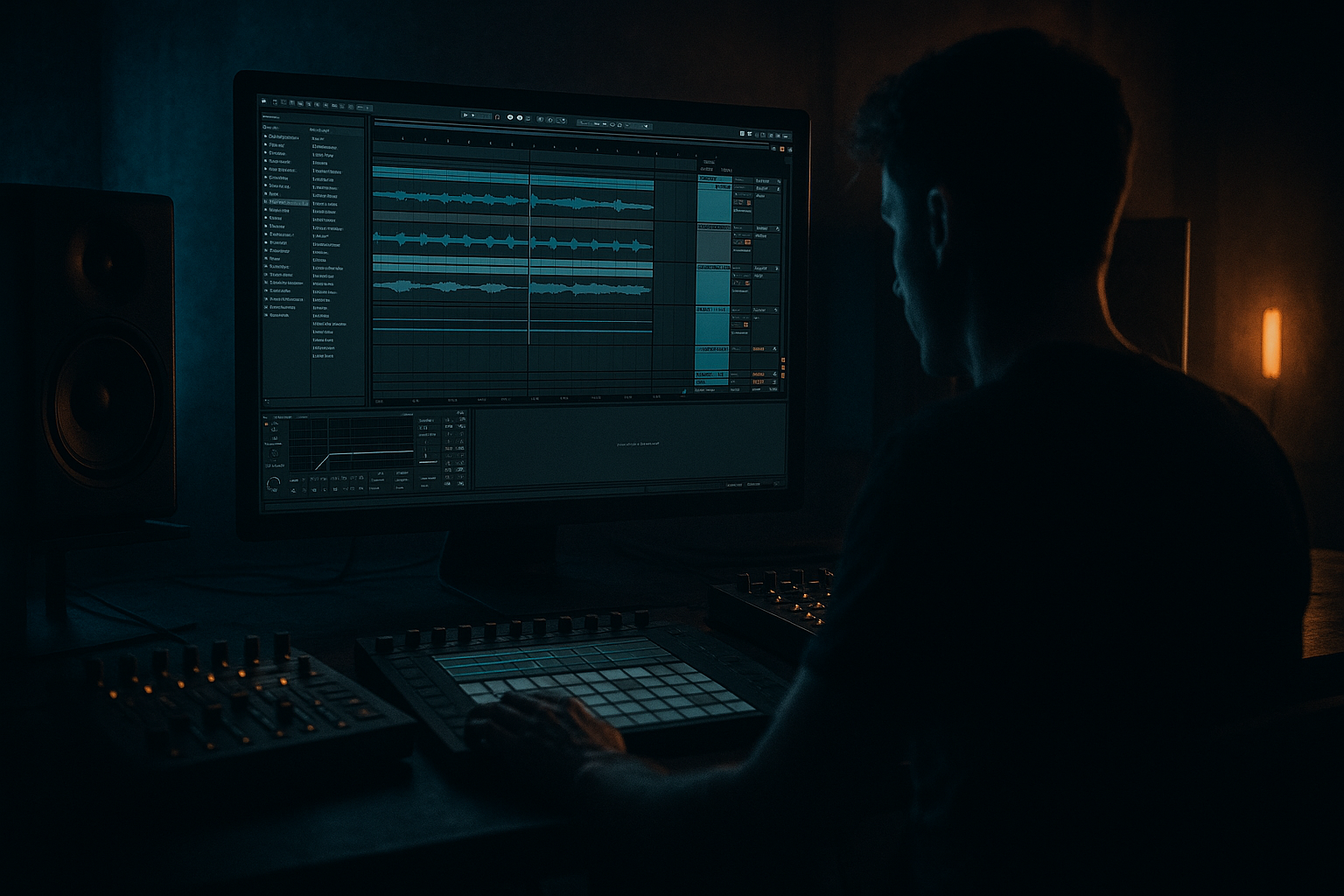
Main tutorial
Lesson Overview
The classic air horn is one of those sounds that instantly says jungle / oldskool DnB energy. In a track, it works like a crowd-control weapon: a short, aggressive callout that can punctuate a drum break, hype the drop, or answer a bass phrase. In this lesson, you’ll build an air horn hit sequence in Ableton Live 12 that feels authentic to jungle and dark DnB, not cheesy or overcooked.
The goal is not just “make a loud horn.” The goal is to create a musical, rhythmically locked horn sequence that sits inside a break-driven groove, works with call-and-response bass phrasing, and can be dropped into a full arrangement as a signature hook or transition tool. We’ll use stock Ableton devices, clean routing, and practical automation so the horn feels like part of the track’s language rather than a random sample pasted on top.
Why this matters in DnB: oldskool jungle and modern darker DnB both rely on short, memorable stabs that interact with the drums. If the horn hits in the wrong pocket, it kills momentum. If it’s tuned, compressed, and arranged well, it can lift an entire section and make the drop feel much bigger. 💥
What You Will Build
By the end, you’ll have an Ableton Live 12 rack or track setup that plays a three- to five-hit air horn sequence with:
- a tight, punchy attack
- a slightly pitched, detuned character for oldskool grit
- gated decay so it doesn’t clutter the mix
- optional delay throws and reverb tails for transitions
- a sequence that can answer a reese bass phrase or sit on top of a classic Amen-style break
- enough control to make it feel junglist, rude, and DJ-friendly
- an 8-bar intro before the drop
- the last 2 bars of a breakdown
- a 4-bar call-and-response section with drums and bass
- a switch-up bar after a main drop loop
- Too much low end in the horn
- Horn is too long and clutters the break
- Hits are on-grid but feel stiff
- Horn is harsh and painful
- Too many horn notes
- Reverb washes out the mix
- Horn fights the bass phrase
- Detune slightly for menace
- Layer a second horn an octave down, quietly
- Use a short gate or volume shaping
- Try distortion before EQ
- Resample and chop the best moments
- Keep the horn mono in the low mids
- Automate a band-pass filter for tension
- Pair it with break edits
- Keep the air horn short, tuned, and rhythmically intentional.
- Use Groove and slight timing shifts so it locks with the break.
- Treat the horn as a call-and-response element with drums and bass.
- Use EQ, saturation, and controlled delay/reverb to make it cut cleanly.
- In darker DnB, the best horn sequences are rude, sparse, and arranged with purpose.
Musically, think of it as a sequence that could sit over:
You’ll end up with something that can feel like: horn on beat 1, answer on the “and” of 2, final hit on beat 4, or a more syncopated one-drop-to-two-drop style phrase that snaps against the break.
Step-by-Step Walkthrough
1. Choose the right source and put it in its own track
Start with an audio track or MIDI track dedicated to the horn. For a classic jungle vibe, use either:
- a clean air horn sample from your library, or
- a synth-generated horn-like stab resampled into audio later
If you’re using a sample, drag it into Simpler. Set Simpler to Classic mode and enable One-Shot so each note triggers the whole hit cleanly. In the Sample tab, tighten the Start point until the transient hits immediately. If there’s too much tail, trim the End so the horn stops before it smears into the next drum hit.
For a more controllable approach, start with a Wavetable or Analog patch and shape a brassy saw-style stab. You don’t need realism here; you need attitude. Keep it short and aggressive.
Why this works in DnB: the horn needs to behave like a percussive accent, not a sustained lead. Jungle arrangements move fast, so the horn must leave space for breaks, sub, and bass movement.
2. Shape the horn envelope so it hits hard and gets out of the way
In Simpler or your synth, shape the amplitude envelope for a short, punchy result:
- Attack: 0–5 ms
- Decay: around 120–350 ms
- Sustain: low or zero
- Release: 40–120 ms
If you’re using Wavetable, a good starting point is a saw-based oscillator with a simple filter envelope:
- Filter: band-pass or low-pass
- Cutoff: around 300 Hz to 2.5 kHz depending on brightness
- Envelope amount: moderate, enough for a “wah” punch
- Drive: light to medium
For an oldskool horn feel, let the first 50–100 ms be bright and brash, then let the body fall away quickly. You’re aiming for a hit that feels like it’s shouting over the break, not singing through the whole bar.
Add Saturator after the source with:
- Drive: 2–6 dB
- Soft Clip: on
- Output: adjusted to keep level sensible
This gives the horn edge and helps it survive dense drum programming.
3. Tune the horn to the track key and build a usable interval pattern
Even in a sample-heavy jungle tune, tuning matters. Use Tuner or your ears with the track key. If your tune is in a minor key, try placing the horn around the root, b3, 5, or b7. For more aggressive tension, use:
- root
- minor 2nd tension
- tritone movement
- octave jumps
A good starting sequence in a minor DnB track might be:
- Hit 1: root
- Hit 2: minor 3rd up
- Hit 3: root or 5th
- Hit 4: octave or lower answer note
If you’re using MIDI, keep the pattern simple and rhythmic. Don’t write a lead melody unless the tune truly needs it. Jungle horns often work best as riff punctuation rather than full melodic lines.
Try a 2-bar pattern:
- Bar 1: beat 1, offbeat after beat 2, beat 4
- Bar 2: beat 1, beat 3, pickup into the next bar
This creates a call-and-response pocket against the drum loop.
4. Lock the horn to the groove with Ableton’s groove tools
The difference between a stiff horn and a proper junglist horn is timing. In Live, use the Groove Pool to pull the horn into the same feel as your drums. If your break has swing, extract or choose a groove with subtle shuffle rather than heavy swing.
Practical settings:
- Start with Groove Amount: 20–45%
- Use a groove that matches your break timing
- Keep Timing shift subtle
- Use Random very lightly, if at all
If your break is a chopped Amen, the horn should often land just ahead of the beat or just behind it depending on the section. Test both. In jungle, slightly late horn hits can feel heavier and more relaxed, while slightly early hits can feel more urgent and aggressive.
You can also manually nudge the MIDI notes:
- move the first hit slightly ahead of beat 1 for tension
- push the response hit slightly late for bounce
- let the final hit fall cleanly on a strong subdivision
This is where the horn starts feeling “performed” instead of programmed.
5. Add EQ, compression, and transient control so it cuts without taking over
Place EQ Eight after the source:
- high-pass around 120–250 Hz to stay out of the sub
- dip harshness around 2.5–5 kHz if it gets too piercing
- add a small presence boost around 700 Hz–1.5 kHz if the horn lacks body
Then add Compressor or Glue Compressor if the horn is spiky:
- Ratio: 2:1 to 4:1
- Attack: 3–15 ms
- Release: 50–150 ms
- Aim for just a few dB of gain reduction
For more snap, use Drum Buss sparingly:
- Drive: low to moderate
- Transient: a little up if the horn needs more attack
- Boom: usually off or very low, unless the horn is intentionally subby
If the horn competes with snare cracks or upper bass harmonics, carve space with EQ instead of making it louder. In DnB, clarity beats raw volume almost every time.
6. Build movement with automation, delay throws, and reverb sends
Use send tracks or device automation to make the horn feel alive. A classic jungle approach is to keep the dry horn punchy, then throw only selected hits into space.
Set up:
- Return A: Reverb
- Return B: Delay
For reverb:
- Hybrid Reverb or Reverb
- short to medium decay
- pre-delay around 15–35 ms
- keep low end filtered out
For delay:
- Echo
- tempo sync on
- try 1/8 or 1/8 dotted
- feedback low to moderate
- filter the delay to keep it dark
Automation ideas:
- send only the last horn hit of an 8-bar phrase to delay
- increase reverb send during a breakdown, then pull it back for the drop
- automate Filter Cutoff slightly open across the sequence for a rising sense of energy
- automate a tiny pitch rise on the second or third hit for tension
A nice arrangement move: in the final bar before the drop, let the horn hit once dry, then again with a delay throw that lands right before the kick returns. That creates a very DJ-friendly pickup.
7. Make it feel like oldskool DnB with call-and-response placement
The most authentic jungle horn sequences often work best as responses to drums and bass, not as constant lead lines. Program the horn so it answers the rhythm rather than fighting it.
Example musical context:
- Bars 1–2: break and sub establish the groove
- Bar 3: horn answers the snare fill on the “and” of 3
- Bar 4: horn lands on beat 1 and again before the drop
- Drop: horn is reduced to one or two hits so the drums and bass breathe
A strong oldskool pattern is:
- Hit 1: bar 1 beat 1
- Hit 2: bar 1 beat 3 offbeat
- Hit 3: bar 2 beat 4
- Hit 4: bar 3 beat 1 or the pickup into bar 4
This gives the horn a ragga/junglist dialogue with the drums. If the break is busy, reduce horn density. If the section is sparse, increase the horn’s rhythmic activity.
8. Glue it into the arrangement and bounce it into a usable performance element
Once the sequence works, group the horn track with its effects and turn it into an Instrument Rack or Audio Effect Rack for speed. Map:
- volume
- filter cutoff
- delay send
- reverb send
- pitch or transpose
Then create a few versions:
- Dry rude version for drops
- Spacey version for breakdowns
- Filtered intro version for build-ups
- Wide/panned version for transitions only
In the arrangement, use the horn as:
- a 4-bar intro statement
- a last-bar pre-drop cue
- a mid-drop switch-up
- a DJ tool for mix transitions
If you resample the processed horn to audio, you can chop it further and create a sequence with more character. This is especially useful in jungle, where edited audio often feels more authentic than overly polished MIDI.
Common Mistakes
- Fix: high-pass with EQ Eight around 120–250 Hz so it doesn’t clash with sub and kick.
- Fix: shorten the envelope or trim the sample end. Jungle needs quick exits.
- Fix: apply a subtle groove, or manually nudge notes slightly ahead/behind the beat.
- Fix: reduce presence around 3–5 kHz, soften with Saturator or a light compressor, and avoid over-brightening.
- Fix: simplify the sequence. In DnB, less often hits harder.
- Fix: keep reverb on sends, filter the return, and use automation only on selected hits.
- Fix: arrange them as call-and-response. If the bass is busy, let the horn hit on the gaps.
Pro Tips for Darker / Heavier DnB
- In Wavetable or Simpler Transpose, detune layers by a few cents for a rougher, more underground edge.
- Keep it subtle and mono. This adds body without turning the sound into a meme.
- A fast envelope gives the horn that clipped, urgent “impact” feel associated with classic rave and jungle systems.
- A light Saturator or Pedal can add attitude. Then clean up the result with EQ Eight.
- Bounce your sequence to audio, then cut the strongest transient and reuse it as a fill or pre-drop hit.
- If you widen it, do it carefully and mostly with reverb or higher-frequency ambience. The core should stay focused.
- A quick sweep from narrow to full can make the horn feel like it’s punching through fog before a drop.
- Let the horn answer a snare fill, a reverse break, or a last-half-bar chop. That’s where it feels most authentic.
Mini Practice Exercise
Spend 10–20 minutes creating a horn sequence for an 8-bar jungle loop.
1. Load a horn sample or synth patch into Simpler/Wavetable.
2. Program a 2-bar MIDI phrase with only 3–5 hits.
3. Set the horn to a minor key note set: root, b3, 5, octave.
4. Add EQ Eight and high-pass the low end.
5. Add Saturator with 2–4 dB drive.
6. Send only the final hit to Echo or Hybrid Reverb.
7. Apply a subtle Groove from the Groove Pool.
8. Loop the full 8 bars and listen to how the horn sits with your break and sub.
9. Make one version that feels dry and rude, and one that feels wide and atmospheric.
10. Resample both versions and compare which one feels more like a real DnB arrangement tool.
Goal: by the end, you should have a horn sequence that could survive in a proper jungle intro or a dark drop without sounding out of place.

