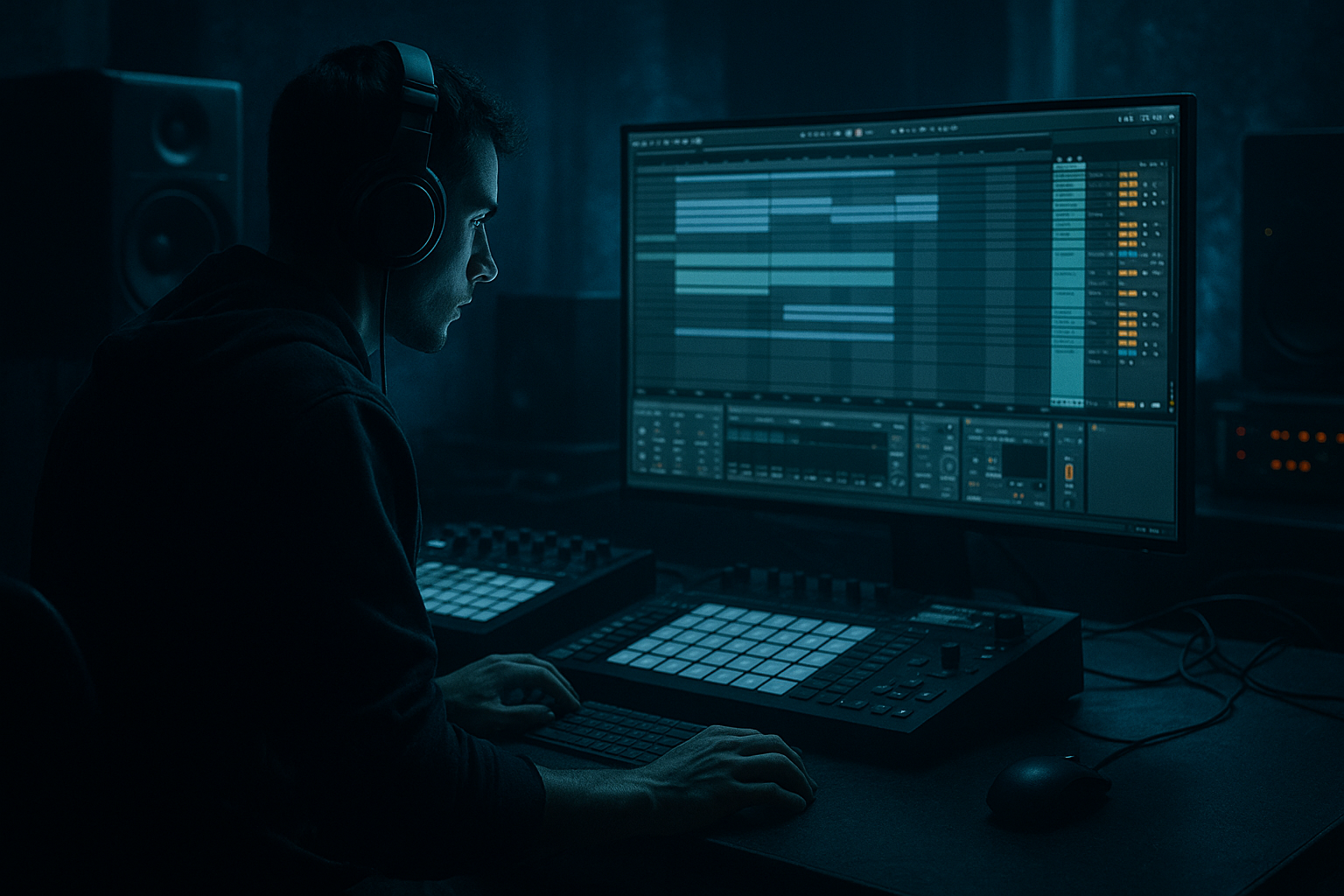
Main tutorial
```markdown
Keeping Sections Distinct for Dark Rollers (Ableton Live) 🖤🥁
Skill level: Beginner • Category: Arrangement • Genre: Drum & Bass (dark roller / jungle-rooted)
---
1. Lesson overview
Dark rollers live or die by momentum—but if every 16 bars feels the same, the track becomes a loop. The goal is to keep the core groove consistent while making each section feel like it moves forward.
In this lesson you’ll learn how to make sections distinct using:
- Arrangement markers + 8/16-bar thinking
- Energy automation (filters, reverb, distortion, stereo width)
- Drum variation that doesn’t break the roll
- Call/response between bass + drums
- Simple Ableton stock device chains that you can reuse every track
- Intro (16–32 bars): drums + atmos, “mixable”
- Build (8–16 bars): tension ramps
- Drop A (32 bars): main groove + bass hook
- Mid-break / switch (16 bars): reset + tease
- Drop B (32 bars): same identity, new twist
- Outro (16–32 bars): DJ-friendly exit
- Kick: hits with the bass, often on 1 and/or “pushes”
- Snare/Clap: beat 2 and 4
- Hats/shakers: driving 1/16 or swung 1/8
- Ghost notes: subtle, gives roll without changing pattern
- Create a Drum Group with:
- Put a Drum Bus on the drum group:
- Hybrid Reverb
- Send small amounts from hats + snare for space.
- Hybrid Reverb
- Use mostly for FX hits, vocal chops, and occasional snare throws.
- Echo
- Automate sends at phrase ends (bar 8, 16).
- Filter: Low-pass
- Frequency start: `150–300 Hz`
- Ramp to: `1–3 kHz` by the build
- Resonance: `5–15%` (don’t whistle)
- Utility on Atmos group: automate Width
- Remove low end briefly (creates hunger for the drop)
- Increase distortion/saturation gently
- Add snare fill or ghost build in last 2 bars
- Increase reverb sends for a “space opens up” moment
- On your Drum Group, add EQ Eight (last in chain):
- On bass group: Saturator
- On master (optional, gentle): Glue Compressor
- Drop A: Bass phrase answers every 2 bars
- Drop B: Bass phrase answers every 1 bar (busier)
- Drop A: tight closed hats + short rides
- Drop B: add a shuffly hat loop, or open hat on offbeats
- Use Drum Rack + Velocity MIDI effect on hats:
- Drop drums to half-time feel briefly (keep sub pulsing)
- Then slam back into full roll
- Mute some hats
- Add a reverb snare throw and a 1-bar silence on bass mids (leave sub)
- Drop A: vinyl noise / jungle air
- Drop B: metallic reese texture or neuro-ish fizz
- Redux (light): Downsample `2–6`, Dry/Wet `5–15%`
- Auto Pan (slow): Rate `0.10–0.30 Hz`, Amount `10–25%` (keep bass mono!)
- Mute kick for 1/8 or 1/4 right before the snare hits
- Mute bass mids for 1 beat (sub can stay)
- Add impact or reverse cymbal
- Add snare fill (very short, not a drum solo)
- Consolidate your 16-bar drum loop (`Cmd/Ctrl + J`)
- Then create automation lanes:
- Use Fade handles on audio clips for clean reverses/impacts.
- Auto Filter (HP at `200–600 Hz`)
- Saturator (Drive `1–3 dB`)
- Utility (Width `120–160%` for tops only)
- “Less top end = more menace.”
- Use distortion as arrangement automation
- Atmosphere is your glue between sections
- Create a “Drop Impact” rack (fast repeatable system)
- One-bar drum switch-ups feel huge at 174 BPM
- Anchor the track with a consistent core groove ⚓
- Arrange in 8/16-bar phrases with clear markers
- Automate a few “energy lanes” (filter, reverb, distortion, width)
- Separate Drop A and B by changing headline elements, not everything
- Add micro-mutes and throws at phrase ends for pro momentum
- Keep it dark by controlling brightness and using texture intentionally 🖤
---
2. What you will build
A clean, DJ-friendly dark roller arrangement with clear sections:
You’ll end with a session that still rolls but has obvious “chapters” 🎚️
---
3. Step-by-step walkthrough
Step 0 — Set up your arrangement like a pro (2 minutes)
1. Set tempo: `172–175 BPM` (classic roller zone).
2. Hit `Cmd/Ctrl + Shift + M` to add Arrangement Markers:
- Intro
- Build
- Drop A
- Break
- Drop B
- Outro
3. Turn on 1 Bar grid for placing sections, and 1/16 for drum edits.
DnB rule of thumb: Make decisions in 8-bar blocks. Most roller changes happen every 8 or 16.
---
Step 1 — Lock a “constant” groove (your anchor) ⚓
You need a foundation that survives every section, while the top layers evolve.
Core drums (typical roller):
Ableton workflow (recommended):
- `Kick`
- `Snare`
- `Hats`
- `Perc`
- `Foley/Noise`
- Drive: `5–15%`
- Boom: `0–20%` (careful in DnB—too much mud)
- Transients: `+5 to +15` (optional)
✅ This “anchor loop” stays ~70% the same across the track. The rest of this lesson is how to change everything around it without losing the roll.
---
Step 2 — Use “energy lanes”: one knob per section 🔥
A beginner-friendly approach: pick 4–6 energy controls and automate them across sections.
Create these return tracks (or put them on groups):
#### Return A: Short Drum Room
- Algorithm: Room
- Decay: `0.4–0.9s`
- Pre-delay: `10–20ms`
- HP filter: `250–400 Hz`
#### Return B: Long Dark Verb (atmos)
- Algorithm: Hall
- Decay: `3–7s`
- HP filter: `400–800 Hz`
- LP filter: `6–10 kHz`
#### Return C: Delay Throws
- Time: `1/4` or `1/8`
- Feedback: `20–35%`
- Filter: HP `300 Hz`, LP `6–8 kHz`
Now the key:
In each section, decide what’s “dry + forward” vs “wet + distant.”
That alone makes sections feel different without rewriting your beat.
---
Step 3 — Make intros/outros DJ-friendly but not boring 🎛️
Intro goal: stable drums, minimal bass, clear phrasing.
Intro recipe (16–32 bars):
1. Start with hats + tops + atmosphere.
2. Bring kick/snare in by bar 9 or 17.
3. Keep bass minimal (sub only or reese filtered heavily).
Ableton device trick (fast):
Put Auto Filter on your bass group for intro filtering.
Add subtle movement:
- Intro: `80–120%`
- Drop: pull to `70–100%` if your bass is wide already
---
Step 4 — Build tension without “EDM risers” (dark roller style) 🕯️
Rollers build tension through subtle pressure, not huge melodic climbs.
Build (8–16 bars) techniques:
Practical Ableton move:
- Automate a high-pass from `20 Hz → 120 Hz` over 8 bars
- Then snap it back to `20 Hz` on the drop
Instant “pressure” automation:
- Drive: automate `2 dB → 6 dB` during build
- Soft Clip: ON
- Attack: `10 ms`
- Release: `Auto`
- Threshold for only `1–2 dB` GR at drop
Keep it subtle. Dark DnB tension is about restraint.
---
Step 5 — Drop A vs Drop B: same roller, different story 🧠
Beginners often duplicate the drop and wonder why it feels flat. The trick:
Change one “headline element” every 16 bars.
Pick 2–3 of these for Drop B:
#### Option 1: Bass call/response switch
OR swap to a new “talking” mid layer while sub stays similar.
#### Option 2: Drum tops variation (safe + effective)
Keep kick/snare identical, change hats/percs:
Ableton tip:
- Random: `10–20`
- This adds life without rewriting.
#### Option 3: “Half-time tease” for 2 bars
At bar 15–16 of a phrase:
How:
#### Option 4: Texture swap (dark roller signature)
Swap the “air layer”:
Ableton stock tools:
---
Step 6 — Use “micro-mutes” and “ear candy” at phrase ends 🍬
This is the biggest “pro arrangement” signal in rollers.
At the end of every 8 or 16 bars, do one:
Ableton workflow:
- Reverb send spike on snare at bar 8/16
- Echo send on a vocal stab at bar 16
---
Step 7 — Make breaks feel intentional (not empty)
A mid-break is where you reset ears and set up Drop B.
Break recipe (16 bars):
1. Keep a filtered version of the drums (tops only).
2. Remove bass mids; keep sub pulses or a single “note” drone.
3. Introduce a new atmosphere or vocal one-shot.
4. Reintroduce elements in a clear ramp:
- Bars 1–8: atmos + tops
- Bars 9–12: snare back
- Bars 13–16: bass tease/filter opening
Ableton toolchain for break drums:
---
4. Common mistakes ❌
1. Copy/paste drop with no new information
Fix: change one headline element every 16 bars (tops, bass phrase, texture).
2. Too many new sounds at once
Fix: add/remove in 2–4 element moves, not 10.
3. Overusing risers/white noise (kills dark vibe)
Fix: use reverb throws, filtering, and space changes instead.
4. No phrase-end punctuation
Fix: every 8/16 bars, do a micro-mute or throw.
5. Bass too wide / messy transitions
Fix: keep sub mono with Utility (Width 0% below 120 Hz) (use EQ split or keep sub on its own track).
---
5. Pro tips for darker/heavier DnB 🥷
Try low-passing hats slightly (EQ Eight shelf around `10–12 kHz`) so the track feels darker.
Automate Saturator drive or Pedal (if you want grit) up into drops, then back down.
Keep one consistent “room tone” (vinyl air, distant rumble, jungle ambience) across the whole track—just automate its level.
Group your impact layers (sub hit, cymbal, noise) → add:
- EQ Eight (HP around `30–40 Hz` if it’s boomy)
- Glue Compressor (light)
- Limiter (ceiling `-0.3 dB`)
You don’t need long fills—tiny edits read as big.
---
6. Mini practice exercise 🎯
Goal: Make two drops feel clearly different without changing the kick/snare pattern.
1. Make a 32-bar Drop A with your main groove.
2. Duplicate it to create Drop B.
3. In Drop B, change only:
- A) hats/percs (new loop or new pattern)
- B) bass mid phrase (new rhythm or new sound)
- C) one texture layer (new noise/atmos)
4. Add phrase punctuation:
- Reverb throw on snare at bar 16
- 1/8 kick mute before bar 17
5. Bounce a quick listen: can you tell Drop B is “the next chapter” within 5 seconds?
If not, exaggerate the tops difference first (easiest to hear).
---
7. Recap ✅
To keep sections distinct in dark rollers:
If you want, paste your current section layout (bar numbers + what elements enter/exit) and I’ll suggest a clean roller arrangement plan for it.
```

