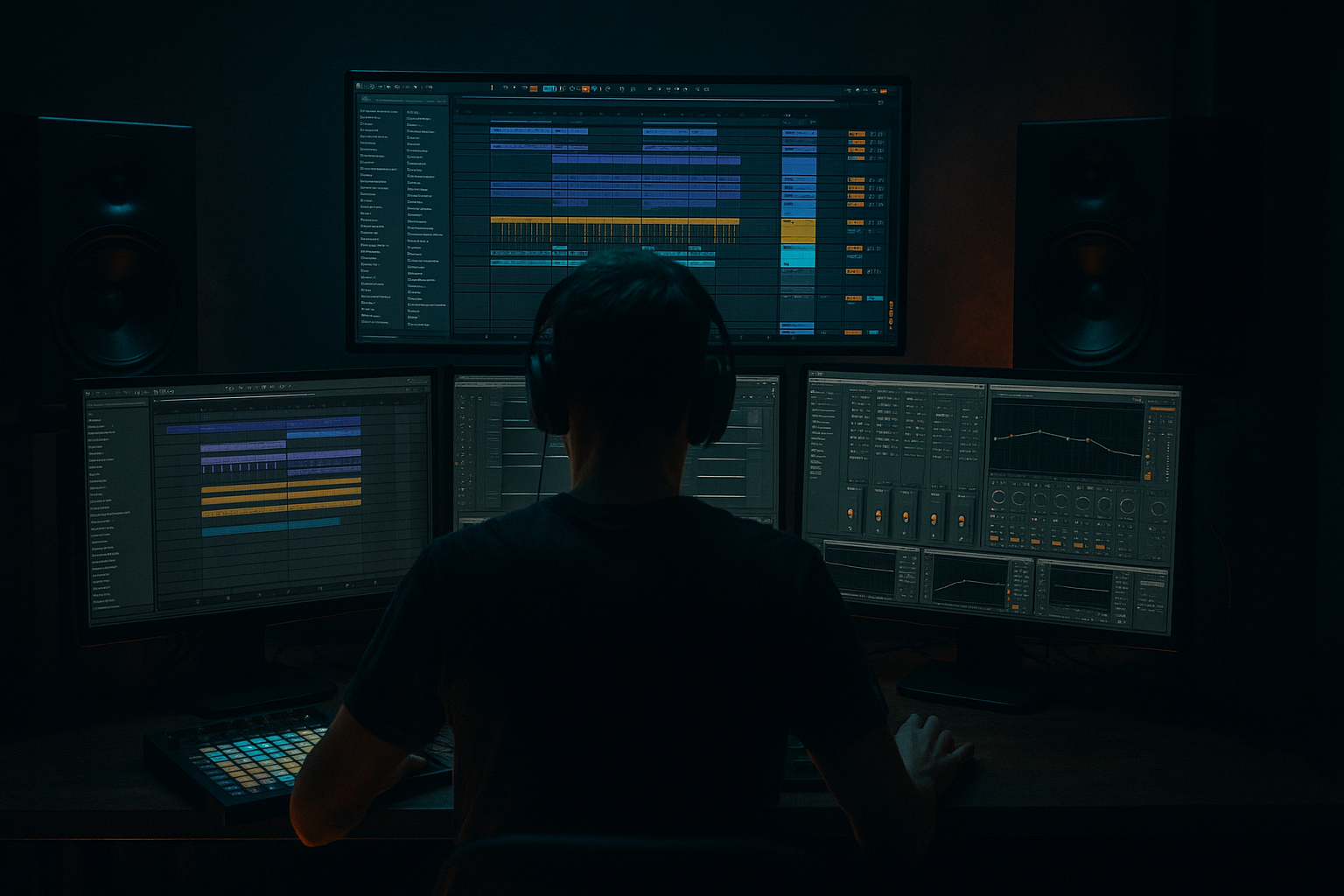
Main tutorial
```markdown
Kick + Sub Pocket From Scratch (Pirate-Radio Energy) 📻🔊
Topic: Kick and sub pocket from scratch for pirate-radio energy
Skill level: Intermediate
Category: Drums (DnB in Ableton Live)
---
1) Lesson overview
In rolling DnB/jungle, the relationship between kick and sub is everything. Pirate-radio energy comes from a tight, confident low-end that hits hard on small speakers and stays clean in a club system.
In this lesson you’ll build a kick + sub pocket from scratch in Ableton Live, using stock devices, and you’ll learn how to:
- Pick/make a kick that doesn’t fight your sub
- Tune and shape the sub to “sit under” the kick
- Create separation using timing, envelopes, and sidechain (not just EQ)
- Get that rolling, transmitter-like weight: mono, controlled, and loud 🧱
- A Kick track that’s punchy, short in the sub region, and tuned
- A Sub track that’s steady and weighty, with controlled movement
- A pocket system: sidechain + micro-timing + spectral separation
- A simple 8-bar DnB loop (170–174 BPM) with kick/sub locked
- Put Spectrum on your PreMaster
- Put Tuner on the Sub track (temporarily)
- Keep your master peaking around -6 dB while building
- A clear transient (2–5 kHz click)
- Controlled low-end (50–100 Hz) that won’t ring forever
- Short decay (unless you’re doing a stompier vibe)
- Load a kick into Simpler (one-shot mode).
- Good sources: clean 909-ish or punchy acoustic-style kick with a tight tail.
- Use Operator:
- Use Transpose in Simpler and aim the “body” to feel stable.
- Don’t obsess over perfect pitch—consistency and pocket matter more than theoretical tuning.
- Osc A: Sine
- Amp Env:
- Add very subtle harmonics:
- Add Utility last:
- Common DnB roots: F, F#, G, G# (not a rule—just common because they sit well on systems)
- Start with F (43.65 Hz) or G (49 Hz) for a safe club-weight zone.
- Kick on 1.1
- Kick on 1.3 (or slightly before/after depending on vibe)
- If your kick hits on 1.1, start your sub note a tiny bit after (like 5–15 ms later)
- In Ableton:
- Keep sub notes held/continuous (classic rolling vibe)
- Use sidechain compression to duck under the kick
- Sidechain: ON → Audio From: Kick
- Ratio: 4:1
- Attack: 1–5 ms (let kick transient through)
- Release: 60–120 ms (tempo-dependent; aim to recover before next low-end hit)
- Threshold: lower until you get 3–6 dB gain reduction on each kick
- Use Multiband Dynamics on the Sub track:
- Put Utility on the Sub track
- Toggle Phase Invert (L and R)
- Slightly change sub timing (Track Delay ±1–10 ms)
- Adjust kick start/end (shorten tail)
- Tune kick slightly (even 1–2 semitones can change the relationship)
- Bars 1–2: Kick + sub only (let the low-end statement land)
- Bars 3–4: Add hats/shuffle, ghost snare, light reese layer (high-passed)
- Bars 5–6: Add a fill (kick variation on bar 6 beat 4)
- Bars 7–8: Pull the kick for 1 beat before the loop resets (tease energy)
- Use a split-bass approach:
- Make the kick “read” in the mids:
- Shorter low-end = heavier at high BPM:
- Clip for attitude (carefully):
- Ghost movement without wobble:
- Pirate-radio low-end comes from tight separation and confident mono weight.
- Build the pocket with:
- Use stock Ableton tools: Operator, EQ Eight, Compressor (sidechain), Saturator, Utility, Drum Buss, Spectrum.
---
2) What you will build
You’ll end up with:
---
3) Step-by-step walkthrough
Step 0 — Set the session up (so you don’t fight your tools)
1. Set tempo to 172 BPM.
2. Create three tracks:
- Kick (Audio or MIDI)
- Sub (MIDI)
- Drum Bus / PreMaster (Audio) (optional, but helpful)
3. Drop a reference track (classic rolling DnB/jungle) onto an audio track and level-match it later.
Meters:
---
Step 1 — Choose a kick that can actually work in DnB
For rolling DnB, your kick usually wants:
Option A: Start with a sample
Option B: Build a kick quickly (stock)
- Osc A: Sine
- Pitch Envelope: Amount +24 to +36 st, Decay 40–90 ms
- Amp Envelope: Decay 120–200 ms (shorter for faster rolls)
- Add a little click: Noise oscillator very low, short decay 10–30 ms
This “pitch-drop + short amp” kick style sits great in DnB when tuned properly.
---
Step 2 — Tune the kick (fast and practical)
1. Put Tuner after the kick (or use Spectrum peak).
2. Play the kick solo.
3. You’re listening for the main low thump (often between 45–70 Hz).
Goal: Decide your song key (or at least your sub note), then tune the kick so it doesn’t land in a weird in-between frequency.
Quick tuning method in Simpler:
---
Step 3 — Shape the kick to leave room for the sub (the crucial move)
Kick device chain (stock, practical):
1. EQ Eight
- HPF at 25–30 Hz (24 dB/oct) to remove rubbish
- If kick is too “subby”: a gentle dip 45–60 Hz (1–3 dB)
- If kick is boxy: dip 200–350 Hz (2–4 dB)
- If it needs more knock: small boost 2–4 kHz (1–3 dB), wide Q
2. Saturator
- Mode: Soft Sine or Analog Clip
- Drive: 2–6 dB
- Turn on Soft Clip
- This helps the kick read on smaller speakers 📻
3. Drum Buss (light touch)
- Drive: 5–15%
- Crunch: 0–10%
- Boom: 0–10% (often OFF for cleaner sub region)
- Transients: +5 to +20 if you want more smack
- Watch output—don’t accidentally gain 6 dB and think it’s “better.”
Key idea: In rolling DnB, you often want the kick to be more punch than sub. Let the sub do the heavy lifting.
---
Step 4 — Build a proper sub (Operator is your best friend)
Create a MIDI track called SUB and load Operator.
Operator Sub settings (clean + controllable):
- Attack: 0–5 ms
- Decay: 300–800 ms (depends on groove)
- Sustain: -inf (if one-shot notes) or 0 dB (if held notes)
- Release: 50–120 ms (avoid clicks)
- Add Saturator after Operator
- Drive 1–4 dB
- Soft Clip ON
Mono + utility:
- Width: 0% (true mono)
- Gain: adjust for level matching
Sub note choice:
---
Step 5 — Program the groove: create the pocket with placement (not just sidechain)
Create an 8-bar loop. Use a classic two-step base:
Kick pattern (DnB 2-step starting point):
Now the pocket trick:
Make the sub avoid stepping on the kick transient.
Two solid approaches:
#### Approach 1: “Sub after kick”
- Use Track Delay on the Sub track: +5 ms (start here)
- Or nudge MIDI notes slightly right
This creates that breathing feel—kick punches, sub follows. Very pirate-radio.
#### Approach 2: “Sub holds, but ducks”
Most rolling DnB uses a blend: slight timing offset + sidechain.
---
Step 6 — Sidechain the sub properly (transparent and loud)
On the Sub track, insert Compressor (stock) with sidechain.
Compressor settings (starting point):
Tip:
If it feels like the sub “wobbles” or pumps too much, shorten Release or reduce GR.
Optional: Frequency-conscious ducking (more surgical)
- Only compress the Low band
- Sidechain not built-in per band (so you’ll usually keep standard Compressor for sidechain), but you can shape sub sustain here afterward.
---
Step 7 — Make the low end read like pirate radio (controlled harmonic weight)
Pirate-radio energy = low end that translates on cheap speakers and earbuds.
On the Sub track, after Compressor:
1. Saturator
- Drive: 2–6 dB
- Soft Clip: ON
2. EQ Eight
- HPF at 20–25 Hz
- Optional gentle boost around 90–150 Hz (1–2 dB) if you need “audibility”
- If it gets honky: dip 200–300 Hz
3. Utility
- Width 0%
- Optional Gain automation for drops/phrases
Important: Don’t turn the sub into a mid-bass. You want just enough harmonic content to translate.
---
Step 8 — Check phase/polarity quickly (avoid “why is it weak?” moments)
Sometimes kick + sub cancel each other.
Fast test:
If the low end suddenly gets stronger/weaker dramatically, you’ve got a phase relationship issue.
Fix options:
---
Step 9 — Arrangement idea: 8-bar pirate-radio roll
Here’s a simple structure that feels authentic in rolling/jungle contexts:
Classic trick: Remove the kick on the last 1/4 note and let sub + hats carry → instant “DJ-friendly” momentum.
---
4) Common mistakes
1. Kick has too much sub tail
Your kick shouldn’t behave like a second sub. Shorten decay or cut lows slightly.
2. Sidechain is doing all the work
If you need 10–12 dB ducking, the sound choices/timing are off.
3. Sub isn’t mono
Stereo sub = unstable translation. Keep it mono (Utility width 0%).
4. Over-saturating the sub
Too much drive creates messy 150–300 Hz and ruins headroom.
5. No gain staging
If you’re slamming into devices, you’ll “hear loud” not “hear right.”
---
5) Pro tips for darker/heavier DnB 🖤
Keep Sub (below ~90 Hz) clean/mono, and build heaviness with a separate Mid Bass track (high-passed at 90–120 Hz).
Add a tasteful 2–4 kHz presence so it cuts through dark reeses.
At 172 BPM, long sub releases smear the groove. Tighten release so the rhythm feels militant.
Use Saturator soft clip on kick/sub busses for density, not distortion.
Add tiny velocity changes to sub MIDI (±5–10) or automate Saturator drive subtly across 8 bars.
---
6) Mini practice exercise (15–25 minutes) 🎯
1. Build a kick using Operator (pitch drop) OR pick a sample.
2. Make a sub in Operator on F.
3. Create an 8-bar loop at 172 BPM:
- Kick on 1.1 and 1.3
- Sub plays long notes, but:
- Add +5 ms Track Delay on Sub
- Sidechain Sub with Compressor (aim 4 dB GR)
4. Export two versions:
- Version A: Sub delay 0 ms
- Version B: Sub delay +8 ms
Compare which one feels more “locked” and punchy.
---
7) Recap ✅
- Kick shaping (short tail, mid click, controlled lows)
- Sub design (clean sine + light harmonics)
- Timing offset + sidechain (the real glue)
If you want, tell me what style you’re aiming for (classic jungle, modern rollers, jump-up, techy minimal), and I’ll give you a kick/sub pocket recipe with exact note placements and an 8-bar MIDI template.
```

