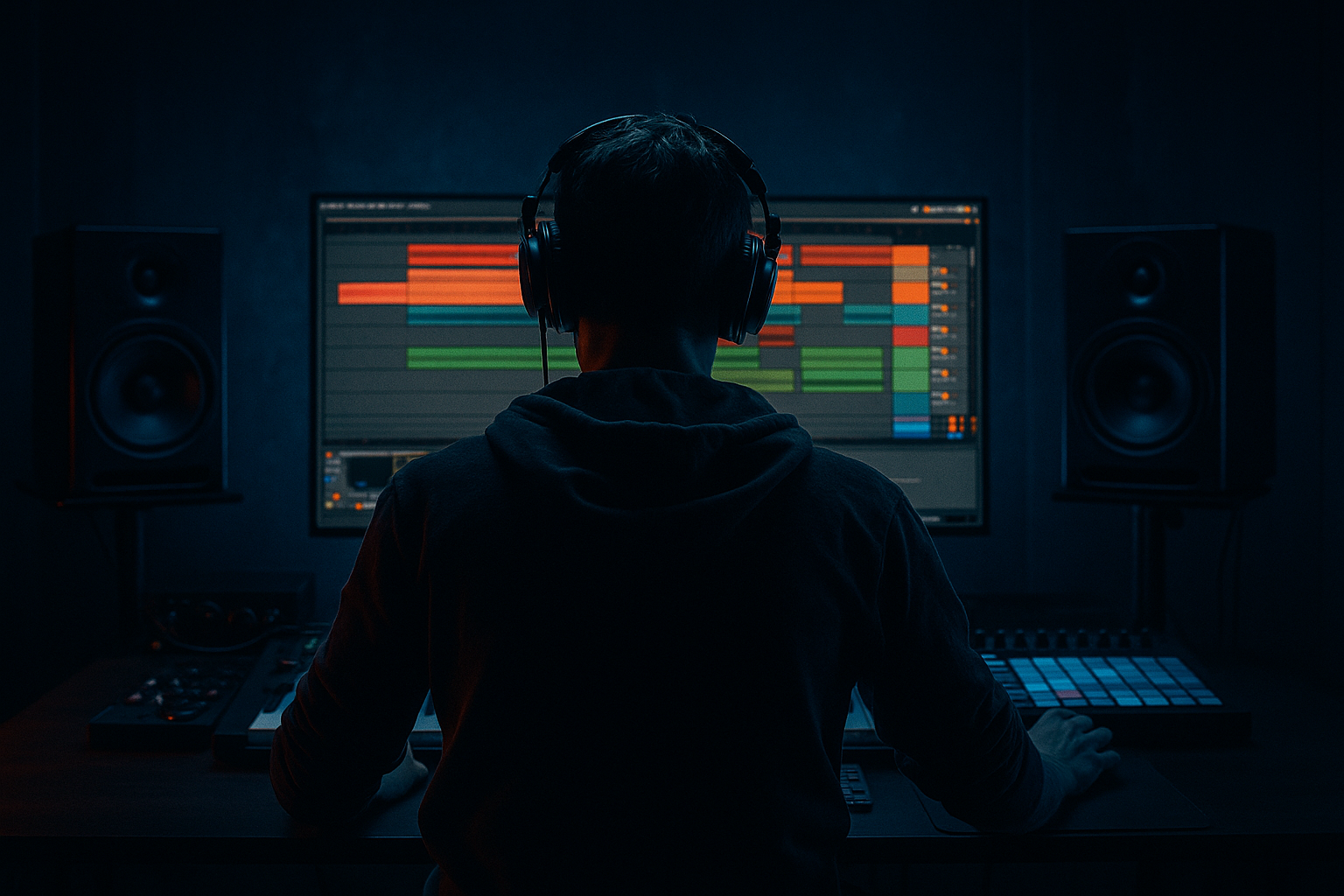
Main tutorial
Late-night Emotional Jungle Writing at 170 BPM (Ableton Live) 🌙🔥
Beginner • Composition-focused • Drum & Bass / Jungle
---
1. Lesson overview
This lesson is about writing late-night, emotional jungle at 170 BPM in Ableton Live—think: misty pads, bittersweet chords, rolling breaks, warm subs, and a touch of VHS nostalgia. We’ll focus on composition + arrangement, with enough sound design and mixing moves to make it feel like a real tune.
You’ll learn a repeatable workflow:
- Set up a jungle-writing template
- Create an emotional chord/melody hook
- Build a tight break + drum groove
- Add rolling bass that supports (not fights) the drums
- Arrange into a proper intro → drop → breakdown → second drop structure
- Tempo: 170 BPM
- Drums: a chopped Amen-style break + layered punchy kick/snare
- Music: moody chords + a simple lead motif (2–4 notes is enough)
- Bass: sub + mid bass layer that follows the groove
- Atmosphere: vinyl noise, reverb tails, distant pads, little ear-candy
- Arrangement: intro, drop, breakdown, second drop (simple but effective)
- Intro (1–17)
- Drop 1 (17–49)
- Breakdown (49–65)
- Drop 2 (65–97)
- Bar 1: Fm (F–Ab–C)
- Bar 2: Db (Db–F–Ab)
- Bar 3: Eb (Eb–G–Bb)
- Bar 4: Cm (C–Eb–G)
- Example notes: Ab → G → F (descending = melancholy)
- Leave space. Jungle breathes between drum hits.
- Echo (1/8 dotted or 1/4, low feedback, low-pass it)
- Reverb small room (keep it subtle)
- Kick-ish hits: on 1 and around “and” of 2 (varies by break slices)
- Snare hits: usually on 2 and 4 (DnB standard)
- Drum Buss
- EQ Eight
- Saturator (optional)
- Add a punchy one-shot kick (short)
- Add a one-shot snare (crisp, not too long)
- Kick: beat 1 (and maybe a ghost on 3 or the “&” of 2)
- Snare: 2 and 4
- Break provides character 🧬
- One-shots provide stability 🧱
- Add EQ Eight on the group to manage low-mid mud (200–500 Hz)
- Add a vinyl crackle sample (very low in mix)
- Add distant field recordings (rain, room tone, city night)
- EQ Eight: high-pass 200–500 Hz
- Hybrid Reverb: big hall, low wet (5–15%)
- Auto Pan: very slow rate (0.05–0.15 Hz), small amount
- Atmos + pads first (set mood)
- Bring in filtered break (low-pass with Auto Filter)
- Tease the lead motif quietly in bars 9–16
- Full drums + bass + chords
- Lead motif stronger
- Add small variations every 8 bars:
- Remove drums
- Let chords breathe (more reverb)
- Add a vocal-ish one-shot (optional) chopped softly
- Bring drums back with extra energy:
- Parallel distortion on drums:
- Reese under the mid bass (quiet):
- Pitch automation on break fills:
- Darker harmony trick:
- Tight mono low end:
- Start with simple, repeating emotional harmony
- Build drums with a break + clean layers
- Add rolling bass that respects drum space
- Use atmos + reverb + subtle movement for night-time depth
- Arrange with 8-bar changes and intentional dropouts
---
2. What you will build
By the end, you’ll have a playable 1:30–2:30 sketch with:
---
3. Step-by-step walkthrough
Step 0 — Session setup (2 minutes) ✅
1. Set Tempo = 170 BPM.
2. Time signature = 4/4 (classic DnB).
3. Create groups:
- DRUMS
- BASS
- MUSIC
- FX/ATMOS
4. Set Global Quantization = 1 Bar (top center).
5. Optional but helpful: set your grid to 1/16 and enable Fixed Grid.
Ableton tip: Use Markers/Locators early (Arrangement View):
---
Step 1 — Write the emotional chord loop 🎹🌫️
Late-night jungle often hits hardest when the harmony is simple and repeating.
#### A) Choose a key + vibe
Good emotional keys: F minor, G minor, D minor.
We’ll use F minor.
#### B) Make a 4-bar chord loop
1. Create a MIDI track called `PAD CHORDS`.
2. Load Wavetable (stock) or Analog.
3. Quick “night pad” Wavetable patch idea:
- Osc 1: Sine or soft wavetable
- Osc 2: low level (optional)
- Filter: LP24, cutoff around 400–1.5kHz, some resonance
- Amp Env: Attack 30–80 ms, Release 2–6 s
4. Add device chain:
- Chorus-Ensemble (subtle width)
- Hybrid Reverb (Hall, 15–30% wet)
- EQ Eight (high-pass around 150–250 Hz to leave room for bass)
#### C) Chord progression (example)
In F minor (4 bars, one chord per bar):
Keep the chords in a comfortable mid register (around C3–C5).
Then duplicate the 4 bars to make 8 or 16 bars later.
✅ Emotional trick: invert chords so notes move smoothly (less jumpy = more “late-night”).
---
Step 2 — Add a simple motif/lead (tiny but memorable) ✨
1. Create MIDI track `LEAD`.
2. Load Operator (super clean for jungle leads).
3. Operator settings:
- Algorithm: A only (sine) or add a little B for brightness
- Filter: LP with cutoff ~ 2–6 kHz
- Amp Env: Attack 5–20 ms, Release 150–400 ms (plucky)
Write a 2-bar call-and-response motif using notes from F minor:
Add:
---
Step 3 — Build the jungle drum foundation (break + reinforcement) 🥁
We’re going for rolling but emotional, not overly aggressive.
#### A) Get a break into Simpler
1. Create an Audio track called `BREAK`.
2. Drop in an Amen-style or classic jungle break (or any break sample).
3. Right-click → Slice to New MIDI Track
- Choose: Slice by Transients
- Put slices into Drum Rack
Now you have a playable chopped break.
#### B) Program a classic 2-step-ish backbone (beginner friendly)
Create a 1-bar MIDI clip for the Drum Rack:
If that’s confusing:
Start by placing your main snare slice on beats 2 and 4, then fill kicks around it using break slices that sound like kick/low hits.
#### C) Tighten the groove
On the Drum Rack chain (or on the BREAK track), add:
- Drive: 5–15
- Boom: 0–20% (careful—can muddy)
- Transients: +10 to +30 (more snap)
- High-pass around 30–60 Hz (unless you really need sub from the break)
- Small cut around 200–400 Hz if boxy
- Soft Clip ON
- Drive 1–4 dB
#### D) Layer a clean snare + kick (for consistency)
Create a DRUM LAYER Drum Rack:
Program them simply:
Now blend:
---
Step 4 — Make it roll: hats + ghosts + swing 🏃♂️
1. Add a `HATS` track (Drum Rack or audio samples).
2. Program 1/16 closed hats, but remove a few hits so it breathes.
3. Add ghost notes:
- Very quiet extra snare taps before the main snare (like 1/16 before beat 2)
4. Groove:
- Use Groove Pool (hot tip for beginners):
- Add a groove like MPC 16 Swing 55–60
- Apply lightly (Timing 10–30, Velocity 10–30)
This creates that human, head-nod jungle motion without over-editing.
---
Step 5 — Write the rolling bass (sub + mid layer) 🔊
Emotional jungle usually likes a warm sub with a gentle mid layer, not massive neuro bass (unless you want it darker later).
#### A) Sub bass (Operator)
1. Create MIDI track `SUB`.
2. Load Operator:
- Osc A: Sine
- Voices: 1
3. Add:
- EQ Eight: low-pass around 120–200 Hz (keep it pure)
- Glue Compressor (optional): gentle control
4. MIDI pattern:
- Follow the root notes of your chords (F, Db, Eb, C)
- Use short notes (1/8–1/4) with gaps so the drums punch through
- Add a few syncopations (notes slightly off the grid) to roll
✅ Jungle trick: Put sub notes around the kick spaces, not on top of every kick.
#### B) Mid bass layer (Wavetable)
1. Create MIDI track `MID BASS`.
2. Load Wavetable:
- Choose a slightly buzzy wavetable, keep it controlled
- Filter low-pass around 300–800 Hz
3. Add:
- Saturator (soft clip, drive 2–6 dB)
- Auto Filter with subtle movement (very slow LFO)
- Utility: set Width to 0–30% (keep bass mostly mono)
Group SUB + MID into a BASS group, then:
---
Step 6 — Sidechain so it breathes (simple + effective) 🫁
On your BASS group:
1. Add Compressor
2. Sidechain input: your Kick layer (or a Drum Bus “kick” track)
3. Settings:
- Ratio: 3:1 to 6:1
- Attack: 1–10 ms
- Release: 80–200 ms
- Adjust threshold until you get 2–5 dB gain reduction
We want subtle “pulse,” not EDM pumping.
---
Step 7 — Atmosphere: late-night texture + space 🌙🎞️
Create `ATMOS` audio track:
Processing chain:
Add occasional reverse cymbal or noise sweeps into the drop.
---
Step 8 — Arrangement: turn the loop into a tune 🧩
Here’s a reliable emotional jungle arrangement:
#### Intro (16 bars)
#### Drop 1 (32 bars)
- Remove hats for 1 bar
- Add a quick break fill
- Add a riser into bar 17 or 25
#### Breakdown (8–16 bars)
#### Drop 2 (32 bars)
- Slightly more break variation
- Add an extra ride/hat layer
- Add a darker counter-melody (super minimal)
✅ “Jungle storytelling” tip: drop elements out for 1 bar on purpose to create tension.
---
4. Common mistakes (and quick fixes)
1. Too many chord changes
- Fix: keep to 2–4 chords, repeat, and automate texture instead.
2. Break too messy / not punchy
- Fix: layer clean kick/snare + use Drum Buss + trim tails.
3. Bass fights the kick + break
- Fix: sidechain + shorten sub notes + high-pass chords higher.
4. Everything is wide and washed out
- Fix: keep bass mono, keep reverb on return tracks, high-pass reverb returns.
5. No progression—just a loop
- Fix: every 8 bars, change one thing (mute, fill, filter, lead variation).
---
5. Pro tips for darker/heavier DnB 🖤⚙️
If you want to push this into heavier territory while keeping emotion:
Create a return track with Saturator → Drum Buss → EQ Eight, send break/snare lightly.
Wavetable detuned saws, low-pass around 500–1k, keep it subtle so it doesn’t ruin the “night” vibe.
Duplicate a fill, pitch down -2 to -5 semitones for menace.
Borrow a chord from parallel major/minor or use bVI / bVII movement (common in moody DnB).
Put Utility on BASS group:
- Bass Mono: enable (or Width 0% below ~120 Hz via EQ M/S approach if you know it)
---
6. Mini practice exercise (20 minutes) ⏱️
Goal: Make an 8-bar drop loop that feels like a real jungle moment.
1. 5 min: Write a 2-chord loop (Fm → Db) with a pad.
2. 5 min: Slice a break and program a 1-bar pattern + layer snare on 2 & 4.
3. 5 min: Add sub bass that hits mostly on roots, leaving space for snare.
4. 5 min: Arrange micro-variation:
- Bar 4: tiny drum fill
- Bar 8: remove drums for the last half-bar and add a reverse cymbal into bar 9
Export a quick bounce and listen on low volume—does it still feel emotional and rolling?
---
7. Recap ✅
You now have a beginner-friendly method for writing late-night emotional jungle at 170 BPM in Ableton Live:
If you tell me what version of Ableton you’re on (and whether you have Suite), I can tailor a ready-to-go template (track list + device chains + routing) for this exact style.

