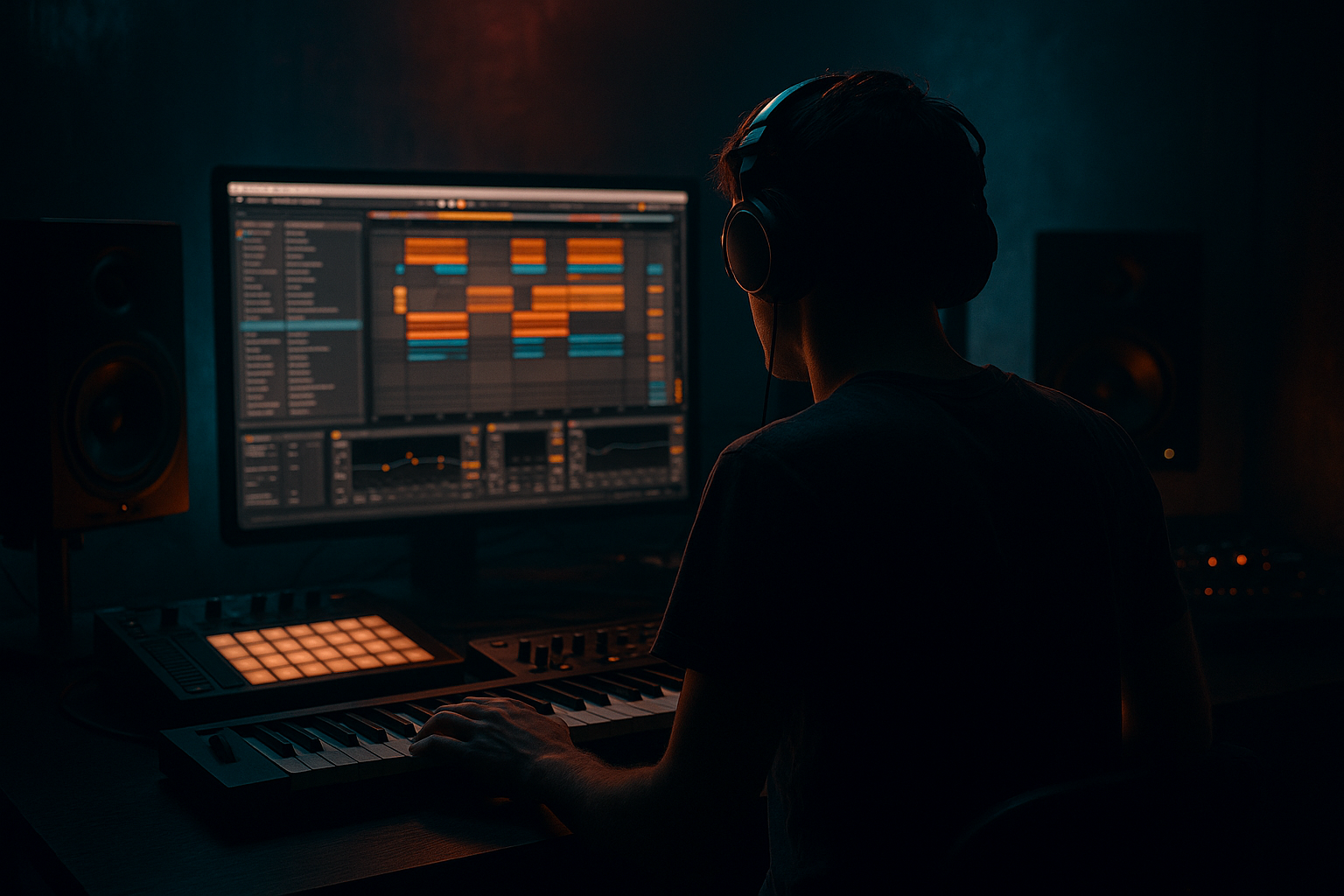
Main tutorial
```markdown
Late-night Emotional Jungle Writing Masterclass (for Jungle Rollers) 🌙🔥
Skill level: Advanced
DAW: Ableton Live (stock devices-first workflow)
Category: Composition (with production-ready execution)
---
1. Lesson overview
This lesson is about writing late-night emotional jungle rollers: fast, rolling, break-led drum & bass that hits hard but feels human—minor-key harmony, airy pads, bittersweet vocals, and tight, propulsive drums.
You’ll learn a repeatable composition system inside Ableton Live:
- How to choose harmonic materials that feel emotional without getting cheesy
- How to build rolling jungle drum momentum that stays interesting for 5–6 minutes
- How to write a bassline that rolls, supports the chords, and leaves space for breaks
- How to arrange classic jungle energy: intro → lift → drop → development → 2nd drop → outro
- How to do it with practical Ableton workflows (Group tracks, resampling, Racks, automation lanes)
- Main drums: Amen-style break + tight kick/snare reinforcement
- Harmony: Minor-key pad/chord loop with late-night voicings
- Lead hook: Short melodic motif or vocal chop
- Bass: Rolling sub + mid-bass movement that glues with the breaks
- Arrangement: Proper tension/release, fills, edits, and second-drop evolution
- Mix intent: Sidechain, frequency management, saturation, and atmosphere
- Option A (classic melancholic):
- Option B (darker lift):
- Instrument: `Wavetable` (or Analog)
- Wavetable settings (starting point):
- Snare on 2 and 4 (main anchor)
- Hats/ghosts carry the roll
- Use ghost snare hits around the main snare (low velocity)
- Add a groove like MPC 16 Swing 57–63
- Apply at 50–70% timing, 0–20% velocity
- Kick (tight, short)
- Snare (sharp transient)
- Closed hat (clean)
- Redux (very subtle): Downsample a touch for grit
- Auto Filter: automate cutoff opening in the build
- Echo: 1/8 or 1/8 dotted, feedback 20–35%
- Use a one-shot phrase, reverse tails, or micro-chops.
- Process heavily so it’s more emotion than lyrics.
- Osc A: Sine
- Envelope: short-ish release (150–350 ms)
- Add Saturator after Operator:
- Follow root notes of progression
- Add a few passing notes (but avoid constant 16ths in the sub)
- Use a saw-ish wave, lowpass it, add slight FM
- Filter envelope for “wah” movement
- Off-beat emphasis (between kicks/snares)
- Short notes with occasional held notes at phrase ends
- Bar 1: root → fifth → root (syncopated 1/8 + 1/16 combos)
- Bar 2: root held into the snare hit (creates tension)
- Intro (0–32 bars): atmos + filtered break + pad
- Pre-drop lift (33–48): snare build, filter opens, hint hook
- Drop 1 (49–112): full drums + bass + hook
- Mid breakdown (113–144): strip drums, emotional chord focus
- Drop 2 (145–208): variation: new break edit or bass counterline
- Outro (209–end): DJ-friendly elements, remove bass first
- Drum fill
- Break slice variation
- Hook answer phrase
- Reverb throw on snare
- Bass rhythm tweak
- FX riser/downlifter
- Pad filter cutoff + reverb send
- Break high-pass in intro (Auto Filter)
- Hook echo feedback in transitions
- Drum Buss drive for impact moments (small moves)
- Create a Return track `A - VERB THROW` with big reverb.
- Automate send only on the last hit of an 8/16 bar phrase.
- Resample a 1-bar drum fill → use Pitch automation down 2–5 semitones quickly.
- Use a short noise burst (Operator noise or a sample) + Auto Filter sweep + Saturator.
- Harmonic darkness: Use borrowed chords (e.g., in A minor, try Bbmaj7 for tension).
- Parallel grit on breaks:
- Rumble-controlled weight:
- Micro-edits = menace:
- Atmospheres in key:
- Does it still feel like it’s “rolling” at low volume?
- Can you rap/step to it without the groove collapsing?
- Emotional jungle rollers hit hardest when harmony is simple but rich, and drums are detailed but controlled.
- Build in this order: chords → breaks + anchors → hook motif → rolling bass → arrangement checkpoints.
- Use Ableton stock tools strategically: Wavetable/Operator, Drum Rack slicing, Echo/Reverb, EQ Eight, Drum Buss, Glue, Utility, and automation for movement.
- Arrange in chapters and evolve Drop 2—jungle is storytelling through edits.
---
2. What you will build
A full arrangement (or at minimum a strong 64–128 bar core) of a 170–174 BPM emotional jungle roller featuring:
---
3. Step-by-step walkthrough
Step 0 — Set the session like a pro (10 minutes) ⚙️
1. Tempo: `172 BPM` (classic roller pocket).
2. Time signature: 4/4.
3. Create Groups early:
- `DRUMS (BREAKS)`
- `DRUMS (ONE-SHOTS)`
- `BASS`
- `MUSIC`
- `FX/ATMOS`
- `VOCAL/CHOPS` (optional)
4. On your Master, keep it clean:
- Limiter OFF for writing (turn on later)
- Optional: Utility with `-6 dB` gain to keep headroom
---
Step 1 — Write the emotional core first (chords that feel “2AM”) 🌌
Late-night jungle often lives in minor keys + jazzy extensions + slow harmonic rhythm (chords that change every 1–2 bars).
1) Choose a key:
A minor / D minor / F minor are common. Let’s use A minor.
2) Build a chord progression (4 bars):
Try one of these emotional jungle-friendly moves:
`Am9 → Fmaj7 → G6 → Em9`
`Am9 → Cmaj7/G → Fmaj7 → E7(b9)` (E7 pulls hard back to Am)
3) Create the pad instrument (stock):
- Osc 1: Basic Shapes (sine/triangle-ish), position ~30%
- Osc 2: slight detune, level -6 dB
- Filter: `LP24`, cutoff ~2–4 kHz, resonance low
- Amp Env: Attack 20–60 ms, Release 1.5–3 s
- Unison: 2–4 voices, Amount low (don’t smear too much)
4) Add late-night movement:
Device chain on the Pad track:
1. Chorus-Ensemble: `Ensemble`, Amount 15–30%
2. Auto Filter: very slow LFO on cutoff (0.02–0.06 Hz), subtle
3. Echo:
- Time: `1/8 dotted` or `1/4`
- Feedback: 15–30%
- Filter: roll off lows below ~200 Hz
4. Reverb:
- Decay: 3–6 s
- Pre-delay: 10–25 ms
- Low cut: 200–400 Hz
5. Utility: set Width 120–160% (but keep low end mono later)
Composition rule:
Keep chord rhythm simple, make tone and automation do the emotion.
---
Step 2 — Build a roller drum foundation (break + control) 🥁
Emotional jungle still needs forward motion. Your drums must be human + edited, not a static loop.
#### 2A) Pick and prep your break
1. Choose an Amen or similar break (or any crunchy jungle break).
2. Drop it to audio on `DRUMS (BREAKS)` track.
3. Right-click → Warp:
- Warp Mode: Complex Pro (if tonal) or Complex
- Set correct original BPM if needed
4. Slice to New MIDI Track:
- Right-click clip → Slice to New MIDI Track
- Slicing preset: Built-in → “Slice to Drum Rack”
Now you’ve got a Drum Rack with slices you can reprogram.
#### 2B) Program a roller pattern (16th-note jungle swing)
In MIDI, start with a classic “rolling but not too busy” pattern:
Ableton Groove:
#### 2C) Reinforce with one-shots (punch + clarity)
On `DRUMS (ONE-SHOTS)` add:
Layering rule:
Break = texture + shuffle. One-shots = punch + translation.
Suggested one-shot processing chain (Group BUS):
1. EQ Eight
- High-pass hats at 200–400 Hz
- Snare notch any harsh ring (often 800 Hz–2.5 kHz)
2. Drum Buss
- Drive: 5–15
- Crunch: 0–20
- Boom: subtle (10–25) tuned low if needed
3. Glue Compressor
- Attack 3 ms, Release Auto, Ratio 2:1
- 1–3 dB gain reduction max
---
Step 3 — Make it “emotional”: hook motifs and call/response 🎛️
Now that harmony and drums exist, add a small motif that feels like a memory.
#### Option: Resampled pad hook (fast, authentic) 🎚️
1. Freeze + Flatten the pad track (or resample it).
2. Create a new audio track called `PAD CHOP HOOK`.
3. Slice/transient chop the audio into 1/4–1/8 bits.
4. Create a 2-bar hook using repetition + one surprise note.
Add chain:
#### Option: Vocal texture (tasteful, not cheesy) 🎙️
Chain:
1. EQ Eight: high-pass 150–300 Hz
2. Gate (sidechain from snare optional) for rhythmic breathing
3. Reverb (long) 5–9 s
4. Utility: width up, but keep it out of the center
---
Step 4 — Write the rolling bass that supports jungle (not a foghorn) 🧠
For jungle rollers, bass should roll and pulse without trampling the break transients.
#### 4A) Sub layer (clean, stable)
Track: `BASS - SUB`
Instrument: Operator
- Soft Clip ON
- Drive 2–6 dB (just to thicken)
Sub pattern:
#### 4B) Mid-bass layer (movement + character)
Track: `BASS - MID`
Instrument: Wavetable
Chain:
1. Auto Filter (or Wavetable filter) with envelope movement
2. Saturator (Soft Clip ON)
3. EQ Eight
- High-pass at 120–180 Hz (leave room for sub)
4. Compressor sidechained from Kick (or a ghost kick)
- Ratio 4:1, Attack 1–5 ms, Release 80–140 ms
- 2–5 dB GR
#### 4C) Bass rhythm: the roller pocket
A great roller bass rhythm is often:
Try this 2-bar idea:
Key compositional trick:
Leave gaps where the break does busy stuff. The contrast makes it roll harder.
---
Step 5 — Arrange like jungle: energy in chapters 📚
Don’t loop for 5 minutes. Arrange with intent.
Typical roller arrangement (guide):
#### Practical Ableton method: “8-bar checkpoints” ✅
Every 8 bars, commit to one change:
Automation lanes to prioritize:
---
Step 6 — Transitions that feel expensive (without overproducing) 💎
1) Reverb throws (snare/vox):
2) Tape-stop style moment (subtle):
3) Impact layer:
---
4. Common mistakes 🚫
1. Too much harmony movement
Emotional jungle works when drums roll and harmony breathes. Keep chords slow.
2. Breaks too loud / no anchor
If your break is the only snare, the mix can feel weak. Reinforce with a clean snare.
3. Bass fighting the break transients
If bass notes are long and constant, the groove smears. Shorten notes and sidechain.
4. Over-widening pads and killing mono compatibility
Wide is great, but keep low mids controlled. Use Utility and high-pass reverbs.
5. No second-drop evolution
If Drop 2 is identical, the track feels unfinished. Change something structural.
---
5. Pro tips for darker/heavier DnB (while staying emotional) 🖤
- Duplicate break → distort heavily (Saturator/Drum Buss) → high-pass at 500–800 Hz → blend quietly.
Keep sub clean; push weight with mid-bass harmonics (150–400 Hz) rather than sub loudness.
Add 1/16 stutters or reverse hits at the end of 8/16 bar phrases. Jungle thrives on edits.
Use Tuner to confirm your atmos/resampled noise isn’t clashing. Even noise layers can have tonal centers.
---
6. Mini practice exercise (30–45 minutes) 🎯
Goal: Create a 64-bar “drop section” that evolves.
1. Write a 4-bar chord loop in A minor using Am9 → Fmaj7 → G6 → Em9.
2. Program a 2-bar break pattern using sliced Amen in Drum Rack:
- Add ghost hits at low velocity (20–50).
3. Layer a clean snare on 2 and 4, and a tight kick that supports the break.
4. Create sub (Operator sine) playing roots + 2 passing notes max per 4 bars.
5. Create mid-bass (Wavetable) with rhythmic off-beat stabs.
6. Arrange 64 bars:
- Bars 1–16: hook minimal
- Bars 17–32: add hook call/response
- Bars 33–48: introduce a new drum edit (fill every 8 bars)
- Bars 49–64: change bass rhythm OR swap break variation
Deliverable: Bounce a rough mix and check:
---
7. Recap ✅
If you want, tell me your target vibe (e.g., “Bukem-style liquid jungle,” “metalheadz dusk roller,” “ragga-tinged emotional”) and I’ll give you a progression + drum edit blueprint tailored to it.
```

