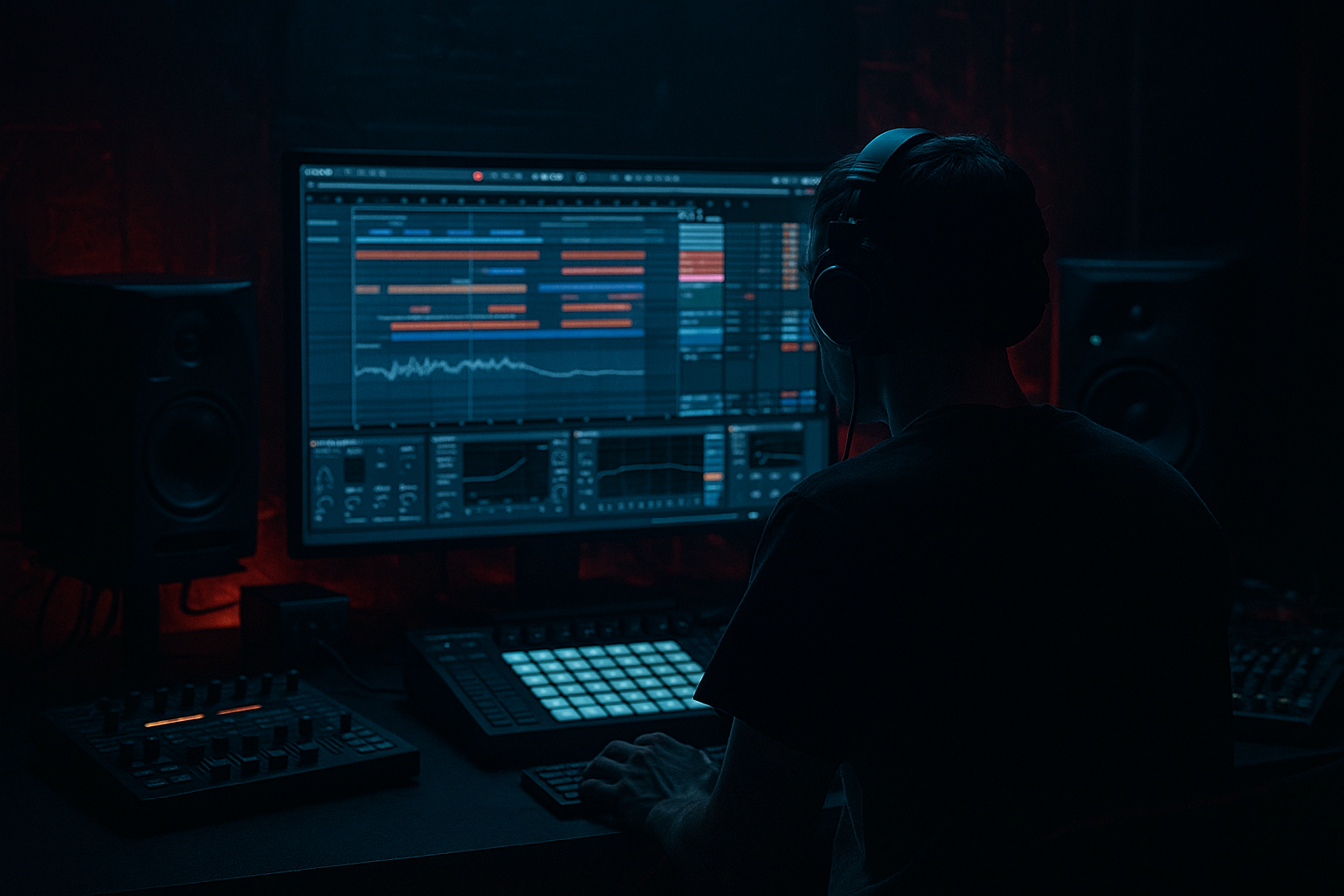
Main tutorial
```markdown
Late-night Emotional Jungle Writing Masterclass (Ableton Live, Stock Devices Only) 🌙🔥
1. Lesson overview
This masterclass is about writing late-night emotional jungle that still rolls hard—think dusty break edits, minor-key chords, haunting pads, restrained but powerful subs, and an arrangement that tells a story.
You’ll do this entirely with Ableton Live stock devices: no third‑party synths, no sample packs required (but you can use Ableton’s core library if you want).
Skill focus (advanced composition):
- Write an emotive harmonic world that supports jungle energy
- Build tension/release through arrangement (not just FX)
- Make breaks feel alive using micro-edits, ghost notes, and swing
- Keep bass minimal but devastatingly effective
- A/B sections: intro → drop → mid variation → outro
- One emotional chord/pad motif
- One main break + one supporting break layer
- A sub + reese/rumble layer (stock synths)
- Classic jungle transitions: tape-stop vibes, filtered drops, impact tails, and little “late-night” ear candy ✨
- Emotional: deep minor chords, nostalgic atmosphere, melancholic lead fragments
- Jungle: chopped Amen-style energy, rolling hats, warm subs, dubby space
- Pick a key like F minor / G minor / D# minor (classic emotional weight).
- Write a 2-chord or 4-chord loop using extended chords:
- Keep voicings close in the midrange (around C3–C5), and let the pad sit behind the drums.
- Packs like Breakbeats, Drum Booth, etc. (depending on your installation)
- Start with a classic 2-step skeleton:
- Then add jungle personality:
- Use Groove Pool: try MPC 16 Swing 54–58 or any subtle shuffle.
- Apply at 20–40%.
- `EQ Eight` HP 250–500 Hz
- `Saturator` Drive 1–3 dB
- `Utility` Width 120–150% (keep kicks/snares mono)
- Pad + filtered chord loop
- Distant break crumbs:
- Add tiny ear candy:
- Bring in `BREAK A` full bandwidth
- Sub enters simple
- Reese enters low in the mix, mostly midrange weight
- Remove some pad lows to keep space
- quick break mute for 1/4 bar
- snare fill (slice retrigger)
- chord inversion change
- tiny bass pickup note
- Pull the sub for 4 bars (or halve-time it)
- Let chords/pad take the lead
- Use `Echo` throws on snare ghosts (automate Send C)
- Same harmony, but:
- Strip layers in reverse order
- Leave one atmospheric motif so the track feels “finished,” not just muted.
- Vinyl-like movement without plugins:
- Tape-stop illusion:
- Risers without synths:
- Impact tails:
- Parallel distortion on reese only:
- Make the snare feel “taller” not “louder”:
- Heavy section contrast:
- Use silence as an impact:
- Build the vibe first: minor/extended chords + pad space
- Keep bass simple: sub carries weight, reese adds pressure
- Make breaks talk: slices, ghost notes, groove pool, micro-edits
- Arrange like a story: foreshadow → drop → variation → darker return
- Use stock tools like Wavetable, Operator, Drum Rack, EQ Eight, Saturator, Echo, Hybrid Reverb, Glue Compressor to get pro results without third-party plugins.
---
2. What you will build
A 2:30–3:30 jungle/DnB sketch with:
Target vibe references (in spirit):
---
3. Step-by-step walkthrough
Session prep (10 minutes)
1. Tempo: set 172 BPM (168–176 is the zone).
2. Project structure: create groups:
- `DRUMS (BREAKS)`
- `DRUMS (TOPS)`
- `BASS`
- `MUSIC (CHORDS/PADS)`
- `FX / ATMOS`
3. Return tracks (simple, powerful):
- A – “ShortVerb”: `Reverb`
- Decay: 0.8–1.2s
- Pre-Delay: 10–20ms
- Low Cut: 250–400 Hz
- High Cut: 7–10 kHz
- B – “DubVerb”: `Hybrid Reverb` (Convolution or Algorithm)
- Decay: 2.5–4.5s
- Size: medium-large
- Low Cut: 300–600 Hz
- Modulation: subtle (keep it late-night, not trancey)
- C – “DubDelay”: `Echo`
- Time: 1/8 Dotted or 1/4
- Feedback: 25–45%
- Filter: HP 250 Hz, LP 6–9 kHz
- Wobble: 2–5% for character
4. Master channel (temporary writing chain): keep it light so you don’t “compose into a lie”
- `Utility` (for quick gain trims)
- `Limiter` (Ceiling -1 dB, just catching peaks)
---
Step 1 — Write the emotional harmonic bed (the “night light”) 🌌
You want simple harmony that can loop for 16–32 bars without getting annoying.
#### Option A: Pad with Wavetable (stock)
1. Create MIDI track: `PAD`.
2. Add `Wavetable`:
- Osc 1: Sine or Triangle (soft)
- Osc 2: Muted saw (very low level, -18 to -24 dB)
- Unison: 2–4 voices, Amount 10–25%
- Filter: LP24, cutoff 400–2k (map cutoff to Macro)
- Amp envelope: Attack 40–150 ms, Release 2–6 s
3. Add chain:
- `Chorus-Ensemble` (very subtle)
- Amount: 10–20%
- Rate: 0.2–0.6 Hz
- `EQ Eight`
- HP at 120–180 Hz
- Gentle dip around 250–450 Hz if muddy
- Send to DubVerb + a touch of DubDelay
#### Harmony writing (practical approach)
- Example in F minor:
- `Fm9` → `Dbmaj7(#11)` → `Ab(add9)` → `Eb6/9`
Ableton trick:
Use `MIDI Effects → Scale` to lock the vibe (e.g., Natural Minor), then break the rules later intentionally.
---
Step 2 — Build the sub (simple, stable, emotional)
Jungle subs are often clean and consistent, especially under busy breaks.
1. Create MIDI track: `SUB`.
2. Add `Operator`:
- Algorithm: A only
- Wave: Sine
- Envelope: Attack 0–10 ms, Release 120–250 ms
3. Add `Saturator`:
- Drive 2–6 dB
- Soft Clip On
4. Add `EQ Eight`:
- Lowpass around 120–180 Hz (keep it pure)
5. Optional `Compressor` (not sidechain yet) for control:
- Ratio 2:1, slow-ish attack (10–30 ms), release (80–150 ms)
Composition note:
Write sub notes that answer the chord movement, but don’t mirror it constantly. Use space: long notes, occasional pickup notes into chord changes.
---
Step 3 — Make a reese/weight layer (dark but controlled) 😈
This is your “late-night pressure” under the emotional music.
1. Create MIDI track: `REESE`.
2. Add `Wavetable`:
- Osc 1: Saw
- Osc 2: Saw (detune slightly)
- Unison: Classic, 4–7 voices, Amount 30–60%
- Filter: LP24
3. Add chain:
- `Saturator` (Drive 3–8 dB)
- `Auto Filter` (for movement)
- Rate: 1/8 or 1/4 (sync)
- Amount: subtle, just a slow chew
- `EQ Eight`
- HP at 80–110 Hz (leave space for sub)
- Notch any harshness around 2–4 kHz
- `Glue Compressor`
- Ratio 2:1
- Attack 10 ms
- Release Auto
- GR 1–3 dB
Key move:
Keep reese notes simpler than the sub. Often: root + occasional 5th or one-note drones that shift per section.
---
Step 4 — Breaks: the heart of jungle (chop, swing, ghost) 🥁
You can do this with any break sample you have, but to stay “stock only,” use Ableton’s library:
#### Main break workflow (fast + surgical)
1. Drag a break loop onto an audio track: `BREAK A`.
2. Right-click → Warp:
- Warp mode: Complex Pro for full loops (or Beats for tighter transient feel)
- If using Beats: set Preserve to Transients, Envelope 50–80
3. Right-click → Slice to New MIDI Track
- Slicing preset: Transient
- This creates a Drum Rack with slices.
#### Programming the “rolling emotional” pattern
- Kick-ish hits on 1 and (often) 11
- Snare on 5 and 13 (DnB grid)
- Ghost snares slightly before/after main snare
- Little kick pickups into bar transitions
- Re-trigger 1/16 stutters at the end of 4 or 8 bars
Groove (mandatory):
Too much swing = drunk breaks (unless that’s the point).
#### Layer a secondary break for texture
1. Add audio track: `BREAK B` (a dustier/airier loop).
2. Highpass it:
- `EQ Eight` HP at 200–400 Hz
3. Compress it into the main break:
- `Compressor` sidechain from `BREAK A` (or use Glue)
- Light GR 1–3 dB so it breathes together.
---
Step 5 — Tops & cymbals: controlled sparkle (not EDM) ✨
1. Create `TOPS` group.
2. Use `Drum Rack` with:
- Closed hat (tight)
- Ride/shuffle hat (grainy)
- Crash/air hit (rare)
3. Pattern tips:
- Hats often run 1/8 with velocity variation, plus a 1/16 fill every 8 bars.
- Keep crashes for section markers only (drop, mid variation, outro).
Stock shaping chain on TOPS group:
---
Step 6 — Sidechain relationships (subtle, musical, not pumping)
Instead of huge pumping, aim for micro-ducking so breaks stay dominant.
1. On `SUB`: `Compressor` with Sidechain from `BREAK A` (or a dedicated “kick/snare trigger” track).
- Ratio 2:1
- Attack 1–5 ms
- Release 60–120 ms
- GR: 1–2 dB
2. On `PAD` and `REESE`: slightly more GR (2–4 dB) so drums lead.
---
Step 7 — Arrangement: tell a night-time story 🕯️
Here’s a proven emotional jungle arrangement that stays engaging:
#### Bars 1–16: Intro (atmos + foreshadowing)
- Use `Auto Filter` on breaks, cutoff low (300–800 Hz), slowly open
- One-shot vocal-ish hit (you can resample your pad, reverse it)
- `Grain Delay` very low mix (5–12%) for dream blur
#### Bars 17–48: Drop A (full breaks + sub)
8-bar movement idea:
Every 8 bars, do one of:
#### Bars 49–64: Mid variation (emotional focus)
#### Bars 65–96: Drop B (darker, heavier)
- Reese gets more bite (open filter a bit)
- Add a second hat line or ride
- Add a new break edit every 4 bars (micro-chops)
#### Bars 97–end: Outro
---
Step 8 — Stock FX that scream “jungle at 3am” 🌙
Use these sparingly; emotional jungle is about taste.
- `Redux` (very subtle)
- Downsample: tiny amount
- Bit reduction: minimal
- `Auto Filter` with slow random LFO
- Automate `Transpose` down on the break clip (complex pro helps)
- Or automate `Frequency Shifter` very gently for Doppler-ish pulls
- Resample pad → reverse → `Auto Filter` sweep + reverb tail
- `Reverb` 100% wet on a return, print it, then gate/trim
---
4. Common mistakes
1. Too many notes in the bass.
Breaks are busy—let the bass be authoritative and simple.
2. Pads fighting the snare.
If your snare loses “crack,” carve 200–500 Hz in the music bus and keep pad transient softness.
3. Over-swinging everything.
Apply groove mainly to hats/ghosts, not necessarily to the entire break rack.
4. Endless 16-bar loop syndrome.
You need arrangement markers: fills, mutes, automation, chord inversions.
5. Reverb in the low end.
Highpass your reverbs/returns or you’ll smear the roll.
---
5. Pro tips for darker/heavier DnB (while staying emotional) 😤
- Create an Audio Effect Rack:
- Chain 1: Clean
- Chain 2: `Saturator` (Drive 8–12 dB) → `EQ Eight` (bandpass 200 Hz–3 kHz)
- Blend chain 2 quietly for bite without wrecking the mix.
- Add a short room verb on snare hits only (send automation)
- Use `Drum Buss` on break group:
- Drive 5–15%
- Crunch 0–10%
- Boom: very careful or off (breaks can get tubby fast)
- Keep Drop A warmer and wider
- Make Drop B slightly narrower + more mid-forward (Utility width automation)
- 1/8 or 1/4 beat mute right before a snare can feel bigger than any riser.
---
6. Mini practice exercise (20–30 minutes) 🧠
Goal: Write a complete 32-bar emotional jungle “A section” with tension and release.
1. Bars 1–8: pad only + filtered break crumbs
- Filter cutoff automation rising
2. Bars 9–16: add tops + sub (simple root notes)
- One chord inversion change at bar 13
3. Bars 17–24: full break drop + sub + reese (quiet)
- One 1/16 slice stutter at bar 24
4. Bars 25–32: variation
- Remove pad for 2 bars, then bring it back with a different voicing
- Add an Echo throw on a ghost snare hit
Export a quick bounce and listen on low volume. If it still feels emotional and rolling, you nailed it.
---
7. Recap ✅
If you want, tell me your preferred substyle (atmo jungle, deep rollers, or darker techy jungle), and I’ll give you a specific 16-bar chord + bass MIDI blueprint in a key of your choice.
```

