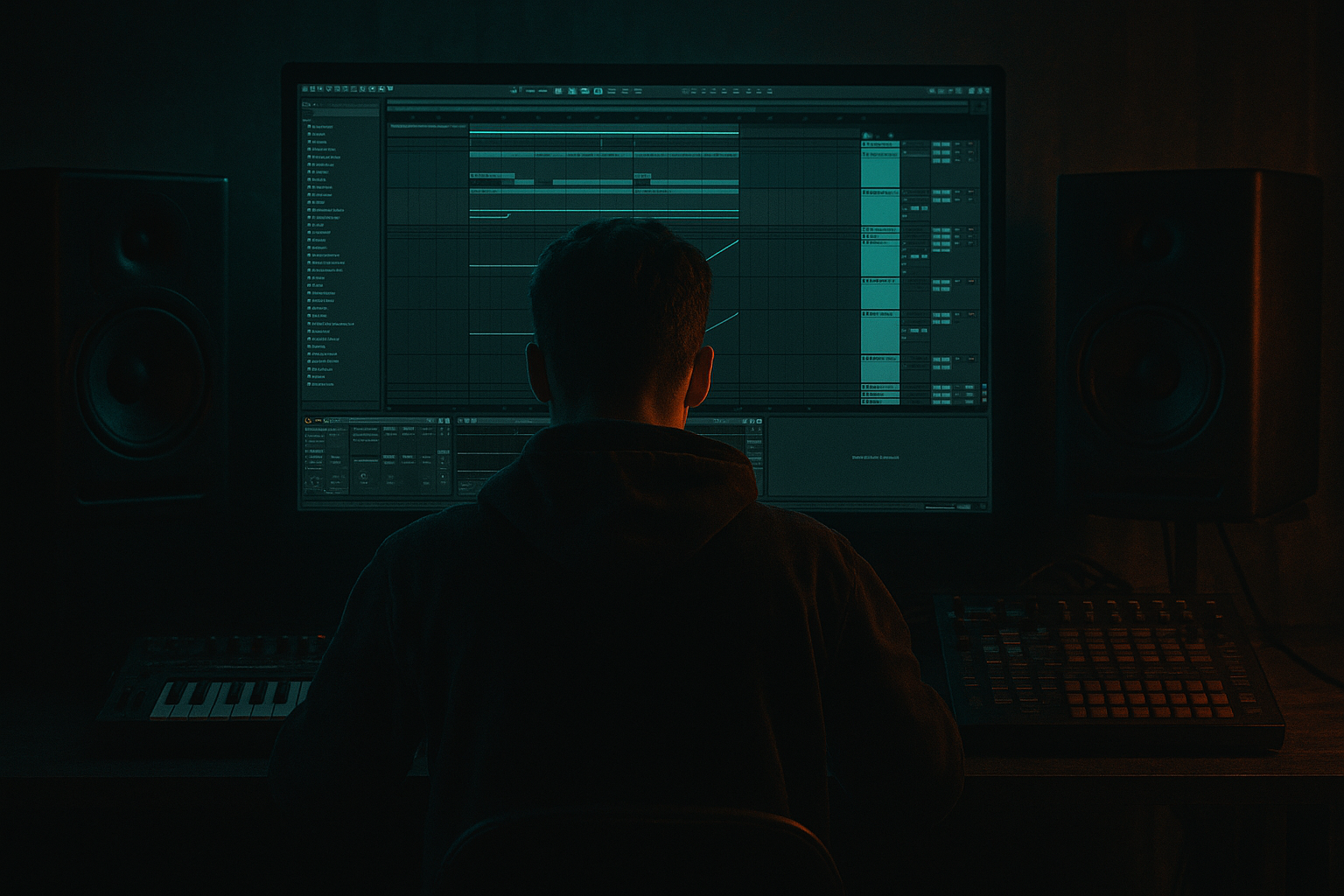
Main tutorial
Late‑Night Jungle Journey: Arranging for Oldskool DnB Vibes (Ableton Live) 🌙🔥
1) Lesson overview
This lesson is all about arrangement—specifically how to build that late‑night, head‑nodding jungle journey: rolling breaks, teased bass, dubby atmos, and those classic “one more bar” tension moves that keep a floor locked.
You’ll learn how to:
- Structure an oldskool‑leaning DnB track without it feeling repetitive
- Create tension + payoff using break edits, bass mutes, FX throws, and “DJ‑friendly” phrasing
- Use Ableton Live stock devices to automate energy and space like a pro
- Arrange with a “journey” mindset: intro → tease → impact → deeper → final push → outro
- DJ‑friendly intro/outro (clean drums + atmos, minimal melodic clutter)
- Two main drops with variation (A/B drop energy)
- A proper breakdown / deep bridge (late‑night tunnel moment)
- Classic jungle arrangement moves:
- Turn on Fixed Grid: 1 Bar for macro arranging.
- Use Locators aggressively. Create these right away:
- DRUMS (Break A, Break B, Tops, Perc, Fills)
- BASS (Sub, Reese/Mid, Bass FX)
- MUSIC (Pads, Stabs, Rave hit, Chords)
- ATMOS/FX (Noise, sweeps, impacts, vinyl, drones)
- RETURNS (Dub delay, plate, verb, special)
- A – Dub Delay: Echo
- B – Plate/Room: Hybrid Reverb (Plate)
- C – Dark Space: Reverb (classic) or Hybrid Reverb (Convolution room)
- D – “Smash Bus” FX (optional): Drum Buss + Saturator (for sends on fills)
- Atmos drone/pad (low energy, wide)
- Minimal tops/hat loop
- Tease the break filtered and low‑passed
- No full sub yet (or very subtle sine ghost)
- On Break track, add Auto Filter:
- Add Vinyl noise or room tone (your sample) → Utility:
- Bring in your main break unfiltered but high‑passed a touch:
- Add a clean kick/sub hit only on key hits (don’t fully 4/4 it)
- Bars 17–25: full break
- Bars 25–29: remove snare layers (or mute snare transient)
- Bars 29–33: bring snare back + add ride or shaker
- Duplicate break to Break B and on Break B add Transient shaping using Drum Buss:
- Automate Break A volume down while Break B fades in for a “DJ swap” feel.
- Take the break, Consolidate, then in Clip:
- Add Reverb send spike on the last snare only.
- Full break + bass + main stab motif
- Keep musical parts simple; let drums speak
- Sub (sine/clean) + mid layer (reese/hooverish)
- On Sub track:
- Sidechain (clean, consistent):
- Add Break B for call/response (every 2 bars swap)
- Add a tambourine/shaker loop but high‑passed
- Create a Drum Rack for tops; map macros:
- Pull music back, push FX and room
- Add dub echoes to stabs/snare tails
- Echo return: increase Feedback + 5–10% for 4 bars, then snap back.
- Auto Filter on music bus: tiny sweep from 12 kHz → 7 kHz to darken.
- Add a new percussion layer or ride
- Introduce a rave hit one-shot every 8 bars (don’t spam it)
- Last 2 bars: mute sub for 1 bar, then bring it back for the final bar (fakeout)
- Final bar: crash + long verb tail → into bridge
- 97–105: drums thin out (tops + ghost break)
- 105–113: bass disappears, atmos widen
- 113–121: tease a new bass phrase / chord
- 121–129: build into Drop 2
- On DRUMS group, add Auto Filter and automate a HP sweep up to 250–400 Hz over 8 bars (energy drop).
- On ATMOS, use Hybrid Reverb (long decay) + Utility width automation:
- Switch to a different break or re-edit the same break (new slice pattern)
- New bass rhythm (same sound family)
- Slightly different drum processing (more crunch / less top)
- B1 (129–145): impact + new bass rhythm
- B2 (145–161): introduce sinister pad or minor chord stab
- B3 (161–177): remove kick layer, emphasize break edits (more syncopation)
- B4 (177–193): final push—add ride, add distortion moment, then strip for outro
- At bar 129, add sub drop (sample) + short silence right before the first hit (even 1/8th) to make the drop feel louder.
- Reduce musical elements first, keep drums rolling
- Then remove bass, leave breaks/tops + atmos
- Final 8 bars: just hats/noise/room tone
- Use Utility on MUSIC and BASS groups:
- Put a gentle Auto Filter LP on the master only for the final 4 bars if you want that “tape powering down” vibe—don’t do it earlier.
- No phrasing discipline: adding/removing things at random bars. Jungle needs 8/16/32 bar logic.
- Same 2‑bar loop for 64 bars: even if the groove is good, you need micro‑edits, mutes, and FX punctuation.
- Overcrowding the drop: too many stabs, pads, vocals and complex breaks—leave air for the break.
- Bass never “tells a story”: if the sub is constant for 3 minutes, the track feels flat. Use planned bass dropouts.
- Too much reverb on breaks: reverb smears transients and kills the snap. Use sends surgically (often on snare only or selected hits).
- Make Drop 2 darker via harmony, not just distortion: shift stabs to a more minor/dissonant voicing, or pitch a pad down -2 to -5 semitones with Complex Pro warp.
- Parallel grime on breaks:
- Sub discipline = bigger track: keep sub mostly mono:
- Use “silence edits” more than risers: jungle tension often comes from removal (half‑bar gaps, snare-only bars).
- Resample your best 8 bars and re-edit them:
- 2 breaks (or 1 break + 1 edited version)
- sub + mid bass
- 1 stab sound
- 1 atmos layer
- Echo + Reverb returns
- Arrange jungle like a DJ: clean intro/outro, 16‑bar logic, 8‑bar tension moves.
- Drop 1 establishes the world; Drop 2 deepens it with contrast (break edits, darker harmony, heavier drum bus).
- Use Ableton stock tools to animate energy:
- The “late‑night journey” feeling comes from planned subtraction, not constant layering.
Assumed: you already know how to program drums, resample, and mix at a decent level.
---
2) What you will build
A ~5:30–6:30 jungle/DnB arrangement at 165–174 BPM with:
- break “call/response” edits
- 8‑bar tension ramps
- bass “fakeouts” + “all‑in” returns
- dubby sends + tape‑ish transitions
---
3) Step-by-step walkthrough
Step 0 — Set the grid like a DJ (foundation first)
Tempo: 170 BPM (good jungle sweet spot)
Arrangement grid: think in 16‑bar sentences with 8‑bar punctuation.
In Ableton:
- `Intro 1–17`
- `Tease 17–33`
- `Drop 1 33–97`
- `Bridge 97–129`
- `Drop 2 129–193`
- `Outro 193–225`
> You can change lengths later, but start with a map. Jungle lives on phrasing.
---
Step 1 — Build a “Journey Group” layout (clean session = fast decisions)
Create Groups in Arrangement View:
Return tracks (stock setup):
- Time: 1/8 Dotted (or 3/16)
- Feedback: 35–55%
- Filter: HP around 250–500 Hz, LP around 6–10 kHz
- Mod: small 3–8%
- Decay: 1.2–2.2s
- Pre‑delay: 15–30 ms
- HP in reverb: 250–400 Hz
- Longer decay 3–6s, darker LP 4–7 kHz for tunnel vibes
Workflow tip: automate send amounts to create movement without adding new elements.
---
Step 2 — Intro: “late‑night loading screen” (bars 1–17) 🌃
Goal: DJ‑mixable, atmospheric, and hints at what’s coming.
Elements:
Practical Ableton moves:
- Type: Lowpass 24 dB
- Frequency start: 400–800 Hz
- Res: 0.7–1.2
- Automate frequency up slightly every 8 bars, then back down (bait & switch)
- Width: 140–170% (keep it airy)
- Gain: ride it down when drums hit
Classic oldskool trick:
At bar 15, drop a 1‑beat break stab (full range) then cut to silence for 1/2 beat → straight back. Tiny moment, huge anticipation.
---
Step 3 — Tease section: “break science” (bars 17–33) 🥁
Here you introduce the main break, but still hold back the full weight.
Drums:
- EQ Eight on Break:
- HP @ 30–45 Hz (12 dB slope)
- Small dip if boxy: 250–400 Hz -2 dB
Tension trick: 8‑bar “subtract then add”
Ableton method:
- Transients: +10 to +25
- Boom: 0–10 (watch low end)
Pre-drop marker:
At bar 32, do a 1‑bar fill:
- Warp Mode: Beats
- Preserve: 1/16
- Transient loop: make a 1/2 bar repeat into the drop
---
Step 4 — Drop 1: establish the loop, then evolve it (bars 33–97) 🚀
Drop 1 is where you lock the groove—but the arrangement must breathe.
Core idea:
Think of Drop 1 as four 16‑bar blocks (A1, A2, A3, A4). Each block changes one main thing.
#### Block A1 (33–49): “statement”
Bass entry:
- Saturator (Soft Clip on, Drive 2–5 dB)
- EQ Eight: lowpass around 120–200 Hz if needed
- Compressor on bass, sidechain from a ghost kick (MIDI track with short click)
- Ratio 4:1, Attack 5–15 ms, Release 60–120 ms
- Aim for 2–5 dB gain reduction
#### Block A2 (49–65): “variation via drums”
Ableton tactic:
- Macro 1: HP filter (Auto Filter)
- Macro 2: Saturation (Saturator drive)
- Macro 3: Send A (Echo) amount (via Rack mapping)
#### Block A3 (65–81): “space and menace”
Automation moves:
#### Block A4 (81–97): “pre-bridge energy”
End-of-drop exit:
---
Step 5 — Bridge: the tunnel moment (bars 97–129) 🕳️
This is where late‑night jungle becomes a journey. Contrast is everything.
Blueprint (32 bars):
Practical devices:
- Width: 120% → 180% during breakdown
- Then snap back to 100–120% at the drop for punch
Oldskool signature move:
Bring in a reggae/dub vocal one-shot or a tiny phrase only once in the bridge, drenched in Echo (1/4) and filtered. It’s a “memory flash” moment.
---
Step 6 — Drop 2: darker, heavier, but still jungle (bars 129–193) 🌑
Drop 2 should feel like the same world—just deeper and more dangerous.
Approach: change 2–3 anchors
Drum processing upgrade (stock chain suggestion):
On DRUMS group:
1. EQ Eight
- Tighten low mud: dip 200–350 Hz if needed
2. Drum Buss
- Drive 5–15%
- Crunch 5–20%
- Boom: 0–10 (careful; jungle already has low content)
3. Glue Compressor
- Attack 3–10 ms, Release Auto
- Ratio 2:1
- 1–2 dB GR (just cohesion)
4. Limiter (safety, not loudness)
Arrangement: “B blocks”
Impact technique:
---
Step 7 — Outro: DJ‑friendly exit (bars 193–225) 🎚️
Ableton tip:
- Automate Gain down smoothly over 16 bars (clean fade without messing limiter thresholds).
---
4) Common mistakes
---
5) Pro tips for darker/heavier DnB (without losing jungle swing) 😈
Create a return with Saturator (Drive 8–12 dB) → EQ Eight (band-limit 200 Hz–6 kHz) → Compressor. Send only snare + ghost notes for controlled filth.
- Utility on Sub: Width 0%
Print DRUMS group to audio, then do micro-cuts (1/16, 1/8) and reverse tails for “handmade” movement.
---
6) Mini practice exercise (20–30 minutes)
Goal: Make a convincing 64‑bar “journey slice” (tease → drop → mini-bridge → drop) using only:
Instructions:
1. Set 170 BPM.
2. Arrange:
- Bars 1–9: filtered break + atmos (LP filter automation)
- Bars 9–17: full break + bass tease (bass lowpassed)
- Bars 17–33: Drop 1
- Bars 33–41: bridge (HP drums, remove bass)
- Bars 41–65: Drop 2 (switch break pattern and add darker stab)
3. Add one signature moment:
- either a 1‑bar silence fakeout
- or a dub echo throw on a vocal/stab
Export and listen away from the DAW—does it feel like it moves, or just loops?
---
7) Recap
- Auto Filter (tension sweeps)
- Echo (dub throws)
- Hybrid Reverb (space control)
- Drum Buss + Glue (weight + cohesion)
- Utility (width + clean fades)
If you want, tell me your BPM + what breaks/bass style you’re using (amen-heavy, thinkbreak, or more modern chopped), and I’ll suggest a tight locator map + specific edit points for your exact loop.

