Main tutorial
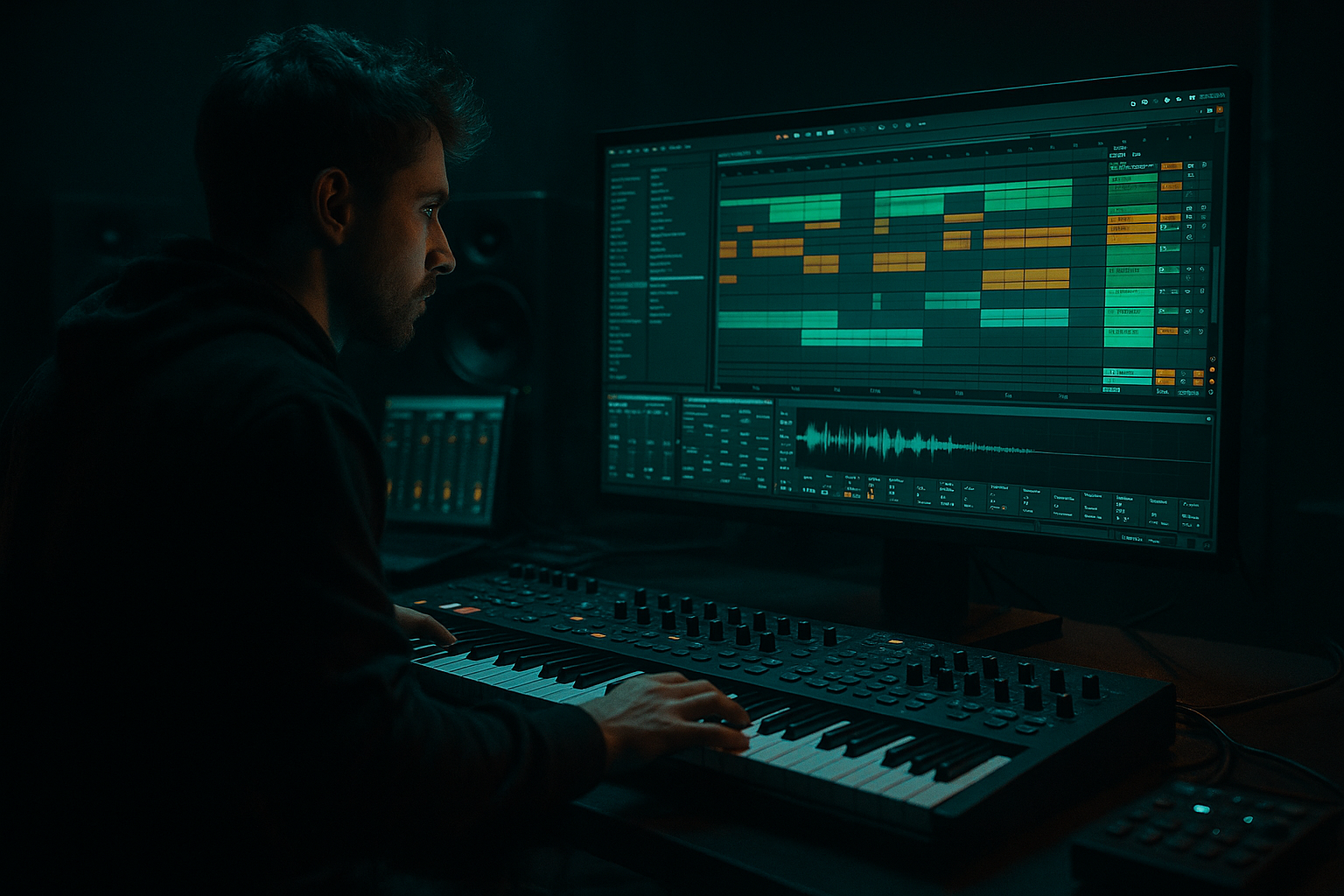
Late-night Jungle Journey Arranging Masterclass (Smoky Afterhours Mood) 🌙🚬
Skill level: Advanced • DAW: Ableton Live • Category: Arrangement
---
1. Lesson overview
This lesson is about arranging jungle/drum & bass like a late-night story: restrained, hypnotic, and inevitable. You’ll learn how to build a journey arrangement using tension management, energy swaps, and micro-variation—without relying on cheesy “EDM” structure.
We’ll focus on:
- Scene-based planning (Session View → Arrangement View workflow)
- DJ-friendly phrasing (16/32/64 bar logic, mix-out points)
- Smoky atmosphere design using Ableton stock devices
- Break control (movement without losing roll)
- Sub/bass staging so the track feels heavy but stays clean
- Long intro for DJ mixing (32–64 bars)
- Two main drops (A + B sections) with evolving breaks
- One restrained breakdown (not a full stop—more of a “foggy corridor”)
- Tension ramp + final 64-bar exit with clean mix-out
- A signature “smoky hook”: vocal smear / horn stab / pad motif
- Kick
- Snare/Clap
- Break A (main)
- Break B (variation)
- Tops (hats/shakers/ride)
- Perc FX (rim, tamb, ghost hits)
- Sub
- Mid bass layer (reese/whomp/low-mid grit)
- Bass FX (shots, fills, growl impacts)
- Pads (air + smoke)
- Stabs (minor chord hits / jazz chord shots)
- Vocal texture (one-shots or phrases)
- Drones / noise bed
- Rises, downlifters, impacts, tape stops, vinyl noise, reloads (tastefully)
- A vocal phrase stretched into haze
- A minor 7th stab (jazz-tinged)
- A two-note motif on a pad or rhodes
- A horn stab resampled and filtered
- Automate the filter cutoff to “breathe” every 8 bars.
- Automate reverb send up on the last 2 beats of bar 16/32 to smear transitions.
- Bars 1–16: Atmos only + distant break ghost
- Bars 17–32: Bring in tops + hint of snare
- Bars 33–48: Full break arrives but bass still muted/filtered
- Bars 49–64: Tease the drop (bass comes closer, tension rises)
- Auto Filter HP 24 dB @ 300 Hz
- Reverb 15–25% wet
- Full drums + full bass + hook present but not overexposed
- Keep 2–3 main elements max in the foreground:
- Introduce Break B variations and micro-edits:
- Sub stays steady (hypnotic), but mid bass changes every 16 bars:
- Remove kick or sub for 8–16 bars, but keep:
- Use Auto Filter on drums and bass bus:
- Put it on a new track called “Ghost Roll”
- Add Reverb (big) + EQ Eight high-pass @ 300–600 Hz
- On Mid Bass, add Amp (stock device) subtly:
- Or use Overdrive:
- First 16: keep drums strong, start removing hook elements
- Next 16: simplify bass (remove mid bass first)
- Next 16: filter breaks gradually (HP up to 200–400 Hz)
- Last 16: leave tops + atmos, then tail
- Reduce stereo width slightly in the last 16 bars (Utility)
- Increase reverb send on atmos for a smooth fade into night 🌫️
- Automate Drum Bus Drive +1–2% in Drop B
- Automate reverb send on hook at the end of every 16 bars
- Automate filter cutoff on a noise bed to “open” before drops
- Automate mute moments: 1/2 beat silences before a snare hit = tension
- Over-arranging the first drop: If you introduce everything in Drop A, Drop B has nowhere to go.
- Break edits that kill the pocket: Jungle relies on feel—too many random chops = chaos, not pressure.
- Sub doing “melody gymnastics”: Late-night rollers often want stable sub hypnosis.
- Over-wet atmos: If your reverb isn’t high-passed, it will fog up the low mids (and your mix will feel weak).
- No DJ phrases: Ignoring 16/32 bar logic makes the track harder to mix and less “professional club-ready.”
- Use silence as weight: A tiny drop-out before a snare makes the next hit feel bigger than distortion does.
- Midrange control > more distortion: Try cutting 250–450 Hz mud before adding saturation.
- Parallel “Threat” channel:
- Bass mono discipline: Keep sub mono; if you want width, widen upper bass only (Utility or chorus on a high-passed layer).
- Resample your best 2 bars: Then reintroduce it as an occasional fill. The track references itself—very effective late-night storytelling.
- You built a late-night jungle arrangement using phrasing, density control, and evolving breaks.
- You created a smoky hook that anchors the story across sections.
- You used Ableton stock devices (Auto Filter, Echo, Reverb, Glue, Drum Buss, Beat Repeat, Utility, Saturator) to drive transitions and energy.
- You kept it DJ-functional: clear intro/outro, strong 64-bar drops, and a breakdown that reduces density without killing momentum.
---
2. What you will build
A 4:30–6:00 late-night jungle roller with:
Target vibe references (conceptually): blue-lit warehouse, cigarette haze, 3am, heads-down rolling.
---
3. Step-by-step walkthrough
Step 0 — Pre-flight: set your arrangement grid (so it behaves like jungle)
1. Tempo: 165–174 BPM (try 170 BPM for classic jungle pressure).
2. Global groove: Keep it tight; apply swing selectively later (Groove Pool).
3. Markers & phrasing:
- In Arrangement View, drop locators every 16 bars:
- `Intro 1 (1–17)`
- `Intro 2 (17–33)`
- `Drop A (33–97)`
- `Bridge (97–129)`
- `Drop B (129–193)`
- `Outro (193–257)`
These are just scaffolds—you’ll flex them, but the grid keeps the story DJ-usable.
---
Step 1 — Build a “Journey Template” track stack (fast to arrange, easy to automate)
Create these groups:
#### Group 1: DRUMS
Drum Bus chain (Ableton stock)
1. Drum Buss
- Drive: 5–15%
- Crunch: 0–10% (careful)
- Boom: 0–10%, Freq around 45–60 Hz (only if it doesn’t fight sub)
2. Glue Compressor
- Attack: 3 ms
- Release: Auto
- Ratio: 2:1
- Aim: 1–2 dB GR on peaks
3. EQ Eight
- High-pass 20–30 Hz
- Gentle dip if harsh around 3–6 kHz (depends on breaks)
#### Group 2: BASS
Bass Bus chain
1. EQ Eight (mid/side if needed)
2. Saturator
- Soft Clip: On
- Drive: 2–6 dB
3. Compressor (optional, light)
4. Utility
- Bass Mono: On (if you’re using Live’s Utility with Bass Mono option)
- Width: 0–20% on low band (keep it controlled)
#### Group 3: MUSIC / ATMOS
Atmos Bus chain
1. Auto Filter (for “fog opening” moments)
2. Echo
- Time: 1/8D or 1/4
- Feedback: 15–35%
- Filter: roll off lows below 200–400 Hz
3. Reverb
- Decay: 2–6 s
- Low Cut: 250–600 Hz
- High Cut: 6–10 kHz
4. Utility (width automation tool)
#### Group 4: FX / TRANSITIONS
---
Step 2 — Design your late-night “smoky hook” (the identity thread) 🎷
Pick ONE signature element that appears in multiple sections:
Practical Ableton method:
1. Drop the sample into Simpler.
2. Set mode to Slice (if it’s a phrase) or Classic (if it’s a stab).
3. Add:
- Auto Filter (LP 12 dB)
- Saturator (Drive 2–4 dB)
- Echo (Ping Pong OFF for darker, centered feel)
- Reverb (Low Cut up to 400 Hz)
Automation idea (key to “smoky mood”):
---
Step 3 — Intro (32–64 bars): make it DJ-friendly but cinematic
Goal: establish mood + rhythm information slowly.
Suggested 64-bar intro layout:
- Break: high-passed, low volume, maybe vinyl crackle under it
- Use Auto Filter on breaks: HP around 250–600 Hz
- Add closed hats or shuffled perc at low level
- Introduce the smoky hook quietly
- Main break at full band
- Bass: sub muted, mid bass filtered
- Add a snare build (not EDM—think: rolling ghost snare activity)
- Short riser + reverb tail into the drop
Ableton trick:
Create an “Intro Filter” Return Track (Return A) with:
Send the breaks to it during intro, then automate send down to 0 at the drop.
---
Step 4 — Drop A (64 bars): lock the roll, then evolve it without changing the groove 🔥
Drop A is not about constant new parts—it's about controlled mutation.
Bars 65–96 (first 32):
- Break + sub/mid bass + hook
Bars 97–128 (second 32):
- Swap a snare hit once every 8 bars
- Add a one-beat stop (tasteful) at bar 128 beat 4
Practical break evolution workflow:
1. Duplicate your main break to Break B.
2. On Break B:
- Add Beat Repeat (set for subtlety):
- Interval: 1 Bar
- Grid: 1/16
- Chance: 10–20%
- Mix: 10–20%
- Automate Beat Repeat On/Off only for fills (don’t leave it running).
3. Use Drum Rack (or audio slicing) for manual edits:
- Take 2–4 signature hits and place them as call-and-response.
Bass arrangement move:
- Add a new harmonic, a short reese layer, or a rhythmic gap.
---
Step 5 — Bridge / “Fog corridor” breakdown (16–32 bars): don’t kill momentum
Late-night jungle breakdowns work best when they reduce density, not energy.
Bridge recipe (32 bars):
- a filtered break loop
- atmospheric hook
- a tension element (riser/noise/reversed cymbal)
- Drums LP cutoff down to 2–5 kHz
- Bass: remove sub (mute sub track) but leave mid texture at low level
Ableton scene trick:
Bounce a section of your drop drums to audio (Resample), then:
This creates the “club memory” effect—your drop still haunts the breakdown.
---
Step 6 — Drop B (64 bars): same world, higher stakes
Drop B should feel like a deeper room—not a new track.
Upgrade strategies (pick 2–3):
1. Drum density increase
- Add a ride pattern or more syncopated tops
2. Bass call-and-response
- Leave the sub consistent but add mid fills at the end of 4/8/16 bars
3. Hook re-contextualization
- Same hook, different filter/resample pitch, or chopped rhythm
4. A “danger bar” every 16
- One bar where breaks stutter, or snare pattern changes, then snap back
Ableton device move for Drop B bite:
- Mode: Clean or Blues
- Gain low, just for edge
- Frequency: 1–2 kHz
- Drive: small, automate only on fills
---
Step 7 — Outro (32–64 bars): clean mix-out with atmosphere
A proper jungle/DnB outro is a gift to DJs.
Outro layout (64 bars):
Final polish automation:
---
Step 8 — Arrangement “energy automation” checklist (advanced but fast)
Do this pass after the structure is placed:
---
4. Common mistakes
---
5. Pro tips for darker/heavier DnB 🖤
Duplicate your drum group → on the duplicate:
- Saturator Drive 8–12 dB
- EQ Eight: band-pass 300 Hz – 6 kHz
- Blend at -18 to -12 dB under main drums
---
6. Mini practice exercise (30–45 minutes) 🎯
Goal: Arrange a convincing 3:00 “micro-journey” without adding new sounds.
1. Take an 8-bar drum loop + bass + one hook.
2. Arrange:
- 16 bars intro
- 32 bars Drop A
- 16 bars bridge
- 32 bars Drop B
- 16 bars outro
3. Rules:
- You may only use automation, mutes, and edits (no new instruments).
- Include one drum fill every 16 bars.
- Include two hook variations (filter + timing change).
4. Export and listen quietly. If it still feels intense at low volume, your arrangement is working.
---
7. Recap
If you want, tell me your current project tempo and whether you’re working from classic breaks, modern punchy drums, or a hybrid—and I’ll suggest a precise 5–6 minute locator map tailored to your style.

