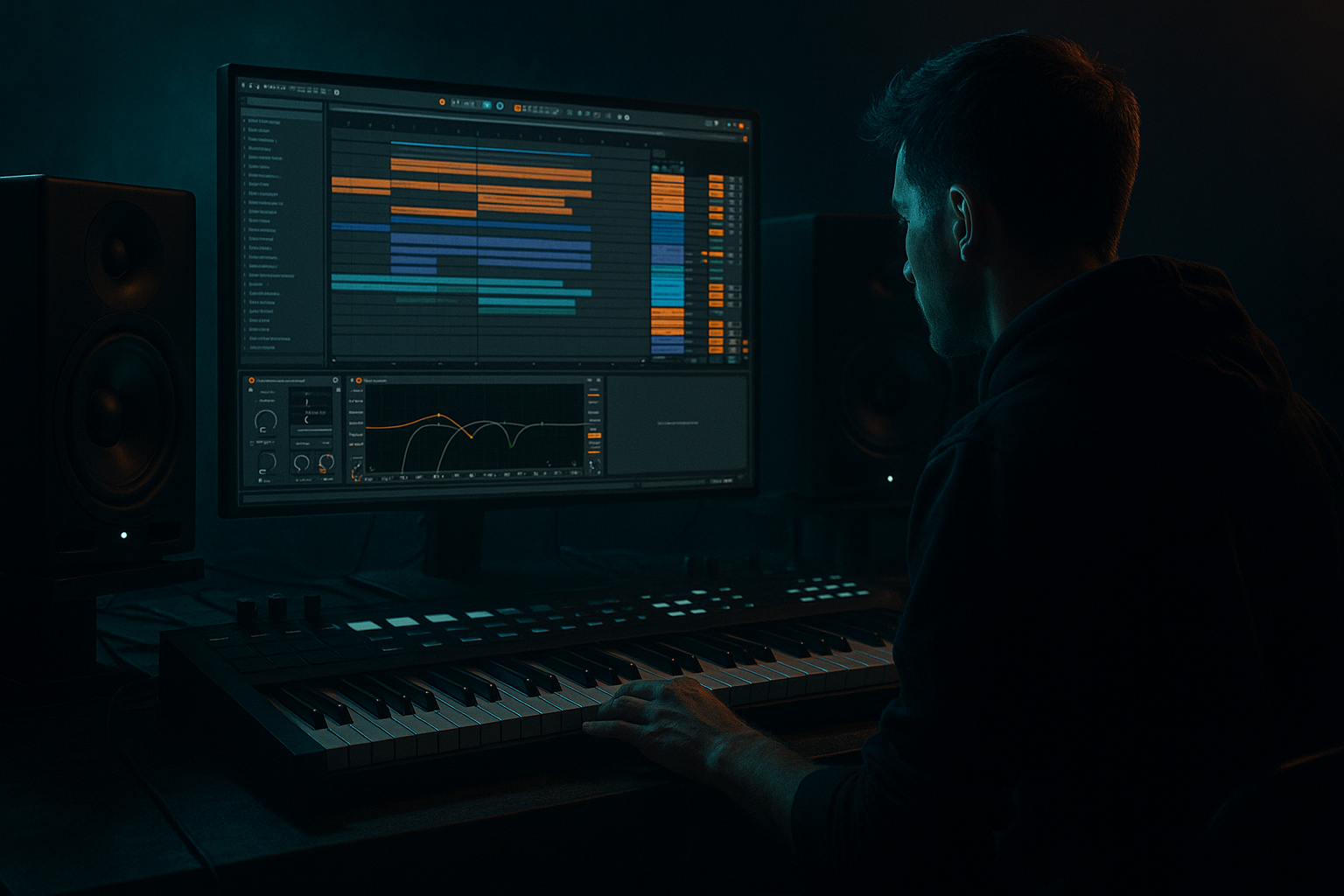
Main tutorial
Layer a Mid Bass for Heavyweight Sub Impact in Ableton Live 12
Jungle / oldskool DnB sampling tutorial for intermediate producers 🔥
1. Lesson overview
In jungle and oldskool DnB, the sub is doing the heavy lifting — but the mid bass layer is what gives the low end presence, movement, and audibility on smaller systems. If your bass feels huge in the room but disappears on headphones, phones, or compact speakers, the problem is usually that your sub has no strong midrange companion.
In this lesson, you’ll learn how to build a mid bass layer from sampled material in Ableton Live 12, then blend it with a clean sub so the whole bassline hits hard, sounds gritty, and still stays controlled.
We’ll focus on a practical jungle / oldskool DnB workflow:
- sample-based bass design
- layering with a dedicated sub
- EQ and saturation shaping
- stereo control
- envelope and arrangement ideas for a rolling bassline
- a mono sub layer holding the low end
- a mid bass layer built from a sampled bass stab or re-sampled note
- a tight, punchy device chain to give body and aggression
- a simple 2-bar DnB bass phrase that works under breakbeats
- a starting point for dark, heavyweight jungle basslines 🎛️
- deep sub pressure
- raspy midrange growl
- short, bouncy note lengths
- space for Amen / Think break drums
- oldskool urgency, not modern EDM wobble
- a single note sampled from an analog-style bass
- a re-sampled Reese-ish bass
- a short bass stab from a loop or record
- a dirty 808-style bass hit with mid content
- a filtered synth bass sample bounced from another project
- strong energy around 80 Hz–300 Hz
- some harmonics in the 500 Hz–2 kHz area
- a clear transient or attack
- not too much stereo width in the low end
- Play around D1–F1 for the sub
- For the mid bass layer, the note can sit there too, but the harmonic content will be more obvious if the sample is tuned correctly
- Use Simpler’s Transpose control
- Match it to your track’s key
- If needed, use Detune slightly for thickness, but don’t overdo it
- High-pass very gently if needed: 20–30 Hz
- Cut muddy area if the sample is boxy: 200–400 Hz
- If there’s harshness, a small dip around 2–5 kHz
- HPF at 25 Hz, 24 dB/oct if the sample contains low rumble
- -2 to -4 dB around 250 Hz if it clouds the mix
- Small dynamic-ish manual cut around 3 kHz if the sample has an annoying bite
- Attack: 0–5 ms
- Decay: short to medium
- Sustain: low to medium
- Release: 20–80 ms
- Attack: 0 ms
- Decay: 180 ms
- Sustain: -6 dB equivalent feel
- Release: 35 ms
- keep it short and percussive
- let it breathe a little more, but keep the tail tight
- Drive: 3–8 dB
- Soft Clip: On
- Output: compensate so level stays controlled
- Curve: default or slightly harder if you want more bite
- Pedal for grungier distortion
- Overdrive for a more aggressive edge
- Amp very subtly if you want character, but be careful — it can get messy fast in the low end
- harmonics around 150 Hz–800 Hz
- enough midrange presence to cut through breaks
- a slightly compressed “in-your-face” feel
- Duplicate the bass MIDI pattern
- Load a clean sine wave or sub patch in Operator or Wavetable
- Or use Simpler with a sine-like sample if you prefer sample-based workflow
- Oscillator: Sine
- Filter: off or minimal
- Attack: 0 ms
- Decay: short
- Sustain: full
- Release: 30–60 ms
- Keep it mono
- EQ Eight: low-pass or keep only the fundamental range
- Utility: width = 0%
- Optional Saturator very lightly if needed
- Sub layer: below 80–100 Hz
- Mid bass layer: above 80–100 Hz
- High-pass at 80–100 Hz
- 24 dB/oct slope if you want a firm split
- Type: Low-pass 24
- Frequency: start around 200–600 Hz
- Resonance: 10–25%
- Envelope: low to medium
- Drive: add if you want extra edge
- open slightly on accented notes
- close for darker notes
- use small movement, not extreme sweeps
- Ratio: 2:1 to 4:1
- Attack: 10–30 ms to let some punch through
- Release: 50–120 ms
- Gain reduction: 2–4 dB
- Drive low
- Crunch moderate
- Boom usually off or very subtle
- This can add weight and attitude, but it’s easy to overcook
- Glue Compressor
- Utility
- answer the drums
- leave room for snares
- feel syncopated
- use repetition with variation
- Bar 1: short note on beat 1, another offbeat stab, longer note into beat 4
- Bar 2: variation with one note shifted earlier or later
- Leave gaps for the snare hits
- 1.1.1 short note
- 1.2.3 short note
- 1.4.1 medium note
- 2.1.3 short note
- 2.3.2 short note
- 2.4.1 medium note
- use slightly different velocities
- vary note lengths
- let some notes hit harder than others
- Sidechain input from kick
- Ratio: 2:1
- Attack: 1–5 ms
- Release: 40–80 ms
- Only 1–3 dB of reduction
- Does the bass still speak when the Amen or chopped break is playing?
- Is the sub overwhelming the kick?
- Does the mid bass disappear when the drums enter?
- Sub should feel powerful but not dominate the whole mix
- Mid bass should be audible even at lower playback volume
- Kick should have a clear transient, not fight the bass tail
- Snare should stay loud and punchy
- you can chop it more easily
- you can reverse, pitch, and resample
- you get a more cohesive, “committed” sound
- resample to audio
- warp off if possible
- chop into new phrases
- use fades to control clicks
- filtered noise
- vinyl crackle
- a detuned low-mid texture
- tension
- movement
- “rising pressure” without turning into a big EDM build
- use subtle pitch bend on select notes
- don’t make it too obvious
- short slides into downbeats can sound very oldskool
- more harmonics
- less sub overlap
- better EQ balance around 200–800 Hz
- EQ Eight
- Saturator
- Auto Filter
- optional Compressor
- 5–8 notes max
- short note lengths
- one variation in bar 2
- sub level
- mid bass high-pass
- saturation amount
- filter cutoff
- original vs resampled
- dry vs processed
- with drums vs without drums
- Start with a sampled bass source that has character
- Use Simpler for quick sampling workflow
- Clean the sound with EQ Eight
- Add Saturator or light distortion for harmonics
- Split the sound into a clean mono sub and a mid bass layer
- High-pass the mid bass around 80–100 Hz
- Use Auto Filter and envelope shaping for movement
- Keep the bassline short, rhythmic, and arranged around the breakbeat
- Check your mix in context and keep the low end controlled
You’ll use stock Ableton devices only, so this works in any Live 12 setup.
---
2. What you will build
By the end, you’ll have:
Target sound
Think:
---
3. Step-by-step walkthrough
Step 1: Choose or create a bass sample source
For a jungle/oldskool sound, don’t start with a supersaw preset. Start with a sample that already has character.
Good source options:
#### Practical source selection rules
Pick a sample that has:
If your sample is too clean, that’s okay — we’ll dirty it up.
---
Step 2: Load the sample into Simpler
1. Create a new MIDI track.
2. Drop your bass sample into Simpler.
3. Set Simpler to:
- Mode: Classic
- Warp: Off if it’s a one-shot sample
- Trigger: Gate for note control
If the sample is long and tonal, you can use Classic mode with a short loop or Slice mode if you want more movement, but for this lesson we’re building a focused mid bass layer, so keep it controlled.
#### Set the MIDI note range
Tune the sample:
---
Step 3: Clean the sample before processing
Before adding grit, remove unnecessary junk.
Use an EQ Eight after Simpler:
#### Suggested starting EQ moves
Don’t make it thin — you’re only clearing space for the sub and drums.
---
Step 4: Shape the amplitude envelope for jungle-style bass hits
Oldskool DnB bass often works best when it’s short, punchy, and rhythmically alive.
In Simpler:
A good starting point:
If your sample is a stab:
If your sample is a note:
This helps the bass leave space for breakbeat ghost notes and snares.
---
Step 5: Add controlled saturation for harmonics
This is the key step for mid bass impact. You want the bass to speak on smaller speakers without ruining the sub.
Add Saturator after EQ Eight.
#### Suggested Saturator settings
If the bass is too clean, increase drive a little.
If it starts fuzzing into mush, back off and use less drive.
You can also try:
#### Best practice
Use saturation to create:
---
Step 6: Split the mid bass from the sub
Now we need a proper sub layer. The trick is to keep the sub clean and mono, while the mid bass carries the character.
#### Create a second MIDI track for the sub
#### Sub track settings
In Operator:
Then process the sub:
#### Frequency split idea
Use EQ Eight on the mid bass:
This is the backbone of the whole technique:
sub for weight, mid bass for audibility and aggression.
---
Step 7: Make the mid bass move with filtering
Oldskool jungle basslines often have a strong sense of movement from filter automation or note variation.
Add Auto Filter after Saturator on the mid bass.
#### Starting Auto Filter settings
Now automate the cutoff:
This creates that classic tension where the bass feels like it’s breathing with the drums.
---
Step 8: Add transient control if the bass is too spiky
If the sample has a harsh click or too much attack, use Compressor or Glue Compressor lightly.
#### Compressor idea
If the bass is too flat, ease off compression and let saturation do more work.
You can also use Drum Buss very carefully:
---
Step 9: Glue the layers together with grouping
Select your sub and mid bass tracks and group them.
Inside the group:
1. First EQ Eight for broad cleanup
2. Then Saturator or Glue Compressor
3. Then Utility for mono check and gain trim
#### Group processing starting point
- Attack: 10 ms
- Release: Auto
- Ratio: 2:1
- GR: 1–2 dB max
- Width: keep bass mostly mono
- Use Bass Mono if needed in Live 12-style workflow, or keep the low track itself mono via device chain
This helps the bass act like one instrument instead of two separate layers fighting each other.
---
Step 10: Program a 2-bar jungle-style phrase
Now build the actual bassline. For oldskool DnB, the bass should:
#### Example 2-bar pattern concept
Try a MIDI pattern like:
If you want that classic jungle lurch:
#### Important
Don’t make the bass line too busy.
In DnB, space is part of the groove.
---
Step 11: Sidechain the bass lightly to the kick if needed
In oldskool jungle, the kick and bass often coexist in a looser way than modern sidechain-heavy genres. But a small amount of control can help.
Use Compressor on the bass group:
This is not for obvious pumping.
It’s just to keep the kick from getting swallowed.
If the kick is short and the bass is already arranged well, you may not need sidechain at all.
---
Step 12: Reference and balance in context with the drums
Now bring in your breakbeat or programmed DnB drums.
Check:
#### Balance targets
Use Utility or simple clip gain to balance before reaching for more processing.
---
4. Common mistakes
1. Making the sub and mid bass both full-range
If both layers occupy the same space, the low end gets bloated and undefined.
Fix: high-pass the mid bass around 80–100 Hz and keep the sub clean.
---
2. Overdistorting the bass
Too much saturation turns the bass into fuzz and kills the punch.
Fix: add harmonics in moderation, then compare with the dry sound.
---
3. Using wide stereo bass below 100 Hz
This causes phase issues and weak low-end translation.
Fix: keep sub mono with Utility, and avoid stereo widening on low frequencies.
---
4. Long releases that blur the groove
DnB bass should groove with the drums, not smear over them.
Fix: shorten envelope release and note lengths.
---
5. Ignoring note choice and rhythm
A great sound won’t save a weak bass pattern.
Fix: write a rhythmic bassline that interacts with the break and snare placements.
---
5. Pro tips for darker/heavier DnB
Tip 1: Resample your processed mid bass
Once you have a good chain, bounce it to audio and re-process it.
Why this works:
Try:
---
Tip 2: Layer a very subtle noise or texture
For darker jungle vibe, add a quiet layer with:
Keep it low in the mix. It should feel more than it should be heard.
---
Tip 3: Use filter automation as arrangement energy
Instead of constantly adding new notes, open the low-pass filter slightly across 8 or 16 bars.
This creates:
---
Tip 4: Use pitch movement sparingly
A tiny pitch glide or pitch envelope can add menace.
In Simpler or Operator:
---
Tip 5: Test on lower volumes
Heavy bass should still feel present when quiet.
If the mid bass disappears at low volume, it likely needs:
---
Tip 6: Keep the kick and bass arranged, not just processed
A lot of heavyweight DnB is really about rhythmic slotting.
If the kick hits on a bass note, shorten the bass.
If the snare lands, leave a pocket before or after.
Let the break breathe.
---
6. Mini practice exercise
Exercise: build a 2-layer jungle bass patch in 20 minutes
#### Step A
Pick a bass sample and load it into Simpler.
#### Step B
Create a mid bass chain:
#### Step C
Duplicate the MIDI to a second track and make a clean sub in Operator.
#### Step D
Write a 2-bar bassline with:
#### Step E
Loop it with a breakbeat and adjust:
#### Step F
Bounce the bass group to audio and compare:
Your goal is to make the bass feel heavier in context, not just louder in solo.
---
7. Recap
To layer a mid bass for heavyweight sub impact in Ableton Live 12:
If you do this well, your bass will feel heavier, clearer, and more authentic to jungle / oldskool DnB — not just louder. That’s the difference between a generic low end and a proper roller 😈
If you want, I can also turn this into:
1. a track-by-track Ableton routing diagram, or
2. a specific jungle bass preset chain using only stock devices.

