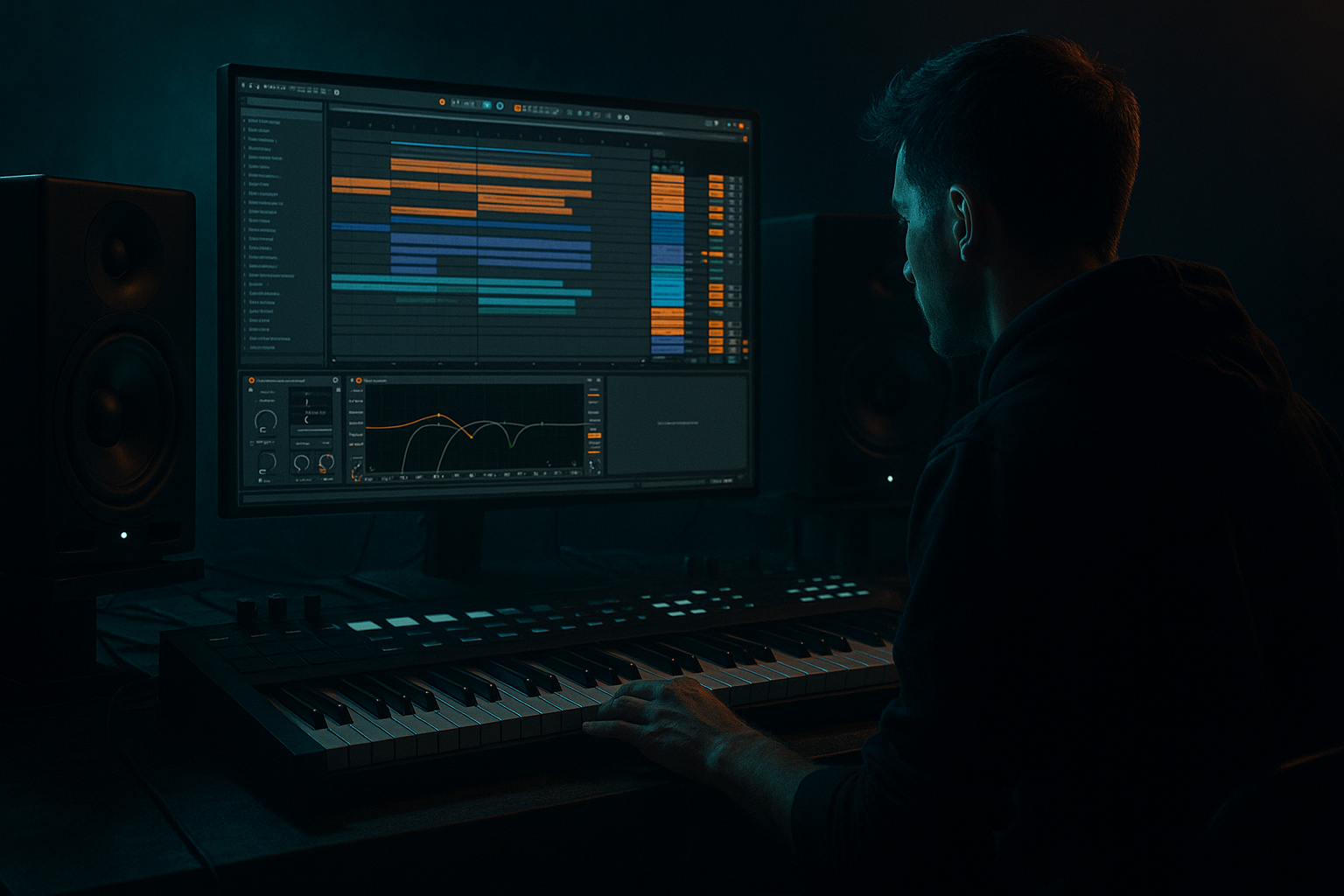
Main tutorial
1. Lesson Overview
This intermediate lesson shows you how to layer a Ray Keith bassline turn in Ableton Live 12 for 90s-inspired darkness. You’ll build a multi-layered bass turn (sub, growl, grit/top) using only Ableton stock devices, route and group the layers correctly, add movement with filter/envelope/Frequency Shifter automation, and bounce a combined audio turn for final texture. The goal is a compact, punchy, ominous “turn” that sits in the mix and reads like classic 90s dark jungle / early DnB.
2. What You Will Build
- A 1-bar MIDI turn pattern with a heavy sub foundation, a mid-range FM-style growl, and a distorted/top layer for bite.
- A grouped bass channel with proper mono/sub control, mid-side treatment for width, and processing (Saturator → EQ Eight → Multiband Dynamics).
- Automation and modulation to produce the signature Ray Keith-style turn (pitch bends, quick filter sweeps, and frequency shifting).
- A resampled audio clip of the layered turn you can tweak further or trigger as a one-shot.
- Layering full-range content on every layer: if every layer contains lots of sub, you get phase/muddy mix — always high-pass growl/top above ~120 Hz.
- Not mono-ing the low end: stereo subs cause phase cancellation. Use Utility width = 0% for sub.
- Overusing saturation: too much drive flattens dynamics and masks the “snap” of the turn. Tilt saturation to taste and automate rather than constant heavy drive.
- Bad EQ order: saturating before removing problematic frequencies amplifies them; remove muddy frequencies early (EQ Eight after Instrument, before heavy saturation).
- Uncontrolled pitch modulation: large, un-smoothed pitch bends can create digital zipper noise. Use small amounts or envelope smoothing.
- Resample multiple variants: resample a clean version and a super-processed version (one with heavy Frequency Shifter + Redux). Layer the two audio variants and blend with crossfades for instant variation.
- Use clip envelopes (Device/Envelope) to draw tiny filter and pitch movements per note — clip-based automation is easy to edit for tight turns.
- For extra 90s authenticity, add a small amount of bit-reduction (Redux) on top layer and make it audible only during the turn via Automation.
- Sidechain the group lightly to kick for clarity (short release for pumping, but keep punch).
- To avoid phase issues between Operator sub and Wavetable growl, invert phase on the growl briefly or nudge its start by a few ms if you hear cancellation.
- Duplicate the turn audio, transpose one copy by +7 semitones and low-pass it to taste, then blend for a classic dissonant turn flavor Ray Keith used.
- Build the three-layer chain (Operator sub, Wavetable growl, Simpler top) and program a 1-bar turn on bar 2 using the note idea given in Step 18.
- Automate a quick Auto Filter sweep and a Frequency Shifter spike during the turn.
- Bounce the result to audio (resample). Trim and place the audio on a Clip slot for later triggering.
- Building dedicated sub, mid growl, and top layers (Operator, Wavetable, Simpler) and routing them into a grouped chain.
- Programming a short, musical turn with pitch/length variation and clip/MIDI pitch modulation.
- Adding movement with Auto Filter, Frequency Shifter, Saturator, and Multiband Dynamics, then resampling the result for flexible use.
- Avoiding common pitfalls (mono low end, phase, over-saturation) and using resampling + automation for punchy, authentic 90s grime and darkness.
3. Step-by-Step Walkthrough
Note: keep Live’s metronome off when crafting swingy turns; set tempo to your track (170–175 BPM typical). I’ll use “C1” as root/sub reference; transpose to your key.
A. Prepare session
1. Create three MIDI Tracks: Bass_Sub, Bass_Growl, Bass_Top. Create a Group called “Bass_Turn_Group”.
2. Set global grid to 1/16 or 1/32 for detail. Create a 1-bar MIDI clip on each track (C1 as main note) and enable loop.
B. Sub layer (Operator) — foundation and punch
3. On Bass_Sub load Operator.
- Osc A: Sine, level 0 dB. Coarse tuned to root (C1). Fine tune 0.
- Osc B/C off.
- Use Osc A’s Envelope: very short decay (0–30 ms) for click + full sustain to keep sub constant. Keep pitch envelope off for sub.
4. Add Utility after Operator: Width = 0% (mono).
5. Add EQ Eight after Utility: High-pass at 100 Hz? No — instead low-pass at 200–300 Hz (type: lowpass 24 dB) to focus sub. Slight boost around 60–80 Hz if needed (+1.5–3 dB).
6. Add Glue Compressor (fast attack, medium release) to glue transients slightly. Optional sidechain to kick later.
C. Growl layer (Wavetable) — core Ray Keith mid growl
7. On Bass_Growl load Wavetable.
- Osc 1: choose a saw-ish or square wavetable (Analog → Morph) — position slightly into harmonic content.
- Osc 2: set to a sine or triangle, route it to FM (Osc 2 -> Osc 1 for light FM).
- Set Unison to 1–2 voices, detune minimal.
- Filter: set to Band-pass (12 or 24 dB), cutoff around 200–800 Hz depending on waveform; resonance to taste (0.8–1.6).
- Amp Envelope: short attack (5–10 ms), sustain 80–100%, decay short.
- Pitch Envelope: small downward bite on short release to create the “snap” on the turn — envelope amount small (few semitones) with fast decay (50–120 ms).
8. Insert Auto Filter after Wavetable:
- Filter type: Band-pass or Low-pass; cutoff automated.
- Set Envelope Follower modulation: not for now; we’ll automate cutoff via clip envelopes for the turn sweep.
9. Insert Saturator (Analog Clip mode) after Auto Filter: Drive 2–4 dB, Soft Clip on.
10. Insert Frequency Shifter after Saturator: shift 1–4 Hz modulated by small LFO to create nasty movement. LFO rate very slow or synced to bar/beat for rhythmic wobble. Dry/Wet 20–30%.
11. Insert EQ Eight: pull out sub below 120 Hz (shelving or high-pass) so sub layer remains dominant. Boost 300–700 Hz for the “growl” presence if needed.
D. Top layer (Sampler or Simpler) — grit, attack, and stereo flavor
12. On Bass_Top load Simpler (Classic mode) and load a short distorted bass sample or single-cycle waveform (you can draw from Wavetable counterpart by duplicating oscillator and resampling — but for speed use Simpler with a square/saw sample).
13. Set Transpose a few octaves higher than sub (2–4 octaves) so it adds top harmonics only.
14. Enable Filter (Low-pass) and set cutoff high, resonance low. Envelope fast attack, short decay to make it percussive.
15. Add Saturator (Tube or Soft Clip) — Drive 3–6 dB, then add Redux for bit-grit (bit reduction small, e.g., 10–12 bits, rate reduction subtle).
16. Add Frequency Shifter on this chain for a metallic sheen (LFO mod the shift amount very small, dry/wet 15–25%).
17. Add Chorus/Delay lightly for stereo interest (Delay Sync 1/16 with low feedback, dry/wet 10%). Use Utility to push width to 30–60%, but keep low end mono.
E. MIDI turn programming (the musical turn)
18. On each MIDI clip, program the same timing skeleton but different pitches:
- Make root note (C1) held through bar except on the last beat where the turn happens (e.g., last 1/8 or last 1/16s).
- Turn example (at 170 BPM, 1 bar loop): positions at bar end: 1:4.3 (a 16th triplet feel) sequence of 4–6 short 1/16 notes: C1 (root) -> B0 (-1 semitone) -> G#0 (-4 semitones) -> A0 (-3 semitones) -> C1 back — adjust to taste.
- Make sub layer play the root and then a damped lower pitch for the turn (don’t overplay sub in the faster notes — you can use shorter note lengths or volume envelope).
- Growl: play the turn in mid range (C2–G#1 area) with overlapping notes to allow filter & pitch envelope to run.
- Top: play the quick staccato stabs, 1/32–1/16 length, high octave.
19. Use MIDI Pitch Bend on the growl track for subtle micro slides (±50 cents to 200 cents) right before the turn notes — set the clip’s Envelope > MIDI Ctrl > Pitch Bend if you prefer clip automation. Alternatively enable Wavetable global glide (portamento) and overlap notes to create slide.
F. Movement & automation (signature “turn” sweep)
20. Automate Auto Filter cutoff on the growl: quick down-sweep into the turn then snap back (example: cutoff from 900 Hz to 300 Hz over 80 ms), or reverse — experiment to taste.
21. Automate Frequency Shifter amount on the growl/top to jump during the turn (a quick spike adds dissonant metallic bite).
22. Automate Saturator Drive subtly over the turn (e.g., +1–2 dB for the last 2–3 sixteenth notes) so it “bites” when the turn hits.
G. Mixing and glue
23. Group all three into Bass_Turn_Group. Insert EQ Eight at group output:
- High-pass set to ~30 Hz (to remove sub rumble), then gentle bell cuts where frequencies clash.
- Use Utility on group: make final mono below 120 Hz (use two-band trick: place Utility before EQ for stereo then use Multiband Dynamics to narrow low band).
24. After EQ, insert Multiband Dynamics:
- Squeeze low band slightly (ratio ~2:1), do mid-band upward compression if you want growl louder. This helps bring mids forward.
25. Final Saturator or Glue Compressor: subtle buss saturation (+0.5–1.5 dB) and gentle compression (2:1 ratio) to glue the layers.
H. Resample the turn to audio (optional but recommended)
26. Create an Audio Track, set Input to Bass_Turn_Group, Arm and record a single repetition of the turn (or bounce via Freeze/Flatten).
27. Use Clip Gain or EQ to shape the resampled turn. You can apply additional Frequency Shifter, Reverse small slices, or timestretch to taste. Having this audio makes it easy to trigger as a one-shot or slice further.
4. Common Mistakes
5. Pro Tips
6. Mini Practice Exercise
Create a 2‑bar loop at 174 BPM. Do the following in 30–45 minutes:
Deliverable: A single 1-bar audio clip with a layered dark Ray Keith-inspired bassline turn that plays on bar 2 of your loop and sits clean under a kick (kick + bass demo).
7. Recap
You’ve just learned how to layer a Ray Keith bassline turn in Ableton Live 12 for 90s-inspired darkness by:
Now go make three variants (clean, dirty, reversed) of your turn and A/B them in your mix — that’s how you’ll find the right one for your track.

