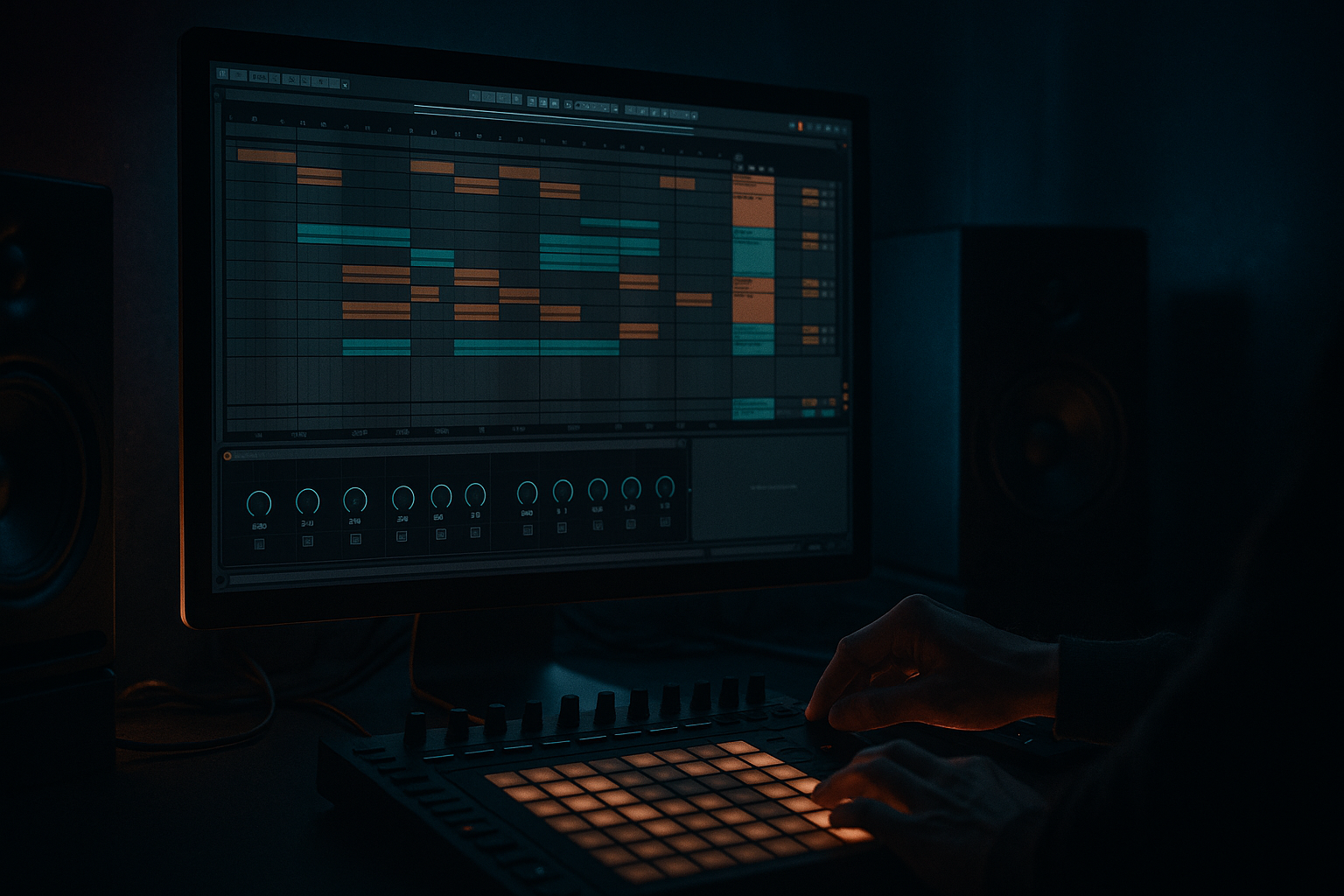
Main tutorial
Layer an Amen‑style Dub Siren for Smoky Warehouse Vibes (Ableton Live 12) 🔥🚨
Advanced Workflow | Drum & Bass / Jungle
---
1. Lesson overview
You’re going to build a proper DnB dub siren layer that sits around an Amen—not fighting it—while adding that smoky warehouse haze: wide, modulated, gritty, and tempo‑locked with tasteful movement.
We’ll do it the way you’d actually use it in a rolling or jungle tune:
- one mid-focused “call” layer that reads on small systems
- one wide “air” layer for vibe and space
- one dirty resampled layer to glue it into the break and bass
- Layer A (Core Siren): pitched, band-limited, punchy, mono-safe
- Layer B (Warehouse Air): wide chorus + long plate/room, filtered top
- Layer C (Resampled Grit): saturation + pitch wobble + “tape” movement
- a Macro workflow (Filter, Wobble Rate, Dirt, Space, Width, Duck)
- Sidechain ducking to the kick/snare so it breathes with the Amen 🥁
- arrangement cues: fills, 16-bar hype markers, call/response with breaks
- Algorithm: simplest (A only)
- Osc A waveform: Sine (or Triangle for more harmonics)
- Pitch:
- Add movement:
- Filter type: Band-Pass
- Freq: 900 Hz – 2.2 kHz (map to Macro later)
- Resonance: 25–45%
- Drive: 2–6 dB
- Envelope: very small or off (keep it stable)
- Mode: Soft Sine or Analog Clip
- Drive: 3–8 dB
- Output: compensate so chain peaks around -12 to -9 dB pre-bus
- HPF: 150–250 Hz (24 dB/oct)
- Gentle dip: 2.5–4.5 kHz if it bites against snare crack
- Optional boost: 1–2 dB @ ~1.2 kHz if it needs “telephone” speak
- Osc 1: Basic Shapes → set toward Saw-ish (more harmonics for reverb)
- Unison: 2–4 voices, Amount low
- Filter: low-pass around 6–10 kHz (avoid fizzy top)
- Mode: try Ensemble
- Rate: 0.15–0.35 Hz (slow)
- Amount/Depth: 25–45%
- Mix: 25–40%
- Algorithm: Plate or Room
- Decay: 2.5–5.5 s
- Predelay: 15–35 ms (keeps transients from smearing)
- EQ inside reverb:
- Mix: 15–30% (keep it as a layer, not a wash)
- Low-pass 4–7 kHz, gentle resonance
- Width: 130–170%
- Bass Mono: On, set around 200 Hz (or just HPF earlier)
- Warp: On
- Mode: Complex or Complex Pro if pitchy; otherwise keep it light
- Add subtle pitch drift with clip envelopes or modulation:
- Downsample: 1.2 – 2.0
- Bit reduction: minimal (0–2)
- Dry/Wet: 5–15%
- Style: Tube / Bass / Noise (pick one that growls)
- Drive: 10–30% (don’t nuke it)
- Tone: slightly dark
- Modulation:
- Band-pass around 700 Hz – 1.8 kHz
- Add a touch of drive/resonance
- Add Compressor
- Sidechain input: your Kick (or Drum Bus)
- Ratio: 4:1 – 8:1
- Attack: 1–5 ms
- Release: 60–140 ms (tune to groove)
- Threshold: set for 3–7 dB gain reduction on hits
- Use Gate sidechained from snare or ghost trigger to create that stabbing siren rhythm.
- Intro (0–16 bars):
- Pre-drop (last 4 bars):
- Drop (first 16 bars):
- Every 16 bars:
- Breakdown:
- Running the siren constantly: it kills impact and masks break detail. Use it like punctuation.
- Too much low end: sirens often sound huge, but in DnB that space belongs to sub + kick. HPF aggressively.
- Over-wide core: keep the readable layer mostly mono; put width in the air layer.
- No ducking: without sidechain, the siren smears kick/snare transients and the Amen loses bite.
- Uncontrolled resonance: band-pass + resonance is a weapon—scan for painful frequencies (2–5 kHz) and tame them.
- Make the siren “fight” the bass less:
- Use Roar as a parallel “system layer”:
- Automate “distance”:
- Amen-friendly EQ carving:
- Resample and re-chop:
- You built a 3-layer dub siren rack designed specifically for Amen-era DnB.
- Layer A = mono-safe core message, band-limited, controlled.
- Layer B = wide warehouse haze with chorus + Hybrid Reverb.
- Layer C = resampled grime using Simpler + Roar for “been-through-the-system” character.
- You mapped Macros for fast automation and used sidechain ducking so it grooves with the break.
- You placed it in the arrangement like a pro: punctuation, not wallpaper.
All inside Ableton Live 12 using stock devices.
---
2. What you will build
A 3-layer dub siren rack that you can play like an instrument and automate like an FX throw:
You’ll also set up:
---
3. Step-by-step walkthrough
Step 0 — Session context (so it actually fits DnB)
1. Set tempo: 170–174 BPM.
2. Have an Amen or Amen-style break running (even a placeholder).
3. Group your drums so you can sidechain easily: `DRUM BUS (Group)` with Kick/Snare prominent.
Goal: Build the siren so it hits in gaps and rides the groove, not masking transients.
---
Step 1 — Create the Siren Instrument Rack (3 layers)
1. Create a new MIDI track: `DUB SIREN`.
2. Drop an Instrument Rack on it.
3. Create 3 chains inside the rack:
- `A - Core`
- `B - Air`
- `C - Grit`
---
Step 2 — Layer A: Core siren (readable + classic) 🚨
Devices (in order):
1. Operator (or Analog; Operator is cleaner and more controllable)
2. Auto Filter
3. Saturator
4. EQ Eight
5. Compressor (sidechain later)
#### Operator settings (classic siren base)
- Start with C3–E3 as your playable range
- Turn on Glide/Portamento: 60–120 ms (for that siren slide)
- LFO → Pitch (in Operator):
- Amount: 10–25 cents (subtle)
- Rate: 1/8 – 1/4 (sync)
- Shape: Sine
#### Auto Filter (band-limit it like a real siren)
#### Saturator (presence without harshness)
#### EQ Eight (slot it into the mix)
Why: This layer is the “message”—it should stay centered and reliable.
---
Step 3 — Layer B: Warehouse Air (width + haze) 🌫️
Devices (in order):
1. Wavetable (or Operator again)
2. Chorus-Ensemble
3. Hybrid Reverb
4. Auto Filter
5. Utility
#### Wavetable (airy harmonic content)
#### Chorus-Ensemble (instant warehouse width)
#### Hybrid Reverb (space that feels real)
- Low cut: 300–500 Hz
- High cut: 6–9 kHz
#### Auto Filter (keep it out of the break’s bite)
#### Utility (width control)
Why: This layer provides the smoke and scale—it should feel wide but not steal focus.
---
Step 4 — Layer C: Resampled grit (the “tape-ragged” layer) 🧱
This is where you make it feel like it’s been in the rave for 20 years.
Devices (in order):
1. Simpler (set to Classic or One-Shot depending on your approach)
2. Redux (sparingly)
3. Roar (Live 12)
4. Auto Filter
5. EQ Eight
#### Source: resample your own siren (recommended)
1. Create an audio track: `SIREN RESAMPLE`.
2. Set its input to resample the `DUB SIREN` track (or Master).
3. Record 8–16 bars of you playing/automating the siren.
4. Drag that audio into Simpler on Layer C.
#### Simpler settings (movement like old hardware)
- Clip Envelope → Transposition: tiny moves ±10–30 cents over a bar
#### Redux (optional, subtle)
#### Roar (glue + menace)
- Assign an LFO to Drive or Filter inside Roar for slow movement
#### Auto Filter (keep it in a “radio band”)
Why: This layer is about texture—it should sound like it’s coming through a system, not like a pristine synth lead.
---
Step 5 — Macro mapping (fast workflow = better arrangement) 🎛️
Map these to Rack Macros (suggestion):
1. Siren Tone → Layer A Auto Filter Freq (and Layer C BP Freq)
2. Wobble Rate → Operator LFO Rate (Layer A) + Roar LFO Rate (Layer C)
3. Dirt → Saturator Drive (A) + Roar Drive (C) + small Redux mix
4. Space → Hybrid Reverb Mix (B) + Decay (small range)
5. Width → Utility Width (B)
6. Duck → Compressor sidechain amount (all layers or bus)
Pro move: set Macro ranges so they’re “safe” (no unusable extremes). Advanced workflow is mostly range discipline.
---
Step 6 — Sidechain ducking so it breathes with the Amen 🥁
You have two solid options:
#### Option A: Compressor sidechain (classic)
On each chain or on the whole `DUB SIREN` track (cleaner workflow):
#### Option B: Ducking with Gate (for rhythmic “on/off”)
DnB context: Duck from kick for steadiness; duck from snare for that classic “answer the 2 & 4” feel.
---
Step 7 — Arrangement placement (Amen-friendly) 🧠
Here are practical placements that work in rolling/jungle:
Air layer only (B), high-passed, lots of space. Automate Siren Tone slowly upward.
Bring in Layer A + C briefly as a call, then cut it hard (silence creates hype).
Use short 1/4 to 1 bar phrases in gaps. Think: siren answers the Amen, not constant.
Do a “siren lift” automation:
- increase Wobble Rate slightly
- open Siren Tone
- add a touch of Dirt
Then reset to baseline to keep the drop from flattening.
Resampled Layer C + long tail (B) = instant warehouse atmosphere.
---
4. Common mistakes
---
5. Pro tips for darker/heavier DnB 🕶️
Sidechain the siren not only to kick/snare but also lightly to the bass bus (1–3 dB) so it never clouds the sub note.
Duplicate Layer C, distort harder, band-limit aggressively (like 500 Hz – 2 kHz), keep it low in the mix. It adds menace without obvious distortion.
In Hybrid Reverb, automate Predelay and Reverb Mix: closer (less mix, more predelay) in drop; farther (more mix) in breakdown.
If your Amen has a snare peak around ~200 Hz and ~3 kHz, carve small dips there in the siren so the break stays upfront.
Print your siren, then cut it like a break: place tiny stabs on offbeats or just before snares for tension.
---
6. Mini practice exercise (15 minutes) ⏱️
1. Build the 3-layer rack as above.
2. Program a 16-bar loop with an Amen and rolling bass.
3. Write a call/response siren pattern:
- Bars 1–4: nothing (let groove establish)
- Bars 5–8: 2 short stabs (1/8–1/4) per 2 bars
- Bars 9–12: one longer 1-bar siren rise (macro automate Tone up)
- Bars 13–16: cut everything except Air tail into the transition
4. Resample the whole 16 bars and listen back on low volume.
Pass condition: you still clearly hear kick/snare snap and the siren feels like atmosphere + hype, not a lead hog.
---
7. Recap
If you tell me whether your track leans more jungle (raw, bright breaks) or rolling/dark DnB (heavier sub, tighter drums), I can suggest exact macro ranges + a ready-to-save rack layout for your template.

