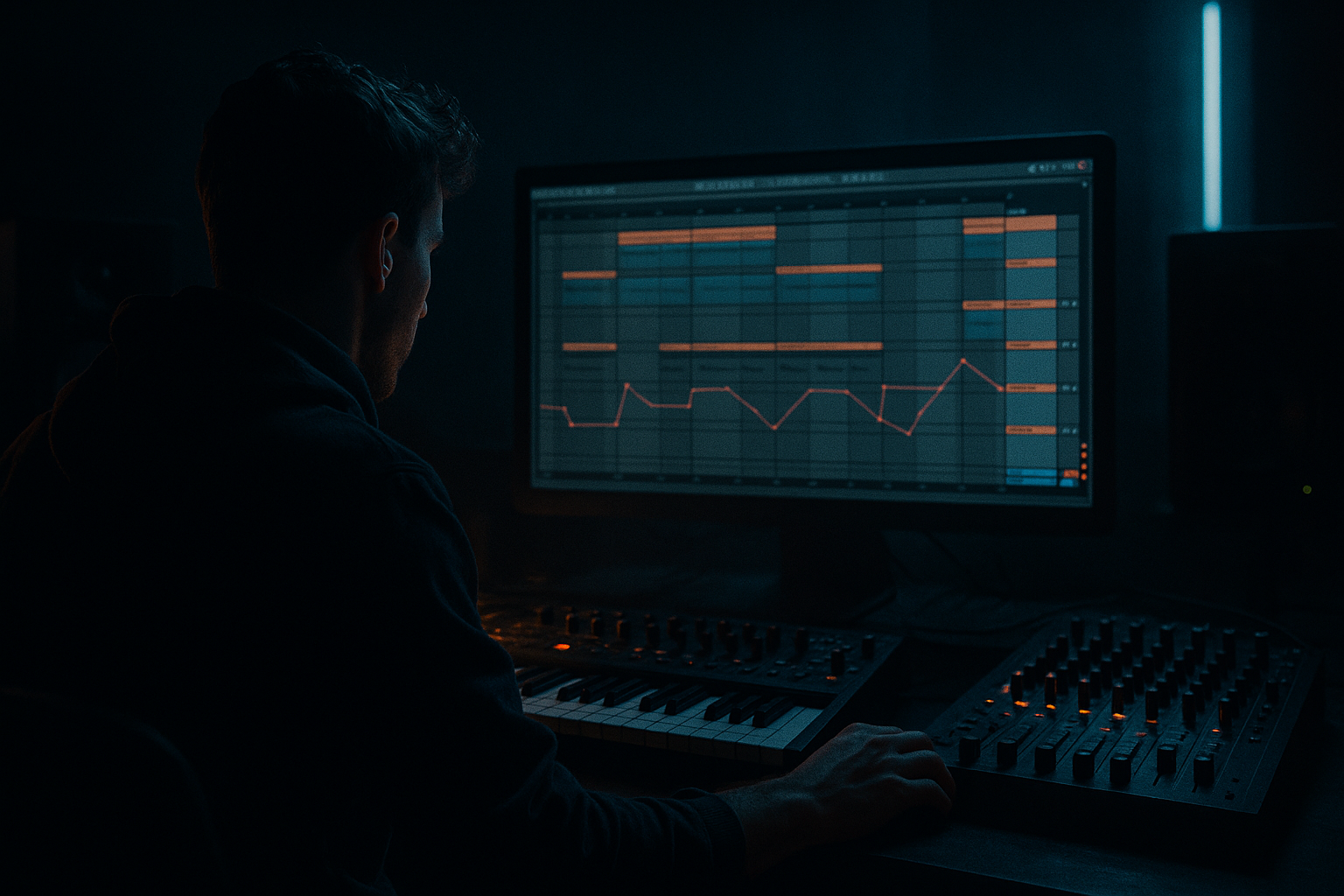
Main tutorial
Layer an Amen‑Style Reese Patch for Sunrise‑Set Emotion in Ableton Live 12 (Advanced / Mixing)
1. Lesson overview
In a sunrise DnB set, the bass needs to feel warm, wide, and emotional without losing clarity and punch against a busy break (Amen edits, ghost snares, rides). This lesson is about mixing a layered “Amen‑style reese” patch: a reese bass that moves like a breakbeat—breathing with the groove, speaking in short phrases, and letting the drums stay king. 🌅
You’ll build a 3‑layer bass bus (Sub / Mid Reese / Air-Noise “Amen rasp”) with tight phase control, intentional sidechain, and dynamic saturation so it feels alive but still rolls.
---
2. What you will build
A bass group that sits under a rolling Amen like classic jungle/DnB, but with modern polish:
- Layer 1 – Sub Anchor: pure, mono, stable (no chorus, no width)
- Layer 2 – Reese Mid: detuned movement + controlled stereo above ~150 Hz
- Layer 3 – “Amen Rasp” Top: a noisy, transient‑shaped layer that mimics the texture + bite of an Amen (not literally a drum loop, but the energy of one)
- sidechain that reacts to the break
- dynamic EQ to carve for snare/kick
- parallel grit for excitement
- mono management for club translation
- Add Spectrum on Master (Block = 4096, Avg = ~1s) to watch low-end consistency.
- Osc 1: Sine
- Unison: Off
- Glide: optional (short)
- Osc 1: Saw (or a richer wavetable like “Basic Shapes” leaning to saw)
- Osc 2: Saw
- Detune: 8–18 cents between osc 1 and 2
- Unison: 2–4 voices (not 8—too wide and messy)
- Stereo: moderate (depends on unison mode)
- Type: LP24
- Cutoff: 180–450 Hz (automate slightly through phrases)
- Drive: a touch (or use Saturator later)
- LFO to fine pitch (very subtle): 0.05–0.15 semitones, rate 0.10–0.25 Hz (slow drift)
- OR LFO to filter cutoff: small amount, synced at 1/2 or 1 bar for gentle breathing
- Chain A: `LOW_MONO`
- Chain B: `HIGH_WIDE`
- Osc A: Noise (or very bright waveform)
- Filter: band-pass-ish vibe using EQ Eight (below)
- Amp Envelope: short-ish release (so it doesn’t smear)
- Intro (16 bars): Sub + very filtered mid (low cutoff), no top rasp
- Drop (16 bars): Mid opens slightly; top rasp appears quietly on offbeats
- Second phrase (16 bars): automate filter cutoff up 5–15%, add a little more parallel grit
- Breakdown / sunrise lift (16 bars): remove top rasp, let pads + sub breathe, then reintroduce mid with a warm sweep
- Wavetable filter cutoff (mid)
- Roar drive (mid or parallel)
- Gate threshold (top) for tighter/looser “Amen sync”
- Wide sub: chorus/unison below ~120–150 Hz = weak club translation.
- Too many voices on the reese: sounds huge solo, messy in a full Amen mix.
- Top layer fights the snare: if your rasp sits in 2–4 kHz, you’ll lose snare snap.
- Over-saturating the bus: sunrise needs warmth, not a scorched midrange.
- Sidechain too fast: if release is tiny, the bass will chatter unnaturally against breaks.
- Swap mid reese LP24 → MS2/PRD style filter (more bite) and push Roar harder.
- Add Corpus lightly on the mid layer (short decay) tuned to the key for metallic edge.
- Use Multiband Dynamics on BASS BUS:
- Make the top layer more aggressive:
- Tighten sidechain:
- You built a layered reese system designed specifically to sit with Amen-style drums:
- You mixed it through a BASS BUS with gentle glue + drum-driven sidechain for rolling breath.
- You used parallel grit to add excitement without ruining the emotional, sunrise-friendly tone. 🌄
All three route to a BASS BUS with:
---
3. Step‑by‑step walkthrough
Step 0 — Project prep (so your mix decisions translate)
1. Tempo: 172–176 BPM.
2. Drums: Put your Amen (or chopped break) on a DRUM BUS group.
3. Reference: Drop a sunrise liquid/atmospheric roller reference on a muted track for level checks.
Metering tip (stock):
---
Step 1 — Create the routing (clean and controllable)
1. Create 3 MIDI tracks:
- `BASS_SUB`
- `BASS_REESE_MID`
- `BASS_AMEN_TOP`
2. Group them into `BASS_BUS` (Cmd/Ctrl+G).
3. Add a Return track called `BASS_PARALLEL_GRIT`.
Why this matters: You’ll be able to push character without wrecking transient headroom or losing the sub.
---
Step 2 — Program a sunrise‑style bass phrase (arrangement starts here)
Sunrise emotion usually = longer notes, fewer stabs, more glide and call/response.
1. On `BASS_SUB`, write a 2‑bar phrase:
- Bar 1: root note (e.g., F) held 1 bar
- Bar 2: walk to 5th or minor 7th with shorter notes (syncopation)
2. Add slides selectively:
- If using a synth with glide/portamento: 40–90 ms
- Or in Live: overlap notes and enable glide in the synth
Groove tip: Nudge a couple of mid-bass notes late by 5–12 ms to sit behind the Amen swing. 🥁
---
Step 3 — Build Layer 1: Sub Anchor (mono, stable, fearless)
On `BASS_SUB`:
Instrument: Wavetable (stock)
Processing chain (in order):
1. EQ Eight
- HP filter: 24 dB at 20–25 Hz (remove rumble)
- Optional tiny dip: -2 dB at 50–70 Hz only if kick lives there
2. Saturator
- Drive: 1–3 dB
- Soft Clip: On
- Purpose: add harmonics so sub is audible on smaller systems
3. Utility
- Width: 0% (hard mono)
- Gain: set so this channel peaks around -12 to -8 dBFS (pre-bus)
Key rule: The sub should not “wobble” in stereo—ever.
---
Step 4 — Build Layer 2: Reese Mid (the emotional movement)
On `BASS_REESE_MID`:
Instrument: Wavetable (or Analog if you like that older reese vibe)
Wavetable settings (good starting point):
Filter:
Movement:
Processing chain:
1. EQ Eight
- HP: 120–160 Hz (get out of the sub’s way)
- Gentle bell dip: -2 to -4 dB at 250–400 Hz if muddy
- Presence lift: +1–2 dB at 900 Hz–1.5 kHz if needed
2. Roar (stock, Live 12) 🔥
- Mode: start with Soft or Warm style (avoid full brutality for sunrise)
- Drive: 5–15% (or equivalent low drive)
- Tone: keep lows controlled; you want texture, not fuzz soup
3. Chorus-Ensemble (optional, for liquid width)
- Amount: 10–25%
- Rate: slow
- Important: Keep this after HP filtering so sub stays clean.
4. Utility
- Width: 80–120%
- Bass Mono: If available in your workflow, do it via Audio Effect Rack (next step)
Critical mixing move (mono split):
Create an Audio Effect Rack after your main EQ:
- EQ Eight low-pass at 150 Hz
- Utility Width 0%
- EQ Eight high-pass at 150 Hz
- Utility Width 120–150% (taste)
This keeps the reese wide without destroying your low end.
---
Step 5 — Build Layer 3: “Amen Rasp” Top (break‑like bite without stealing snare)
This is the trick that makes the bass feel woven into the Amen. The idea: add a noisy, gritty, transient-shaped layer that speaks in the same pocket as your breaks.
On `BASS_AMEN_TOP`:
Instrument option A (fast + controllable): Operator
Processing chain:
1. EQ Eight
- HP: 700–1,200 Hz
- LP: 6–10 kHz
- Narrow dip: around 2–3.5 kHz if it fights snare crack
2. Drum Buss (yes, on bass top!) 🧩
- Drive: 5–15%
- Crunch: 5–20%
- Transients: +5 to +20 (adds “tick”/definition like a break)
- Boom: Off
3. Auto Filter (for motion like chopped breaks)
- Band-pass or high-pass
- Envelope: tiny amount so notes “speak”
4. Gate
- Sidechain input: your Amen track
- Mode: Sidechain
- Threshold: set so it opens on break hits
- Return: short (tight chatter)
- This makes the noise “dance” with the Amen without constant hiss. 🎛️
Result: a top layer that feels like the bass is part of the drum loop, but it won’t swallow the mix.
---
Step 6 — Glue + sidechain on the BASS BUS (the mixing heart)
On `BASS_BUS`, put this chain:
1. EQ Eight (cleanup)
- Very gentle low shelf if needed (avoid big boosts)
- Notch any nasty resonances you hear when the reese moves (often 180–260 Hz or 700–900 Hz)
2. Glue Compressor (bus control)
- Attack: 10 ms
- Release: Auto
- Ratio: 2:1
- Aim: 1–2 dB gain reduction on peaks (not pumping)
3. Compressor (sidechain from DRUM BUS)
Sidechain it from your Amen/kick group for that rolling “breathing” feel:
- Attack: 2–10 ms (let some bass transient through)
- Release: 80–160 ms (tempo-dependent)
- Ratio: 2:1 to 4:1
- GR: 2–5 dB on loud drum hits
4. Limiter (safety, not loudness)
- Ceiling: -1 dB
- Only catching rare spikes (1–2 dB max)
Sidechain philosophy: For sunrise, you want gentle sway, not aggressive EDM pumping.
---
Step 7 — Parallel grit (keep the main bass pretty, add excitement on a send)
On `BASS_PARALLEL_GRIT` return:
1. Roar or Saturator
- Push harder here than on the main bus
2. EQ Eight
- HP: 200–300 Hz (do not distort sub)
- Small presence bump at 1–3 kHz if needed
3. Compressor
- Faster attack/release to keep it dense
4. Bring the send up until you miss it when muted (usually subtle).
This keeps sunrise emotion intact while adding modern density. ✨
---
Step 8 — Arrangement ideas (make it feel like a sunrise progression)
Use the layers to tell a story over 64 bars:
Automation targets that work well:
---
4. Common mistakes
---
5. Pro tips for darker/heavier DnB
When you want this patch to lean neuro/tech without losing the “Amen integration”:
- tame low-mid build-up (120–300 Hz) while letting 1–3 kHz bite through.
- Drum Buss Transients up, then clip it (Saturator Soft Clip + higher drive).
- faster attack, release around 60–110 ms for more “drive” in a roller.
---
6. Mini practice exercise (15–25 minutes)
1. Build the three layers exactly as above.
2. Pick one Amen loop and do two mixes:
- Mix A (sunrise): minimal top rasp, gentle sidechain (2–3 dB GR)
- Mix B (heavier): more top rasp + more parallel grit, stronger sidechain (4–6 dB GR)
3. Bounce 16 bars of each and check:
- Does the sub stay solid in mono?
- Can you still hear snare crack cleanly?
- Does the bass feel “woven” into the break rather than sitting on top?
---
7. Recap
Sub (mono) + Mid reese (controlled width) + Top rasp (gated to break hits).
If you want, tell me what key/tempo you’re working in and whether your Amen is more “clean classic” or “crunchy modern,” and I’ll give you a tuned set of cutoff points and sidechain timings for your exact groove.

