Main tutorial
Lesson Overview
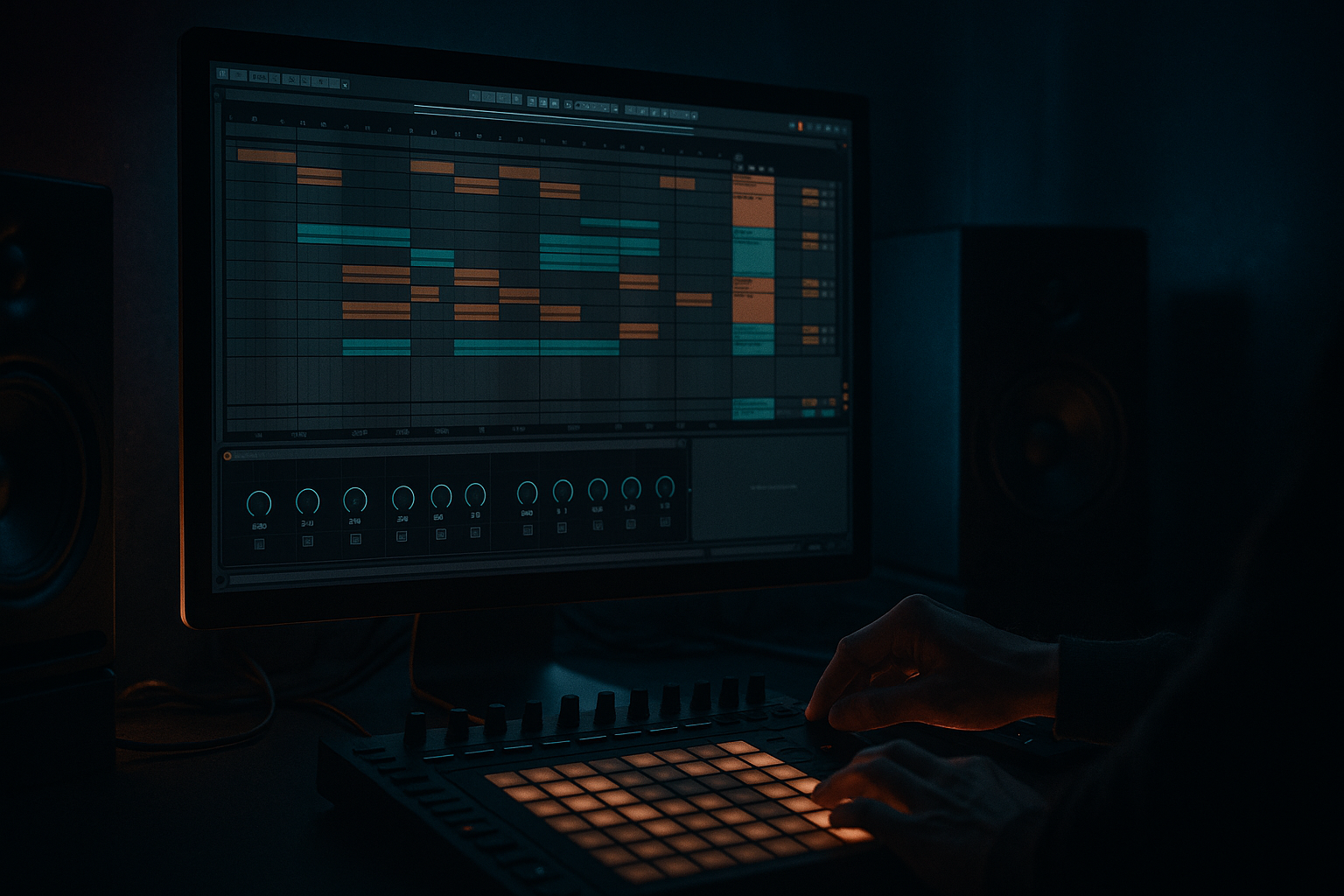
An oldskool DnB ride groove is one of the fastest ways to make a drum & bass loop feel alive, human, and instantly genre-correct. In this lesson, you’ll build a layered ride pattern in Ableton Live 12 and use Macro controls to shape the groove creatively without losing control of the mix.
This sits right in the “energy layer” of a DnB track: above the kick, snare, and break, but below the main lead or bass hook. Think of it as the top-end motion that helps a roller feel forward-driving, gives a jungle loop some vintage swing, or adds nervous tension to darker bass music without flooding the mix with noise.
Why this matters in DnB: rides and high percussion often carry the forward momentum between snare hits. In fast tempos like 170–174 BPM, tiny changes in ride tone, decay, stereo width, and filter movement can dramatically affect feel. By mapping those moves to Macros, you can quickly switch from restrained intro groove to full-drop shimmer to dark, stripped-back tension — all from one instrument rack. 🎛️
You’ll also learn a workflow that makes sense in Ableton Live:
- keep the sound organized inside an Instrument Rack
- layer two ride sources for tone and body
- shape them with stock devices only
- map useful Macros for performance and arrangement
- automate the rack like a proper DnB production tool
- bring the ride in gradually over 8 or 16 bars
- make it darker for a breakdown
- push it brighter and wider for the drop
- add movement without drawing loads of automation lanes
- Making the ride too loud
- Leaving too much low-mid buildup
- Using a ride that’s too bright and harsh
- Over-widening the top end
- Automating too many things at once
- Ignoring the breakbeat
- Darken the ride before the drop, then open it at impact
- Use light saturation instead of just EQ boosting
- Keep the low-mids clean for bass weight
- Use Macro-controlled blend between bright and dark layers
- Add subtle modulation to width or filter every 4 or 8 bars
- If the track is neuro-influenced, keep the ride more controlled
- For oldskool jungle flavor, let the ride breathe a little more
- Layering two ride sounds gives you more control over tone, body, and movement.
- An Instrument Rack with a few well-chosen Macros is a fast, beginner-friendly DnB workflow.
- Keep the ride clean with EQ Eight, controlled with Utility, and optionally colored with Saturator.
- Automate tone, width, drive, and space to shape the ride across the arrangement.
- In drum & bass, the best ride grooves support the break, the bass, and the section change — they don’t just fill space.
The goal is not just to make a ride sound good in isolation. The goal is to make a ride layer that works inside a real drum & bass arrangement: tight, editable, and flexible enough to carry you from intro to drop without rebuilding the part.
What You Will Build
By the end of this lesson, you’ll have a custom Ableton Live 12 ride groove rack that does three things:
1. Plays an oldskool-style ride pattern with swing and lift
2. Layers two ride textures:
- one brighter, more metallic layer for presence
- one darker, slightly washed layer for width and glue
3. Uses Macros to control:
- overall tone
- decay length
- stereo width
- drive/grit
- filter movement
- reverb send
Musically, the result will feel like a classic DnB top-loop element: a ride that can sit behind a break in a jungle-style intro, then open up in a roller drop, then narrow down again for a mixdown-friendly breakdown.
You’ll be able to:
Step-by-Step Walkthrough
1. Start with a clean DnB drum group and choose your ride source
Open a new Ableton Live 12 project at 170–174 BPM. If you’re already working inside a drum group, create a new MIDI track called something like Ride Layer.
For the first layer, drag in a stock cymbal or ride-style one-shot from your browser if you have one, or use any clean metallic percussion sample that already has a long tail. The important thing is not the exact sample name — it’s the character:
- bright enough to cut through drums
- not too noisy in the low end
- long enough to feel like a ride, not just a tick
For beginner workflow, keep it simple:
- one MIDI note triggering the ride
- a repeated pattern on 1/8ths or syncopated offbeats
- short loop length: 1 or 2 bars
If your sample is too harsh, don’t worry yet. We’ll shape it with stock devices. The point is to start with a usable source and then make it DnB-ready inside the rack.
2. Build the actual oldskool ride groove pattern
In your MIDI clip, program a basic ride pulse that supports the drum break rather than fighting it. A common oldskool feel is:
- 1/8-note pulse for forward motion
- occasional offbeat accents for bounce
- a few velocity variations so it doesn’t sound like a machine gun
Try this beginner-friendly starting point:
- place ride hits on every offbeat for 1 bar
- duplicate to 2 bars
- lower every second hit’s velocity by about 10–20%
- add one extra ghost hit near the end of bar 2, just before the snare, to create lift
In DnB, rides work best when they create momentum between the main drum accents. That’s why this works: the ride fills the “air gaps” in the groove and makes the track feel faster without needing more kick hits.
Use Ableton’s MIDI Note Velocity lane to keep accents musical:
- stronger hits around 90–110 velocity
- lighter hits around 50–75 velocity
- avoid every hit being identical
If you’re layering with a breakbeat, leave space for the snare transient. The ride should enhance the break’s energy, not mask its punch.
3. Create a second ride layer for weight and depth
Duplicate the track or place a second Simpler inside the same Instrument Rack on a second chain. This second layer should be darker, shorter, or slightly more blurred.
Good beginner choice:
- Layer 1: brighter ride sample
- Layer 2: darker metallic hit, a slightly shorter ride, or a filtered version of the same sample
In Ableton, using two chains inside an Instrument Rack is perfect here because you can control them together with Macros. For Layer 2, shape it with:
- Simpler
- Filter on
- Transpose down -3 to -7 semitones if the sample still sounds too shiny
- Start/End adjusted to tighten the attack if needed
Practical range:
- Layer 1: full brightness, slightly longer decay
- Layer 2: low-pass filtered around 7–10 kHz, a bit quieter, and more mono
This layering gives you both presence and body. In DnB, that matters because cymbal energy can disappear once bass, snare, and break all get busy. Layering helps the ride stay audible without needing to push volume too hard.
4. Group the layers into an Instrument Rack and organize it properly
Select both ride chains and press Cmd/Ctrl + G to create an Instrument Rack. Rename the chains clearly:
- Bright Ride
- Dark Ride
Good workflow matters a lot here. If you label things properly now, you’ll move faster later when building the drop or automating transitions.
Inside each chain, use stock devices in a simple order:
- Simpler
- EQ Eight
- Saturator
- Utility
Suggested starting settings:
- EQ Eight: high-pass around 200–350 Hz to remove rumble
- Saturator: Drive around 1–4 dB for edge
- Utility: use this for gain staging and width control
Keep the rack lean. Beginner mistake is loading too many devices before the groove even feels right. For DnB, the groove should already work at low volume before you start adding polish.
5. Map the most useful parameters to Macros
Now map your best control points to Macros. This is where the lesson becomes truly useful in real production.
Map these parameters:
- Macro 1: Ride Tone
- controls EQ Eight high shelf or low-pass cutoff
- Macro 2: Ride Width
- controls Utility Width on the brighter layer, or the overall rack if needed
- Macro 3: Ride Drive
- controls Saturator Drive
- Macro 4: Ride Decay
- controls Simpler Fade or Release if your sample supports it
- Macro 5: Ride Space
- controls Reverb Dry/Wet on a send or inside the rack
- Macro 6: Ride Dark Blend
- controls volume balance between bright and dark layers
If you’re using Simpler, a practical beginner-friendly move is to map the Filter Freq and Gain, because those are easy to hear:
- filter cutoff range: roughly 4 kHz to 14 kHz
- drive range: 0 to 5 dB
- width range: 70% to 120% depending on how wide you want the top end
Keep the Macros musical. Don’t map 12 things just because you can. In a DnB workflow, fewer useful controls are faster to finish with than a giant rack you never touch again.
6. Add movement with stock modulation and subtle FX
Now make the ride groove feel alive over time. The easiest beginner move is to use automation on your Macros rather than editing each MIDI note.
A strong combo is:
- Macro 1 (Ride Tone) slowly opens over 8 bars in the build
- Macro 3 (Ride Drive) increases slightly in the drop
- Macro 5 (Ride Space) is higher in intro/breakdown, lower in the drop
Add a stock Auto Filter on the rack if you want extra control:
- low-pass mode for breakdowns
- automate cutoff from about 4 kHz up to 12–14 kHz
- resonance around 0.5 to 1.5 for a little bite, but don’t exaggerate it
For space, use a Return track with Reverb or Echo:
- Reverb: short decay, small size, low mix
- Echo: very subtle, high-cut the repeats so the ride stays clean
DnB context example:
- In an 8-bar intro, keep the ride dark and narrow
- At bar 9, open the tone and widen it
- At bar 17, reduce space so the drop feels more direct and aggressive
This gives you arrangement contrast without writing a new part from scratch.
7. Tighten the groove with groove, swing, and transient discipline
Oldskool ride patterns often feel better with a little swing or human movement. In Ableton, you can use Groove Pool lightly if your break and ride need to lock together.
Beginner-safe approach:
- try a small swing groove, around 54–58% feel
- apply it subtly, not aggressively
- make sure the ride still lands cleanly against the snare
If your ride feels too splashy, shorten it:
- reduce Release in Simpler
- use an EQ Eight high-pass
- lower the reverb send
- reduce width below 2 kHz if the layer is getting messy
If the ride is too stiff, do the opposite:
- slightly lengthen decay
- add a touch more Saturator
- automate tone open on every 4 bars
- nudge a few MIDI notes earlier or later by a few milliseconds for feel
Why this works in DnB: at high tempo, micro-shifts in timing and tone are more noticeable than huge arrangement changes. A ride that breathes slightly can make the whole track feel more human and less programmed.
8. Arrange the ride so it supports the track, not just the loop
Think like a DnB arranger, not just a loop maker. Your ride should change with the section.
Example arrangement:
- Bars 1–8: dark, filtered intro with reduced width
- Bars 9–16: ride opens a little, more drive, no extra reverb
- Bars 17–32: full drop, brighter ride, tighter decay, more movement
- Bars 33–40: breakdown, tone closes again, space returns
- Bars 41–48: final drop, widest and most energetic version
Use clip automation if you want a fast workflow, or automate the Macros directly in Arrangement View for easier overview. For a beginner, the simplest workflow is:
- one main MIDI clip
- a few Macro automations
- duplicate the clip across sections
- change only 2–3 Macros per section
This keeps the track coherent and avoids the “every bar is a new sound” problem. In DnB, you want variation, but the listener should still feel a single strong groove identity.
Common Mistakes
Fix: pull the ride down until it supports the snare and break. If you hear it more than the snare, it’s probably too high.
Fix: high-pass around 200–350 Hz with EQ Eight. Ride layers can pile up unnecessary haze fast.
Fix: low-pass or shelf down the top end, then add a little Saturator instead of raw brightness.
Fix: keep the layer mostly mono below the midrange and use Utility Width carefully. Wide rides can smear the stereo image and weaken the drop.
Fix: stick to 2–3 meaningful Macro moves per section. In DnB, clarity beats complexity.
Fix: listen to the ride with the drums, not alone. If it masks the break’s hats or ghost notes, simplify the pattern or shorten the decay.
Pro Tips for Darker / Heavier DnB
This creates a stronger contrast and makes the drop feel bigger without adding more elements.
A small amount of Ableton Saturator drive can add density and make a ride cut through a heavy reese bassline without sounding painfully sharp.
In darker DnB, the sub and reese need room. Cut unnecessary body from the ride so it doesn’t cloud the bass.
This is a great one-knob solution for arrangement. Lower blend for tension, raise it for release.
Small motion creates life. Big swings can wreck mix clarity.
Neuro and darker rollers usually need precision. A ride that’s too washy can blur the impact of bass rewinds, fills, and switch-ups.
A touch more decay and some swing can make the groove feel classic and organic.
Mini Practice Exercise
Set a 15-minute timer and build one ride rack from scratch.
1. Choose one bright ride sample and one darker metallic sample.
2. Create an Instrument Rack with two chains.
3. Build a 2-bar MIDI groove using offbeats and velocity variation.
4. Add EQ Eight and high-pass both layers around 250 Hz.
5. Add Saturator with 2–3 dB Drive on the bright layer.
6. Map 4 Macros:
- Tone
- Width
- Drive
- Dark Blend
7. Automate the Macros across 8 bars:
- bars 1–4: darker and narrower
- bars 5–8: brighter and wider
8. Listen in context with a kick, snare, and a bass placeholder.
Goal: by the end, your ride should feel like a real section of a DnB arrangement, not just a loop.

