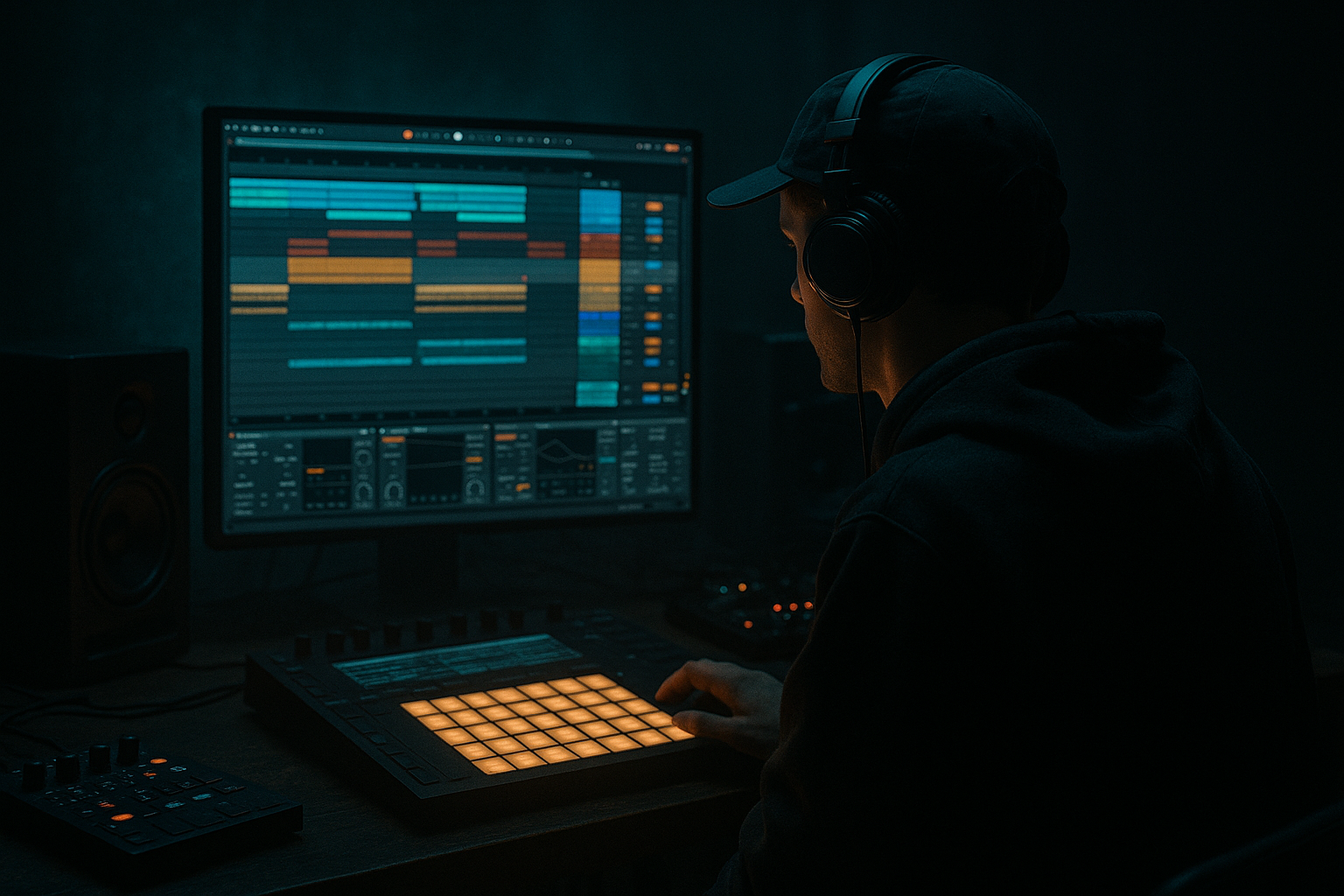
Main tutorial
1. Lesson overview
------------------
Energetic greetings! This lesson gets you hands-on with filters and envelopes in Ableton Live, specifically tuned for drum & bass (DnB) — think rolling basslines, dark reeses, and punchy subs at 174 BPM. You’ll learn how to shape sound with filter types and ADSR envelopes, how to combine stock devices into practical chains, and how to use automation and sidechaining to make your bass and breaks sit in a heavy mix. Expect concrete device settings, workflow steps, and arrangement ideas you can use right away. 🎧🔥
2. What you will build
----------------------
A compact DnB bass patch and arrangement idea:
- A two-layer bass: a clean sub (mono sine) + a growly reese (detuned saws) processed with a filter envelope and Auto Filter movement.
- A simple 8-bar rolling drum loop (break + kick/snare layering) with sidechain compression to let the bass breathe.
- A short arrangement slice: intro with filtered bass, a build using a lowpass sweep, then an open-drop with distorted reese and tight sub.
- Set BPM to 174 (typical DnB tempo).
- Create three audio/MIDI tracks: Drum Rack (MIDI), Bass (MIDI), Returns for Distortion/Reverb.
- Track A: "Sub"
- Track B: "Reese"
- Place both Bass tracks in a group called "Bass Group".
- In the sub track, lower the volume until combined level sits well with the Reese. Use Utility to keep sub mono.
- Send upper harmonics of Reese to a Return called "Distort" (Saturator or Overdrive on return) for heavy mid distortion while keeping Sub clean. Send amount ~10–20%.
- Add Compressor on the Bass Group (or on the Reese track):
- This lets the kick punch through and creates the rhythmic "breathing" of DnB.
- Bars 1–8: Intro with filtered Reese (cutoff low), kick + hats only.
- Bars 9–16: Bring in the sub, lightly open filter cutoff.
- Bars 17–20 (build): Automate Auto Filter cutoff to open, raise resonance slightly, send more to Distort return.
- Bar 21: Drop — fully open Reese + saturated mids + tight sub + break full-volume.
- Add variation every 8 bars: small filter pokes, short filter LFO at 1/16 on a send, or a stuttering automation.
- Making the whole bass wide: keep sub mono. Use Utility Width = 0% on the sub layer. Widen only the mid/high harmonic layer.
- Over-resonating at low cutoff: big resonance boosts at low cutoff lead to boomy ringing and phase problems. If you want that “whistle,” automate resonance only when cutoff is higher.
- Losing sub when filtering: lowpass sweeps can remove essential sub energy. When automating cutoff, maintain a separate sub layer (mono sine) and don’t send it through the same extreme filtering.
- Too slow envelopes for DnB plucks: long decay/release make basses muddy. For punch and roll, keep filter & amp decay in the 100–400 ms range for plucky sounds.
- Not checking phase/polarity: detuned layers and reese chords can phase-cancel the sub. When in doubt, solo and use Utility phase inversion to check or slightly offset pitch/detune.
- Using distortion before cleaning EQ: saturating full-range content can push inaudible sub harmonics; high-pass the distorted signal to keep the sub clean.
- Split your bass by frequency:
- Parallel distortion: send Reese to a return with Saturator/Overdrive + EQ Eight (HP at 100 Hz) and blend to taste. Keeps sub clean but mids nasty. 🔥
- Mid/Side processing:
- Dynamic filter envelope modulation:
- Layer pitched noise/grain:
- Use transient shaping:
- Band-specific compression & saturation:
- Filters shape tone by removing or emphasizing frequency bands; envelopes (ADSR) control how filters or amplitude evolve over time — essential for DnB pluck, growl, and movement. ✅
- Use a two-layer bass approach: mono sub (sine, clean) + mid/harmonic reese (detuned saws, filtered & distorted). Keep the sub mono and clean; saturate the mids. 🎯
- Practical device chain examples: Wavetable/Operator → Saturator → EQ Eight → Compressor (sidechain) → Utility. Use Auto Filter for macro sweeps and Wavetable/Sampler envelopes for precise filter shaping. 🛠️
- Watch out for phase, excessive resonance at low cutoff, and losing sub frequencies when sweeping filters. Keep experiment logs and save presets per patch. 📝
Stock Ableton devices used: Wavetable (or Operator), Simpler (or Sampler), Auto Filter, EQ Eight, Saturator, Compressor (with sidechain), Utility, Drum Rack, Glue Compressor (optional), and Ableton’s Sends/Returns.
3. Step-by-step walkthrough
---------------------------
Set the scene
A. Build the sub + reese bass (two-layer approach)
1. Insert Operator (or Wavetable) on a MIDI track. Name it "Sub".
2. Oscillator: Sine wave (Operator: Osc A sine). Octave -1.
3. Amp Envelope (Operator) — quick but full:
- Attack: 0 ms
- Decay: 300 ms
- Sustain: -4 dB (or 0.2 normalized)
- Release: 80 ms
4. Add Utility after Operator:
- Width: 0% (mono sub)
- Gain: -1 to 0 dB
5. Insert EQ Eight after Utility:
- Low cut: no (keep sub)
- High shelf: roll off above 1.2–2 kHz (set a low-pass slope by reducing high band)
6. Optional: Light Saturator (Drive: 1–3, Soft Clip) but keep it subtle to preserve pure low end.
1. Insert Wavetable (or Analog) on a MIDI track. Name it "Reese".
2. Oscillators: Two saws (Osc 1 & Osc 2), set to different wavetable positions or both saw waves.
3. Detune/unison:
- Unison: 2 voices per oscillator, Detune: 0.06–0.12
- Stereo spread moderate.
4. Filter: Low-pass 24 dB (LP24). Start cutoff around 600–900 Hz.
5. Filter envelope (this is crucial):
- Filter envelope Amount: +45 (positive if opening filter)
- Attack: 8–12 ms (fast but not clicky)
- Decay: 180–350 ms (for a plucked growl; adjust to taste)
- Sustain: 0.15–0.25
- Release: 40–100 ms
- Filter Resonance (Q): 0.15–0.35 (watch for harshness)
6. Global amplitude envelope:
- Attack: 0–6 ms
- Decay: 180–300 ms
- Sustain: -6 to -12 dB (or 0.2 normalized)
- Release: 60–150 ms
7. Add device chain: Wavetable → Saturator (Drive 3–5, Soft Sine) → EQ Eight (cut below 40–60 Hz to avoid clash with sub) → Utility (Width 80–100% or auto widen) → Glue Compressor (fast settings if you want to glue).
8. Make sure Reese doesn’t contain strong sub below ~40–60 Hz (EQ to remove sub).
B. Combine and route
C. Drum Rack: quick rolling break
1. Create Drum Rack, load a classic DnB amen or chopped break into 2–3 pads (or use samples from Ableton library).
2. Layer a solid kick sample under the break transient:
- Kick transient pitched and EQ’d to sit with sub: low shelf at 50–60 Hz.
3. Process:
- Drum Rack → EQ Eight (cut muddy 200–400 Hz if needed) → Glue Compressor (fast attack ~1–3 ms, release auto) to glue the break.
D. Sidechain and pumping
- Sidechain input: Drum Rack (Kick) or a dedicated kick track
- Threshold: -20 to -30 dB (adjust)
- Ratio: 3:1–6:1
- Attack: 0.5–2 ms
- Release: 60–150 ms (sync to tempo; faster for tight DnB pumping)
E. Movement with Auto Filter and automation
1. Put Auto Filter on Reese (after Saturator) or on the Bass Group (for global moves).
- Mode: Lowpass
- Filter Slope: 24 dB
- Cutoff start: 400–800 Hz
- Resonance: 0.12–0.35
- LFO: Off for now (we’ll use automation/envelope)
2. For builds:
- Automate Cutoff up over 1–4 bars to create a sweep into the drop.
- Add a high resonance bump at the peak and then snap to the open sound at the drop.
3. For ominous textures:
- Use Auto Filter in Band Pass mode at approx 300–900 Hz and automate center frequency with a slow 1/2–2 bar movement.
F. Quick arrangement idea (8–32 bars)
4. Common mistakes
-------------------
5. Pro tips for darker/heavier DnB
----------------------------------
- Track 1 (Sub): Sine, mono, full-range low end.
- Track 2 (Reese): Wavetable/Analog, detuned saws for mid harmonics. Process heavy.
- Use two separate chains for independent processing and send the Reese to heavy distortion returns.
- Use EQ Eight in M/S mode on the Reese to boost side info only in 500–2kHz for width, keeping the sub centered.
- Automate filter envelope Amount parameter over the timeline — increase env amount in drops for more bite.
- Add a short burst of filtered noise (Simpler with a loop) gated by a short amp envelope and a bandpass filter to add projectile attack to bass transients.
- Give bass a sharper transient with a transient shaper (or Compressor with fast attack/low release) before sidechaining.
- Multiband approach: compress/saturate the mids/harmonics separately from the sub. Ableton’s EQ Eight and parallel routing is enough on a budget.
6. Mini practice exercise
-------------------------
Goal: Build a rolling 8-bar DnB loop (174 BPM) using filters + envelopes.
Steps (estimated time: 30–45 minutes)
1. Create two MIDI tracks and name them "Sub" and "Reese". Set project BPM to 174.
2. Sub:
- Load Operator. Choose Sine (Osc A), Octave -1.
- Amp Envelope: Attack 0 ms, Decay 300 ms, Sustain 0.2, Release 80 ms.
- Utility: Width 0%.
- EQ Eight: High shelf roll-off above 1.2 kHz.
3. Reese:
- Load Wavetable. Osc 1 & 2: Saw. Unison 2, Detune 0.08.
- Filter: Low-pass 24 dB. Cutoff 700 Hz. Resonance 0.2.
- Filter Env: Amount +50, Attack 10 ms, Decay 220 ms, Sustain 0.18, Release 60 ms.
- Amp Env: Attack 3 ms, Decay 250 ms, Sustain 0.18, Release 80 ms.
- Add Saturator: Drive 4, Soft Clip.
- EQ Eight: HP 40 Hz, cut below so sub remains clean.
4. Drum Rack:
- Load a chopped break on pad(s). Layer a punchy kick sample underneath.
- Add Glue Compressor on Drum Rack (fast attack ~1ms, release 200 ms) for glue.
5. Mix and sidechain:
- Compressor on Bass Group. Sidechain input = Drum Rack kick. Threshold adjust so bass ducks slightly when kick hits (fast attack, release 90–120 ms).
6. Automation & arrangement:
- Put Auto Filter on Reese (LP24) and automate cutoff from 400 → 1500 Hz over bars 5–8 for a small build.
- On bar 9, open filter fully and increase Reese send to Distort return for an aggressive drop.
7. Export:
- Loop the 8 bars, render a quick bounce and listen on monitors/headphones. Tweak decay/cutoff/resonance to taste.
7. Recap
--------
Now get into Ableton and try the mini exercise. If you want, send me a screenshot of your device chains or a short clip and I’ll critique the filter/envelope settings and suggest tweaks for a darker, heavier drop. Let’s make that sub rattle the room. 💥🎚️

