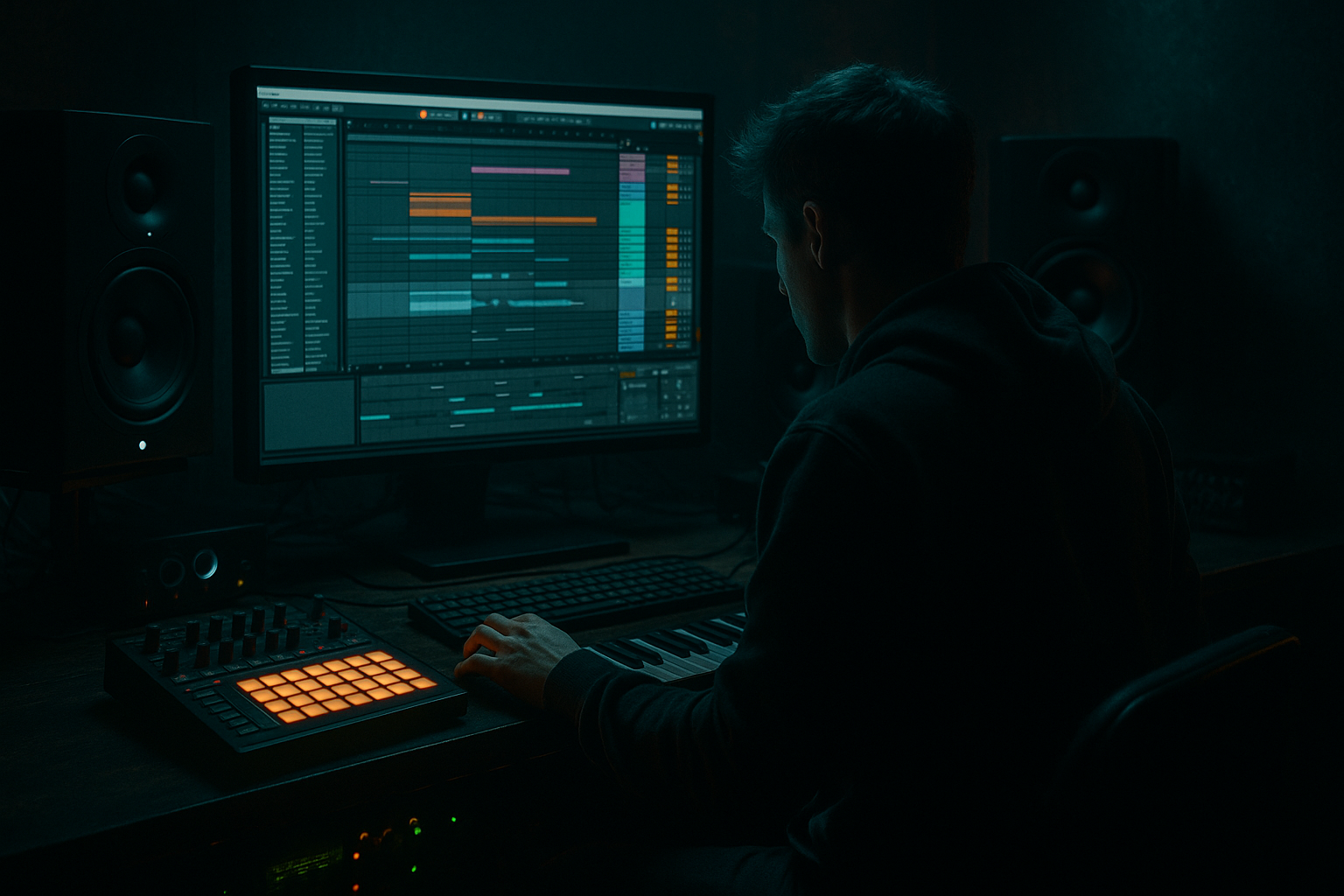
Main tutorial
Lo‑fi Intro Degradation From Scratch (with Clean Routing) — Ableton Live (DnB) 🎛️
1) Lesson overview
In modern drum & bass, the intro often feels like it’s coming from a busted tape deck or a pirate radio broadcast—then the drop hits clean and wide. In this lesson you’ll build a controllable lo‑fi degradation system in Ableton Live that:
- Degrades your intro on purpose (noise, wobble, filtering, mono, distortion, bitrate, reverb smear)
- Keeps routing clean and mix-safe (parallel vs series choices, gain staging, easy bypass)
- Switches to full‑fidelity at the drop without clicks, level jumps, or phase weirdness
- Group: `MUSIC BUS` (your musical elements: pads, atmos, breaks, bass excluding kick/sub if you want them clean)
- Return tracks:
- Intro (8–32 bars): mostly Lo‑Fi path
- Pre-drop: ramp clarity + width back in
- Drop: Dry path dominant, Lo‑Fi tucked or off
- Utility
- Auto Filter
- Over 16 bars, sweep Freq from ~4 kHz → 12–16 kHz leading into the drop.
- Saturator
- Redux
- Chorus-Ensemble
- Frequency Shifter
- Erosion
- Glue Compressor
- Drop a vinyl noise sample (classic jungle move)
- Or use Ableton stock:
- EQ Eight
- Auto Filter
- Saturator
- Compressor
- Hybrid Reverb
- Saturator after the reverb
- Utility
- Group the whole chain into an Audio Effect Rack
- Map key parameters:
- Filter Freq: 3 kHz → 18 kHz
- Downsample: 6 → 1.5
- Width: 20% → 100%
- Drive: 5 dB → 1 dB (yes, reduce toward drop)
- Bars 1–8: heavy lo‑fi
- Bars 9–24: reveal detail
- Bars 25–32 (pre-drop tension):
- Drop bar:
- Route Sub Bass directly to MASTER (or a `LOW BUS`)
- Keep `MUSIC BUS` for everything else
- On `MUSIC LOFI`, add EQ Eight at the very start:
- Overdoing Redux/Erosion: you lose snare identity and it stops feeling like DnB energy—just broken audio.
- No gain staging: saturation + compression will jump in level; always match loudness when A/B’ing.
- Lo‑fi on sub: makes the drop feel smaller. Keep low end clean or filtered out of the lo‑fi path.
- Messy routing loops: if `MUSIC LOFI` feeds itself (or sends back into the same bus), you’ll get feedback or doubling. Keep sends intentional.
- Stereo chaos: chorus + reverb + widening can smear transients. Use Utility width control and keep intro narrower if you want the drop to feel huge.
- Use band-pass “pirate radio” moments: Auto Filter Band-Pass around 500 Hz–4 kHz for 1–2 bars before the drop, then slam full range.
- Transient contrast is everything: keep intro drums softened (LP + saturation), then restore crisp tops at the drop for instant impact.
- Dirty verb but controlled lows: always cut reverb lows >250 Hz so your pre-drop doesn’t turn into mud.
- Mono intro trick: set `MUSIC LOFI` width to 0% early, then automate Dry to wide at the drop. Instant “club opens up” effect.
- Sidechain the noise to a ghost kick pattern: even in beatless intros, a subtle pumping noise bed creates anticipation in a rolling way.
- Micro pitch instability: subtle Chorus or Frequency Shifter movement sells “tape”. Keep it under 15% wet.
- You built a parallel lo‑fi degradation system with clean routing: Dry path stays trustworthy, Lo‑Fi path provides character.
- A solid stock chain (Utility → Filter → Saturation → Redux → movement → Glue) gives you tape/radio/crunch without ruining mix control.
- The magic is in automation and contrast: narrow/dirty intro → wide/clean drop.
- For DnB, protect the kick/sub and keep degradation mostly in the mids/highs.
This is aimed at advanced users: we’ll design the chain like a mini post‑production rig, not a random pile of plugins.
---
2) What you will build
A reusable routing template:
- Dry path (unprocessed)
- Lo‑Fi path (degraded, filter-smeared, noisy)
- Return A: `LOFI VERB` (short/dirty space for intro haze)
- Return B: `NOISE BED` (optional: constant vinyl/air/radio noise with sidechain ducking)
And a simple arrangement macro:
---
3) Step-by-step walkthrough
Step 0 — Prep your DnB intro material (quick but important)
1. In Arrangement, make a typical rolling DnB setup:
- Break loop / drums (tops, rides, ghost snares)
- Atmos/pad
- A vocal stab or jungle sample hit
- Bass elements (consider keeping sub clean—we’ll discuss)
2. Gain stage now:
- Aim for ~‑12 to ‑6 dB peak per channel before buses.
- You want headroom for saturation and resampling.
---
Step 1 — Build clean routing: Dry vs Lo‑Fi in a Group
1. Select all your intro musical tracks (pads/atmos/samples/breaks).
Right‑click → Group Tracks → name it `MUSIC BUS`.
2. Inside `MUSIC BUS`, create two audio tracks:
- `MUSIC DRY`
- `MUSIC LOFI`
3. Route all source tracks to both paths cleanly:
- On each source track (pad, break, sample):
- Set Audio To: `MUSIC BUS` → `MUSIC DRY`
- Then create a Send to feed `MUSIC LOFI` cleanly:
- Easiest method: set the source track’s Audio To to `MUSIC DRY` only, and use a Send to `MUSIC LOFI` (we’ll set it up as a “return-like” track inside the group).
4. Configure `MUSIC LOFI` to behave like a return:
- Set `MUSIC LOFI` Monitor: In
- Create a Send from source tracks to `MUSIC LOFI` (use Send A if you like, but inside-group you can also just duplicate routing with an External Audio Effect style—however Sends are cleanest).
- Alternative (simple): Duplicate the source tracks and route duplicates into `MUSIC LOFI`—but that’s heavier and easier to mess up.
Why this matters: You’ll be able to automate one fader (Lo‑Fi level) and not destroy your core mix.
---
Step 2 — The Lo‑Fi device chain (stock-only, powerful)
On `MUSIC LOFI`, build this chain in order:
#### 2.1 Utility (gain + width control)
- Gain: start at ‑6 dB
- Width: 0–60% (intro = narrower/older)
- Bass Mono: On, Freq 120 Hz (keeps low end stable)
> Tip: If your lo‑fi chain adds harshness, reduce level first—distortion reacts to input.
#### 2.2 Auto Filter (radio/tape bandwidth)
- Type: LP24 (low-pass 24 dB)
- Freq: 3–8 kHz for intro “covered” feel
- Res: 0.70–1.20 (a little whistle is fine for jungle vibe)
- Drive: 1–3 dB (adds edge)
Automation idea:
#### 2.3 Saturator (tape-ish grit)
- Type: Soft Sine or Analog Clip
- Drive: 2–6 dB
- Soft Clip: On
- Output: trim so the level matches bypassed signal (A/B honestly)
#### 2.4 Redux (bitrate/sample rate crunch)
- Downsample: 2.0–6.0
- Bits: 6–12 (lower = more obvious)
- Filter: On (helps tame nasty fizz)
DnB taste move: automate Redux intensity so it “falls apart” in the first 4–8 bars, then gradually cleans up.
#### 2.5 Chorus-Ensemble OR Frequency Shifter (wow/flutter vibe)
Pick one depending on flavor:
Option A: Chorus-Ensemble (warble)
- Amount: 10–25%
- Rate: 0.15–0.40 Hz
- Delay 1/2: keep modest (too much = seasick)
Option B: Frequency Shifter (AM radio weirdness)
- Mode: Ring Mod (for metallic/radio)
- Frequency: 10–40 Hz (low = subtle movement)
- Dry/Wet: 5–15%
#### 2.6 Erosion (digital sand / speaker fuzz)
- Mode: Noise
- Frequency: 2 kHz–8 kHz
- Width: 0.60–0.90
- Amount: 0.20–1.00
Keep this subtle—erosion is a spice, not the meal.
#### 2.7 Glue Compressor (stitch the damage together)
- Attack: 3 ms
- Release: 0.3 s or Auto
- Ratio: 2:1
- Threshold: aim for 1–3 dB GR
- Soft Clip: On
This makes your degraded path feel like “one tape print” rather than separate FX.
---
Step 3 — Add controlled noise (without wrecking your mix) 🌫️
Create Return B: `NOISE BED` (or an Audio track set to Monitor In).
#### 3.1 Make a noise source
Options:
- Operator → Oscillator set to Noise (if available in your version), or
- Analog noise, or
- Any short “air” recording looped
#### 3.2 Shape it like a broadcast layer
On `NOISE BED`:
- HP at 200–400 Hz (keep low end clean)
- Gentle dip around 2–4 kHz if it fights snares
- Band-pass 300 Hz–6 kHz (radio band feel)
- Drive 2–5 dB (makes it present at low volume)
#### 3.3 Sidechain duck it to the groove (pro clean)
- Sidechain from Drum Bus / Breaks (or a ghost kick)
- Ratio 3:1
- Attack 5–15 ms
- Release 80–200 ms
- Threshold until noise “breathes” with the break
Now your noise feels glued to the rhythm, not sitting on top.
---
Step 4 — “Dirty reverb haze” return (intro depth without mud)
Create Return A: `LOFI VERB`
Add:
- Algorithm: Hall or Plate
- Decay: 1.2–2.8 s
- Pre-delay: 10–25 ms
- Lo Cut: 250–500 Hz
- Hi Cut: 4–8 kHz
- Drive 1–4 dB (dirty reflections = jungle tape space)
- Width 80–120% (keep it wide while the main is narrow)
Send only selected intro elements (pads, vocal stabs, rides), not your whole drum mix.
---
Step 5 — Macro control: automate clarity into the drop 🚦
Make your life easy with 3–5 “performance controls”.
If you’re on Live 11/12, you can use Instrument/Effect Rack Macros.
#### 5.1 Create an Audio Effect Rack on `MUSIC LOFI`
1. LP Filter Freq (Auto Filter)
2. Redux Downsample
3. Saturator Drive
4. Utility Width
5. Rack Output Gain (for final leveling)
Suggested macro ranges:
#### 5.2 Arrangement automation (classic DnB structure)
Example 32-bar intro into drop:
- Lo‑Fi fader high, Dry low
- Filter ~4–6 kHz, narrow width
- Slowly open filter
- Reduce Redux + Erosion
- Add a touch more stereo width
- Bring Dry up
- Pull Lo‑Fi down
- Add a short tape-stop-ish moment (optional: automate filter + reverb send spike)
- Lo‑Fi path muted or ~‑20 dB
- Dry full
- Noise bed cuts or ducks hard
Zero-click tip: automate fades over 30–100 ms instead of hard mutes.
---
Step 6 — Keep kick/sub clean (advanced but important for DnB)
Lo‑fi on sub = weak drop. Two common approaches:
Approach A (recommended): exclude sub from MUSIC BUS
Approach B: split by frequency
- High-pass at 120–180 Hz
This ensures lo‑fi is mostly mids/highs while low end stays stable.
---
Step 7 — Optional: Resample the intro for “printed” realism 🧪
If you want it to feel like a bounced cassette:
1. Create a new audio track: `INTRO PRINT`
2. Set Audio From: `MUSIC BUS` (post-fader)
3. Arm and record the intro in real time
4. Now you can:
- Chop it like a jungle sample
- Reverse bits
- Stretch with Complex/Texture for extra grime
- Add tiny edits (silences, stutters) before the drop
---
4) Common mistakes
---
5) Pro tips for darker/heavier DnB 🖤
---
6) Mini practice exercise (15–25 minutes)
1. Take a 16-bar jungle-style intro: pad + break + vocal stab.
2. Build the `MUSIC BUS` with `MUSIC DRY` + `MUSIC LOFI`.
3. On `MUSIC LOFI`, add: Utility → Auto Filter → Saturator → Redux → Glue.
4. Automate:
- Filter Freq: 4 kHz → 16 kHz across 16 bars
- Lo‑Fi fader: start 0 dB, end ‑18 dB
- Dry fader: start ‑18 dB, end 0 dB
5. Add Return `NOISE BED`, sidechain it to the break, and automate it to fade out in the last 2 bars.
Deliverable: export 16 bars and check that the drop feels 2× brighter and wider without being louder.
---
7) Recap
If you tell me your subgenre (liquid, deep, neuro, jungle-roller) and the tempo (170–176), I can suggest a tighter parameter set and an 8/16/32-bar automation plan that matches the vibe.

