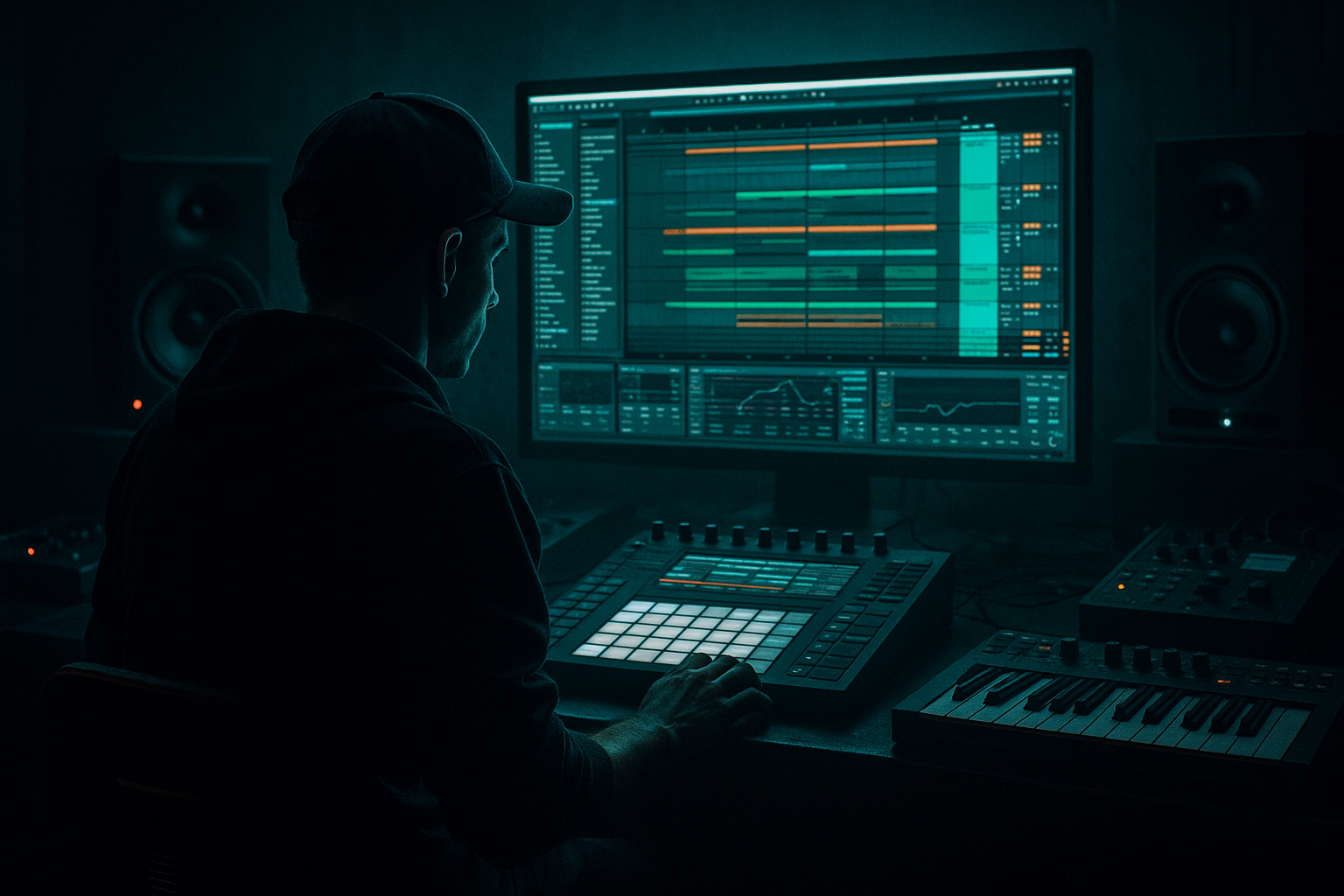
Main tutorial
1. Lesson overview
Energy in drum & bass isn’t just about loudness — it’s about momentum: the controlled rise and fall of rhythmic density, bass weight, timbral grit and stereo motion across long spans (16–128 bars). In this lesson you’ll learn practical Ableton techniques to shape long-form momentum in DnB/jungle/rolling-bass tracks so your mixes stay exciting for longer without sounding gimmicky. Expect hands-on device chains, workflow steps, and arrangement ideas you can apply right away. ⚡️🥁
Difficulty: Intermediate
Genre focus: Drum & Bass / Jungle / Rolling Bass (170–176 BPM typical)
Tools used: Ableton Live stock devices (Drum Rack, Simpler/Sampler, EQ Eight, Compressor, Glue Compressor, Saturator, Auto Filter, Utility, Beat Repeat, Reverb/Echo/Hybrid Reverb, Multiband Dynamics, Drum Buss, Audio Effect Rack, Clip Envelopes, Groove Pool).
---
2. What you will build
A flexible long-form momentum control system for a DnB track:
- A master “momentum rack” (Audio Effect Rack) with macros that simultaneously control low-end, distortion, stereo width, and reverb/delay sends so one control sculpts energy over long sections.
- Drum and bass processing chains (parallel distortion + sub-preserve chain) allowing you to dynamically add/remove texture across 8–32 bar passages.
- Arrangement blueprint showing where to thin/thicken elements, automate tempo pulls/pushes, and use follow-actions/Beat Repeat for evolution and fills.
- Over-automating everything at once: too many simultaneous changes = loss of groove. Map and automate a few well-chosen macros instead.
- Moving sub frequency too much: cutting or modulating the sub range causes perceived drop in energy. Keep sub consistent; automate mids and grit for perceived energy.
- Over-using reverb on low frequencies: that makes the low-end muddy. Always HPF reverb sends at 200–400 Hz.
- Too much tempo automation: dramatic changes break dancer/playlist expectations. Use subtle BPM nudges (0.5–1.5 BPM).
- Not using parallel processing: applying heavy saturation/compression directly without a parallel chain can kill transients and clarity.
- Ignoring groove: precise quantize can sound robotic—use Groove Pool and velocity variation to keep breaks alive.
- Bass split and multiband distortion: Use Multiband Dynamics or a split rack to compress/pump mids independently while preserving the sub. Chain: Sub (LP @ 120 Hz) -> dry; Mid (HP @100 Hz) -> Saturator Drive 4–8 -> Redux subtle -> EQ.
- Use “colour” not only loudness: Replace broadband saturation with harmonics focused around 200–1000 Hz to make the bass perceived heavier without raising sub level.
- Fast transient shaping on drums: Drum Buss with Transient around +10 and Drive 4 adds the hard punch you want. Glue comp attack 5–15ms to retain snap.
- Modulate filter phase and resonance: Auto Filter with envelope amount controlled by an envelope follower or macro. Set Resonance low-moderate; too much Q in the mids makes it sound whistly.
- Use short reverb tails for drums but long pitch-shifted tails for transitions: Send a snare to a reverb return with Freeze or long decay, pitch it down a few semitones, lowpass to keep it dark — bring it in before a drop for menace.
- Saturation chain example (Mids/Growl): EQ Eight (HP @ 90 Hz) -> Saturator (Analog Clip, Drive 5) -> Overdrive (Tone 6) -> EQ Eight (cut 4000–8000) -> Multiband Dynamics to tame highs.
- Keep kicks tight: If a heavy mid-bass competes, sidechain the mid growl to the kick with faster release (50–120 ms) and the sub with slightly longer release.
- Momentum in DnB is about controlled changes: density, harmonic content, stereo image, effects space and subtle tempo nudges.
- Build chains that preserve the sub but let mids/dirt evolve (Audio Effect Rack split chains are your friend).
- Use a master Momentum Rack with mapped macros to sculpt many parameters with one automatable control — this keeps long-form changes musical and reproducible.
- Use Groove Pool, clip envelopes, follow actions and Beat Repeat for rhythmic evolution while automating macro contours over 8–32 bar blocks.
- For darker/heavier DnB, focus on multiband distortion, tight transient processing, and careful reverb/delay routing to maintain punch and clarity.
End result: a 2–3 minute section that rises and falls organically, with controlled changes that preserve groove and sub energy.
---
3. Step-by-step walkthrough
Prep: set tempo to 174 BPM (typical), create a basic drum & bass loop (kick, snare, amen/loop chops), a sub sine bass and a mid/bite growl bass layer.
A. Build core rhythm and bass foundations (quick)
1. Create Drum Rack, load sliced Amen/Choong breaks or chopped single-hit drums into pads. Use Simpler for single samples, Sampler for multis.
2. Warp breaks in Beats mode, set Preserve to Transient for best chops. Nudge slices until groove sits at 174 BPM.
3. Program a basic DnB pattern: kick on 1, snare on 2 & 4, ghost snares and shuffled hi-hat 16th/32nd variations for roll feel.
B. Drum bus chain — make it punchy and flexible
1. On the drum group: Insert EQ Eight first. High-pass at 35–45 Hz (slope 24 dB). Remove sub rumble but keep weight. Boost slight 200–400 Hz if kicks need warmth.
- Example: HP @ 40 Hz, Q moderate, -inf below.
2. Add Drum Buss (for glue/saturation). Settings: Drive 3–7, Transient 9–15, Boom 0–3. Subtle — add color, not destroy transients.
3. Add Glue Compressor: Ratio 4:1, Attack 10–30 ms, Release Auto or ~100 ms, Makeup gain to taste.
4. Parallel brightness chain: Create an Audio Effect Rack with two chains:
- Chain A (Dry): lightly compressed.
- Chain B (Bright Parallel): EQ Eight boosting 2–8 kHz, saturator Drive 3–5, Glue compressor heavier. Macro maps Dry/Wet to blend. Use Chain Volume or Macro to automate density.
C. Bass split chain — keep sub intact, make mid noisy
1. Create an Audio Effect Rack on the bass channel with two chains using EQ Eight to split:
- Chain Sub (low): EQ Eight with Low-pass @ ~120–200 Hz, slope 24 dB. Optionally Multiband Dynamics to keep sub tight.
- Chain Growl (mids): EQ Eight High-pass from ~100 Hz upward. Saturator -> Overdrive -> EQ to sculpt harmonics. Add Auto Filter for movement or an LFO (use Auto Filter’s LFO or Live 11 LFO device via Max) set to 1/8–1/4 rate for slow wobble.
2. Sidechain: Put Compressor after the Rack on the bass send; set sidechain input from kick/snare (or a trigger bus). Suggested settings: Ratio 3–4:1, Attack 1–5 ms (fast), Release 100–200 ms (sync to tempo). Adjust threshold so each kick rides slightly under the bass.
D. Build a Master “Momentum” Audio Effect Rack
1. Create a new Audio Effect Rack and drop it on the Group/Master track for section-controlling macros (you can also put it on a bus and send more tracks through it).
2. Create 4 chains inside the rack (no audio, just macros controlling many devices via Map):
- Macro 1: “Sub Contour” -> maps to EQ Eight on bass sub chain cutoff (min 40 Hz -> max 250 Hz).
- Macro 2: “Grit / Dist” -> maps to Saturator drive on drums + growl chain Drive / Overdrive amount (0 -> 7 dB).
- Macro 3: “Width” -> maps to Utility width on drums + bass mid chain (-30% -> +50%).
- Macro 4: “Space” -> maps to Reverb/Delay Send amounts (Dry/Wet on return sends or Send knob on channels).
3. Map multiple targets per macro: select a macro, click Map, move device parameters you want controlled. Ensure ranges are sensible — you’ll be automating these macros in Arrangement.
E. Long-form automation workflow
1. Plan by sections: Define 8–16 bar blocks. Example:
- Bars 1–16: low energy intro (thin drums, sub present, minimal mids).
- Bars 17–48: build (raise grit, open mid/bite, add hats).
- Bars 49–80: full energy main (full layers, width broad).
- Bars 81–96: breakdown (cut drums, lowpass sub, increase space).
- Bars 97–128: re-entry and peak.
2. Automate Momentum Rack macros over these blocks in Arrangement:
- Sub Contour: slowly open over 32 bars during build, drop abruptly on breakdown.
- Grit/Dist: increase in steps (8 bars) to add harmonic content progressively.
- Width: subtly increase in build (+10–25%), then shrink in breakdown to focus low-end.
- Space: increase reverb/delay sends early in build (creates sense of "farther") and cut reverb for punch during main sections.
3. Use tempo automation sparingly: a 0.3–0.8% tempo push (e.g., 174 -> 175 or 176) for 4–8 bars before a drop can create adrenaline. Implement in Arrangement by enabling the “Mixer”/Master tempo automation lane and drawing small ramps. Don’t exceed 1–2 BPM without musical reason.
F. Rhythmic density and Groove Pool
1. Use Groove Pool to introduce swing/shuffle on percussion or breaks. For rolling DnB, import an MPC or classic swing groove or create custom: quantize to 1/16 and nudge alternate 16th notes by -8 to -20 ms.
2. Apply different grooves to elements:
- Drums / breaks: conservative Swing (5–12%).
- Percussion/hi-hats: slightly more shuffle to create rolling feel.
3. Use clip-level velocity envelopes and randomization (MIDI effect Random or clip Velocity) to keep long loops from looping identically.
G. Evolving texture: Follow actions + Beat Repeat for fills
1. In Session View, create 2-bar drum variations and set Follow Actions to create semi-randomized long evolution:
- Clip length 2 bars, Follow Action A = Play Next, B = Play Again, A/B times 1/2–2 bars, set Chance A 70% so it mostly progresses but sometimes repeats.
2. Add Beat Repeat on a return track for fills. Settings:
- Interval: 1/8 or 1/4
- Grid: 1/16 or 1/32
- Chance: 20–40%
- Decay: 0.2–0.6s
- Filter: High-pass (to keep low sub stable)
- Map a macro to Beat Repeat’s Chance and Grid to increase glitchiness during buildups.
H. Arrangement ideas (practical)
1. Use layer drop/add method: every 8 bars, add or remove one mid/high percussion or ghost note. This is the simplest form of momentum change.
2. Large contour changes (32 bars): open low-pass on bass and bring in distortion gradually; cut drums down to percussion for a half-bar micro-break and then reintroduce with reversed cymbal and tempo nudge.
3. Automation gestures:
- 32-bar filter sweep (low-pass on master reverb): keeps reverb tails long in breakdown, but low-passed so sub remains tight.
- Multi-param dips: at 1 bar before a drop, reduce “Space” macro, increase “Grit”, raise “Width” slightly, and nudge tempo +0.5 BPM, then snap back on drop.
I. Final polishing
1. Bounce stems if CPU heavy. Freeze/flatten tracks as you finalize parts.
2. Check phase when layering bass: solo Sub and Mids, invert phase if cancellation occurs.
3. Automate send levels to leave room for tails — avoid abrupt reverb cutoff unless intended (or use utility gain automation on return track to duck tails).
---
4. Common mistakes
---
5. Pro tips for darker/heavier DnB 🖤
---
6. Mini practice exercise (30–60 minutes) 🔧
Goal: Create a 2-minute rolling DnB section with controlled momentum changes every 16 bars.
Step-by-step:
1. Set tempo to 174 BPM. Load an Amen break and a kick/snare into Drum Rack. Create a 2-bar loop with snare on 2 and 4 and kicked feel like DnB. (10 min)
2. Create a simple two-layer bass:
- Sub: sine in Operator or Wavetable low oscillator. LP around 110–140 Hz (no distortion).
- Growl: one-shot wavetable or sampled growl in Simpler. HP at 120 Hz. Add Saturator Drive 4. (10 min)
3. Drum bus: EQ Eight HP @ 40 Hz, Drum Buss (Drive 4, Transient 10), Glue Comp (4:1, Attack 10 ms, Release 120 ms). Create a parallel bright chain and map Dry/Wet macro. (5 min)
4. Momentum Rack:
- On a group track, build macros: Sub Cutoff, Grit, Width, Space. Map to bass EQ, growl saturator, utility width and reverb send. (10 min)
5. Arrange 128 bars:
- Bars 1–16: Sub present, Grit low, Space moderate.
- Bars 17–48: Automate Grit rising and Sub Cutoff opening over 32 bars.
- Bars 49–64: Peak: Grit high, Width +20%, Space low.
- Bars 65–80: Breakdown: pull Sub Cutoff lower, Space up, drop drums to percussion only.
- Bars 81–128: Rebuild to peak with tempo nudge +0.5 BPM for 4 bars before final hit. (15–20 min)
6. Add Beat Repeat on a send, map its Chance to “Grit” macro so fills increase during build. (5 min)
7. Listen and adjust thresholds, sidechain release times, and macro curves by ear.
Result: A small track section showing how one macro automation can morph the track’s energy while preserving low-end consistency.
---
7. Recap ✅
Go make something that slowly creeps under the listener, then smacks them when it needs to — and keep the energy moving, not just louder. If you want, send me one section of your Ableton project (stems or screenshots) and I’ll suggest specific macro curves and device settings for it. 🎛️🔥

