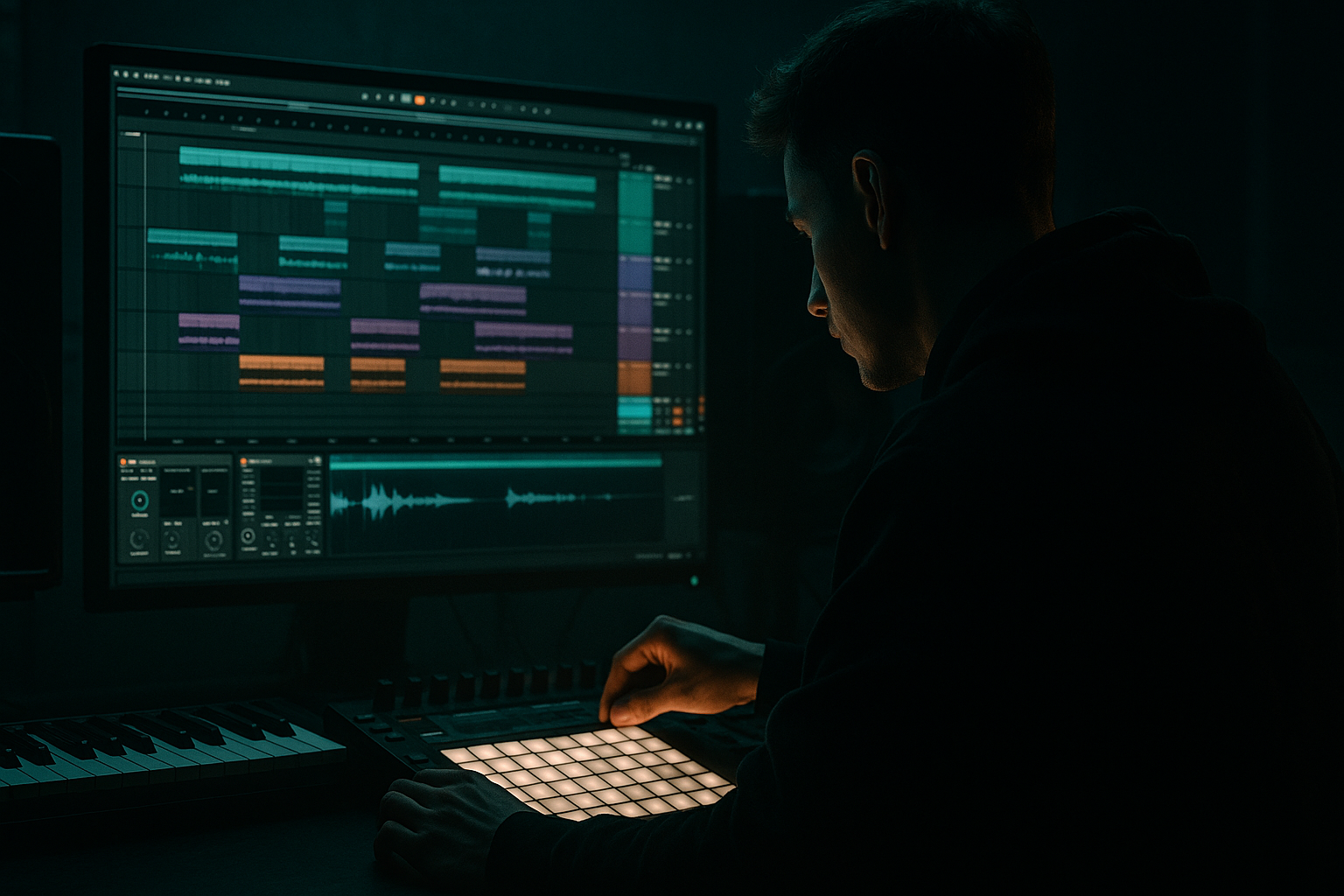
Main tutorial
Long Intro Atmospheres for Smoky Late‑Night Moods (DnB in Ableton Live) 🌫️🌙
Category: Arrangement | Skill level: Beginner
---
1. Lesson overview
A great drum & bass track doesn’t start with drums—it starts with vibe. Long, smoky intros are about tension, space, and slow reveal, so when the drop hits, it feels inevitable.
In this lesson, you’ll learn a repeatable Ableton Live workflow to build a 16–64 bar atmospheric intro that feels late-night, cinematic, and rooted in rolling/jungle aesthetics—without getting lost in endless sound design.
---
2. What you will build
You’ll build a DnB intro that includes:
- Atmospheric bed (noise/field recording + wide pads)
- Harmonic mood layer (minor chords, dusty keys, or resampled pad)
- Ear candy (vinyl crackle, distant shakers, reversed hits)
- Tension risers (filters, automation, and subtle movement)
- Arrangement map (clear progression into the drop)
- Drag in an audio clip: rain, room tone, train station, street ambience, vinyl room noise.
- Warp mode: Complex (or Complex Pro if it sounds weird).
- Add Operator (MIDI track)
- Play a long note (C3) and freeze/flatten if needed.
- Osc 1: Sine-ish / mellow wavetable
- Unison: 2–4 voices
- Detune: low (5–15%)
- Filter: LP24, cutoff ~ 400–2kHz (automate later)
- Amp envelope:
- Keep it simple: 1–2 chords that feel ominous.
- Examples in F minor:
- Instrument: Electric or Simpler (keys sample)
- Write a 2-bar motif (repeat it sparsely).
- Vinyl crackle (quiet)
- Distant rimshots
- Reversed cymbals
- One-shot radio/vox chops (heavily processed)
- Tiny shakers (super low in mix)
- Load Drum Rack
- Add a closed hat/shaker sample
- Pattern: 1/16 with velocity variation
- Process:
- Put Reverb first, then EQ Eight after it.
- After reverb, low-pass to 4–7 kHz so it feels far away.
- Atmos bed + pad
- No drums
- Gentle filter movement only
- Add dusty keys motif (very sparse)
- One reverse cymbal into bar 17
- Slightly open pad filter
- Add tiny shaker loop (low level)
- Add one distant snare hit every 2 bars (optional)
- Add sub tease notes (quiet)
- Introduce a short riser (noise swell)
- Automate intro group to feel like it’s “coming into focus”
- Add a 1-bar pause or tape-stop-style cut right before the drop (optional)
- Auto Filter cutoff slowly rising on PAD
- Reverb Dry/Wet slightly decreasing toward drop (makes drop feel “drier” and punchier)
- Utility gain +1 to +2 dB in the last 8 bars (tiny lift)
- Optional: Vinyl / noise fades down right before drop (clean impact)
- Too much low end in the intro: pads + reverb + atmos can create hidden sub rumble. High-pass aggressively where needed.
- Reverb everywhere, full volume: big reverbs are great, but stack them and you get cloudy mush. Choose 1–2 “big space” elements.
- No arrangement movement: if nothing changes for 32 bars, it feels like a loop. Add a new element or automation every 4–8 bars.
- Over-revealing the drums: don’t start with full breaks. Tease with ghosts, distant hits, or filtered hats.
- Too bright: smoky moods usually mean controlled highs. Low-pass some elements and keep brilliance for later.
- Use dissonance lightly: try adding a pad top note a semitone away (very quiet) to create unease.
- Midrange “threat layer”: add a low-volume reese-like texture (Wavetable) but high-pass it around 150–250 Hz so it doesn’t step on the sub later.
- Pre-drop contrast: slightly reduce reverb and wideness in the last bar, so the drop feels bigger when width returns.
- Jungle nods: sprinkle tiny chopped-amen ghosts at -20 dB with heavy filtering—just enough to hint at breaks culture.
- Automation > more tracks: one pad with smart cutoff + reverb automation often beats five competing layers.
- A smoky late-night DnB intro is built from texture + harmony + slow change.
- Start with an atmos bed, add an evolving pad, then sprinkle dusty musical fragments and ear candy.
- Use automation to create progression: filters opening, reverb shifting, subtle level lifts.
- Keep the intro controlled in low end and highs so the drop hits harder.
Target vibe: smoky warehouse / 3AM drive / neon rain 🌧️
---
3. Step-by-step walkthrough
Step 0 — Set your session up (fast + organized)
1. Set Tempo:
- Rolling DnB: 172–175 BPM
- Jungle: 165–172 BPM
2. Set Global Key (optional but helpful): F minor or G minor (classic dark DnB keys).
3. Create these tracks (color-code them):
- ATMOS Bed (audio)
- PAD (MIDI)
- MUSIC/CHORDS (MIDI)
- FX + Ear Candy (audio)
- Sub Tease / Bass Hint (MIDI)
- Drum Ghosts (MIDI) (optional)
Workflow tip: put all intro elements into a Group called `INTRO` so you can process/automate together later.
---
Step 1 — Build the smoky “air” layer (Atmos bed) 🌫️
Goal: a consistent texture that fills space but stays out of the way.
Option A: Use a field recording (best)
Option B: Make noise in Ableton (no samples needed)
- Oscillator A: Noise (instead of a waveform)
- Filter: ON
- Filter type: Lowpass 12
- Cutoff: 2–6 kHz
- Resonance: low (0–10%)
Atmos device chain (stock devices):
1. EQ Eight
- High-pass around 120–250 Hz (remove rumble)
- Gentle dip around 2–4 kHz if harsh
2. Auto Filter
- Lowpass 12, cutoff around 3–8 kHz
- Add subtle movement: LFO Amount 5–15%, Rate 1/8–1/4 (try Sync)
3. Reverb
- Type: Large Room / Hall
- Decay: 4–8s
- Predelay: 20–40 ms
- Dry/Wet: 15–30%
4. Utility
- Width: 130–170%
- Gain: adjust so it sits quietly
Arrangement note: Keep this layer present from bar 1 to the drop as your “fog”.
---
Step 2 — Create a moody pad that evolves (PAD)
Goal: slow harmonic movement + width + subtle modulation.
1. Create a MIDI clip 16 bars long.
2. Choose an instrument:
- Wavetable (great modern pads)
- Analog (warm)
- Drift (organic wobble)
Beginner-friendly pad with Wavetable:
- Attack 200–800 ms
- Release 2–6s
Pad chain:
1. Chorus-Ensemble
- Mode: Chorus
- Amount: 20–40%
2. Reverb
- Decay 5–10s
- Dry/Wet 20–35%
3. EQ Eight
- High-pass 150–300 Hz
4. Auto Pan (optional movement)
- Rate: 1/4 or 1/8
- Amount: 10–25%
- Phase: 180° (wide)
Write chord voicings (DnB friendly):
- Fm → Dbmaj7 (dark but lush)
- Fm → Eb (classic minor lift)
- Fm(add9) held for tension
Arrangement idea: hold one chord for 8 bars, then slightly change the top note to signal progression.
---
Step 3 — Add a “dusty music” layer (keys/resample trick) 🎛️
Goal: something melodic but restrained—like a memory in the haze.
Option: Electric piano / keys
Dusty chain:
1. Redux
- Downsample: 2–8 (subtle)
- Bit Reduction: 0–2 (very light)
2. Saturator
- Drive: 1–4 dB
- Soft Clip: ON
3. EQ Eight
- High-pass: 200–400 Hz
- Low-pass: 6–10 kHz
4. Delay (Echo works too)
- Time: 1/4 or 1/8 dotted
- Feedback: 15–35%
- Dry/Wet: 10–25%
Pro move: Resample this layer to audio, then reverse small bits for transitions.
---
Step 4 — Ear candy: subtle jungle signals (FX + tiny percussion) ✨
Goal: keep the intro engaging without “starting the track” too early.
Add 2–4 ear candy elements:
Quick shaker loop (super subtle):
- EQ Eight high-pass 500–800 Hz
- Auto Filter low-pass ~ 6–9 kHz
- Reverb 10–20% wet
“Distance” trick (stock):
---
Step 5 — Hint the bass without giving the drop away (Sub Tease) 🖤
Goal: suggest weight and key center, but keep it restrained.
1. Add Operator for a clean sub.
- Osc A: Sine
- Add a very short MIDI note every 2 bars (or one long held note).
2. Chain:
- EQ Eight (low-pass around 120–200 Hz)
- Saturator (Drive 1–3 dB, Soft Clip ON)
- Utility (Mono ON below 120 Hz via Bass Mono if available; otherwise keep width at 0–50%)
Keep this quiet. It’s a shadow, not the main character.
---
Step 6 — Arrange the long intro (16 / 32 / 64 bars) 🧭
Here’s a reliable 32-bar smoky DnB intro blueprint:
Bars 1–8: “Fog + tone”
Bars 9–16: “Signal emerges”
Bars 17–24: “Pulse appears”
Bars 25–32: “Tension + pre-drop”
Automation checklist (this is the magic):
Ableton tip: Press `A` to show automation lanes quickly.
---
Step 7 — Glue the intro together (Intro Bus processing)
Group all intro tracks into `INTRO` group and add:
1. EQ Eight
- High-pass 20–30 Hz (safety)
- Gentle dip 200–400 Hz if muddy
2. Glue Compressor
- Attack: 10 ms
- Release: Auto
- Ratio: 2:1
- Gain reduction: aim for 1–2 dB max
3. Saturator (optional)
- Drive: 0.5–2 dB for vibe
Keep it subtle—intro should feel cohesive, not squashed.
---
4. Common mistakes
---
5. Pro tips for darker/heavier DnB 🏭
---
6. Mini practice exercise (15 minutes) ⏱️
1. Create a 16-bar intro using only:
- 1 Atmos bed (audio)
- 1 Pad (MIDI)
- 1 Ear candy FX (reverse cymbal or vox)
2. Requirements:
- At least two automations (e.g., pad filter cutoff + reverb wet)
- At least one transition moment at bar 9 or bar 13 (reverse, silence gap, or riser)
3. Bounce a quick export and ask:
- Does it feel like it’s going somewhere every 4–8 bars?
- Is the low end clean?
---
7. Recap
If you want, tell me your tempo + subgenre (rolling, jungle, halftime, neuro) and I’ll suggest a specific 32-bar intro map and chord vibe to match.

