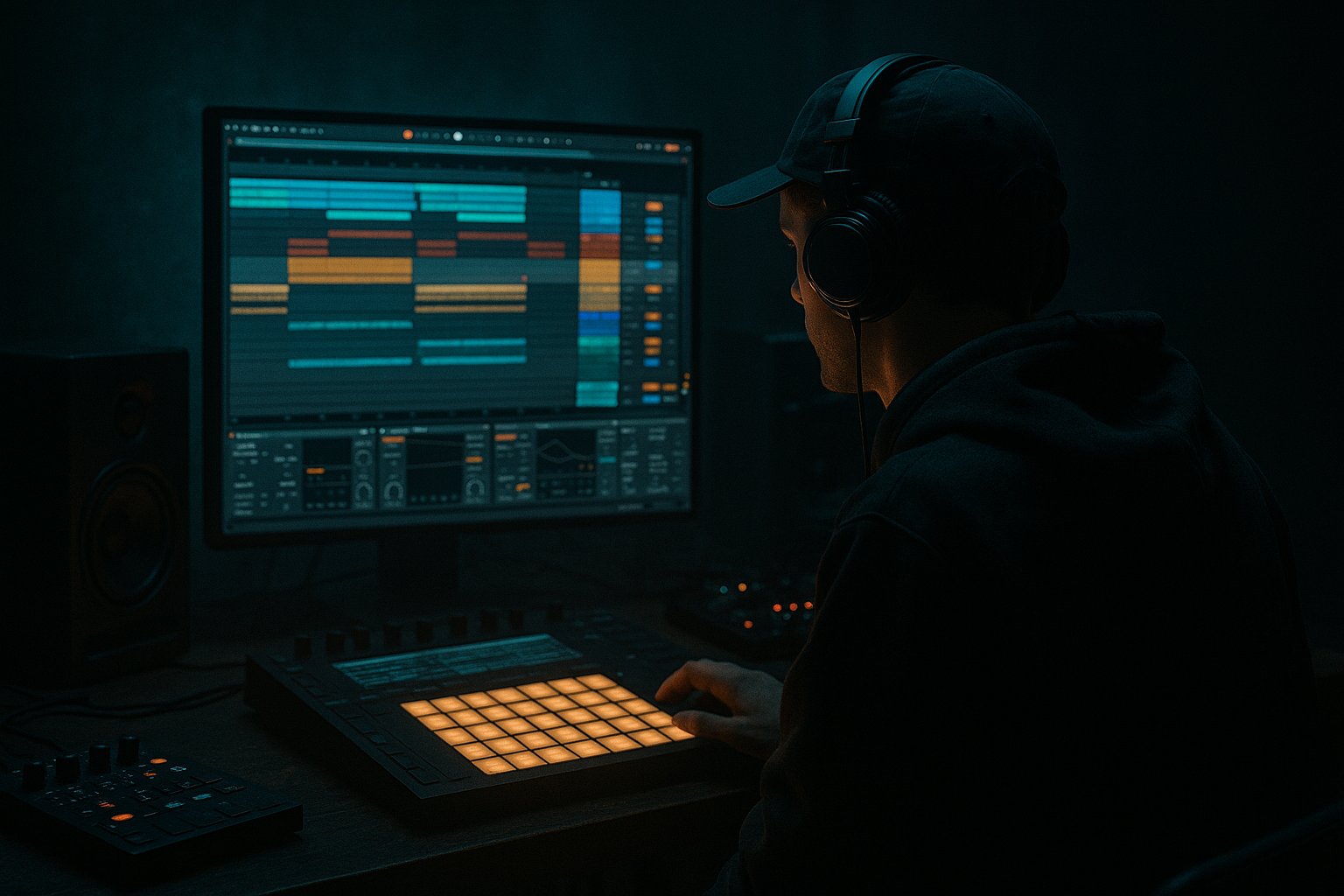
Main tutorial
1. Lesson overview
Goal: Learn how to place percussion "loosely" so your drum & bass grooves breathe and roll like classic jungle/DnB, instead of sounding robotic. You’ll get hands-on Ableton Live techniques (MIDI and audio), device chains, timing/velocity tricks, and arrangement ideas so even a beginner can make grooves that swing and feel alive. Tempo examples will use 170–175 BPM. 🎧🥁
What “loose percussion” means here: small, intentional timing offsets, velocity variance, layered humanized hits and subtle swing that create momentum without sounding sloppy.
---
2. What you will build
A 1‑bar rolling DnB percussion loop (usable as a building block for intros, breakdowns, or to layer under breaks) that includes:
- Punchy kick & snare / break layering
- Loose hi-hat & cymbal placement (micro-timing offsets)
- Ghost percussion (shakers/congas) with randomized velocity
- A small drum-bus chain (Glue Compressor + Saturator/Drum Buss + EQ Eight)
- A return reverb/delay setup for space
- Over-delaying everything — if all elements are off-grid, the groove loses pulse. Keep foundational hits (kick/snare) relatively stable.
- Excessive randomization — too high Random or Velocity Range causes inconsistent pocket. Use subtle values.
- Applying large reverb on high-frequency percussion — this muddies mix and kills transients. Use high-cut on reverb return.
- Forgetting to low-pass/HPF percussive reverb/delay returns — clutter in low mids happens fast.
- Using Groove pool with extreme timing values without testing at full mix — may ruin bass alignment.
- Tighten core hits, loosen auxiliary percussion: Keep kick & main snare locked; make hats, shakers, and percussive noise loose.
- Gated short reverb on snare/sub-snares: Reverb decay 0.2–0.5 s + gate (use Compressor sidechain or Utility automation) for punch with space.
- Parallel distortion chain for aggression:
- Use Drum Buss for intentional transient shaping: increase Transients to add snap, then add Saturation for harmonic content. Settings start: Transients +6, Drive 2.
- Lower mid cleanliness: On Drum Bus EQ Eight, apply a gentle cut at 250–400 Hz (−1.5 to −3 dB) to keep bass/bottom clear.
- Use short, filtered noise hits delayed by 12–24 ms panned wide for a haunted slap feel.
- Automate Groove Random/Timing per section: increase Random/Timing for atmospheric parts, reduce for aggressive drops.
- Layer sub-kick under looser percussive patterns and sidechain heavily so percussion breathes around bass.
- Loose percussion = small timing offsets + velocity variation + tasteful groove application.
- Use Ableton tools: MIDI Random/Velocity, Groove Pool, Drum Rack/ Simpler, Clip nudge, Warp/transient markers for audio, Drum Buss/Glue/Saturator and returns for space.
- Keep core elements (kick/snare) anchored; make hats, shakers and layered percs slightly off-grid and lower in velocity.
- For darker/heavier DnB, use gated reverb, parallel distortion, careful EQ cuts, and automate looseness to build tension.
You’ll be able to toggle tighter vs looser percussion for arrangement contrast.
---
3. Step-by-step walkthrough
Prerequisites: Ableton Live (Intro/Standard/ Suite). Use Live’s stock devices: Drum Rack, Simpler, Glue Compressor, Compressor, Saturator, EQ Eight, Utility, Reverb, Ping Pong Delay, Velocity and Random MIDI devices, Beat Repeat (optional).
Tempo: 174 BPM (adjust to taste)
A. Project & Tracks
1. Create a MIDI track named “Drum Rack” and set BPM to 174.
2. Create an Audio Return for Reverb (Reverb device) and another for Delay (Ping Pong Delay). Send knob defaults 0 dB.
B. Build a basic kit
1. Drag Drum Rack onto "Drum Rack".
2. Load:
- Kick on C1 (one-shot sample, or a low punchy sub-kick)
- Snare on D1 (layer with break/snare or sample chop)
- Hi-hat closed on F#1
- Hat open on A#1
- Shaker/conga on E1
3. Recommended sample selection: for DnB/jungle, pick a tight punchy kick, a crisp mid-high snare (with room), and percussive shakers with mid/high energy. Keep one break loop saved for layering later (e.g., an Amen slice).
C. Make a starting MIDI clip
1. Create a 1-bar MIDI clip.
2. Place kick on beat 1 (1.1.1) and a “half-kick” ghost on the “and” of 2 (1.2.3.000 or 1.2.2.480 depending on grid).
3. Place snare on 2 and 4 if you want a half-time groove; or create break-style snare hits (snare on 1.2 and 1.4 with ghost snare on 1.3 small hits — experiment).
4. Add hi-hats on 16th or 32nd grid. Don’t worry about tightness yet.
D. Humanize with the MIDI Random & Velocity devices (fast wins)
1. Put a MIDI Random device before Drum Rack. Settings:
- Chance: 30–45%
- Choices (Max Shift): 10–30 ticks (for small pitch randomness if using Choices, but more useful is timing — see next)
Note: Random in Live randomizes pitches. For timing use the Groove Pool or manual offsets described below.
2. Add a Velocity MIDI device (after Random). Settings:
- Out Hi = 110, Out Low = 60 (adjust)
- Mode: Scale (to map incoming varying velocities into a humanized range)
3. Alternatively, use Velocity device’s “Range” and “Mode” to set lower minimums for ghost notes.
E. Micro-timing (the core of loose placement)
Option 1 — Clip-level manual offsets (best control):
1. In the MIDI clip, enable Fixed grid: set Grid to 1/16 or 1/32.
2. Select individual hi-hat/hat notes and nudge them using the Arrow keys (Left/Right) or by dragging them slightly off-grid by 5–30 ms. In Ableton, one grid unit at 174 BPM for 1/16 = ~43 ms; aim for 5–25 ms offsets.
3. Use small delays:
- Push back hi-hats slightly (10–20 ms) to sit behind the beat.
- Pull one hat slightly ahead (−5 to −12 ms) for a subtle shuffle.
Option 2 — Groove Pool (apply swing/shuffle globally to clip):
1. Open Groove Pool (Shift+Cmd+G / View > Groove Pool).
2. Try these grooves: swing_8-5 Groove, or extract groove from a break loop: drag a break audio sample into Groove Pool > click “Extract Groove”.
3. Apply groove to your MIDI clip and set Timing to 30–70 (start low and increase until the feel is right). Set Random to 7–20 for subtle humanization.
4. Quantize using that groove (Right-click clip > Quantize Settings > play with percentage).
F. Timing via Transient Warping for Audio percussion
If using audio percussion loops or single-shot shakers:
1. Double-click audio clip, turn Warp on.
2. Use transient markers (Cmd/Ctrl + click) to nudge transient markers slightly left/right by 5–20 ms.
3. For a looser feel, leave one or two shakers slightly delayed relative to the grid.
G. Percussion layering & velocity groups
1. Use Drum Rack chains: layer two hat samples (one bright, one darker).
2. Place both on same pad and use chain selector or Zone via Velocity to have a “hard” and “soft” sample for dynamic response. To do velocity zones:
- Drag second sample into another pad, and map MIDI note to trigger both, or use Simpler with velocity zones in Drum Rack (simpler has an amplitude envelope and transpose can be modulated by velocity).
3. Use short ghost shakers (very low velocity) on off-beats to enhance groove.
H. Drum Bus + Processing
Create a group/bus for your Drum Rack (or route Drum Rack to a Drum Bus track).
1. EQ Eight: High-pass filter for percussion 120–160 Hz to reduce low-mud on hats/shakers.
2. Glue Compressor: Ratio 2:1, Attack 10–30 ms, Release auto/0.1–0.3 s, Gain reduction 1–3 dB. This glues the transient picture together without squashing life.
3. Saturator (or Drum Buss): Drive: 2–6 dB, Soft Clip: On. For Drum Buss device: add Transients +2–7, Crunch 1–3, Lump 0 to taste.
4. Utility: Stereo width on hats (90–120%), center the kick & big snare.
I. Space and movement
1. Send small perc elements to Reverb return:
- Reverb: Size small (0.2–0.4), Decay 0.6–1.2 s, High-cut 4–8 kHz (to keep tails dark)
- Pre-Delay: 10–30 ms
2. Send occasional hits to Ping Pong Delay for movement; low wet amount (10–25%).
3. Automations: automate send amounts or Dry/Wet on Reverb to make looser parts bloom in breakdowns.
J. Arrangement suggestions (where to use loose percussion)
1. Intro/Breakdown: make percussion looser (increase Groove Random, more delay on hats) to create space.
2. Drop: tighten percussion (reduce delays, bring velocities up) to make the drop hit harder.
3. Transition: gradually increase hat looseness / reverb sends right before a fill to create suspension.
---
4. Common mistakes
---
5. Pro tips for darker/heavier DnB
- Duplicate Drum Rack track > on duplicate, heavy Saturator/Overdrive + EQ to focus 200–800 Hz and 2–6 kHz. Blend back with original for grit.
---
6. Mini practice exercise (10–20 min)
Follow these exact steps and listen for the result:
1. Set tempo to 174 BPM.
2. Create Drum Rack and load:
- Kick (C1), Snare (D1), Hat Closed (F#1), Shaker (E1).
3. Make a 1-bar MIDI clip:
- Kick at 1.1.1 and a ghost kick at 1.3.2 (the “and” of 2).
- Snare at 1.2 and 1.4.
- Hats on every 1/16.
- Shaker on every 1/32 but keep velocity low (30–55).
4. Add MIDI Random device before Drum Rack — set Chance 35% and choose “Choices” 0 (we’re using it for subtle note variation if you loaded multi-sampled hats).
5. Add Velocity device after Random — Out Low = 50, Out High = 110.
6. In the MIDI clip, select alternate hat notes and nudge them back by 8–18 ms (drag slightly off grid).
7. Open Groove Pool, drag “swing_8_64” (or extract groove from a short break) to the clip. Set Timing = 45, Random = 12.
8. Create a return Reverb (send 1) — Reverb Decay 0.8 s, Pre-Delay 12 ms, High Cut 5 kHz. Send shaker/main hats 8–12%.
9. On Drum Rack track create a Drum Bus chain (or route to group) and insert:
- EQ Eight: High-pass 120 Hz
- Glue Compressor: 2:1, Attack 20 ms, Release 0.15 s, 2 dB Gain Reduction
- Saturator: Drive 3 dB, Soft Clip ON
10. Play loop and toggle the Groove Timing between 0 and 45 to hear tight vs loose. Save as “LoosePercDemo”.
If it sounds too sloppy: reduce Timing/Random in Groove by half and reduce hat offsets.
---
7. Recap
Go make a loop now — experiment with 5–20 ms offsets and Groove Timing 20–60 and you’ll feel the groove come alive. If you want, share your Ableton Live Set and I’ll point out specific tweaks. 🔊🔥

