Main tutorial
Low End Conversation with Kickless Sections (DnB in Ableton Live) 🔊🥁
1) Lesson overview
In drum & bass, the kick and sub are usually best friends… until you remove the kick. Kickless moments (drops, breaks, fills, “2-step fakeouts”) can feel huge or hollow depending on how your low end is managed and “speaks”.
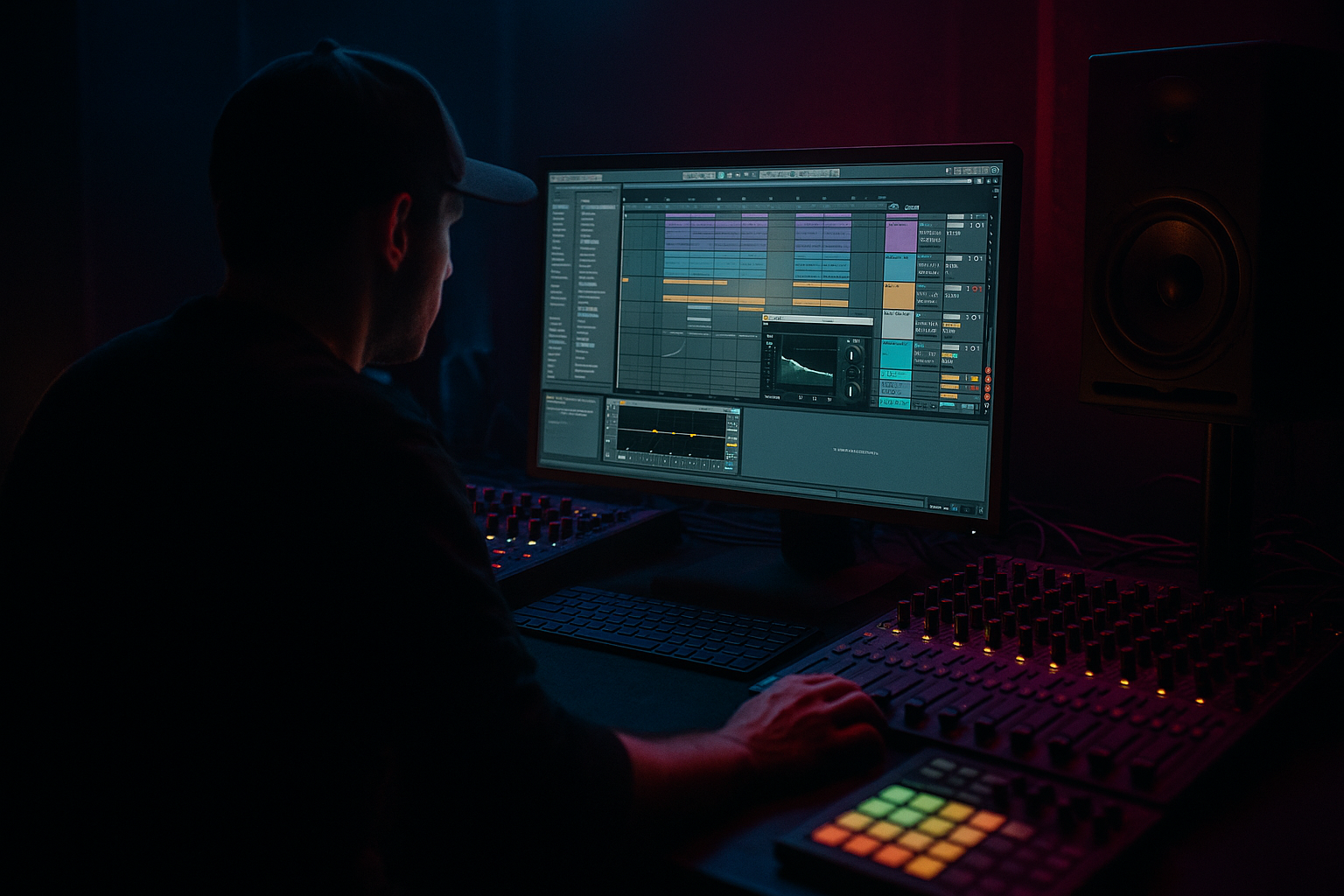
This lesson shows you how to make the sub + bassline keep the groove alive during kickless sections, while staying clean, loud, and mix-ready in Ableton Live (stock devices).
---
2) What you will build
You’ll build a small DnB loop and arrangement that includes:
- A clean Sub track (pure low fundamentals)
- A Mid Bass track (character/texture that reads on small speakers)
- A Kick / Drum Buss group (for the “with kick” sections)
- A kickless 1–2 bar section that still feels heavy
- A “low end conversation” system:
- Oscillator A: Sine
- Level: ~ -12 dB (leave headroom)
- Envelope:
- Osc 1: Basic shapes (Saw/Square-ish)
- Unison: 2–4 voices (subtle)
- Filter: Low-pass around 200–800 Hz depending on aggressiveness
- Keep the true sub out of this track.
- Pick a key like F minor (classic DnB territory)
- Write a pattern that “breathes” around the drums.
- Bar 1: F (short) → F (short) → Eb (short) → F (long)
- Bar 2: F (short) → G (short) → F (short) → (rest)
- Short notes = punchy
- Longer notes = weight
- Change some notes/lengths slightly so it “answers” the sub.
- Or keep notes identical but add filter automation so the mid “talks”.
- Track 1: Kick (on 1 and “& of 2” style, or classic 2-step placement)
- Track 2: Snare (on 2 and 4)
- Track 3: Hats/shakers (16ths with swing)
- Drum Buss
- EQ Eight
- Add a lighter sidechain (same kick input)
- Aim for 1–3 dB reduction so the mid bass stays audible.
- Sidechain stops pumping (because no kick signal)
- The sub might feel too flat or too loud
- Put a short click or muted kick sample.
- Turn its track volume all the way down or route it to Sends Only (so you don’t hear it).
- SUB Compressor sidechain → GHOST KICK
- MID BASS Compressor sidechain → GHOST KICK
- Add short sub “stabs” where the kick used to be.
- Add tiny gaps before snares (space = impact).
- Example:
- Automate Threshold or Dry/Wet (if using Glue Compressor; stock Compressor doesn’t have dry/wet—use an Audio Effect Rack for parallel).
- During kickless section:
- Put SUB processing inside an Audio Effect Rack
- Chain A: “Dry”
- Chain B: “SC Comp” (with sidechain)
- Automate chain volumes between sections.
- Automate MID BASS Auto Filter cutoff slightly higher
- Or automate Saturator Drive up by 1–2 dB
- Use Operator sine
- Very short note (50–120 ms)
- Place it where the kick used to be (or sparingly before snares)
- Limiter (very light, 1–2 dB max gain reduction)
- Or Glue Compressor (gentle, 1–2 dB GR)
- Bars 9–10: kickless, but keep snare + hats and let bass rhythm do the work
- Bar 10 last beat: 1/4 bar silence (tiny dropout)
- Bar 11: kick returns with full low end
- Split roles clearly:
- Saturate the mid, not the sub:
- Add subtle pitch movement:
- Use “negative space”:
- Make kickless sections threatening:
- EQ Eight (surgical separation)
- Saturator / Overdrive (harmonics)
- Compressor / Glue Compressor (controlled dynamics)
- Auto Filter (movement + automation)
- Drum Buss (drum weight)
- Kickless sections work when the bass replaces the kick’s rhythmic job.
- Build a clean SUB and a separate MID BASS so you can shape “weight” vs “readability.”
- Use Ghost Kick sidechain to keep the low-end breathing even without an audible kick.
- In kickless bars, add groove with short sub notes, gaps, and mid-bass automation.
- Keep it controlled with light bus compression/limiting and clean EQ separation.
- Sidechain behavior that changes when the kick disappears
- Sub pattern edits that replace the kick’s rhythm
- A tiny bit of mid-bass emphasis to keep perceived power
---
3) Step-by-step walkthrough
Step 0 — Session setup (fast + DnB-ready)
1. Set Tempo: 172–176 BPM
2. Turn on Warp for samples if needed.
3. Make a 16-bar arrangement:
- Bars 1–8: Full groove (kick + bass)
- Bars 9–10: Kickless section (bass carries)
- Bars 11–16: Kick returns (bigger impact)
---
Step 1 — Build a proper Sub track (your foundation)
Create MIDI Track → name it `SUB`.
Instrument (stock): `Operator`
- Attack: 0 ms
- Decay: ~ 300–800 ms (taste)
- Sustain: -inf or low (if you want plucks), OR sustain around -6 dB for held notes
- Release: 50–120 ms (avoid clicks)
Add a device chain (in this order):
1. EQ Eight
- HP filter at 20–30 Hz (gentle slope) to remove rumble
- Optional tiny dip around 200–400 Hz if it muddies later (but don’t overdo it)
2. Saturator (very light!)
- Drive: 1–3 dB
- Soft Clip: On
- This adds harmonics so the sub “exists” on smaller systems.
✅ Goal: A sub that’s stable, clean, and consistent.
---
Step 2 — Create a Mid Bass that “translates” (the conversation partner)
Create MIDI Track → name it `MID BASS`.
Instrument option A (quick): `Wavetable`
Device chain (in this order):
1. EQ Eight
- High-pass at 90–120 Hz (steep-ish) so it doesn’t fight the sub
2. Saturator or Overdrive
- Aim for harmonic energy in 150–600 Hz
3. Auto Filter
- For movement: automate cutoff slightly (more later)
4. Optional: Amp (adds gritty mid growl without going “dubstepy” too fast)
✅ Goal: The mid bass provides audible rhythm + tone even when the kick disappears.
---
Step 3 — Program a rolling DnB bass pattern (with kick)
In your SUB MIDI clip (start with 2 bars):
Example idea (2-bar loop):
Important: Use note length like a groove tool:
Now copy the same MIDI to MID BASS, but:
---
Step 4 — Create drums + kick (simple 2-step)
Make a DRUMS group:
Use Drum Rack if you like.
Add on DRUMS group:
- Drive: 5–15% (taste)
- Boom: OFF or low (careful with low end)
- Keep kick fundamental clear (often 45–70 Hz in DnB kicks, but depends)
---
Step 5 — Sidechain the Sub (with kick present)
This is where the low end “conversation” begins.
On the SUB track:
1. Add Compressor
2. Enable Sidechain
3. Sidechain input: Kick track
4. Settings (starting point):
- Ratio: 4:1
- Attack: 1–5 ms
- Release: 50–120 ms (tempo dependent—aim so it recovers in time for the groove)
- Threshold: adjust for 3–6 dB gain reduction on kick hits
On the MID BASS track:
✅ With kick: the kick “speaks first,” then bass answers.
---
Step 6 — Design the kickless section (so it still slaps) 🔥
Now the key lesson: when the kick disappears, you must replace its rhythmic function (not necessarily its sound).
#### A) Remove the kick for 1–2 bars
In the arrangement, mute/delete the kick for bars 9–10.
You’ll notice:
We’re going to control that.
---
#### B) Option 1: Use a “Ghost Kick” to keep pumping (best for rolling DnB)
Create a new track: `GHOST KICK`
Route sidechain input:
Now copy the original kick MIDI into the ghost track, including the kickless bars.
✅ Result: Even when the real kick drops out, the low-end groove still breathes like the kick is there.
---
#### C) Option 2: Change the Sub pattern in kickless bars (more “jungle intelligence”)
In bars 9–10, edit the SUB clip:
- On kickless bar: put short sub notes on beat 1, “e” of 1, and “&” of 2 (syncopation)
- Leave beat 3 more open to let the snare feel huge
Tip: Keep the sub notes short and clean; let the mid bass provide the “tail” and attitude.
✅ Result: The bass becomes the drum.
---
#### D) Option 3: Automate sidechain amount for kickless moments (clean + controlled)
Instead of ghost kick, you can automate compressor behavior:
On SUB Compressor:
- Reduce sidechain effect (so the sub gets fuller), but avoid overload.
Easy parallel trick (stock):
✅ Result: You choose exactly how “pumpy” it remains.
---
Step 7 — Make kickless sections feel bigger, not smaller
Kickless sections often need perceived low end, not just more sub.
Try these DnB-friendly moves:
#### A) Add a tiny mid-bass emphasis
In the kickless bars:
This makes the bass “speak” even without a kick transient.
#### B) Add a short “sub hit” layer (controlled)
Create `SUB HIT` track (optional):
Important: HP at 20–30 Hz, and keep it quieter than you think.
#### C) Control peaks
On the Bass Group (SUB + MID BASS), add:
This prevents kickless sections from accidentally being louder than the drop.
---
Step 8 — Arrangement idea: “Kickless tease” that makes the return hit harder 😤
Classic DnB move:
Add a Reverse crash or noise sweep (Ableton `Noise` in Operator or a sample) into the return.
---
4) Common mistakes
1. Letting the sub become constant in kickless sections
If the sub turns into a flat drone, the groove dies. Add rhythm via note lengths or ghost sidechain.
2. Mid bass contains too much sub
If MID BASS isn’t high-passed (90–120 Hz), it’ll smear the low end and kill punch.
3. Sidechain release is too long
If Release is huge, your bass never fully returns between hits—feels weak and “laggy.”
4. Kickless section gets louder than the drop
Without kick transients, bass can dominate. Watch meters and use gentle bus control.
5. Trying to “fix” emptiness by adding more sub
Usually you need mid harmonics + rhythm, not more 40 Hz.
---
5) Pro tips for darker/heavier DnB 🖤
SUB = clean sine (30–90 Hz)
MID = aggression + character (120 Hz–2 kHz)
Keep SUB saturation minimal; put your filth on MID BASS.
In MID BASS, add tiny LFO to filter cutoff (slow) for creepy motion.
Remove bass entirely for 1/8–1/4 beat right before a snare. Dark DnB loves that vacuum effect.
Automate a low-pass opening, increase reverb tail on a stab, or add a distorted reese layer quietly behind.
Stock tools that shine here:
---
6) Mini practice exercise (15–20 minutes) 🧪
1. Create a 16-bar DnB loop at 174 BPM.
2. Program:
- 2-step drums with kick present in bars 1–8
- Kickless in bars 9–10
3. Make the kickless section work using two methods:
- Method A: Ghost Kick sidechain
- Method B: Sub rhythm edits (stabs + gaps)
4. Bounce/export a quick demo and check:
- Does the kickless part still groove on low volume?
- Does the drop (kick return) feel bigger than before?
---
7) Recap ✅
If you tell me your typical sub note range (key) and whether you prefer roller or neuro/darker, I can suggest a specific 2-bar bass MIDI pattern and sidechain release timing for your BPM.

