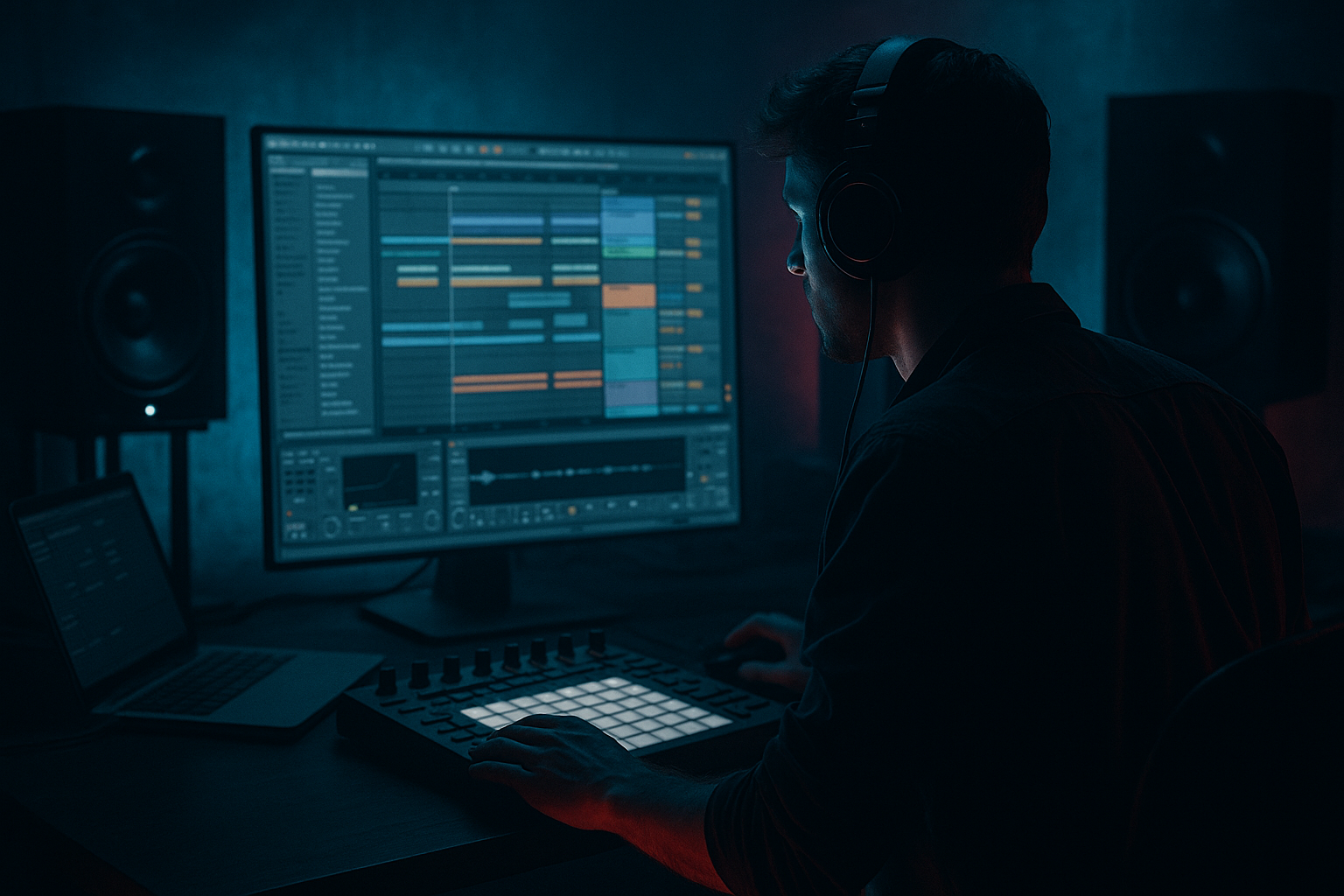
Main tutorial
Lesson Overview
This lesson is about building low-end pressure with a chopped-vinyl texture in Ableton Live 12 using resampling as the main workflow. The target is that oldskool jungle / early DnB feeling where the bass is not just “sub plus reese,” but a living, slightly unstable, record-like pressure source that sits under the break and gives the track identity.
This technique lives in the lane between the bassline, break edit, and arrangement glue. It matters because in jungle and oldskool-flavoured DnB, the low end often needs to feel like it came from a performance or a printed audio source, not a perfectly static synth lane. That means you’re balancing three things at once:
- Weight: the sub has to hold the room
- Texture: the chopped-vinyl edge has to speak without stealing the sub
- Function: the bass has to work against breaks, not just sound good soloed
- Treat the chop layer like threat, not decoration. The best dark jungle textures don’t sound pretty; they sound like they’re leaning into the groove with intent. Keep the rhythm sparse enough that the listener feels the weight of every return.
- Use octave discipline. If the sub says “floor,” let the chopped layer stay in the low-mid and upper-mid character bands. A tiny octave lift in the texture layer can add menace without weakening the root.
- Exploit bar-to-bar contrast. One bar can be nearly naked, the next can have three micro-chops. That contrast is what makes the bassline feel like it’s breathing, which is a huge part of oldskool tension.
- Print distortion, then reduce it. A common advanced move is to overdrive the printed chop layer slightly more than needed, then pull the level back until it feels like atmosphere instead of a distortion demo. That gets you grit without fuzz fatigue.
- Use break interaction as your movement source. If the break already has syncopation, the bass chops can be simpler but better placed. Let the kick and snare define where the bass can be aggressive.
- Reserve the nastiest version for the second drop. In darker DnB, the first drop can introduce the chop pattern; the second drop can remove a few safety rails: less filtering, fewer notes, more exposed texture, stronger contrast.
- Keep the low-end core boring on purpose. The more unstable the texture gets, the more the sub should behave like an anchor. That tension is what creates pressure.
- Use only stock Ableton devices
- Make the sub/core mono
- The chopped layer must be band-limited
- You may use only one main automation lane
- 4 bars of drums + bass
- One printed audio chop layer
- One arrangement change in bar 4, such as a filter move, mute, reverse slice, or density shift
- If you mute the chopped layer, does the bass still hold the tune?
- If you mute the sub/core, does the texture still imply a rhythm?
- In mono, does the low end stay stable and the snare remain clear?
Best fit: jungle, oldskool-inspired rollers, darker halftime-to-rolling hybrids, and club-focused DnB with a heritage feel. It also works beautifully for intros, drop openers, and second-drop evolutions where you want the bass to feel like it’s mutating across the arrangement.
By the end, you should be able to hear a tight mono foundation with a gritty, chopped upper layer that bounces like vinyl fragments, while the kick and snare keep their lane. The successful result should feel like the bass is pressurising the groove rather than sitting on top of it.
What You Will Build
You’re going to build a two-part low-end system inside Ableton Live:
1. A clean pressure core: sub and low-mid body that keeps the tune solid in mono
2. A resampled chopped-vinyl texture layer: a printed, edited, filtered, and reprocessed layer that adds movement, attitude, and oldskool character
Musically, the finished result should feel like a rolling bassline with intentional gaps and chopped phrases, not a continuous synth drone. The texture should suggest needle drops, worn vinyl, and edited loop fragments, but still read as a modern DnB bassline in a club.
Rhythmically, it should lock to the break in a way that feels slightly human, slightly unstable, and very deliberate. The bass can answer the snare, dodge ghost notes, or leave space for the kick to punch through. It should not smear across the bar.
Mix-wise, it should be polished enough to use in a real arrangement, meaning the sub is controlled, the chop layer is band-limited, and mono compatibility is intact. If you mute the texture layer, the tune should still work. If you mute the sub, the character should disappear but the groove should remain recognisable.
Step-by-Step Walkthrough
1. Build the pressure core first, then treat the texture as a second-pass layer
Start with an Instrument Rack or separate MIDI track for your bass core. Use a stock synth such as Operator or Wavetable and keep it blunt: a sine or near-sine for the sub, and if needed a second oscillator or harmonics for a low-mid body. Aim for a note range that lives around D1 to G1 for the core movement, depending on your tune key and drum pattern.
Keep this first layer boring on purpose. High-pass nothing. Instead, control it with note length, envelopes, and level. If you use Operator, a short amp envelope with a little hold and a decay that does not fully vanish between notes can create pressure without clicky retriggering. A useful starting point is an attack at 0–5 ms, decay around 150–300 ms, sustain moderate, release short if you want a clean rolling hit.
Why this works in DnB: the break and snare already carry a lot of rhythmic information. The bass core has to be stable enough to let the chopped layer do the expressive work without collapsing the low end.
2. Write a bass phrase that leaves obvious “resample windows”
Don’t start with a full 8-bar loop. Write a 1- or 2-bar phrase with clear empty pockets. In jungle and oldskool DnB, chopped texture gets stronger when it has places to appear and disappear. Place notes so they interact with the snare, not against it. A classic starting move is to let the bass answer the snare on the “and” after 2 or 4, or to leave a gap before a snare hit and let the chopped tail flick into the next kick.
Use note lengths deliberately. Shorter notes create more editable material; longer notes create more printed sustain to slice later. If you want the bass to feel like it “breathes,” try a bar where the first half is more sparse and the second half gets busier.
What to listen for: the groove should already feel good without the texture. If the bass only works once you add FX, the phrase is too weak.
3. Print the bass core to audio before overcomplicating it
Once the MIDI feels right, resample or freeze/flatten to audio so you can work like a jungle editor rather than a synth programmer. In Live, a practical workflow is to record the bass output onto a new audio track. This gives you material you can cut, reverse, warp, and re-sequence with much more character than MIDI can provide.
This is the first big commit point: stop here if the bass phrase isn’t locked to the drums yet. Fix the phrasing first. Don’t chase texture on top of a bad pocket.
Why this matters: chopped-vinyl bass textures sound convincing when they’re treated as printed artefacts, not endlessly tweakable MIDI notes. Resampling forces decisions and creates the slight irregularities that oldskool DnB feeds on.
4. Create the chopped-vinyl layer from the printed bass, not from a separate random loop
Duplicate the printed bass audio and make a new track for the texture layer. Slice it into small fragments using the audio clip editor. Work with 1/8, 1/16, and occasional 1/32 slices, but don’t quantize everything to death. A few nicks early or late are what make it feel “played” and not like a preset loop.
Then, decide between two valid flavours:
A. Tight editorial chop
- Use shorter slices
- Keep the rhythm almost grid-locked
- Best for modern rollers, tighter club mixdowns, and clearer drum interaction
B. Loose vinyl drift chop
- Let a few slices hang or start slightly late
- Use more tiny gaps and reverses
- Best for darker jungle tension and more authentic worn-record character
Choose A if your drums are already busy and you need the bass texture to stay controlled. Choose B if the break is simpler and you want the bass to provide more of the motion.
5. Process the texture layer like a band-limited “dust track”
The texture layer should not carry full-range bass. Shape it with stock Ableton devices so it behaves like a usable top-mid and low-mid garnish.
A practical chain:
- EQ Eight: high-pass around 90–150 Hz depending on the sub content, and low-pass somewhere around 2.5–6 kHz depending on how fizzy you want the vinyl edge
- Saturator: try Drive around 2–6 dB, Soft Clip on if needed
- Redux or subtle Vinyl Distortion-style grit via Ableton stock tools if appropriate for the colour
- Optional Auto Filter with a slow envelope or automation on the cutoff to make the chopped texture “open and close”
The goal is not obvious lo-fi. The goal is a texture layer that reads as pressed, chopped, and slightly worn, while the sub remains clean below.
What to listen for: when soloed, the layer should sound almost too thin. In context, it should suddenly make the bass feel more physical.
6. Use a second stock-device chain to add motion without wrecking mono
On the chopped layer, build a second processing pass for movement. A useful chain:
- Auto Filter
- Saturator
- Utility
Set Utility Width to 0% on anything that touches low frequencies. If you want stereo interest, keep it only in the higher texture band, not in the foundation. Use Auto Filter resonance lightly; too much resonance turns the bass into a whistle instead of pressure. A useful cutoff zone for movement is roughly 200 Hz to 2 kHz on the texture layer, depending on how bright the source is.
If you want the chopped-vinyl layer to breathe, automate filter cutoff in 2- or 4-bar phrases. Open the filter slightly into the end of a fill, then pull it back down on the downbeat so the drop hits heavier. This is especially good for oldskool-style tension without needing huge risers.
Mix-clarity note: keep the actual low-end core mono. If you want width, do it in the chopped layer only and above the sub region.
7. Reassemble the audio slices against the break, then check the pocket in context
Bring the chopped layer back into the full drum loop. Don’t judge it soloed. Put it against your break, kick, and snare immediately. This is where the idea either becomes a track or turns into a gimmick.
Place the chopped fragments so they:
- answer the snare,
- leave room for the kick transient,
- and avoid masking the break’s ghost notes.
A good DnB phrasing move is to let the chopped texture hit just after the snare on one bar, then slightly before it in the next bar. That tiny alternation creates forward motion. For an 8-bar section, try:
- Bars 1–2: sparse chopped answers
- Bars 3–4: one extra slice per bar
- Bars 5–6: a filter open or octave lift in the texture only
- Bars 7–8: strip it back before the next section
What to listen for: the break should still feel like the lead drummer. The bass texture should make the groove feel more dangerous, not busier for its own sake.
8. Use automation to make the resampled layer evolve across sections
The real payoff comes when the chopped-vinyl layer changes over arrangement time. Automate one or two parameters only—don’t animate everything.
Good automation targets:
- Filter cutoff on the texture layer
- Saturator drive
- Utility gain for subtle lifts/drops
- Occasional warp position or clip gain edits if you’re reusing printed slices
For a drop, you might start with the texture layer filtered darker, then open it by the 9th or 17th bar so it feels like the tune is “waking up.” For a second drop, do the reverse: remove some slices, darken the filter, and let the bass feel more ruthless.
Arrangement example: a 16-bar drop can use the chopped layer as a call-and-response with the drums in bars 1–8, then switch to a denser, more aggressive chop pattern in bars 9–16, with a one-bar mute before the second phrase lands. That mute creates real lift without needing a huge FX wash.
9. Commit, print, and edit like a sampler operator
Once the chop pattern is doing its job, commit this to audio. Don’t keep endlessly tweaking MIDI and synth settings after the vibe is working. In oldskool-style DnB, the discipline is in the edit. The point of resampling is to lock in a texture that has a “taken from somewhere” quality.
After printing, do micro-edits:
- trim slice tails so they don’t blur the kick
- add a few short fades to remove clicks
- reverse one slice as a transition before a snare fill
- duplicate one tiny hit to create a stutter
Keep the edits musical. If you can’t hear why a slice exists, remove it.
10. Finish with a full-context balance pass
Balance the low-end core and chopped layer against the full drum kit, not against each other in isolation. Use Utility or clip gain to keep the sub front and centre. If the chopped layer is fighting the kick, pull 1–3 dB from the texture before you start carving EQ holes into the rest of the mix.
A practical finishing pass:
- Sub/core: centered, stable, no unnecessary stereo
- Chop layer: band-limited, slightly distorted, lower in level than you think
- Drums: kick and snare still dominant in transient terms
- Master headroom: leave space, don’t pin the chain
If your texture layer only feels exciting when the track is quiet, it’s too loud. In a proper DnB mix, it should survive the full drum pressure and still feel like it belongs.
Common Mistakes
1. Making the chopped layer carry the sub
- Why it hurts: low-end slices smear the kick and make the bass unstable in clubs
- Fix: high-pass the texture layer around 90–150 Hz, keep the core sub in mono, and use Utility to control width above the low-end band
2. Chopping before the bass phrase is musically solid
- Why it hurts: you end up dressing up weak phrasing instead of enhancing a strong groove
- Fix: write the bass against the break first, then resample once the bar feels locked
3. Over-quantizing every slice
- Why it hurts: the chop loses vinyl character and becomes a sterile MIDI loop
- Fix: leave a few slice starts slightly early or late, especially on answer notes and transitions
4. Using too much saturation on the texture layer
- Why it hurts: the bass turns into midrange fuzz and eats the snare presence
- Fix: reduce drive, use EQ Eight to band-limit the distortion, and compare in context with drums on
5. Ignoring mono compatibility
- Why it hurts: chopped stereo tricks can disappear on club systems or fold down badly
- Fix: keep the sub/core mono with Utility, and check the mix in mono when balancing the layer relationship
6. Letting the texture layer loop unchanged for 16 bars
- Why it hurts: the idea gets old fast and stops contributing arrangement energy
- Fix: automate filter, mute one bar, reverse a slice, or change the chop density between phrases
7. Masking the snare with low-mid chop content
- Why it hurts: the track loses impact and the backbeat gets cloudy
- Fix: carve the texture around the snare body zone, often somewhere around 180–300 Hz, and keep the slice tails shorter near snare hits
Pro Tips for Darker / Heavier DnB
Mini Practice Exercise
Goal: build a 4-bar low-end pressure loop with a printed chopped-vinyl texture that works against a break.
Time box: 15 minutes
Constraints:
Deliverable:
Quick self-check:
Recap
Build the solid bass core first, then resample it into a chopped texture layer and edit that like a sampler performance. Keep the sub mono, band-limit the grit, and let the chop layer interact with the break rather than fight it. The real jungle/oldskool result is not “more FX” — it’s printed bass pressure with controlled chaos, arranged so the groove keeps moving and the dancefloor stays locked.

