Main tutorial
Lesson Overview
A DJ intro flip is one of the most useful advanced tricks in Drum & Bass mastering: you take a mix that already works in a club or on a radio edit and reshape the intro so it becomes a pressure-building, DJ-friendly opening with controlled low-end energy, clear mix-in space, and a more powerful handoff into the drop. In DnB, this matters because the intro is often the first 16–32 bars a DJ uses to blend tracks, and if that section is too busy, too wide, or too bass-heavy, it can destroy the transition before the tune even earns its drop.
The Low-End Pressure approach focuses on keeping the intro physically heavy without becoming muddy. Instead of filling the intro with constant sub, you create the impression of weight using restrained sub pulses, filtered bass ghosts, drum tension, and carefully managed dynamics. In mastering terms, this is about making the intro feel solid and loud enough on big systems while still leaving room for the drop to hit harder.
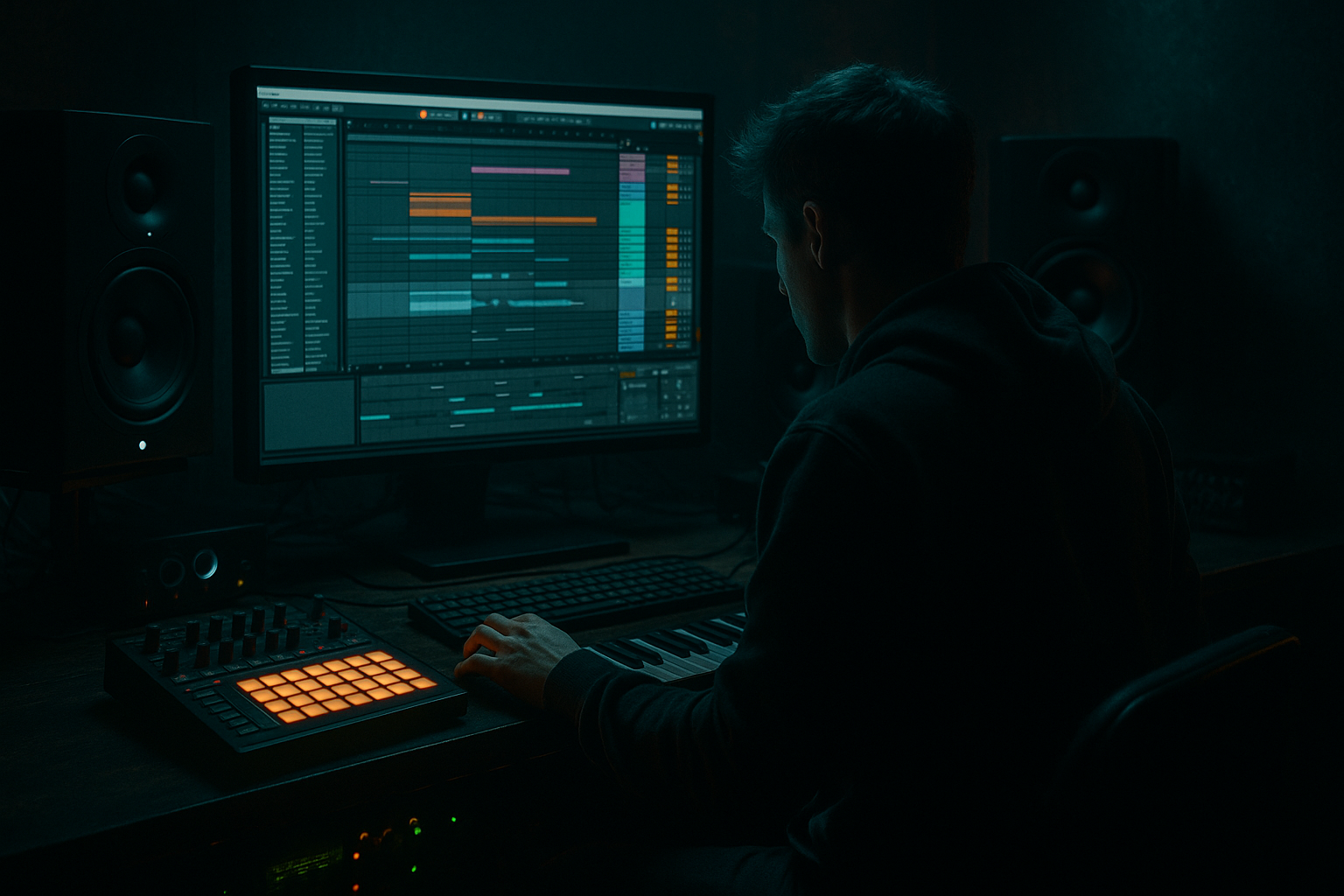
This lesson shows how to build that in Ableton Live 12 using stock tools only. You’ll work with an existing DnB arrangement, flip the intro into a DJ-friendly version, and use arrangement, group processing, automation, and spectral control to keep the low end powerful, clean, and mix-ready. Think dark rollers, neuro intro discipline, jungle pressure, and label-ready phrasing — not generic EDM intro design.
What You Will Build
You’ll create a 16- or 32-bar DJ intro flip for a DnB track that:
- opens with a clean, mixable drum-led intro
- uses controlled low-end pressure instead of full sub rollout
- introduces the bass through filtered movement, ghost notes, and call-and-response
- keeps the intro mono-safe and club-tight
- creates a clear tension ramp into the first drop
- preserves mastering headroom while still sounding finished and intentional
- bars 1–8: stripped drums, atmosphere, low-end hints
- bars 9–16: bass theme appears in fragments
- bars 17–32: stronger motion, risers, drum fills, and a final pre-drop lock-in
- Putting full sub in too early
- Wide bass on the low end
- Too much low-mid buildup from drums, reverb, and bass together
- Making the intro louder instead of more intense
- Ignoring DJ phrasing
- Over-processing the bus and flattening the transient story
- Add a parallel distortion layer to the bass using Saturator or Overdrive, then high-pass that layer so it contributes grit without muddying the sub.
- Use Resampling in Ableton to print a bass phrase, then chop it into tighter intro stabs. This often sounds more authentic for neuro and darker rollers than perfectly programmed MIDI.
- For extra menace, automate a slow Auto Filter sweep on a reese from around 200 Hz down to 120 Hz just before the drop, then cut it completely for one beat.
- Layer a quiet vinyl crackle, room noise, or field texture under the intro, but high-pass it aggressively so it doesn’t cloud the low end.
- Use Drum Buss Punch carefully on break layers to bring out attack without making the intro too aggressive.
- If your intro needs more weight, add mid-bass harmonics around 150–300 Hz, not more sub. That reads as pressure on systems while keeping headroom intact.
- In darker DnB, silence is a weapon. Pull elements out for half a bar before the drop and let the system breathe.
Musically, the result should feel like a proper DnB opening:
The intro should sound like something a DJ can blend cleanly into another tune, while still feeling like part of the record’s identity.
Step-by-Step Walkthrough
1. Choose the section you are flipping and define the DJ function
Start by identifying what your current intro does. Is it too full? Too melodic? Too much sub early? In Ableton Live 12, locate the intro and decide whether you are creating a 16-bar DJ intro, a 32-bar long mix intro, or a hybrid intro that supports both club mixing and streaming attention.
For advanced DnB, a strong intro usually has:
- a clean first 8 bars for beatmatching
- a bass hint that appears after the DJ has had time to lock in
- a tension shift around bars 9–16 or 17–24
- a very deliberate pre-drop bar
If the tune is a darker roller or neuro tune, keep the intro less melodic and more rhythmic. If it’s jungle-influenced, let the break and percussion breathe earlier, but still control the sub until the transition moment.
Mastering mindset: before you add anything, decide how much peak level the intro should own relative to the drop. Usually the intro can sit about 1.5–3 dB lower perceived loudness than the drop, even if the peak meter looks similar. That contrast helps the drop feel larger.
2. Build the foundation: drum bus first, bass later
In a new group or intro section, start with your drums only. Use Drum Rack, Simpler, or audio clips for chopped breaks. If you’re using a break edit, place it on one audio track and apply:
- EQ Eight to high-pass gently around 25–35 Hz to remove unusable rumble
- Glue Compressor with 1–2 dB of gain reduction for cohesion
- Saturator with Drive around 1–3 dB for density
- optional Drum Buss with Drive at 5–15% and Transients slightly positive for snap
The goal is not to make the drums huge yet. The goal is to make them stable, punchy, and mixable so the intro can carry momentum without needing full bass.
For a DnB intro flip, use a drum pattern that suggests the drop without revealing everything:
- kick on the one
- sparse snare hits
- ghosted break slices
- subtle hats or rides to imply motion
Why this works in DnB: the listener’s body locks onto transient rhythm before the bass arrives. In a club, that gives DJs something to phrase-match to while the track slowly loads low-end tension.
3. Create the Low-End Pressure bed with filtered sub hints
Instead of playing full sub from bar 1, build a low-end bed using a restrained bass layer. This can be a resampled sine/sub note, a filtered reese, or a mono bass tail from your drop. Keep it understated.
On the bass track, use:
- Operator with a sine waveform for a pure sub foundation
- or Wavetable/Analog-style bass if you want a darker texture
- Auto Filter with low-pass or band-pass movement
- Utility to force mono
- Saturator to add harmonics without widening the low end
Good starting settings:
- sub level low enough that the intro feels heavy but not dominant
- Auto Filter cutoff around 80–180 Hz for early intro hints
- resonance moderate, around 0.20–0.40
- Utility width at 0% on anything carrying true sub
Try a phrase like this:
- bars 1–4: no sub, only drums and atmosphere
- bars 5–8: one or two low notes filtered heavily
- bars 9–16: bass answers the drums with short hits or a sustained tail
- bars 17–32: introduce the bass rhythm more clearly, but still hold back the full drop tone
Keep the sub note lengths short at first. In DnB mastering, short bass events often sound louder than long ones because they preserve headroom and transient clarity.
4. Flip the intro with call-and-response bass phrasing
A DJ intro flip works best when the bass does not simply “start earlier” — it should answer the drums. Build a call-and-response pattern between kick/snare and bass stabs.
In Ableton, use MIDI clips with simple phrase blocks:
- bass note 1 on the tail of a kick
- bass note 2 after the snare, leaving a pocket
- occasional rest bars to let the mix breathe
For a roller, try two-note movement that outlines the root and fifth, with one note length around 1/8 to 1/4 bar. For neuro/darker material, use shorter rhythmic cells with more space between them. You can also duplicate the bass to a parallel audio track, resample it, and then edit the audio for tighter rhythmic control.
Advanced move: use Clip Envelopes or automation to slightly change filter cutoff per phrase, for example:
- section A: cutoff around 120 Hz
- section B: cutoff around 180–240 Hz
- final intro bar: open briefly to 300–500 Hz before the drop
This creates a feeling of the bass “waking up” without spilling full energy too soon.
5. Shape the intro drum energy with ghost notes and controlled fills
The intro should not just be bass and kick. Add movement through break edits, ghost snares, hat ticks, and reverse textures. Keep everything in service of the transition.
Use:
- Simpler to slice a break and trigger ghost notes
- Beat Repeat very lightly on select percussion hits for rhythmic agitation
- Auto Pan on hats or noise layers with slow rate for subtle motion
- Frequency Shifter very gently on atmosphere for eerie tension
A strong DnB intro often uses:
- sparse break variations in the first 8 bars
- more fills in bars 9–16
- a snare pickup or break fill in the last 2 bars
- a short silence or filtered drop-out before the drop lands
Use group buses for control. Put all drum layers into a Drum Bus and apply:
- EQ Eight to carve mud around 200–400 Hz if the intro gets boxy
- Glue Compressor with soft ratio and slow-ish attack to glue hits
- Drum Buss only as much as needed to keep the intro energetic, not crushed
Keep transient shape in mind. If the intro is for DJ mixing, it needs enough top-end detail to cut through a blend, but not so much that it sounds aggressive before the drop.
6. Use automation to create a mastering-friendly tension ramp
This is where the low-end pressure approach becomes “mastering-aware.” Instead of stacking more elements, automate the intro so it feels louder and more intense without actually bloating the low end.
Key automation targets in Ableton Live 12:
- Auto Filter cutoff on bass or atmos
- EQ Eight low shelf or high shelf on the intro bus
- Reverb dry/wet on pads or hits
- Delay feedback for a trailing sense of space
- Utility gain for small intro-level ramps
- Saturator drive on bass harmonics or drum bus
Useful ranges:
- bass filter opening over 16 bars: from roughly 100 Hz to 500 Hz
- reverb wetness: 5–12% early, then taper back before the drop
- utility gain ramp: +0.5 to +1.5 dB across the intro, if needed
- saturation drive: increase only slightly, then pull back at the end to preserve punch
The trick is to automate the perceived size upward while keeping the actual low-end footprint controlled. That’s how you get a DJ intro that feels powerful on a system without sabotaging the first drop.
7. Check mono, phase, and low-end translation early
This is non-negotiable for DnB mastering. Use Utility on the master or on the bass bus and check mono compatibility. If your intro gets thinner or the bass disappears in mono, fix it now.
Focus on:
- sub below roughly 120 Hz staying centered
- no wide chorus or unhinged stereo on the sub
- reese width living mostly above the fundamental
- atmospheric stereo content kept out of the sub range
Practical workflow:
- put Utility on bass tracks and set Width to 0% for sub sources
- use EQ Eight to high-pass side/ambient elements if they conflict
- if the intro sounds huge in stereo but weak in mono, reduce width on the bass texture and reinforce midrange harmonics instead
For a dark DnB mastering perspective, this step often makes the difference between “nice headphones intro” and “club-ready intro.” On large systems, mono low-end is what makes the pressure hit physically.
8. Balance the intro bus like a pre-master, not a demo
Treat the intro section as if it already has to survive mastering. Your job is to leave enough headroom and spectral balance so the drop can still land harder later.
On the intro group or scene bus, consider:
- EQ Eight to tame harshness around 3–6 kHz if hats or reese harmonics get sharp
- a very light Glue Compressor for cohesion, not loudness
- Limiter only for safety checks, not final loudness design
- Spectrum to visually confirm low-end buildup and identify rogue peaks
Compare the intro to the drop:
- intro should have less sub density
- intro can have slightly more space in the low mids
- drop should own the full bass bandwidth and feel more compressed/anchored
If the intro feels too loud, don’t just lower it. Instead, remove some low-mid clutter, trim reverb tails, or narrow the bass movement so the pressure is felt rather than smeared.
9. Design the pre-drop transition as a DJ tool
The final 1–2 bars before the drop are where the DJ intro flip proves itself. This moment should help a DJ mix out cleanly or signal the incoming drop with confidence.
Strong transition options in Ableton:
- one-bar drum fill with break slices
- reversed cymbal or reversed room tone
- short riser with Auto Filter opening
- bass cut for a half-bar to create vacuum
- final snare flam or impact into the drop
A classic DnB arrangement example:
- bars 1–8: drums and atmosphere
- bars 9–16: bass hints and added percussion
- bars 17–24: fuller groove, more ghost notes
- bars 25–32: tension lift, bass stop, fill, drop
The key is contrast. If the intro never releases energy, the drop won’t feel like a payoff. If it gets too busy, DJs lose blendability. The best intro flips feel like they’re constantly moving, but never overcommitted.
Common Mistakes
Fix: delay the real sub until the intro has established groove. Use filtered hints first.
Fix: keep sub mono with Utility; move width to upper harmonics only.
Fix: carve 200–400 Hz on the intro bus and shorten reverb tails.
Fix: increase rhythmic density, harmonic movement, and automation rather than raw gain.
Fix: structure the intro in 16- or 32-bar units so a DJ can mix and phrase cleanly.
Fix: use lighter Glue Compression and let the drum edits do the work.
Pro Tips for Darker / Heavier DnB
Mini Practice Exercise
Set a timer for 15 minutes and build a DJ intro flip from one of your current DnB loops.
1. Take an existing 8-bar drop or bass loop.
2. Copy it into a new section and strip out the full sub for the first 4 bars.
3. Add a drum-only opening with Drum Rack or break edits.
4. Create a mono sub hint with Operator or a filtered bass layer.
5. Automate Auto Filter opening across 16 bars.
6. Add one fill and one drop-out moment before the transition.
7. Check mono with Utility and reduce width if the bass weakens.
8. Compare intro vs drop and make sure the drop still feels bigger.
Goal: finish with an intro that feels mixable, heavy, and clearly different from the drop — without adding new instruments.
Recap
A strong Low-End Pressure DJ intro flip in Ableton Live 12 is about controlled weight, smart phrasing, and mastering-aware restraint. Keep sub mono, build tension with drums and filtered bass hints, automate movement instead of just loudness, and make the intro work as a DJ tool. In DnB, the best intros don’t flood the system — they load it with pressure and make the drop feel inevitable.

