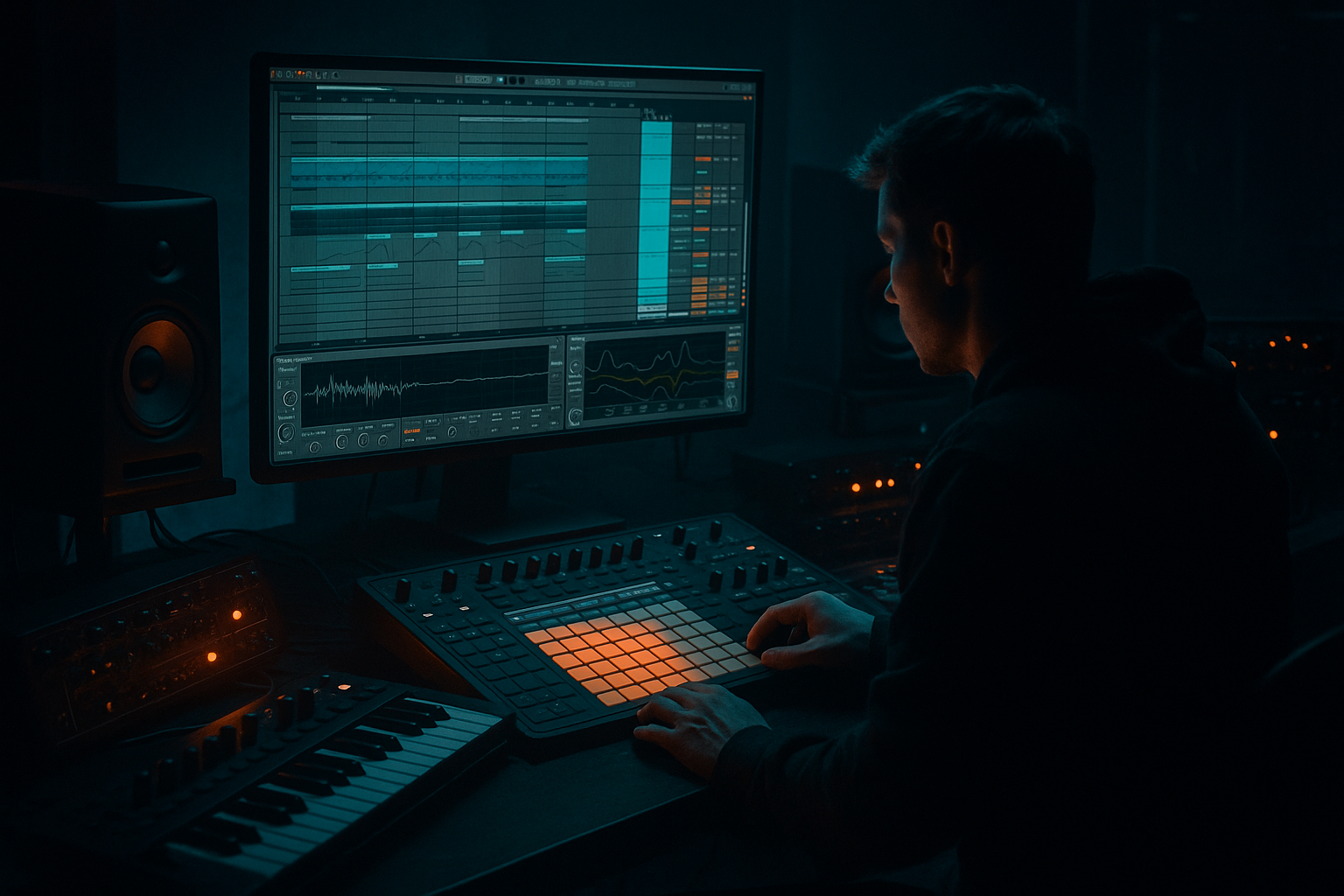
Main tutorial
Lesson Overview
In this lesson, you’ll build a Low-End Pressure bass wobble humanize system in Ableton Live 12 designed for jungle / oldskool DnB / rollers / darker bass music. The goal is to create a bass that feels alive and unpredictable, but still locked to the drums like a proper DnB system.
This matters because in drum & bass, the bassline often carries the emotional weight of the drop, but if it’s too static it can sound robotic; if it’s too random it can wreck the groove. The sweet spot is a bass movement system that reacts like a player, not a loop. You want wobble that breathes with the breakbeat, shifts across phrases, and changes intensity without losing sub stability.
This technique fits especially well in:
- Drops, where the bass and drums need to hit with controlled movement
- 8-bar call-and-response sections, where the bass can answer the break
- Oldskool jungle-style roller grooves, where the bassline feels human and slightly unstable
- Dark halftime switch-ups inside DnB arrangements, where you want tension without overcomplicating the patch
- a solid mono sub
- a mid-bass wobble layer with controllable movement
- a humanize system that introduces subtle timing, filter, and modulation variation
- macro controls for wobble rate, wobble intensity, grit, width, and phrase movement
- a rack you can use for oldskool jungle stabs, deep rollers, or darker neuro-influenced bass phrasing
- a sub pulse under the kick and snare
- a mid-range wobble that swells in response to 1-bar or 2-bar phrases
- occasional ghost movement between main notes
- a bass that can go from tight and restrained in the intro to more animated and nasty in the drop
- Making the wobble too fast all the time
- Letting the sub wobble or widen too much
- Overusing distortion before the rhythm is locked
- Ignoring note lengths
- Pushing width too hard in the low mids
- Using random modulation without a purpose
- Automate filter cutoff against the snare phrase so the bass opens slightly after the snare rather than on top of it. That creates tension and release without clutter.
- Layer a faint distorted duplicate of the mid bass, high-passed aggressively, to add “teeth” without muddying the sub.
- Use very subtle pitch envelopes on the mid layer for attack movement, especially in neuro-influenced darker DnB.
- Resample the bass with effects on, then chop the audio for new rhythmic phrasing. This often sounds more authentic than endless MIDI editing.
- Automate wobble depth more than wobble rate in heavier tracks. Depth changes feel more musical and less gimmicky.
- Use a short delay return on the bite layer only, with low feedback and filtered repeats, to create motion in gaps without washing out the drop.
- Keep the intro version dry and narrow, then open the system up in the drop. That contrast makes the drop feel bigger even if the patch is the same.
- Reference classic jungle arrangements where the bass leaves space for breaks. The power often comes from restraint, not constant density.
- Build the bass as separate sub, mid, and bite layers
- Keep the sub mono and stable
- Use macro controls to shape wobble, drive, width, and humanization
- Make the bass respond to drum phrasing, not just loop mechanically
- Automate movement across 8-bar DnB sections
- Resample your best passes to capture real performance energy
- Always check that the bass supports the kick, snare, and break groove rather than fighting them
The big idea: build one bass instrument rack with macros that control wobble speed, filter depth, distortion drive, stereo width, and humanization offsets, then automate or perform those macros like a musician. This gives you a flexible system you can resample, rearrange, and reuse across tracks.
Why this works in DnB: the genre lives on contrast—tight drums, heavy sub, and movement that evolves in short phrases. Humanized wobble helps the bass sit around the break rather than fighting it. It creates groove without stealing transient energy from the kick and snare.
What You Will Build
You’ll create a multi-layer bass rack in Ableton Live that can produce:
Musically, the result should feel like:
Think of it as a bass performance system, not just a sound.
Step-by-Step Walkthrough
1. Start with a clean 3-layer bass rack
Create a new MIDI track and drop in an Instrument Rack. Inside it, make three chains:
- Sub
- Mid Wobble
- Noise / Bite
For the Sub chain, use Operator or Wavetable with a simple sine wave. Keep it mono and simple:
- Oscillator: sine
- Filter: off or very gentle low-pass
- Volume: conservative, leaving headroom
- Add Utility and set Width to 0%
For the Mid Wobble chain, use Wavetable or Analog:
- Start with a saw or square-like source
- Low-pass filter around 120–250 Hz
- Add a touch of resonance, around 10–25%
- Use an LFO or modulation source if available in the synth, but keep it subtle at first
For the Noise / Bite chain, add a small amount of higher-frequency texture:
- Erosion, Saturator, or Overdrive
- High-pass the chain so it doesn’t interfere with sub
- Use this for aggression and attack, not body
This separation is crucial for DnB because your sub needs to stay stable while the mid layer carries the wobble character.
2. Build the wobble movement with macro-ready modulation
On the Mid Wobble chain, insert:
- Auto Filter
- Saturator
- Redux or Overdrive if you want extra bite
- Optional Echo very lightly for atmospheric movement, but only if it doesn’t blur the groove
Map these to macros:
- Macro 1: Wobble Rate
- Macro 2: Wobble Depth
- Macro 3: Drive
- Macro 4: Tone
- Macro 5: Width
- Macro 6: Humanize
- Macro 7: Sub Trim
- Macro 8: Bite
For the wobble itself, use Auto Filter LFO or device-rate modulation if your synth supports it. Suggested ranges:
- Wobble rate: 1/8 to 1/32
- Depth: 20% to 70%
- Filter cutoff movement: roughly 300 Hz to 2.5 kHz, depending on how aggressive you want it
If you’re working in a more oldskool jungle style, keep the wobble movement less “talking bass” and more like a rolling, breathing filter motion. You want it musical, not cartoonish.
3. Create the humanize system using controlled variation, not randomness chaos
The “humanize” part is what turns a bass loop into a performance. You can do this in Ableton Live 12 with a combination of:
- Velocity variation
- Note length variation
- slight pitch nudges
- macro automation
- optional MIDI effects like Random used very lightly
Set up a MIDI clip with a simple 1-bar or 2-bar bass pattern. Then:
- Vary note lengths so some notes are slightly shorter, especially before snares
- Use velocities around 70–110 for mid-bass notes if the synth responds well
- Keep sub notes more even, usually around 90–110, unless you want intentional dropouts
For the humanize macro:
- Map it to filter cutoff
- Map a small amount to stereo width
- Map a tiny amount to fine detune or oscillator drift if your synth supports it
- Map it to Send level into a delay/reverb return, but only a little
Suggested behavior:
- At 0–20%, the bass is tight and controlled
- At 20–50%, there’s gentle variation
- At 50–80%, wobble becomes more animated and unstable
Why this works in DnB: human variation makes repeated bass phrases feel like they’re reacting to the drums instead of looping mechanically. In oldskool jungle especially, the groove often feels slightly “played,” even when it’s programmed.
4. Lock the bass to the breakbeat using call-and-response phrasing
Drop your bassline into a section with a classic break or chopped drum loop. Use 8 bars as your working phrase.
Arrange the bass so it answers the drums:
- Let the bass hit hard in the gaps between kick/snare accents
- Pull back under the snare to avoid clutter
- Use short pickups or ghost notes into bar 5 or bar 7
- Keep the first 2 bars simpler, then increase wobble or movement in bars 3–4
A strong jungle-style structure:
- Bars 1–2: restrained, mostly sub and a little mid motion
- Bars 3–4: add wobble depth and bite
- Bars 5–6: introduce one extra note or slide
- Bars 7–8: heighten tension, then strip back for the loop repeat
If your break has busy ghost notes, keep the bass rhythm slightly sparser. If the break is more stripped-back and roller-like, you can let the bass phrase breathe more freely.
5. Use Macro automation to create phrase energy across the arrangement
This is where the system becomes performance-ready. In Arrangement View, automate your macros across sections:
- Intro: low wobble depth, low drive, narrow width
- Build: gradually increase filter cutoff and humanize
- Drop: bring in full wobble depth and bite
- Switch-up: reduce wobble rate for a half-time feel, or increase it for a more frantic section
Good automation ideas:
- Wobble Rate: move from 1/8 in the main groove to 1/16 or 1/32 for a fill
- Drive: push harder for 1-bar or 2-bar peaks
- Tone: brighten slightly before a snare reset
- Humanize: increase on the last 2 bars of a phrase, then snap it back for the next drop
For oldskool DnB, a classic move is to keep the bass relatively stable for the first half of a drop, then introduce a small phrase lift in the second half. That could be a slightly faster wobble, more cutoff movement, or an extra distortion swell.
6. Add drum-aware sidechain and transient discipline
DnB low end must respect the drums. Put Compressor on the bass group and sidechain it from the kick, or from the combined drum bus if that gives you a more musical pump.
Suggested sidechain settings:
- Attack: 1–10 ms
- Release: 50–120 ms for rollers, a bit longer if the groove needs more air
- Ratio: 2:1 to 4:1
- Gain reduction: usually 2–5 dB, sometimes more in dense drops
If the snare is fighting the bass, try:
- Shaping the bass envelope so it dips slightly on snare hits
- Using EQ Eight to carve a small notch in the bass around the snare’s main body range if needed
- Making the bass note lengths shorter before snares
This is one of the biggest reasons the system works in DnB: the bass movement can be huge, but if the transient timing is disciplined, the drums still feel punchy and the mix stays readable.
7. Resample a few passes and pick the best performance moments
Once your rack is working, record the output to audio. In Ableton, create an audio track and resample the bass while you perform macro moves in real time.
Record:
- one pass with conservative movement
- one pass with heavier wobble and drive
- one pass with filter sweeps and humanize changes
Then comp or slice the best moments:
- A tight 2-bar loop for the main drop
- A more aggressive 1-bar fill for transitions
- A filtered intro version with less sub activity
This is especially useful in jungle and darker DnB because resampling turns your synth patch into audio phrasing, which often feels more authentic than leaving everything live and static.
8. Finish the low end with mono discipline and frequency roles
Split the jobs clearly:
- Sub: mono, clean, centered
- Mid bass: movement, character, mostly controlled stereo
- Bite layer: only enough high-end presence to translate on smaller systems
Use Utility on the sub chain with Width at 0%. On the mid chain, keep width modest—try 10–35% max unless the section is intentionally wide and atmospheric.
With EQ Eight, make sure:
- Sub fundamentals are clear and not masked by kick or low toms
- Unnecessary highs are removed from the sub chain
- Harsh resonance around 2–5 kHz is controlled on the mid layer if it starts biting too hard
If your bass feels huge in solo but weak in context, it usually means the mid movement is too busy or the sub is not stable enough. In DnB, a smaller-sounding bass in solo can often hit harder in the full mix.
Common Mistakes
Fix: reserve fast wobble for fills and switch-ups. Keep the main groove more restrained.
Fix: keep sub mono, simple, and consistent. All the movement should happen above the true low end.
Fix: get the phrasing and sidechain right first. Then add grit.
Fix: shorten notes before snares and overlaps. In DnB, bass note duration is part of the groove.
Fix: widen only the upper part of the bass. Check in mono regularly.
Fix: make sure every automation move supports phrase energy, drum pocket, or drop impact.
Pro Tips for Darker / Heavier DnB
Mini Practice Exercise
Spend 10–20 minutes building a 2-bar loop using this system.
1. Create the 3-chain bass rack.
2. Program a simple bassline with only 3–5 notes.
3. Set the sub to mono and keep it steady.
4. Automate or map wobble depth and filter cutoff to two macros.
5. Make one note longer, one shorter, and one slightly delayed to create human feel.
6. Sidechain the bass to the kick.
7. Duplicate the loop and create a second version where the wobble rate increases only on the last bar.
8. Resample both versions and compare which one feels more “played.”
Goal: by the end, you should have one version that feels like a tight roller, and one that feels like a more animated jungle variation.

