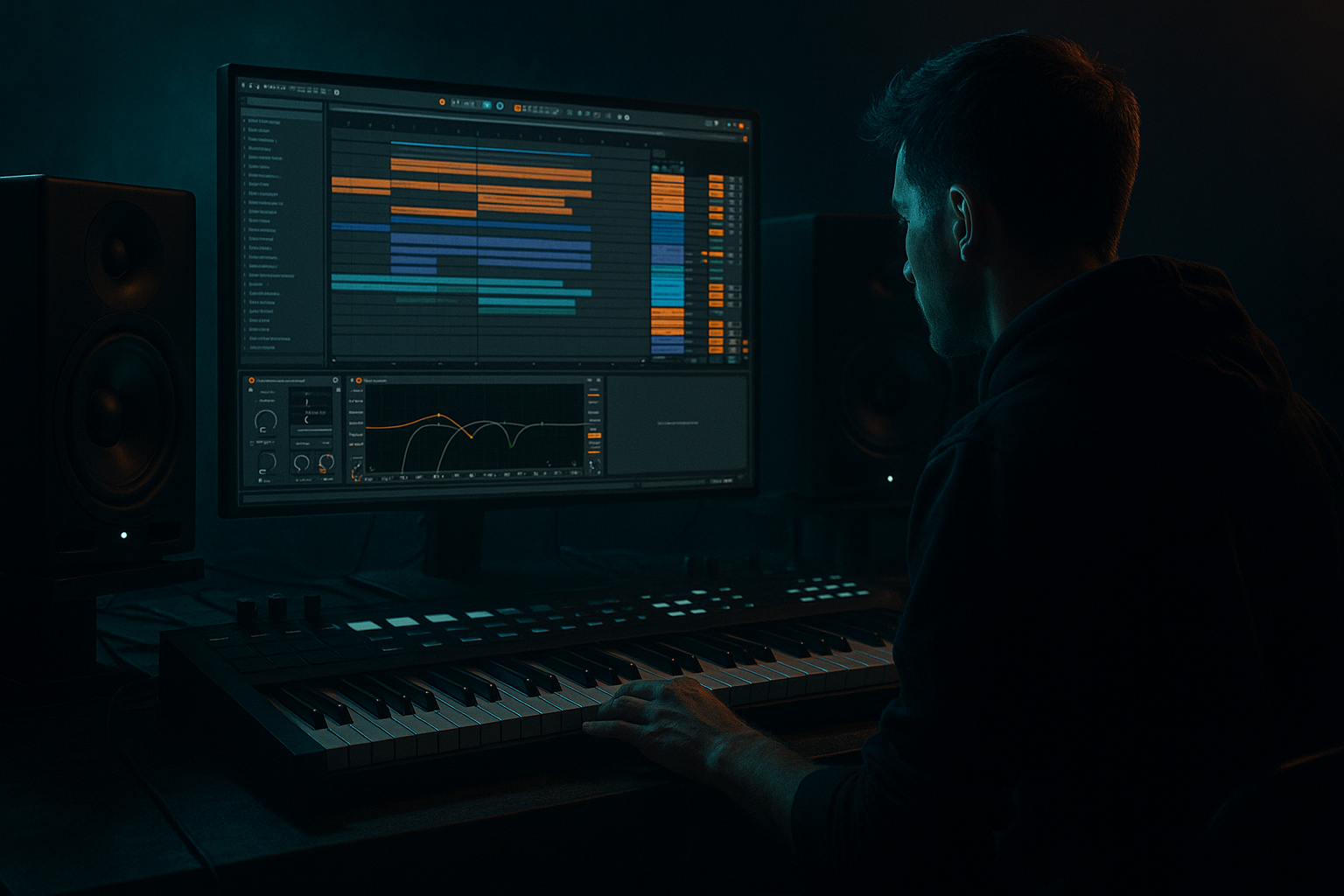
Main tutorial
```markdown
Low-End Pressure Ghost Note Pull (with Crunchy Sampler Texture) — Ableton Live 12 (Jungle / Oldskool DnB) 🔊🥁
1) Lesson overview
This lesson is about manufacturing low-end pressure in rolling jungle / oldskool DnB by using ghost notes to “pull” the sub and create that elastic groove—without muddying the mix.
We’ll also add crunchy sampler texture (think worn Akai / early jungle resample grit) using Ableton Live 12 stock devices and a DJ-tool mindset: fast, repeatable, and performance-ready.
You’ll build a bass chain that:
- Reacts to ghost MIDI notes (not audible notes) for groove and movement
- Uses Sampler texture + resampling to get that chewy, crunchy “low-end pressure”
- Stays controlled on a big rig (sub discipline + transient management)
- Tight sine/triangle sub (Operator or Wavetable)
- Monophonic, clean, consistent
- Sampler-based layer (or resampled bass)
- Crunch texture + band-limited grit
- Movement created by ghost note pull via sidechain/gating/filtering
- sidechain pumping
- transient shaping
- filter envelope “tugs”
- subtle saturation hitpoints
- Drum Buss
- EQ Eight
- Saturator
- Limiter (safety, not loudness)
- Bars 1–9: clean bass + break
- Bars 9–17: introduce ghost pull intensity (increase Gate release or sidechain depth)
- Bars 17–25: add resampled layer quietly (texture appears)
- Bar 25: tiny drop-out (1/2 bar) + bass stab
- Bars 25–33: full pressure return
- Gate Release (pull length)
- Compressor threshold (pump amount)
- Auto Filter cutoff on crunch lane (brightness)
- Saturation drive (build energy)
- Keep sub mono: Utility on SUB lane → Width 0%.
- Add controlled “fear harmonics”: Put Saturator on SUB but filter its input first (low-pass around 120–160 Hz so it creates harmonics without harshness).
- Roar for menace (but band-limit it): Put Roar on CRUNCH lane, then EQ Eight to keep it from spraying 2–6 kHz too hard.
- Sidechain to the kick separately: Ghost pull is groove; kick duck is survival. Use two compressors if needed:
- Rumble shadow (subtle): Very low-level, short room on CRUNCH lane only:
- Ghost notes aren’t just extra notes—they’re control signals for movement and pressure.
- Split bass into clean sub + textured low-mid so you can push vibe without wrecking weight.
- Use Gate/Compressor sidechain keyed from a ghost trigger track to create the “pull.”
- Add Sampler + Redux + saturation and resample for authentic crunchy jungle texture.
- Automate pull depth and texture for a DJ-tool arrangement that evolves in 16–32 bars.
---
2) What you will build
A DJ-tool style bass instrument rack with two lanes:
Lane A — Clean Sub (stable weight)
Lane B — Crunchy “Sampler” Low-Mid (character + pull)
Groove concept (core idea)
You’ll program ghost notes (very low velocity, short notes) between main bass hits.
These ghosts won’t necessarily “play” audible pitch — instead they trigger dynamics:
That creates the rolling tug-of-war feeling jungle basslines have under breaks.
---
3) Step-by-step walkthrough
Step 0 — Session context (so it feels like real jungle)
1. Set tempo: 165–170 BPM
2. Drop a classic break (Amen/Think/Hot Pants style) on an audio track.
3. Warp mode for breaks: Beats
- Preserve: Transients
- Transient loop: adjust until punchy
4. Add Groove Pool groove (optional but useful): MPC swing-ish (subtle, 10–20%).
- Oldskool swing helps the ghost pull feel less “grid-robot”.
---
Step 1 — Build the bass MIDI clip (main + ghosts)
Create a MIDI track named BASS (Ghost Pull).
1. Insert a 1-bar or 2-bar MIDI clip.
2. Program a simple jungle-ish bass phrase:
- Root note hits on 1, 1.3, 2, 2.3 (or similar offbeat roll)
- Keep it minimal: rolling bass works because micro-events do the movement
3. Add ghost notes:
- Place short notes (1/32 to 1/16) just before key hits (like 10–40 ms early)
- Velocity: 1–20
- Length: very short (aim 5–40 ms, depending on patch)
- Pitch: either same root, or one octave up (ghost triggers can be higher to avoid sub re-articulation)
4. Separate intent:
- Main notes = audible bass
- Ghost notes = trigger/control notes (movement & tug)
✅ Advanced trick: Put ghosts on a separate MIDI channel/chain (we’ll do this with an Instrument Rack so you can “hear-less trigger”).
---
Step 2 — Create an Instrument Rack with two chains (Sub + Crunch)
On BASS (Ghost Pull) insert:
Instrument Rack → open Chain List.
#### Chain A: SUB (Clean)
1. Add Operator
2. Oscillator A: Sine
3. Envelope:
- Attack: 0–5 ms
- Decay: 250–600 ms (depends on pattern)
- Sustain: -inf or very low if you want plucks; or sustain up for held notes
- Release: 60–120 ms
4. Add Saturator (subtle):
- Drive: 1–3 dB
- Soft Clip: ON
5. Add EQ Eight
- Low-pass around 120–180 Hz (keep sub clean)
- Optional tiny dip around 50–70 Hz if your kick owns that zone
#### Chain B: CRUNCH (Sampler Texture)
1. Add Sampler
2. Source options:
- Resample a reese, a sub + mid combo, or even a single-cycle wave
- Or load a short bass stab sample and loop it
3. In Sampler:
- Filter: MS2 or PRD style
- Drive: 2–8 (taste)
- Filter Env Amount: small (5–20) for bite
- Key tracking: minimal if you want that old “same texture across notes” vibe
4. Add Redux
- Downsample: 2–6
- Bit Reduction: 8–12 bits (don’t go too extreme unless you want pure ragga crunch)
- Dry/Wet: 10–35%
5. Add Auto Filter
- Mode: Low-pass 24dB
- Cutoff: start 200–800 Hz (we’ll modulate this with ghosts)
6. Add Saturator or Roar (Live 12) for character:
- Roar: pick a gentler mode (avoid nuking low end)
- Blend/Drive: moderate, then control with EQ after
7. Add EQ Eight
- High-pass around 90–130 Hz (this lane should not fight the sub)
- Shape a growl band around 250–800 Hz
- Optional dip around 300–400 Hz if it boxes up
---
Step 3 — The “Ghost Note Pull” mechanism (two reliable methods)
Method A (clean + controllable): Gate/Sidechain keyed by Ghost-only trigger
We’ll create a ghost trigger track that the listener doesn’t hear.
1. Create a new MIDI track: GHOST TRIG
2. Copy the same MIDI clip from bass, then delete main notes, keep only ghost notes.
3. On GHOST TRIG, load a short click/hi-hat sample in Simpler:
- Filter it high (HP around 1–2 kHz) so it has no low
- Turn track volume all the way down OR route to Sends Only
4. On CRUNCH (Sampler Texture) lane (inside the rack or after it), add Gate
- Enable Sidechain
- Sidechain input: GHOST TRIG
- Listen (sidechain monitor) briefly to confirm it’s triggering
- Settings to start:
- Threshold: adjust until ghosts open it reliably
- Attack: 0–2 ms
- Hold: 0–10 ms
- Release: 40–120 ms (this is your “pull” tail)
5. Result:
- Ghost notes cause tiny opens/closures in the crunchy layer, giving groove tug and pressure.
🎛️ Variation: Put the Gate before saturation for more bite, or after saturation for cleaner dynamics.
---
Method B (classic DnB pump feel): Compressor sidechain “micro-duck”
This creates the sensation that the bass is being “pulled” forward.
1. Add Compressor after your bass rack (or on CRUNCH only if you want sub stable).
2. Turn Sidechain ON, input: GHOST TRIG
3. Settings:
- Ratio: 2:1 to 4:1
- Attack: 0.1–3 ms
- Release: 50–180 ms (sync by feel; jungle likes slightly longer releases)
- Threshold: aim for 1–4 dB gain reduction on ghost events (not main hits)
4. Blend:
- If using Glue Compressor, use Dry/Wet around 50–80%
- If using standard Compressor, reduce threshold gently and avoid audible choking
✅ Pro move: Sidechain only the CRUNCH lane; keep SUB lane mostly un-ducked so weight stays constant.
---
Step 4 — Make ghosts affect tone (filter tug) without changing pitch
Now we make ghosts create movement rather than new notes.
Option 1: Use Envelope Follower keyed from GHOST TRIG
1. On GHOST TRIG, add Envelope Follower
2. Map it to Auto Filter Cutoff on the CRUNCH lane
3. Settings:
- Attack: 0–5 ms
- Release: 60–200 ms
- Amount: small to moderate (you want a tug, not a wah)
4. This makes the ghost clicks “yank” the cutoff slightly, creating that pressure pull.
Option 2: MIDI velocity as macro control
1. In Sampler, use Velocity modulation to affect Filter Env Amount or Volume
2. Keep ghost velocities low so they barely sound, but still add a tiny envelope tick.
---
Step 5 — Crunchy “old sampler” resample workflow (DJ tools mindset) 📼
This is where the vibe gets real.
1. Create a new audio track: BASS RESAMPLE
2. Set its input to Resampling
3. Arm it and record 8–16 bars while your bass plays
4. Now you’ve got a “printed” bass performance you can treat like a break:
- Slice it
- Reverse small bits
- Pitch sections
- Add little edits for fills
Post-resample texture chain (stock):
- Drive: 5–20
- Crunch: 10–30
- Boom: OFF (usually) or very low
- Tight HP @ 25–35 Hz
- Notch resonances if needed
- Soft Clip ON
Then layer the resample quietly behind your clean sub for that lived-in weight.
---
Step 6 — Arrangement ideas (DJ tool: 16-bar functional structure)
Make it playable for DJs and easy to drop in sets:
Automation targets:
---
4) Common mistakes
1. Ghost notes too loud
If you can clearly hear the ghost as pitch, your bassline may sound messy. Ghosts should mostly be felt through movement.
2. Sub + crunch both full-range
If your CRUNCH lane still has heavy sub (below ~100 Hz), you’ll get phase fights and inconsistent low-end.
3. Release times not tuned to tempo
Overlong release = mushy bass tail; too short = no pull. Start at 60–120 ms and fine-tune.
4. Over-saturating the sub
Sub distortion is addictive but ruins headroom fast. Distort low-mids, not pure sub (or split bands).
5. Trigger track bleeding into the master
Ensure GHOST TRIG is muted/inaudible (or routed away) while still feeding sidechain.
---
5) Pro tips for darker/heavier DnB 🕳️
- Compressor A: duck CRUNCH from GHOST TRIG (movement)
- Compressor B: duck SUB+CRUNCH from KICK (space)
- Reverb: Decay 0.3–0.7s, HP 200 Hz, LP 2–4 kHz, Dry/Wet 2–6%
- Creates a dark halo without washing the sub.
---
6) Mini practice exercise (20 minutes) ⏱️
1. Build the two-lane rack (SUB + CRUNCH) as described.
2. Write a 2-bar bass loop with:
- 4 main notes
- 6–10 ghosts (very short)
3. Create GHOST TRIG and make Gate sidechain control the CRUNCH lane.
4. Print 8 bars to BASS RESAMPLE and slice it into 1-bar chunks.
5. Make a 16-bar DJ tool:
- Bars 1–8: clean
- Bars 9–16: ghost pull + resample layer introduced
Goal: when you bypass the ghost-triggered processing, the loop should feel noticeably less alive—but not obviously “effected.”
---
7) Recap
If you want, tell me your target vibe (Metalheadz roller, ragga jungle, techstep edge, etc.) and what break you’re using, and I’ll suggest a ghost pattern + exact timing offsets for that groove.
```

